Why the SEER2 Rating on Your AC Unit Matters in Baton Rouge, LA
What is a SEER2 rating on an AC unit is one of the most common questions homeowners ask when shopping for a new air conditioner — and for good reason. Your AC's efficiency rating directly affects how much you pay every month to stay cool.
Quick Answer: What Is a SEER2 Rating?
• SEER2 — What It Means: Seasonal Energy Efficiency Ratio 2 — the updated federal standard for measuring AC efficiency
• What it measures — What It Means: How much cooling your system delivers per watt-hour of electricity used, averaged across a full cooling season
• Why "2"? — What It Means: Updated in 2023 by the U.S. Department of Energy using stricter real-world testing conditions
• Rating scale — What It Means: Typically 13 to 26 — higher numbers mean greater efficiency and lower energy bills
• Who sets minimums? — What It Means: The DOE sets regional minimums; in Louisiana and the Southeast, the minimum for most split-system ACs is 14.3 SEER2
Think of it like the miles-per-gallon rating on a car. The higher the number, the less energy your system burns to do its job. In a place like Baton Rouge, LA — where your AC runs hard for eight or more months a year — that number has a real impact on your utility bills and home comfort.
The SEER2 standard replaced the older SEER rating on January 1, 2023, when the DOE mandated a new testing method designed to more accurately reflect how systems actually perform inside a real home, not just in a laboratory. The result is a rating system that's more honest — and more useful for homeowners making big decisions about heating and cooling equipment.
Whether you're replacing an aging system or just trying to decode the label on a new unit, understanding SEER2 is the first step toward making a smarter investment in your home's comfort and energy efficiency.
What is a SEER2 Rating on an AC Unit?
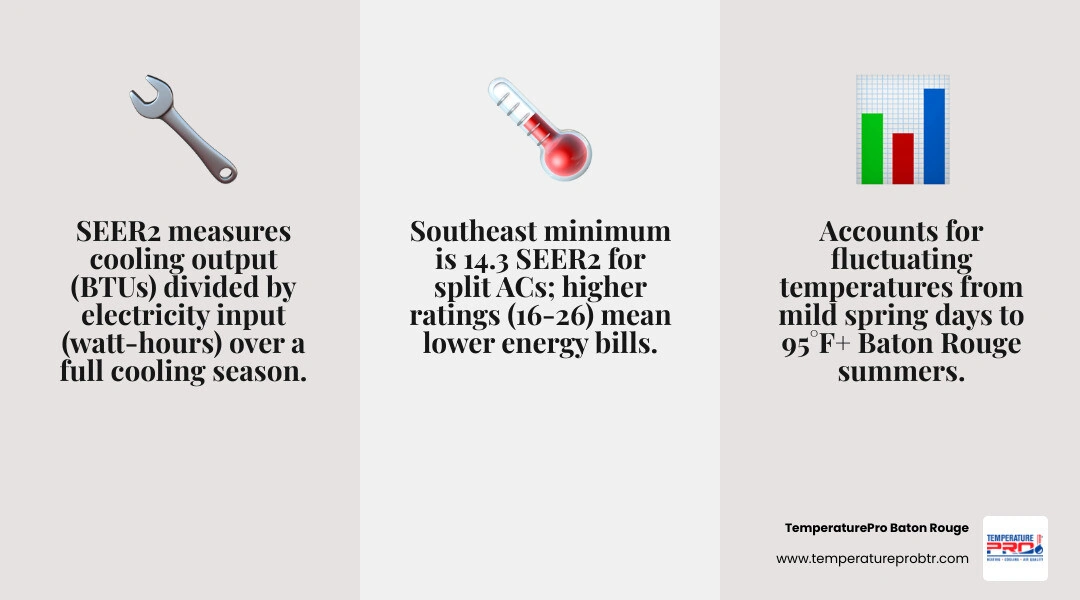
When we talk about what is a SEER2 rating on an ac unit, we are looking at the math of modern comfort. The Department of Energy (DOE) uses this rating to define the ratio of the total cooling output of an air conditioner during its normal annual usage period, divided by the total electric energy input during that same period. In simpler terms, it measures how much "cooling" you get for every "watt" of electricity you buy.
Because SEER2 is a "seasonal" average, it accounts for the fact that outdoor temperatures fluctuate. It doesn't just measure how the unit performs on the hottest day of the year in Baton Rouge; it looks at performance from the mild spring days to the sweltering August afternoons. This helps us provide a more accurate estimate of your annual operating costs.
Understanding this rating is particularly vital when you start noticing AC System Replacement Warning Signs. If your current unit was installed before 2023, it likely carries a legacy SEER rating. Modern SEER2 units are built to meet much higher standards of energy conservation, helping to reduce the national energy load while keeping your specific home more comfortable.
How to Find the SEER2 Rating on Your AC Unit
If you are curious about the efficiency of your current system or a unit you are considering for your home in Prairieville or Denham Springs, there are a few places to look:
1. The EnergyGuide Label: This is the bright yellow sticker usually found on the side of the outdoor condensing unit. It will clearly display the SEER2 rating and compare it to the range of efficiency available for similar models.
2. The Manufacturer Data Plate: This is a metal or plastic plate located on the outdoor unit that contains technical specifications. While it might not always say "SEER2" explicitly, it will list the model and serial numbers.
3. Model Number Verification: We can often determine the efficiency by looking at the model number. Many manufacturers "hide" the rating in the digits (for example, a model number starting with "16" might indicate a 16 SEER or SEER2 unit).
4. The AHRI Directory: The Air Conditioning, Heating, and Refrigeration Institute (AHRI) maintains a database where we can verify the exact SEER2 rating of a specific combination of indoor and outdoor equipment.
SEER vs. SEER2: Understanding the M1 Testing Standard
The transition from SEER to SEER2 wasn't just a name change; it was a total overhaul of how equipment is tested. The primary difference lies in the "static pressure"—essentially the resistance the air faces as it moves through your home's ductwork.
• External Static Pressure — Legacy SEER (Pre-2023): 0.1 inches of water column — SEER2 (Current M1 Standard): 0.5 inches of water column
• Real-World Simulation — Legacy SEER (Pre-2023): Minimal; assumes perfect ducts — SEER2 (Current M1 Standard): High; simulates actual duct resistance
• Blower Testing — Legacy SEER (Pre-2023): M Standard — SEER2 (Current M1 Standard): M1 Blower Procedure
• Rating Accuracy — Legacy SEER (Pre-2023): Often optimistic — SEER2 (Current M1 Standard): More realistic
The legacy SEER test was conducted under laboratory conditions that assumed very little resistance to airflow (0.1 in. w.g.). However, the DOE realized that the average residential duct system creates much more pressure. By increasing the testing pressure to 0.5 inches of water column—a five-fold increase—the new M1 procedure forces the AC's blower motor to work harder during the test, just as it does in your home.
This is a critical distinction when Choosing the Right AC Replacement. Because the testing is harder, a unit’s SEER2 number is typically about 4.5% to 5% lower than its old SEER number would have been, even though the equipment is technically more efficient.
Why should a homeowner in Zachary or Central care about "static pressure"? Because your ductwork isn't a perfect vacuum. Every turn, every vent, and every filter creates airflow resistance. The M1 procedure accounts for this, ensuring that the efficiency rating on the box is closer to the efficiency you’ll actually see on your utility bill.
Furthermore, the SEER2 testing more accurately accounts for "system cycling losses." This is the energy wasted when a system frequently turns on and off. In our humid Louisiana climate, units that cycle too quickly don't just waste energy; they also fail to remove moisture, leaving your home feeling clammy. SEER2 rewards systems that operate efficiently across varying speeds and cycles.
Regional Minimums and Efficiency Standards in the South
The United States is divided into three regions for HVAC efficiency standards: the North, the Southeast, and the Southwest. Here in the Baton Rouge area, we fall under the Southeast region guidelines.
As of May 2026, the federal minimum requirements are strictly enforced. For split-system air conditioners in our region, the minimum is generally 14.3 SEER2 for units under 45,000 BTU. Larger residential units (over 45,000 BTU) have a slightly lower threshold of 13.8 SEER2.
It is also important to note that split-system heat pumps have a national minimum of 14.3 SEER2. These standards are designed to handle the heavy cooling loads we experience. Given the Average Lifespan of an AC System in the South, which is often 15 to 20 years, choosing a unit that meets or exceeds these standards is a long-term investment. Considering How Long Does an AC System Last in Louisiana, where high humidity and salt air can take a toll, starting with a high-efficiency SEER2 unit ensures you aren't stuck with an obsolete, expensive-to-run system for the next two decades.
What is a Good SEER2 Rating on an AC Unit for Louisiana Homeowners?
While 14.3 is the minimum, is it the best choice for you? In our experience serving families from Gonzales to St. Gabriel, we often categorize ratings into three tiers:
• Standard Efficiency (14.3 – 15.1 SEER2): Great for homeowners on a budget or those who don't plan on staying in their home for more than a few years.
• High Efficiency (15.2 – 17 SEER2): The "sweet spot" for many. These units offer a significant reduction in monthly bills and often qualify for various rebates.
• Premium Efficiency (17.1+ SEER2): These units represent the pinnacle of comfort and energy savings. They almost always utilize variable-speed technology.
When weighing the Repair vs Replace Your AC in Louisiana, the jump in efficiency is a major factor. Moving from an old 10 SEER unit (common a decade ago) to a 16 SEER2 unit can reduce your cooling energy consumption by 40% or more. In Baton Rouge, where the "latent load" (humidity) is often higher than the "sensible load" (temperature), a higher SEER2 rating usually means better dehumidification and a more comfortable home.
Maximizing Savings with Advanced Compressor Technology
The engine behind a high SEER2 rating is the compressor. How the compressor operates determines how much energy is used during those long Louisiana summers.
• Single-Stage Compressors: These are either 100% "on" or 100% "off." They are like a light switch. Because they always run at full blast, they cycle on and off frequently, which is less efficient and harder on the equipment.
• Two-Stage Compressors: These have a "high" and a "low" setting (usually around 65% capacity). They can run on the lower setting during milder days, saving energy and providing better humidity control.
• Variable-Speed (Inverter) Technology: These are the gold standard. They can adjust their speed in tiny increments, sometimes running as low as 30% capacity. By staying on at a low, steady speed, they maintain a perfectly consistent temperature and remove massive amounts of humidity.
When you are asking When is it Time for AC Replacement, we highly recommend looking at variable-speed options. They are the primary reason some units can reach staggering ratings of 22 to 26 SEER2.
SEER2 vs. EER2: Which Metric Matters Most in Baton Rouge?
While SEER2 is the "seasonal" average, EER2 (Energy Efficiency Ratio 2) is a "snapshot" of efficiency. EER2 is calculated based on a fixed outdoor temperature of 95°F.
In Baton Rouge, we have plenty of days that stay at or above 95°F for hours on end. In these "peak load" conditions, EER2 might actually be a more important metric for you than SEER2. A unit with a high EER2 will perform better and use less electricity during the absolute hottest parts of the day. For homeowners in the Southwest or the humid Southeast, we recommend looking for a balance: a high SEER2 for overall seasonal savings, and a solid EER2 (usually 12+) to handle our mid-July heatwaves.
Financial Incentives and Long-Term ROI
We know that a higher SEER2 rating often comes with a higher upfront price tag. However, the long-term Return on Investment (ROI) is often much better than it seems at first glance. Between lower monthly utility bills and various incentives, the system can often pay for itself over its lifespan.
Deciding How to Decide Between AC Repair and Replacement often comes down to these financial facts. If your repair bill is high and your unit is inefficient, the "opportunity cost" of not upgrading to a SEER2 unit grows every month.
Qualifying for Federal Tax Credits in 2026
Thanks to the Inflation Reduction Act, homeowners in 2026 can take advantage of significant tax credits. The 25C Energy Efficient Home Improvement Credit allows you to claim 30% of the project cost, up to specific limits.
• Central Air Conditioners: To qualify for a tax credit (up to $600), split systems generally need to meet or exceed 16 SEER2.
• Heat Pumps: These are the "stars" of the Inflation Reduction Act. Qualifying high-efficiency heat pumps can earn you a tax credit of up to $2,000 per year.
To qualify, equipment usually needs to meet "ENERGY STAR Most Efficient" criteria. We can help you navigate these requirements to ensure you choose a system that maximizes your tax savings while providing top-tier comfort in Walker or French Settlement.
Frequently Asked Questions About SEER2 Ratings
Does a higher SEER2 rating mean my home will be colder?
Not necessarily. A 14.3 SEER2 unit and a 20 SEER2 unit of the same tonnage will both produce the same amount of "cold." The difference is that the 20 SEER2 unit will do it using significantly less electricity. However, higher SEER2 units (especially those with variable-speed compressors) are much better at removing humidity. Because dry air allows your sweat to evaporate more easily, a home at 75°F with 45% humidity will feel much "colder" and more comfortable than a home at 72°F with 70% humidity.
Can I install a SEER2 outdoor unit with an old indoor coil?
We strongly advise against this, and in many cases, it is actually illegal under DOE regulations. SEER2 ratings are based on "matched systems"—the combination of the outdoor condenser and the indoor evaporator coil. An old, inefficient indoor coil will prevent a new SEER2 outdoor unit from reaching its rated efficiency. It can also lead to premature compressor failure because the pressures and refrigerants may not be compatible.
How much can I save by upgrading from 10 SEER to 16 SEER2?
The savings can be dramatic. Upgrading from a 10 SEER unit to a 16 SEER2 unit (which is roughly equivalent to a 16.8 legacy SEER) can reduce your cooling costs by approximately 40%. For a typical Baton Rouge home with high summer utility bills, this could translate to hundreds of dollars in savings every year. Over the 15-year life of the system, that’s thousands of dollars back in your pocket.
Conclusion
Understanding what is a seer2 rating on an ac unit is about more than just numbers—it’s about choosing the right level of comfort and efficiency for your family. However, even the highest-rated 26 SEER2 system will underperform if the installation is poor. Factors like ductwork integrity and a proper Manual J load calculation (to ensure the unit is sized perfectly for your home’s square footage and insulation) are just as important as the number on the yellow sticker.
At TemperaturePro Baton Rouge, we are a family and veteran-owned company that treats every customer like part of our own family. We specialize in helping homeowners across Baton Rouge, Prairieville, Gonzales, and the surrounding areas find the perfect balance between upfront budget and long-term energy savings. Whether you need a quick repair or a complete system overhaul, our certified technicians are here 24/7 to ensure your home remains a sanctuary of comfort.
Ready to lower your energy bills and upgrade your home's air quality? Schedule your high-efficiency system consultation with our experts today.