Navigating AC Repair in Garden District Homes with Narrow Lot Lines
Navigating AC Repair in Garden District Homes with Narrow Lot Lines
Older Baton Rouge properties often face airflow starvation due to three-foot side yards. Learn how to restore reliable cooling when your outdoor space is severely restricted.
The Hidden Cooling Challenge in Historic Neighborhoods
Your outdoor unit is running nonstop, but the house never fully cools down, which is a common frustration our team at TemperaturePro Baton Rouge encounters when navigating AC repair in Garden District homes with narrow lot lines. Older architectural layouts present a unique physics problem for modern cooling equipment. The historic homes in the Baton Rouge Garden District offer incredible architectural beauty, but they were built long before central air conditioning became a modern necessity. Today, we see homeowners constantly forced to balance the preservation of their historic properties with the demand for efficient, reliable indoor comfort.
If you are looking to upgrade your air conditioning systems or need to schedule professional AC repair, our technicians always emphasize that resolving airflow starvation is the critical first step to restoring reliable comfort.
The core of the issue lies in the physical space available outside the home. Many properties in these historic districts feature side yards that are only three to five feet wide. These extremely tight property lines heavily restrict where standard HVAC equipment can be installed and how well it can operate once in place. Validating this architectural headache is the necessary first step to finding a viable, long-term repair or replacement strategy. You cannot simply ignore the physical constraints of the property; the equipment must be tailored to fit the space.
The Reality of 3-to-5-Foot Clearances
When our technicians see a standard air conditioner wedged into a narrow alleyway between two homes, we know it immediately begins to suffer from airflow starvation. The system struggles to pull in enough fresh air to cool the internal coils, and it has nowhere to exhaust the heat it removes from your home. This leads to a cascade of performance issues that standard troubleshooting guides often overlook. Specialized approaches are entirely necessary for air conditioning systems in these unique, constrained spaces.
• Constant cycling: The system turns on and off rapidly because it cannot properly dissipate heat.
• Elevated energy bills: The compressor works twice as hard to achieve the same amount of cooling.
• Premature component failure: Capacitors, fan motors, and compressors burn out years before their expected lifespan.
• Inadequate indoor cooling: The thermostat never reaches the set temperature during the hottest parts of the day.
Understanding the 'Heat Canyon' Effect in Tight Side Yards
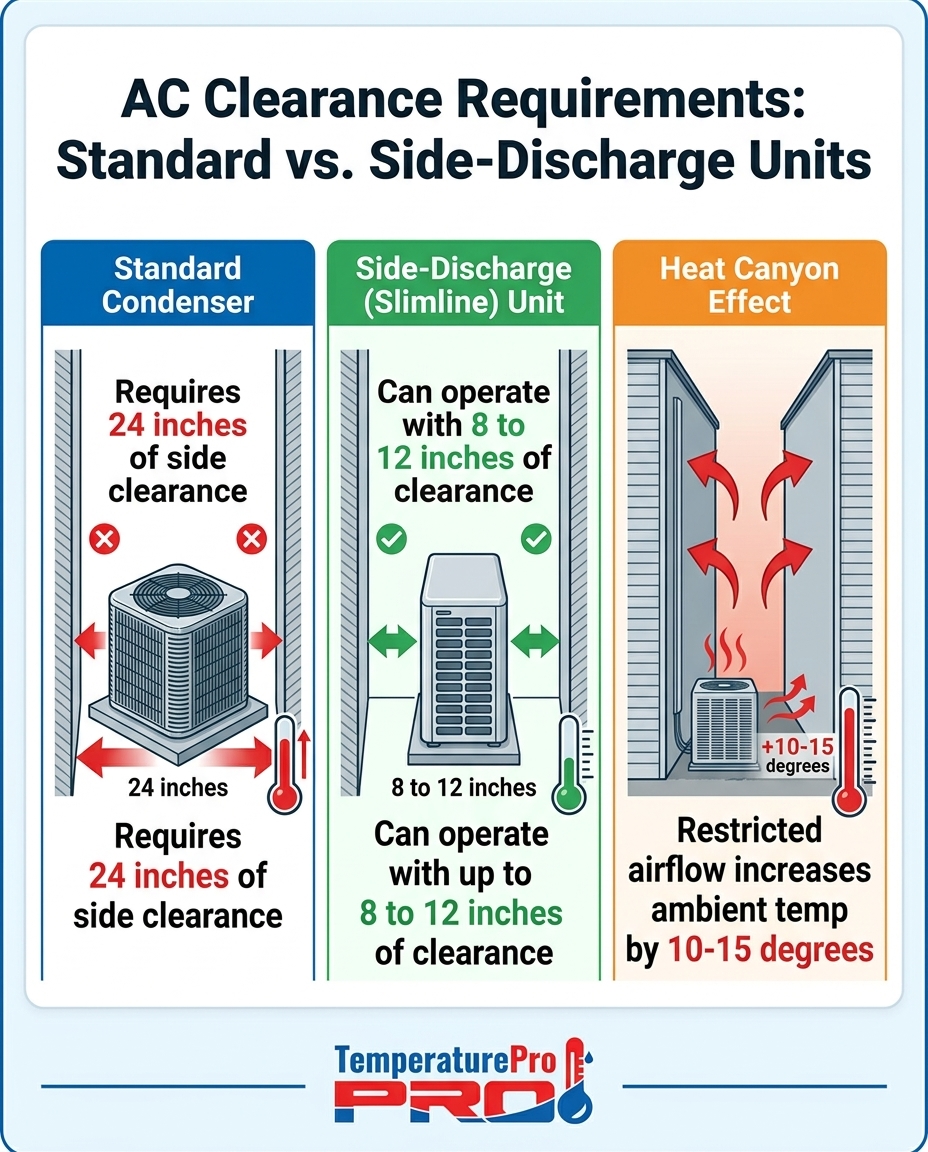
To fully grasp why systems fail in tight spaces, it helps to understand the thermodynamics of how an air conditioner actually works. Standard traditional AC condensers typically require a minimum of 24 inches of unobstructed clearance on all sides for proper airflow. The unit pulls ambient air through the side fins, passes it over the hot refrigerant coils, and exhausts the hot air straight up out of the top. When you have wide, open spaces, this process works flawlessly.
However, when a condenser is squeezed into a narrow gap between two close rooflines or a house and a tall privacy fence, it creates what we in the industry call the "heat canyon" effect. The hot air exhausted from the top of the unit hits the overhanging eaves or bounces off the neighboring wall, and is immediately sucked right back into the side intakes. The unit ends up recirculating its own exhausted hot air.
During a humid Louisiana summer, peak July heat and high humidity already push cooling equipment to its limits. When our team measures ambient temperatures directly around outdoor units in these heat canyons, we often find them 10 to 15 degrees higher than the actual weather outside. If it is 95°F in your front yard, it might be 110°F in the narrow side yard where the AC is trying to operate.
The Toll of Thermal Overload
This restricted airflow directly connects to frequent system shutdowns and chronic overheating. The compressor inside the unit has an internal thermal limit. When the ambient air is too hot to cool the coils, the compressor overheats and trips its internal safety switch, shutting the entire system down to prevent a catastrophic meltdown. In our experience, this thermal overload happens much faster in the heavy, humid air of the Gulf South than it does in cooler, drier climates.
• Open Yard (Standard) — Ambient Temperature Around Unit: Matches local weather forecast — Airflow Status: Unobstructed intake and exhaust — System Impact: Normal operation and expected lifespan
• Narrow Side Yard (Restricted) — Ambient Temperature Around Unit: Weather forecast + 10 to 15 degrees — Airflow Status: Recirculating hot exhaust air — System Impact: Frequent thermal trips and high energy draw
• Severe Heat Canyon — Ambient Temperature Around Unit: Exceeds 115°F during peak summer — Airflow Status: Completely choked off — System Impact: Rapid compressor failure and constant shutdowns
Why Modern High-SEER Units Struggle in Historic Footprints
If you have an older air conditioner that is starting to fail, you might assume that replacing it with a brand-new model will automatically solve your cooling problems. Unfortunately, in historic neighborhoods, the opposite is often true. Newer, energy-efficient units—known as high-SEER (Seasonal Energy Efficiency Ratio) models—are physically much larger than the units installed 15 to 20 years ago. To achieve higher efficiency ratings, manufacturers had to increase the surface area of the cooling coils, which resulted in significantly taller and wider exterior cabinets.
This footprint mismatch validates the frustration many homeowners express to us when they receive standard HVAC advice. A technician used to working in wide, open suburban developments might recommend a massive, ultra-efficient 18-SEER unit without considering the architectural reality of the Baton Rouge Garden District. At TemperaturePro Baton Rouge, we know that forcing a modern, oversized standard unit into a historic lot line drastically reduces its lifespan and efficiency because it chokes off whatever minimal airflow the space previously allowed.
Proactive Monitoring in Tight Spaces
When the physical cabinet takes up 80% of the available width in an alleyway, the system is doomed to fail prematurely. The unit cannot breathe, and the efficiency gains you paid for are completely negated by the extreme operating conditions. This is why standard suburban advice fails in historic urban footprints.
Because these systems operate under extreme duress, proactive measures are required to monitor system health before a total breakdown occurs. Keeping a close eye on the system's performance and keeping the coils pristine is non-negotiable. We strongly recommend staying on top of routine AC maintenance to ensure that your restricted unit is operating as cleanly and efficiently as possible, compensating slightly for the lack of physical breathing room.
Protecting Your Historic Property During Complex Repairs
Servicing an air conditioner in a zero-lot-line environment is not just a technical challenge; it is a physical and logistical hurdle. Technicians must maneuver heavy tools, recovery cylinders, vacuum pumps, and bulky replacement parts through a property line that is often less than 36 inches wide. Acknowledging the physical difficulty of this work is essential for homeowners preparing for a major repair or installation.
The primary concern during these complex repairs is the risk of accidental damage to the property itself. Historic homes feature delicate architectural details that cannot be easily replaced at a local hardware store. Navigating a 200-pound condenser through a narrow gap requires immense precision to avoid scraping original wood siding, chipping antique brickwork, or crushing decades-old, delicate landscaping that lines the property.
Professional Property Protection Standards
Because of these risks, specialized care and expertise are required to perform diagnostics and repairs safely in the Baton Rouge Garden District. Our professional technicians at TemperaturePro Baton Rouge respect historic properties and take mandatory precautions to ensure no damage occurs while navigating tight property lines.
• Ladder feet covers: Rubberized boots are placed on all ladders to prevent scratching historic porches or antique paving stones.
• Heavy-duty drop cloths: Canvas and padded drop cloths are laid down over delicate landscaping and original walkways to protect them from heavy equipment.
• Protective wall shields: Temporary barriers are sometimes used when brazing copper lines to ensure the torch heat never touches the home's siding.
• Multi-technician lifts: Instead of dragging heavy units on dollies through tight mud pathways, multiple technicians physically lift and carry the equipment to prevent ground damage.
The mandatory use of protective gear and careful logistical planning ensures that your home remains pristine while the necessary mechanical work is completed safely.
Actionable Equipment Solutions: The Rise of Side-Discharge Units
When traditional top-discharge air conditioners simply will not fit or function in a narrow alley, our team highly recommends an effective technical solution: the side-discharge unit. Also known as slimline condensers, these units feature a completely different form factor and fan orientation. Instead of a large, cube-shaped cabinet with a fan blowing hot air straight up, a side-discharge unit looks more like a large, flat suitcase standing on edge, with a fan that blows air horizontally out of the front.
The data clearly supports this transition for historic homes. Side-discharge units are specifically designed for narrow spaces and tight urban corridors. While a traditional cube condenser requires two feet of clearance on all sides, a slimline unit can operate efficiently with as little as 8 to 12 inches of clearance on certain sides, allowing it to sit nearly flush against an exterior wall.
Most importantly, this horizontal design eliminates the heat canyon effect. By blowing the hot exhaust air horizontally away from the home—often straight down the alleyway rather than up into the eaves—the unit prevents the hot air from recirculating back into its own intake fins. We consistently see that matching the equipment profile to the architectural reality of the home results in massive long-term reliability and efficiency gains.
Comparing Clearance Requirements
Understanding the dimensional differences helps clarify why side-discharge models are rapidly becoming the standard for historic properties.
• Traditional Condensers: Require significant overhead clearance (often 4 to 5 feet) so the top-blowing fan can exhaust heat, plus 24 inches of side clearance for intake.
• Slimline Condensers: Engineered specifically for zero-lot-line compliance, these units require almost zero overhead clearance and drastically reduced side clearance, making them perfect for placement under stairs, decks, or in 3-foot side yards.
AC Clearance Requirements: Standard vs. Side-Discharge Units
Space Modification and Relocation Strategies
If installing a side-discharge unit is not the preferred route, homeowners must consider alternative solutions to solve chronic airflow starvation. Deciding whether to relocate the outdoor unit entirely or modify the surrounding space requires a careful assessment of the property. Our local experts at TemperaturePro Baton Rouge can evaluate the specific layout of your Baton Rouge Garden District home to recommend the most cost-effective path forward.
1. Relocating the outdoor unit: The most permanent solution to narrow lot lines is moving the equipment to an area where airflow is completely unobstructed. This often means relocating the condenser to a spacious backyard or even utilizing a flat rooftop. While this requires extending the copper refrigerant lines and electrical wiring, it permanently solves the heat canyon problem.
2. Modifying hardscaping and barriers: Sometimes the airflow restriction is compounded by solid wooden privacy fences or dense, overgrown shrubbery. Replacing a solid fence with a slatted or lattice design near the AC unit allows the exhaust heat to escape the alleyway, drastically lowering the ambient temperature around the equipment.
3. Elevating the equipment: In some historic layouts, mounting the condenser on sturdy wall brackets above head height can lift it out of the most restricted part of the alley, giving the exhaust fan a clearer path to open air.
4. Increasing coil cleaning frequency: If the unit absolutely must remain in a highly restricted side yard, the only way to protect it is through rigorous maintenance. A restricted unit pulls air harder and faster, acting like a vacuum for dust, pollen, and debris. Increasing the frequency of chemical coil cleanings ensures the limited air that does reach the unit can transfer heat effectively.
Because every historic home is unique, finding the right solution requires a custom approach tailored to the specific dimensions of the property. Technicians familiar with the various Baton Rouge service areas understand exactly how to navigate these local architectural challenges.
Navigating Emergency Repairs When the Heat Peaks
Airflow restrictions rarely cause system failures on mild spring days; they almost always trigger a breakdown when the weather is at its worst. Restricted units are most likely to fail during peak temperature days when they are forced to run continuously. During severe July heat waves, a struggling AC in a historic home quickly escalates from a nuisance to an outright emergency.
When a system shuts down due to thermal overload, a rapid, professional response is vital. One Baton Rouge homeowner experienced this firsthand when their restricted unit triggered an emergency shutdown on a sweltering Friday afternoon. Because they reached out to our team immediately, a TemperaturePro Baton Rouge technician arrived right away, accurately diagnosed the thermal trip, resolved the immediate airflow strain, and had the upstairs completely cool in time for expected weekend guests.
Diagnosing Thermal Overload vs. Component Failure
A timely diagnostic is crucial because the symptoms of airflow starvation often mimic catastrophic mechanical failure. When the system stops cooling, a professional must differentiate between a simple tripped thermal sensor (which is protecting the system) and a failing compressor (which requires major repair). If the unit is simply overheating due to the heat canyon effect, resetting the system and addressing the airflow restriction can save the equipment.
Preparing the home and system to withstand extreme seasonal loads is the best defense against these mid-summer emergencies. Taking steps to ensure your AC survives the Louisiana summer—such as clearing the immediate area of debris, shading the unit if possible, and scheduling pre-season diagnostics—can prevent a thermal shutdown when you need your cooling system the most.
Frequently Asked Questions
How much clearance does an outdoor AC unit need?
A standard traditional outdoor AC condenser requires at least 24 inches of unobstructed clearance on all sides, and 4 to 5 feet of overhead clearance. This space is necessary for the unit to pull in fresh air and exhaust hot air without recirculating it. If this clearance is compromised, the unit will suffer from airflow starvation and reduced efficiency.
Can I put my AC unit in a narrow side yard?
Yes, but installing a standard top-discharge unit in a narrow side yard often leads to overheating and premature failure due to the "heat canyon" effect. If your side yard is less than three feet wide, you should strongly consider a side-discharge (slimline) unit designed specifically for tight spaces. Alternatively, relocating the unit to the backyard may be a safer long-term choice.
What is a side discharge air conditioner?
A side-discharge air conditioner, often called a slimline unit, features a compact, suitcase-like cabinet with a fan that blows air horizontally out the front rather than vertically out the top. This design allows the unit to operate efficiently with as little as 8 to 12 inches of side clearance. They are the preferred solution for historic homes, zero-lot-line properties, and tight urban spaces.
Why does my AC compressor keep overheating?
Your AC compressor is likely overheating because it cannot dissipate the heat it removes from your home, usually due to restricted airflow around the outdoor unit. When trapped in a narrow space, the ambient temperature around the condenser spikes, causing the compressor's internal safety switch to trip. Dirty coils, failing fan motors, and low refrigerant can also compound this thermal overload.
How do you fix restricted airflow on an outside AC unit?
The quickest fix for restricted airflow is clearing away any encroaching vegetation, debris, or solid fencing that sits within two feet of the unit. If the restriction is caused by the physical walls of the home itself, the solution involves deep-cleaning the coils to maximize whatever airflow exists. For a permanent fix, you may need to upgrade to a slimline unit or relocate the equipment entirely.
Are slimline AC units compliant with historic district regulations?
In most cases, slimline AC units are highly compliant and often preferred by historic district committees because their compact footprint makes them easier to hide behind low fencing or landscaping. Because they sit closer to the exterior wall, they are less visually intrusive than bulky standard condensers. Always consult your local historic preservation guidelines before finalizing an installation location.
Living in a beautiful, older neighborhood shouldn't mean sacrificing your modern indoor comfort. If you are tired of dealing with constant breakdowns and inadequate cooling caused by tight property lines, there are viable, long-term solutions available. Reach out to our team at TemperaturePro Baton Rouge today to evaluate your property's specific layout, explore side-discharge equipment options, and secure actionable options for repair or replacement that finally solve your historic lot line headaches.
Thank you! Your submission has been received!
Oops! Something went wrong while submitting the form.
Sudden static shocks are a clear diagnostic sign that your indoor air is too dry. Understand the physics behind this fall shift and why whole-home humidification is the ultimate fix.
Flipped homes look great but often hide starved HVAC returns behind new drywall. Discover how objective static pressure testing reveals these hidden bottlenecks before winter heating season begins.
Tired of massive energy spikes during sudden winter freezes? See how modern inverter-driven heat pumps maintain efficiency without relying on energy-hogging resistive strips.