5 min read
Recognizing Low Refrigerant Signs in Your AC System Before the Fall Transition
Prevent a fall HVAC breakdown with these home maintenance tips and troubleshooting steps. See why we check refrigerant levels before switching to heat.


Waking up to strange burning smells? See our home maintenance tips and troubleshooting criteria to decide when to ride it out and when to call a professional.
Are you frantically searching for home maintenance tips and troubleshooting advice because a strange burning smell from your vents just woke you up? You are certainly not alone. When a sudden system shutdown or a bizarre odor strikes late at night, your first reaction is often panic. Do you need to pay for an after-hours dispatch right now, or can this wait until normal business hours? During the volatile seasonal shifts in the Baton Rouge area, deciding whether to call for help or ride it out causes unnecessary anxiety.
To help you navigate these stressful moments, we recommend scheduling professional HVAC services when you are unsure about your system's safety. However, having a basic understanding of how your equipment operates can save you from unnecessary worry. This guide will walk you through a simple triage process for your heating and cooling system. We will help you identify the difference between a minor seasonal quirk and a genuine hazard, allowing you to make safe, informed decisions without ever resorting to risky DIY fixes.
The late-night dilemma: When an issue arises outside of standard business hours, the stakes feel higher. The house might be getting uncomfortably warm, or a strange noise might be echoing through the hallways. By learning how to assess the situation calmly, you can protect your home, your family, and your equipment.
Because the Baton Rouge area features a heavily cooling-dominated climate, local heating systems often sit completely dormant for eight to nine months out of the year. During this long, humid off-season, heating elements collect a significant amount of dust, pet dander, and mold spores. When you finally initiate that October heating startup, those accumulated particles instantly incinerate. This creates a distinct burning smell that frequently alarms homeowners.
This is where the "30-Minute Rule" comes into play. Normal dust burn-off typically clears out of your home within half an hour to an hour of the initial cycle. If the odor dissipates quickly, your system is likely functioning normally. However, if the smell resembles melting plastic, electrical ozone, or rotten eggs, you are facing a genuine hazard. In these dangerous scenarios, you should shut the system down immediately and arrange for emergency AC repair or heating service.
• Faint, dusty burning smell — Likely Cause: Normal dust burn-off on dormant elements — Required Action: Wait 30-60 minutes; monitor closely
• Acrid, melting plastic odor — Likely Cause: Overheating wires or failing components — Required Action: Shut down immediately and call a professional
• Rotten egg or sulfur smell — Likely Cause: Natural gas leak — Required Action: Evacuate, call utility company, then call HVAC pro
• Electrical ozone or "fishy" smell — Likely Cause: Melting circuit board or wire insulation — Required Action: Shut down immediately at the breaker
During an October heating startup, a brief, dusty odor is entirely expected. If the smell is faint and clears out within 30 to 60 minutes, your system is simply clearing off the summer's debris. As long as there is no visible smoke, no triggering of carbon monoxide alarms, and no electrical sparking sounds, you can safely let the system run its course.
You must take immediate action if you detect acrid, burning plastic odors or smells that persist longer than an hour. Furthermore, if your carbon monoxide alarms trigger at any point, evacuate the house immediately. These are clear indicators of a severe malfunction, such as a cracked heat exchanger or melting wire casing, which require professional intervention before the system can be safely operated again.
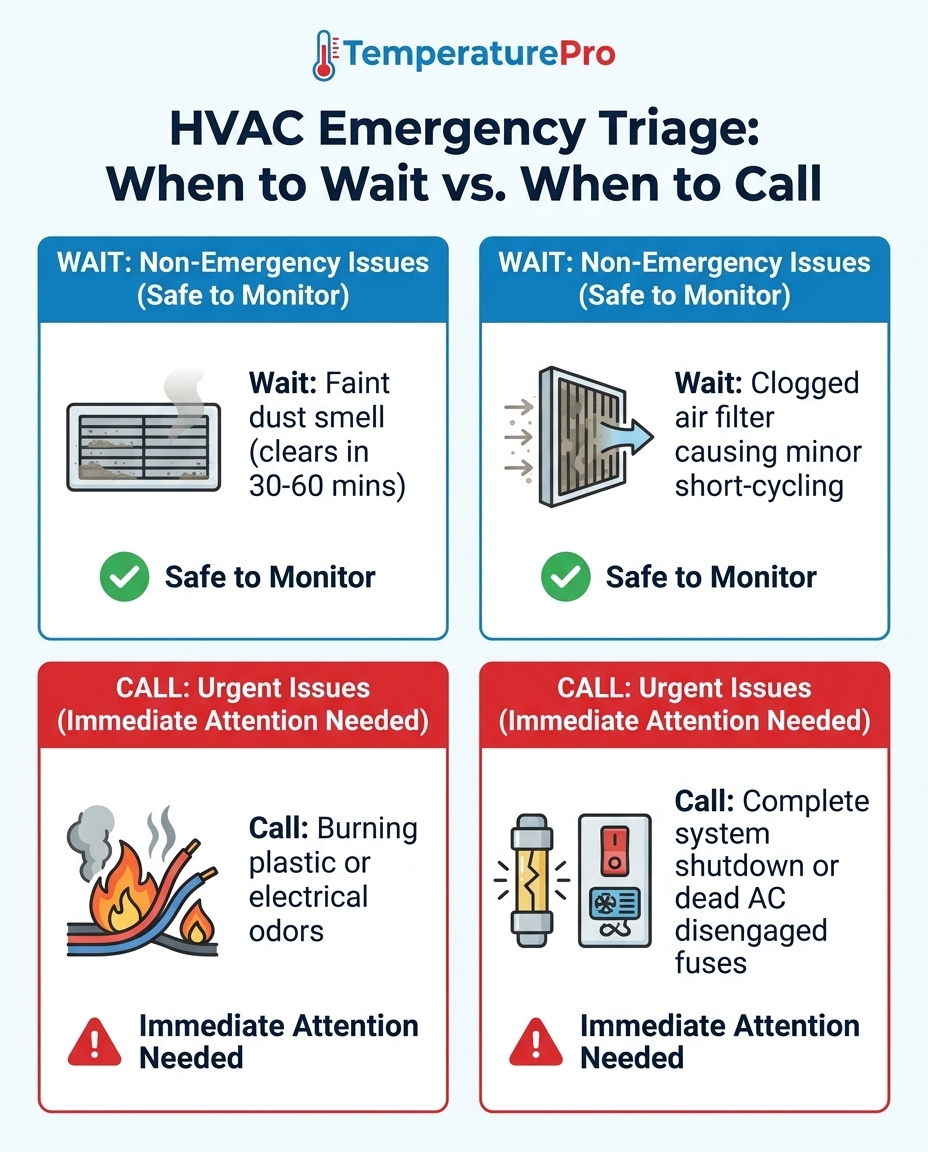
While a dusty smell might be harmless, electrical issues are strict, non-negotiable emergencies. Compromised circuit boards, disengaged fuses, and sparking wires pose immediate fire risks to your home. These issues often arise when foreign substances—such as pest intrusion, heavy condensation, or water damage—bridge the electrical connections on your system's internal components.
One Baton Rouge area homeowner needed a comprehensive AC inspection in the immediate aftermath of Hurricane Ida. Because of the severe weather exposure, a rapid professional response was necessary to ensure the system was safe to operate and free of electrical hazards. When dealing with potential electrical failures, a fast response isolates the issue and restores safety quickly.
If you suspect an electrical failure, follow these safe shutdown steps:
1. Turn off the thermostat: Set your thermostat to the "off" position to stop it from calling for heating or cooling.
2. Flip the breaker: Locate your home's main electrical panel and completely turn off the dedicated breaker for your HVAC unit.
3. Do not reset repeatedly: If a fuse has disengaged or a breaker has tripped, do not force it back on. This is a safety mechanism doing its job.
4. Call for emergency service: Any suspected electrical issue overrides standard business hour waiting periods. Leave the system off until a technician arrives.
Never attempt to clean a circuit board or replace internal fuses yourself. These are strict professional-only fixes that require specialized diagnostic tools to ensure the root cause is actually resolved.
Another common issue that causes late-night panic is short-cycling. This occurs when your system turns on, runs for only a few minutes, and shuts off rapidly without ever completing a full temperature cycle. This constant starting and stopping puts immense strain on your components, but is it an emergency?
The urgency depends entirely on the root cause. Benign causes, such as a severely clogged air filter restricting airflow, can usually wait for the morning. Severe causes, however, such as a failing blower motor, a refrigerant leak, or a malfunctioning compressor, might warrant an urgent call. If you are unsure, you can safely troubleshoot your HVAC system by checking a few basic external factors before requesting a dispatch.
Before you make a late-night call during your October heating startup, run through this safe triage checklist:
• Verify the thermostat is set correctly: Ensure it is set to the correct mode (heat or cool) and that the temperature setpoint is actually higher or lower than the current room temperature.
• Inspect and replace heavily soiled air filters: A blocked filter restricts airflow, causing the system to overheat and trip its internal safety switches. Replacing a dirty filter often cures short-cycling instantly.
• Ensure vents are open and unobstructed: Walk through your home and make sure rugs, furniture, or curtains are not blocking your supply and return registers.
If you perform these safe checks and the system continues to short-cycle, leave it turned off to prevent permanent compressor damage and schedule a professional diagnostic.
There are specific scenarios where waiting until morning is simply not an option. If extreme indoor temperatures are affecting vulnerable family members—such as infants, the elderly, or those with medical conditions—you should confidently request an after-hours emergency dispatch.
Rapid response times are especially critical during late-night or weekend system failures when severe weather is approaching. For example, another local homeowner faced a failing system on a Saturday evening just before Hurricane Ida made landfall. Technicians arrived late that night, added refrigerant, fixed a leak, and restored cooling before the storm hit, providing crucial relief when it mattered most.
When you make the call, a professional technician will guide you through the assessment process. They will diagnose the root cause of the failure and provide a clear path forward. Working with a veteran-owned company means you get honest, no-nonsense assessments during stressful emergency calls. You receive a clear explanation of the problem without any aggressive sales tactics, allowing you to make the best decision for your home.
The best way to handle an emergency is to prevent it from happening in the first place. The transition from heavy summer cooling to initial fall heating places incredible stress on your entire HVAC system. The long, oppressive summer demands near-constant operation from your blower motor and electrical components. By the time October arrives, these parts are heavily worn and vulnerable.
If you are wondering what to do when your AC stops working in summer, the answer usually involves immediate repair. But in the fall, the strategy shifts to proactive prevention. A pre-winter inspection catches degraded components before the first major temperature drop forces them to fail under pressure.
Consider the peace of mind that comes from a routine system evaluation. Instead of waking up to a freezing house and a burning smell during an October heating startup, you can rest easy knowing your system has been cleaned, tested, and cleared for safe operation. Once your immediate emergency is resolved, shifting your focus to proactive maintenance is the smartest investment you can make for your home's comfort.
When your system acts up unexpectedly, it is natural to have questions. We have compiled authoritative answers to the most common homeowner anxieties regarding system smells and behaviors in the Baton Rouge area. If you want to avoid these issues altogether, consider enrolling in a routine AC maintenance program to keep your equipment in peak condition year-round.
Yes, briefly, due to dust burn-off on dormant elements. When your heater sits unused for months, dust and debris settle on the heat exchanger. The moment the system fires up, these particles incinerate, creating a distinct dusty, burning odor that is completely normal for the first cycle of the season.
Typically 30 to 60 minutes; persistent smells require professional attention. If your home is well-ventilated, the initial dust burn-off should clear out within an hour. If the smell lingers for several hours or grows stronger, turn the system off and request an inspection.
Airflow restrictions, thermostat issues, or internal component failures are the most common culprits. A clogged air filter is the most frequent offender, as it causes the system to overheat and shut down prematurely. If changing the filter does not resolve the rapid on-and-off cycling, a professional needs to evaluate the blower motor and sensors.
If the smell is electrical, plastic, gas, or lasts longer than an hour, you need a professional immediately. Odors resembling melting wires, sulfur, or rotten eggs indicate severe safety hazards. Never ignore these warning signs; shut off the unit and call for emergency service.
Yes, moisture combined with dust can degrade components over the long summer. In humid climates, the dust that settles on internal parts can absorb moisture, leading to minor corrosion or stubborn buildup. This makes the initial startup smell stronger and increases the wear on moving parts.
Always check your thermostat settings, air filter, and circuit breakers first. Ensure the thermostat has working batteries and is set to the correct mode. Verify that your air filter is clean and that a tripped breaker isn't the sole cause of a sudden shutdown. If these basics are fine, it is time to call a pro.
Ignoring persistent warning signs from your HVAC system is never a gamble worth taking. Whether you are dealing with a strange odor during an October heating startup or a system that refuses to stay running, your safety and indoor air quality should always come first. While the 30-minute rule can help you triage minor dust burn-off, genuine electrical or mechanical hazards require a trained eye.
If your system is displaying any concerning symptoms, do not wait for a complete breakdown in the middle of the night. Secure your peace of mind by seeking a professional assessment. Reach out to a trusted, honest technician to ensure your heating and cooling equipment is safe, efficient, and ready to handle whatever the season brings.
Go With Experience