Recognizing Low Refrigerant Signs in Your AC System Before the Fall Transition
Recognizing Low Refrigerant Signs in Your AC System Before the Fall Transition
Prevent a fall HVAC breakdown with these home maintenance tips and troubleshooting steps. See why we check refrigerant levels before switching to heat.
The Hidden Risks of Flipping the Thermostat Without Checking Your System
The mid-fall October transition is finally bringing cooler evening temperatures to Louisiana, but before you simply switch your thermostat from cooling to heating, mastering a few essential home maintenance tips and troubleshooting strategies can save your system from an immediate breakdown. After running nearly non-stop through a grueling summer, your heating, ventilation, and air conditioning equipment has endured significant wear and tear. Ignoring the lingering signs of summer strain and demanding instant heat on the first chilly night is a recipe for catastrophic failure. If you want to ensure your equipment survives the shift in seasons, addressing performance issues now is critical before you require comprehensive air conditioning services or emergency heating repairs.
At TemperaturePro Baton Rouge, we see many homeowners fall into the trap of believing that because the air conditioner technically survived the summer, the heater will automatically function flawlessly. This assumption overlooks the reality that modern HVAC systems are deeply interconnected. The stress placed on your system during peak July and August heat does not magically reset when the calendar turns to October. Parts vibrate loose, electrical connections fatigue, and most importantly, refrigerant levels can slowly drop due to micro-leaks.
The Transition Risk Factor:
• Undetected slow refrigerant leak — Immediate Winter Impact: Heat pump fails to extract outdoor heat, running constantly without warming the house.
• Dust buildup on the evaporator coil — Immediate Winter Impact: Restricted airflow causes the furnace heat exchanger to overheat and trip safety switches.
• Clogged condensation drain line — Immediate Winter Impact: Trapped moisture creates stagnant odors that are blasted through the vents when the fan kicks on.
• Strained electrical contactors — Immediate Winter Impact: System refuses to power on when switching modes, leaving you without any climate control.
By taking a proactive approach during this mid-fall October transition, you give yourself a vital window of opportunity. Identifying and resolving minor cooling struggles now ensures that when you finally do push that thermostat over to the "heat" setting, your home will warm up safely, efficiently, and without any unpleasant surprises.
How Summer Cooling Issues Threaten Winter Heat Pump Operation
In our years of servicing local HVAC systems, we've found that to understand why a summer cooling problem is actually a winter heating emergency in disguise, you have to look at how modern heat pumps operate. Unlike traditional gas furnaces that generate heat by burning fuel, a heat pump simply moves heat from one place to another. If your system relies on this technology, learning to troubleshoot your HVAC system requires understanding that the exact same mechanical components handle both your summer cooling and your winter heating.
The Shared Refrigerant Cycle Explained
Your heat pump uses a specialized component called a reversing valve. During the summer, this valve directs the flow of refrigerant so that it absorbs heat from inside your house and releases it outdoors. When you switch your thermostat to heating mode, the reversing valve shifts. Now, the refrigerant absorbs ambient heat from the outdoor air—even when it feels cold outside—and releases that concentrated heat inside your home.
Because the fundamental process is identical, refrigerant is the absolute lifeblood of both functions. If your system suffered a slow leak over the summer and is now operating with a low charge, it lacks the physical medium required to transfer heat. A system that struggled to keep your living room at 72°F in August will be mathematically incapable of warming that same room to 68°F in December.
Why Heating Demands Expose Summer Leaks
The Problem: You enter the heating season with an unaddressed, slow refrigerant leak that developed over the summer.
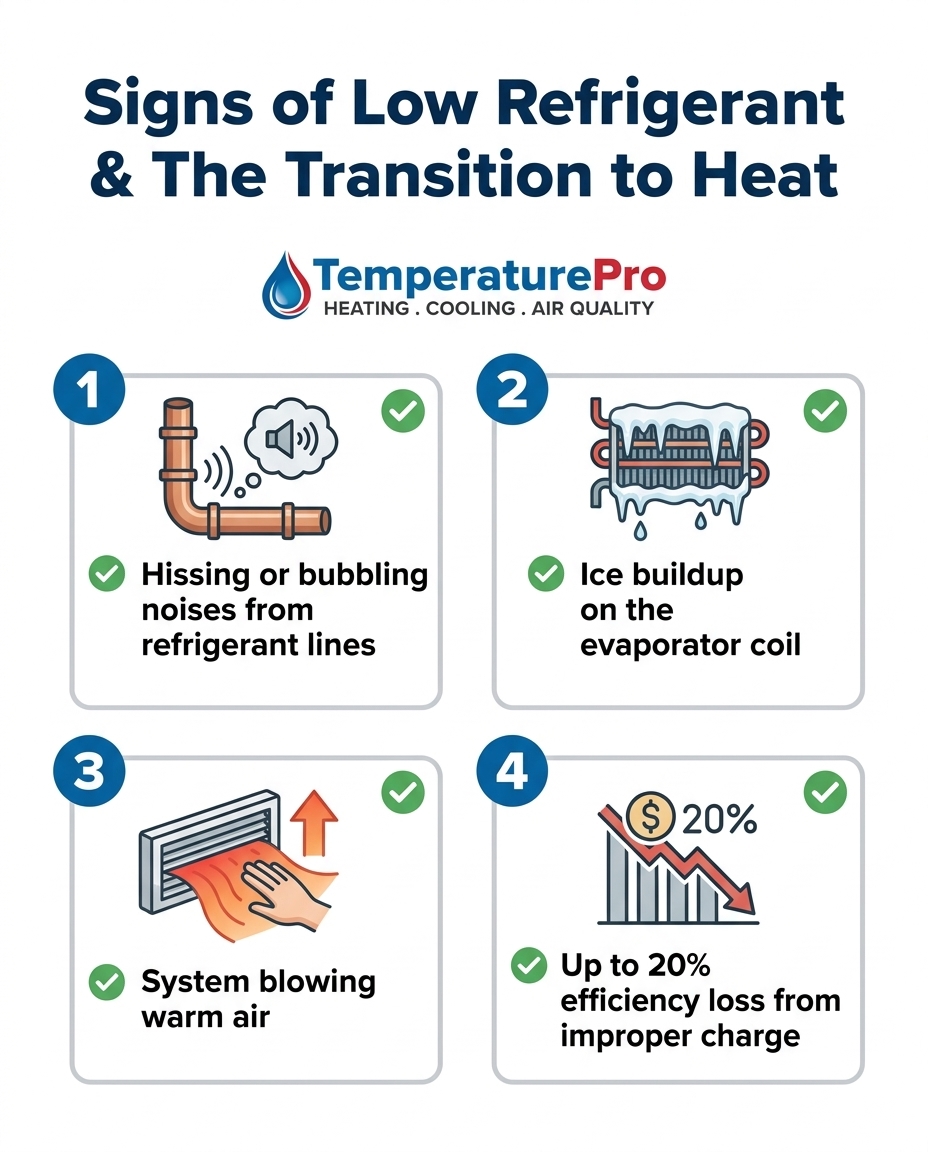
The Cause: As outdoor temperatures drop, there is less ambient heat available in the air. A fully charged system handles this easily, but a compromised system with low refrigerant must work twice as hard to extract the same amount of thermal energy. According to federal energy guidelines, an improper refrigerant charge can drastically reduce heating efficiency by up to 20 percent.
The Solution: The system runs continuously, driving up your energy bills while failing to warm the house. Eventually, this excessive workload causes the compressor—the most expensive component in your entire system—to overheat and suffer catastrophic failure. Resolving the leak before changing modes prevents this cascading mechanical disaster.
Identifying Low Refrigerant Signs in Your AC System
Spotting a refrigerant issue early is one of the most valuable skills a homeowner can develop. Because the system operates in a closed loop, the signs of a leak are distinct and highly recognizable if you know what to look and listen for. Paying attention to these symptoms during the mid-fall October transition can save your compressor from an early grave.
Our technicians frequently encounter these core symptoms that indicate a system is losing its vital heat-transfer fluid:
• Hissing or bubbling noises: Refrigerant transitions between a liquid and a gas as it moves through your system. If there is a crack or pinhole leak in the copper lines, the pressurized refrigerant escaping will often create a distinct hissing sound. If the leak is occurring where the refrigerant is in a liquid state, you may hear a gurgling or bubbling noise.
• Ice buildup on the evaporator coil: It sounds counterintuitive, but low refrigerant actually causes your indoor coil to become too cold. Without enough refrigerant to absorb the heat from your indoor air, the temperature of the coil drops below freezing. The natural humidity in the air then condenses and freezes directly onto the metal fins, encasing the unit in solid ice.
• Running constantly but blowing warm air: If your system runs for hours but the house never reaches the target temperature, the heat transfer process is failing. If you want to understand why your air conditioner is blowing warm air, low refrigerant is often the primary culprit. The fan is working, the motors are spinning, but the chemical capability to move heat is gone.
In a Baton Rouge high-humidity environment, these symptoms often compound rapidly. A freezing coil doesn't just stop cooling your home; it creates a massive block of ice that will eventually melt, leading to a host of secondary water damage issues if left unchecked.
Signs of Low Refrigerant & The Transition to Heat
The Impact of High Humidity on a Struggling System
While a refrigerant leak is a mechanical problem, the local climate dictates exactly how that problem manifests inside your home. With extreme heat and a grueling 6+ month cooling season, our team knows firsthand that Baton Rouge's high-humidity environment makes air conditioning performance absolutely critical. Your HVAC system is not just lowering the temperature; it is actively pulling gallons of moisture out of your indoor air every single day.
When your system struggles due to low refrigerant, its dehumidification capacity plummets. The home begins to feel sticky, clammy, and uncomfortably warm, even if the thermostat reads a seemingly normal temperature. This elevated indoor humidity forces the system to run longer cycles, accelerating the wear on already strained components.
The Danger of the Thaw:
If low refrigerant has caused your evaporator coil to freeze over, that ice eventually has to melt. When the system cycles off, the massive block of ice rapidly thaws, sending a surge of water into the condensation drain pan. Often, this volume of water overwhelms the drain lines—which may already be partially clogged with summer algae and dust—causing the pan to overflow into your attic or utility closet.
Furthermore, entering the heating season with a moisture-laden, dirty coil creates severe indoor air quality (IAQ) risks. When you turn the heater on for the first time in October, the warm air blows directly over that stagnant water and biological growth. The resulting damp, dirty odors are immediately distributed through your ductwork into every room of the house, creating an unhealthy breathing environment right as you seal the windows for winter.
Why a Temporary Refrigerant Top-Off is Never the Right Answer
One of the most pervasive and damaging myths in the residential HVAC industry is the idea that air conditioners naturally "consume" or "use up" refrigerant over time. This is entirely false. Your system operates on a closed-loop circuit. The amount of refrigerant inside the copper lines should remain exactly the same on the day the system is installed as it is ten years later. If your system is low on refrigerant, there is only one physical explanation: you have a leak.
Because of this, simply paying for a "top-off" is never the right answer. Adding refrigerant without finding and repairing the hole is a temporary bandage. The new refrigerant will eventually leak out through the exact same crack, wasting your money, harming the environment, and leaving your compressor vulnerable to failure all over again.
As a veteran-owned company, our team at TemperaturePro Baton Rouge focuses heavily on technical integrity and operational honesty. That means doing the job right the first time by locating the actual source of the leak, repairing the compromised copper or coil, and then properly recharging the system to factory specifications.
We recently helped one local homeowner who experienced this firsthand late one Saturday evening as a summer hurricane approached. Their AC unit was failing to cool the house, creating a highly stressful situation right before the storm. Rather than just dumping in a temporary charge of refrigerant and leaving, our responding technician took the time to properly locate and fix the actual leak, restoring reliable, long-term comfort and providing true peace of mind before the severe weather hit.
Decoding the Burning Dust Smell and Other Transition Warnings
As the mid-fall October transition arrives, a highly common phenomenon occurs in homes across our service area: the dreaded "burning dust" smell. When you flip the thermostat to heat for the first time in over half a year, it is completely normal to notice a faint, smoky odor coming from your vents.
Throughout the long cooling season, microscopic dust particles, pet dander, and airborne debris settle on your furnace's heat exchangers or the heat pump's auxiliary heating strips. When these components heat up for the very first time, that settled dust is instantly incinerated.
However, we always advise our customers to differentiate between a normal seasonal quirk and a serious warning sign that requires professional intervention.
• Brief burning dust smell (lasts 15-30 minutes) — Likely Cause: Normal incineration of settled summer dust on heating elements. — Required Action: Monitor the system; the smell should dissipate completely.
• Persistent burning plastic or electrical smell — Likely Cause: Failing blower motor, melting wire insulation, or electrical short. — Required Action: Turn off the system immediately and call a professional.
• Musty, "dirty sock" or stagnant water odor — Likely Cause: Algae growth in the drain pan or a dirty, moisture-laden evaporator coil. — Required Action: Schedule a deep coil cleaning and drain line flush.
A comprehensive pre-winter system check prevents the panic associated with these odors. By having the system professionally cleaned and inspected before you actually need the heat, you ensure that the internal components are free of excessive debris, keeping your indoor air quality pristine and your mind at ease.
Proactive Steps to Protect Your HVAC Equipment Before Winter: Home Maintenance Tips and Troubleshooting
The transition between seasons is the most vulnerable time for your climate control equipment. Taking proactive steps now is the difference between a cozy, uneventful winter and a freezing night spent waiting for an emergency repair truck. A proper pre-winter system check goes far beyond just changing the air filter—it involves a thorough mechanical evaluation of the entire system.
When you schedule routine AC maintenance with our Baton Rouge team ahead of the cold weather, a qualified technician will perform several critical steps to secure your equipment:
1. Inspecting and Clearing Drain Lines: After combating the Baton Rouge high-humidity environment all summer, condensation drain lines are frequently clogged with algae and sludge. Technicians flush these lines to ensure any remaining moisture drains safely outside, preventing winter overflow and indoor mold growth.
2. Cleaning Evaporator and Condenser Coils: Dirt acts as an insulator. By carefully washing the indoor and outdoor coils, the technician restores the system's ability to transfer heat efficiently, lowering your energy consumption and reducing strain on the compressor.
3. Verifying Refrigerant Levels: Using precision gauges, the technician measures the system's internal pressure to ensure the refrigerant charge is exact. If levels are low, they will initiate the process to locate and repair the leak before the heating season begins.
4. Testing Electrical Components: Capacitors, contactors, and relays are tested under load to ensure they haven't fatigued during the summer. Replacing a weak capacitor now prevents the system from failing to start on a cold morning.
5. Calibrating the Reversing Valve and Thermostat: The technician forces the system to switch between cooling and heating modes, verifying that the reversing valve shifts smoothly and the thermostat accurately commands the equipment.
For example, one local customer recently reached out to us for help diagnosing ongoing, frustrating AC issues before the weather turned. Our technicians arrived right within the estimated time window, performed a full diagnostic evaluation of these exact components, and helped the customer establish a clear, actionable path forward to fix their HVAC issues permanently before the heavy heating demands began.
Ensure a Safe and Comfortable Heating Season
The shift from summer cooling to winter heating shouldn't be a gamble. By understanding the mechanical link between your air conditioner and your heater, you can spot the warning signs of low refrigerant and excessive wear before they cause a total system failure. The peace of mind that comes from knowing your equipment is clean, fully charged, and mechanically sound is invaluable.
Don't let lingering summer cooling issues threaten your comfort this winter. Take the time during this mid-fall October transition to invest in professional inspections with TemperaturePro Baton Rouge and familiarize yourself with reliable home maintenance tips and troubleshooting practices. Addressing these concerns today ensures that when the cold weather finally settles in, your home will remain a safe, warm, and highly efficient sanctuary.
Frequently Asked Questions
What happens if I run my AC with low refrigerant?
Running your system with low refrigerant forces the compressor to overwork while failing to properly cool the home. This leads to frozen evaporator coils, drastically higher energy bills, and eventually, catastrophic compressor failure. It is critical to have a professional locate and repair the leak rather than continuing to run a compromised system.
Why does my heater smell like burning dust when I turn it on?
This smell is caused by the incineration of microscopic dust and debris that settled on the heat exchangers or heating strips during the long summer cooling season. While a brief, 15-to-30-minute burning dust odor is a normal part of the fall transition, persistent smells of burning plastic or electrical components require immediate professional attention.
Can low refrigerant affect my heat pump in the winter?
Yes, low refrigerant will severely cripple a heat pump's ability to warm your home in the winter. Heat pumps use the exact same refrigerant cycle to extract heat from the outdoor air; without the proper chemical charge, the system cannot transfer thermal energy, resulting in a system that runs constantly but only blows cold air.
How do I know if my home needs a fall HVAC tune-up?
If your system struggled to keep up during the summer, makes hissing noises, or if you haven't had it professionally inspected in the last twelve months, a fall tune-up is highly recommended. Preventative maintenance clears out summer wear-and-tear, verifies refrigerant levels, and ensures the system can safely handle the transition to heating mode.
What are the most common signs of a refrigerant leak in a residential system?
The most recognizable signs include a system that runs constantly but blows warm air, ice buildup on the indoor copper lines or evaporator coil, and distinct hissing or bubbling noises coming from the equipment. You may also notice an unexplained spike in your monthly energy bills as the system loses its efficiency.
Thank you! Your submission has been received!
Oops! Something went wrong while submitting the form.
Prevent sudden heating breakdowns with these home maintenance tips and troubleshooting insights. Get clear answers on why pre-winter HVAC inspections matter.
Most homeowners think a late-week appointment is the most convenient choice for an HVAC tune-up. Discover why our dispatchers highly recommend booking on a Tuesday morning instead.
A furnace shutting down repeatedly during early fall tests is frustrating, but jumping the safety switch is a dangerous mistake. Understand the severe fire hazards of this DIY workaround.