5 min read
When Your AC Can't Keep Up in Louisiana Heat: Troubleshooting the Fall Transition
Why do fall HVAC startups fail? Apply these home maintenance tips and troubleshooting steps to safely transition your system before winter.


Why does your heater smell like burning dust in fall? See how to spot normal burn-off versus a real hazard in these common homeowner questions answered.
You switch the thermostat from cool to heat for the first time during a late October cold snap, and within minutes, an alarming burning odor fills the house. Among the most common homeowner questions answered by technicians every fall is whether this sudden, acrid stench means the HVAC system is failing—or worse, catching fire. The jarring transition from months of steady cooling to suddenly needing warmth often catches homeowners off guard, and the resulting smell spreading through the vents is enough to make anyone panic.
Here is the thing: in the vast majority of cases, this odor is a completely normal part of the October heating startup process. However, as a homeowner, your immediate priority is determining if you are dealing with a harmless seasonal occurrence or a dangerous electrical issue that requires shutting down the system. Before you reach for the phone in a panic, taking a few minutes to understand the mechanics of your heating system will give you the clarity you need to make a safe, informed decision.
For year-round climate control solutions, learn more about our air conditioning repair and service.
To understand why your heater smells like burning dust, you have to look at what your system has been doing for the past eight to nine months. In southern climates, heating strips and furnace heat exchangers sit completely dormant for most of the year. While the air conditioner works tirelessly to keep your home cool, the heating components are essentially gathering dust in the dark.
Baton Rouge's oppressive summer humidity forces HVAC systems to work overtime, pulling in massive amounts of moisture and airborne particulate matter. Unlike dry northern climates where dust is light and powdery, high indoor humidity makes airborne particles much "stickier." As your system circulates air throughout the long summer, this heavy, moisture-laden dust clings stubbornly to the unused heating elements. Over the course of three seasons, it builds into a surprisingly thick, insulated layer.
When the late October cold snap finally arrives and you activate the heat, those dormant electrical strips or heat exchangers rapidly heat up to hundreds of degrees. The thick layer of accumulated summer dust is instantly incinerated. Because there is significantly more buildup—and because it is bound tighter to the components due to the region's humidity—the resulting smoke and odor are far more intense than they would be in a drier climate.
If you have ever wondered why your air conditioner is blowing warm air in the late afternoon during the summer, it is often due to similar environmental stress and airflow struggles. That same heavy workload directly contributes to the sheer volume of dust waiting to be burned off when autumn arrives.
While a burning dust smell is standard during the October heating startup, you should never ignore an odor that seems genuinely hazardous. You need a clear, safe way to differentiate between harmless dust incineration and a dangerous electrical failure without ever opening the HVAC cabinet yourself. Opening the unit exposes you to high-voltage components and should strictly be left to licensed professionals.
When an HVAC emergency strikes, rapid response is critical. For instance, one local homeowner recently moved into a new house during peak summer heat, only to have the AC fail immediately, leaving the home at 90 degrees. After their home warranty company failed to assist, a rapid response team arrived within the hour to restore service. You should treat a persistent electrical burning smell from your heater with that exact same level of urgency.
Use this sensory checklist to evaluate the situation safely:
• The Scent Profile — Normal Dust Burn-Off: Smells like dry, dusty earth, similar to a vacuum cleaner running hot. Slightly metallic but not sharp. — Electrical / Mechanical Emergency: Smells like melting plastic, ozone, scorching wire, or burning rubber. Highly acrid and chemical.
• Visual Cues — Normal Dust Burn-Off: No visible smoke in the home. Vents blow clear, warm air. — Electrical / Mechanical Emergency: Visible wisps of smoke from vents or the indoor unit. Smoke detectors activating.
• System Behavior — Normal Dust Burn-Off: System runs continuously and cycles normally. — Electrical / Mechanical Emergency: Breakers tripping repeatedly, loud buzzing, or grinding noises from the blower motor.
• Check your smoke detectors: Ensure they are active and not alarming. A normal dust burn-off rarely produces enough particulate to trigger a well-placed smoke alarm.
• Monitor the vents closely: Stand near the register closest to the indoor unit. The smell should be strongest here but should not burn your eyes or throat.
• Never attempt DIY diagnostics: If you suspect an electrical issue, do not remove access panels to look for melted wires. High-voltage capacitors retain lethal charges even when the system is off.
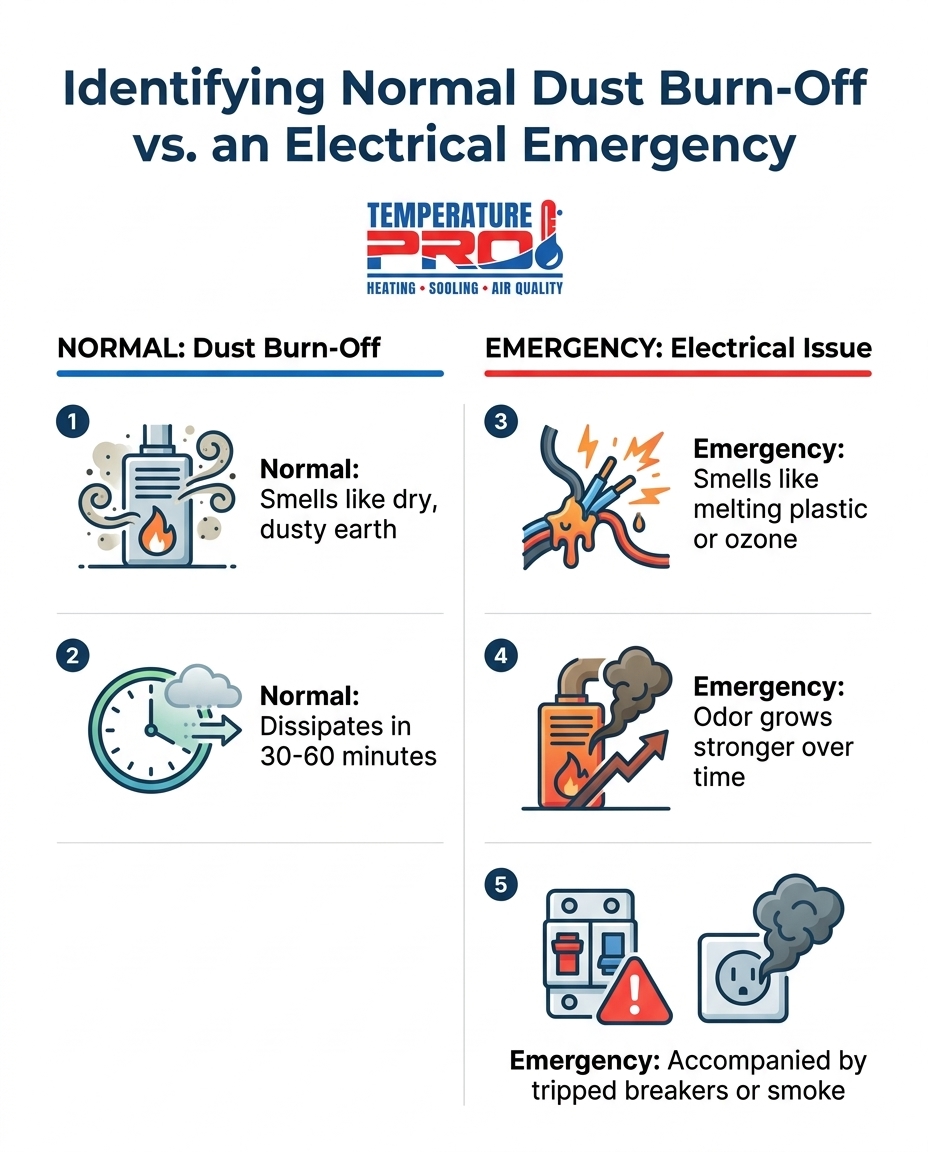
One of the most critical factors in diagnosing a seasonal odor is the timeframe. Establishing a strict window to wait and observe prevents panic-driven service calls while keeping your home safe. The golden rule for a normal October heating startup is the 30-to-60-minute window.
When you first turn on the heat, the smell should peak within the first 10 to 15 minutes. This is when the bulk of the accumulated dust is actively incinerating on the heat strips. After this initial peak, the odor should gradually but noticeably begin to dissipate as the fresh, warm air circulates through your home and the heating elements are wiped clean by the heat.
If the smell persists unchanged beyond an hour, or if it actively grows stronger and more pungent, you have exceeded the safe timeframe. At this point, it is no longer a simple case of a heater smelling like burning dust. You must take immediate action to protect your home.
1. Turn off the thermostat: Switch the system setting from "Heat" to "Off." Do not just lower the temperature; shut the cycle down completely.
2. Switch the fan to auto: Ensure the fan setting is on "Auto" rather than "On" so it stops circulating the odor through the ductwork.
3. Check the breaker box: Look for any tripped breakers labeled for the furnace or air handler. If a breaker has tripped, leave it off.
4. Call a professional: Reach out to a licensed technician to inspect the system for stuck sequencers, failing blower motors, or compromised wiring.
Often, homeowners assume the burning smell comes entirely from the heating unit itself, but your ductwork and air filters play a massive role in how long that odor lingers. A seasonal burning smell is frequently connected to general airflow restrictions and poor indoor air quality.
Your HVAC system requires a precise volume of air moving over the heating elements to operate safely. When you have a clogged, dirty air filter, it chokes off this vital airflow. Without enough air passing over the heat strips to carry the warmth away, the internal temperature of the unit spikes. This causes the system to run much hotter than intended, which not only burns off the dust violently but can actually scorch lingering debris in the immediate ductwork, severely exacerbating the burning smell.
Furthermore, a dirty filter fails to trap the incinerated particles as the air recirculates. Instead of filtering out the burned dust, the system pushes it back into your living space, making the odor linger far longer than the standard 60 minutes.
The very first step you should take before turning the heat on for the season is checking and replacing your air filter. Starting with a fresh filter ensures optimal airflow, keeps the internal temperatures regulated, and helps capture the initial wave of airborne particles generated by the burn-off.
For homeowners who want to minimize this issue permanently, upgrading your filtration strategy is key. Implementing professional indoor air quality solutions—such as high-efficiency media cabinets or active air purifiers—can drastically reduce the amount of dust that settles on your heating elements year-round. Less dust accumulating during the summer means a significantly milder burn-off when autumn arrives.
While a brief smell is entirely normal, it is vital to know when a professional service call is actually necessary. If your heater smells like burning dust for hours, if the scent shifts to melting plastic, or if your system repeatedly trips the circuit breaker, you need a licensed technician.
Diagnosing complex system issues requires a methodical approach. One homeowner reached out after experiencing ongoing, unexplained HVAC malfunctions that other companies failed to resolve. A technician arrived promptly, bypassed the guesswork, and established a clear repair path to fix the issues for good. Working with a veteran-owned and family-operated company means you get that exact same level of discipline, accountability, and honest diagnostic rigor for your winter heating needs.
Unfortunately, some companies use a simple seasonal burning smell as a scare tactic to push unnecessary, expensive system replacements. Honest diagnostics mean looking beyond the obvious. A professional pre-winter inspection doesn't just involve wiping down the unit; it involves safely cleaning the heat strips, testing amp draws, and performing a thorough "second-row" inspection.
A second-row inspection looks at the underlying components that cause safety hazards. Technicians will check for a disengaged fuse, loose wiring connections that could arc and cause real burning, and failing limit switches that prevent the system from overheating. Catching these minor issues before they escalate ensures your system operates safely all winter long. Investing in a routine AC maintenance plan that includes fall heating tune-ups is the most reliable way to prevent startling odors and unexpected breakdowns.
Yes, it is completely normal. It is simply the accumulation of summer dust burning off the heating elements. After sitting dormant for months, the sudden high heat incinerates the settled particles, creating a temporary odor that spreads through the vents.
The odor typically lasts between 30 and 60 minutes. It should peak within the first ten minutes and gradually fade. If it lasts longer than an hour or grows stronger, turn the system off and contact a professional immediately.
Yes. Burning plastic or electrical odors are not normal. This indicates a serious wiring issue, a failing motor, or a melting internal component. You should shut the system down at the thermostat and call for emergency repair services.
While rare, excessive debris combined with a malfunctioning safety switch can pose a hazard. If the limit switch fails and airflow is restricted, the unit can overheat. Routine seasonal maintenance significantly reduces this risk by keeping components clean and tested.
No. Opening the cabinet exposes you to high-voltage components and complex wiring. Internal cleaning, testing, and maintenance should always be handled by a licensed professional to ensure your safety and protect the equipment.
The first October heating startup always brings a few surprises, and that initial burning smell is certainly one of the most startling. However, by understanding how summer humidity contributes to dust buildup and knowing the difference between normal burn-off and an electrical emergency, you can navigate the transition with confidence.
Remember the golden rule: monitor the system closely for the first hour of operation. If the smell of dry dust dissipates within 60 minutes, your system is simply clearing its throat for the winter. If the odor shifts to something chemical or persists for hours, do not hesitate to shut the unit down. For ultimate peace of mind, routine inspections remain your best defense against seasonal surprises. If you have any lingering safety concerns or need a thorough seasonal tune-up, rely on our professional HVAC services to keep your home safe and warm all season long.
Go With Experience