5 min read
Common Homeowner Questions Answered: Why Your Heater Smells Like Burning Dust
Why does your heater smell like burning dust in fall? See how to spot normal burn-off versus a real hazard in these common homeowner questions answered.


What It Really Takes to Keep Your AC Running Through a Louisiana SummerHow to make sure your AC survives a Louisiana summer comes down to a handful of consistent habits: change your filter monthly, flush your condensate drain line every 30
How to make sure your AC survives a Louisiana summer comes down to a handful of consistent habits: change your filter monthly, flush your condensate drain line every 30 days, schedule a professional tune-up each spring, set your thermostat to 78°F when home, and never turn your system completely off when you leave.
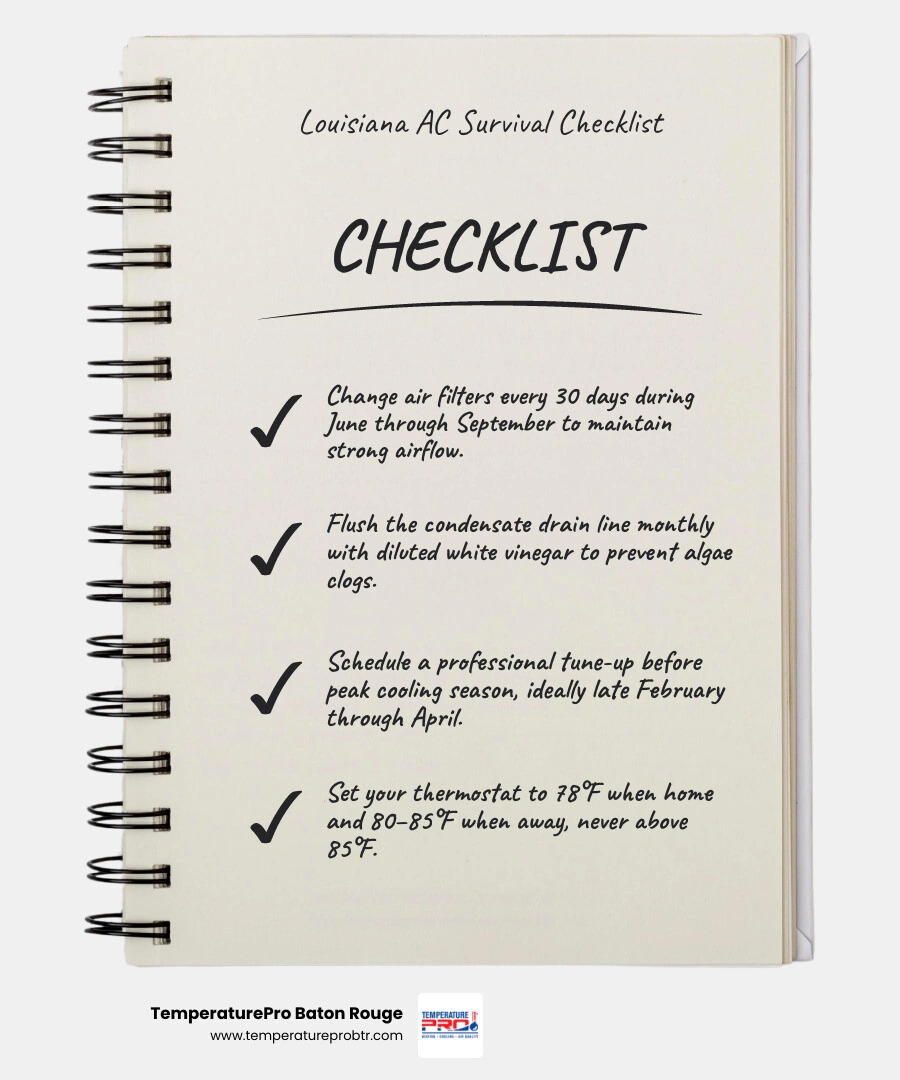
Here's a quick-reference checklist:
1. Change air filters every 30 days during June through September
2. Flush the condensate drain line monthly with diluted white vinegar to prevent algae clogs
3. Schedule a professional tune-up before peak cooling season (ideally late February through April)
4. Set your thermostat to 78°F when home; 80–85°F when away (never above 85°F)
5. Keep at least 2 feet of clearance around your outdoor condenser unit
6. Watch for warning signs like warm air, short cycling, strange noises, or musty odors
7. Know the 50% Rule — if repairs cost more than half the price of a new system and your unit is over 10 years old, replacement is likely the smarter move
While a central AC unit lasts 15–20 years in most parts of the country, that same system in Louisiana typically survives just 10–15 years. That gap isn't bad luck — it's physics. Louisiana logs 2,800–3,200 cooling degree days per year, nearly triple the national average of 1,000–1,500. Your AC doesn't get a break. It runs hard from spring through fall, fighting both extreme heat and humidity levels that regularly hit 70–85%. That combination doesn't just make your home uncomfortable — it puts serious mechanical stress on every component in your cooling system.
The good news? Most AC failures during a Louisiana summer are preventable. With the right maintenance habits and a little expert support, your system can go the distance even in Baton Rouge's punishing climate.
In Louisiana, we don't just deal with heat; we deal with "thick" air. As we look at the weather trends for May 2026, it’s clear that the workload on a local HVAC system is significantly higher than in drier climates. This is due to a concept called latent heat.
In most states, an AC unit spends the majority of its energy lowering the air temperature (sensible cooling). In Louisiana, about 30% of your system's energy is spent just removing moisture from the air (latent cooling). Because the relative humidity regularly hits 85%, your AC has to act as a massive dehumidifier before you can even feel the temperature drop. This extra work is why How Louisiana Heat and Humidity Affect AC Lifespan is such a critical topic for homeowners in Baton Rouge and Prairieville.
Furthermore, we face the challenge of salt-air corrosion. If you live in Southern parishes like St. Gabriel or French Settlement, the moisture in the air can carry corrosive elements that eat away at aluminum fins and copper coils. This leads to refrigerant leaks and forces the compressor to run longer to achieve the same cooling effect. This constant "thermal cycling stress" — where the unit turns on and off under extreme pressure — is what causes a system that should last 20 years to give out after just 12.
You don't need a toolbelt to help your system survive. Some of the most effective ways to protect your investment are simple tasks you can do yourself.
The number one DIY task is managing the condensate drain line. Because our air is so humid, your AC pulls gallons of water out of the air every day. This water flows through a PVC pipe. In our heat, algae and "biofilm" grow rapidly in those pipes. A monthly flush with a cup of diluted white vinegar can prevent the dreaded "clog and flood" that ruins ceilings and triggers emergency shut-offs. For more on this, check out our AC and Humidity Control Tips for Gulf Coast Homes.
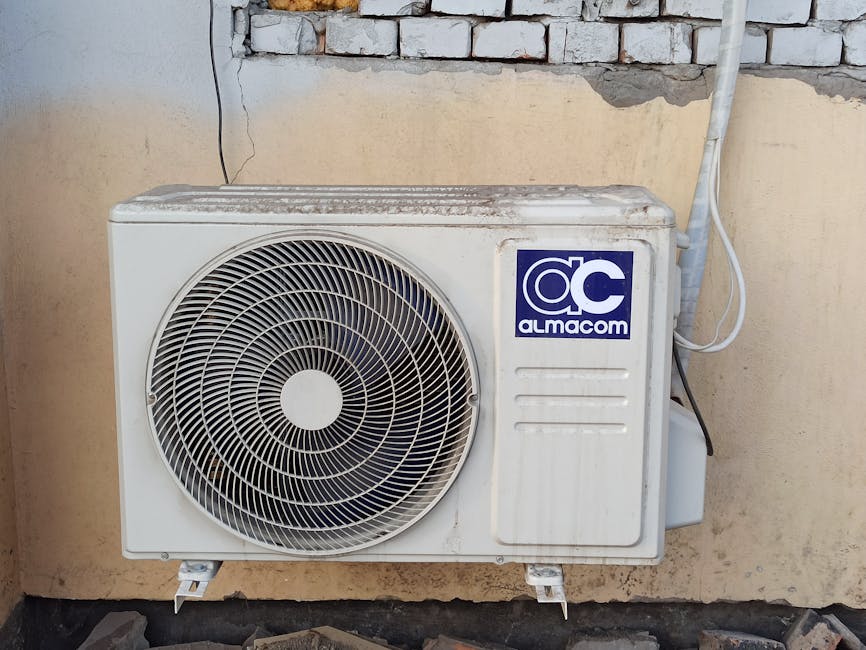
Don't forget the outdoor unit! Your condenser needs to "breathe" to release the heat it gathered from inside your home. Ensure there is at least 2 feet of clearance around the unit. Trim back any hibiscus, azaleas, or vines that might be creeping toward the fins. If the unit is choked by debris, the compressor will overheat and eventually fail. Following these Summer AC Maintenance Tips can save you from a mid-July breakdown.
In Louisiana, the air filter isn't just for dust; it's a frontline defense against the sticky humidity that makes dust cling to your internal components. During the peak months of 2026, we recommend checking your filter every 30 days.
We suggest using filters rated MERV 8 to 11. While higher MERV ratings catch more particles, they can also restrict airflow if they get even slightly dirty. In a high-humidity environment, a clogged filter causes the evaporator coils to get too cold, which leads to ice buildup. Once your coils freeze, your AC stops cooling entirely. If you have pets or allergies, knowing How Often Should You Change Your AC Filter in Louisiana is the difference between a cool home and a frozen system.
Moisture management is a survival skill in the South. Your AC produces a lot of "condensate," and if that water has nowhere to go, it will back up into your home. We highly recommend ensuring your system has a working float switch. This safety device detects if the drain pan is filling up and shuts the system down before water overflows and causes thousands of dollars in property damage.
Beyond clogs, excess moisture inside your ductwork can lead to mold growth. By keeping your drain lines clear and your system properly maintained, you are practicing the best form of How to Extend the Life of Your AC in Louisiana.
While DIY steps are great, there are things only a professional can handle. A professional tune-up is like a physical for your AC.
During a visit, we perform critical tasks such as:
• Capacitor Testing: Capacitors are the "batteries" that start your motor. In Louisiana heat, they are the most common part to fail. We test them to ensure they aren't about to pop.
• Refrigerant Level Checks: If your refrigerant is low, your system works twice as hard. We ensure it's charged to exact manufacturer specs.
• Coil Cleaning: We use specialized cleaners to remove the biofilm and dirt that acts as insulation on your coils, preventing heat transfer.
• Blower Calibration: We ensure your blower is delivering 325-375 CFM per ton, which is the "sweet spot" for removing Louisiana humidity.
Our Ultimate AC Maintenance Guide Louisiana explains why these steps are non-negotiable if you want to avoid the panic of When Your AC Can't Keep Up With the Heat.
One of the biggest mistakes we see in Baton Rouge and Denham Springs is homeowners thinking "bigger is better." If an AC unit is oversized for the home, it will "short cycle." This means it cools the air so fast that it turns off before it has a chance to remove the humidity. You end up with a home that is 70 degrees but feels "clammy" and smells musty.
Modern variable-speed compressors are the gold standard for our climate. They can run at lower speeds for longer periods, which is much better for dehumidification. Paired with a whole-home dehumidifier, these systems can significantly reduce the workload on your AC and extend its lifespan.
How you use your system matters just as much as how you maintain it. The Department of Energy recommends setting your thermostat to 78°F when you are home. We know that sounds high to some, but every degree you raise your thermostat can save you 4% to 8% on your cooling costs.
Using a ceiling fan allows you to feel just as comfortable at 78°F as you would at 74°F because of the wind-chill effect. Just make sure the fan is spinning counter-clockwise in the summer! To learn more about saving money while staying cool, read our guide on How to Lower AC Bills During Louisiana Summers.
• Raise Thermostat 1°F — Estimated Cooling Bill Savings: 4% – 8%
• Use Ceiling Fans (Raise Thermostat 4°F) — Estimated Cooling Bill Savings: 15% – 20%
• Clean Air Filters (Improve Efficiency) — Estimated Cooling Bill Savings: 5% – 15%
• Seal Air Leaks & Add Insulation — Estimated Cooling Bill Savings: Up to 10%
• Upgrade to LED Lighting — Estimated Cooling Bill Savings: $225 per year (Average)
Beyond the thermostat, consider these upgrades:
• Attic Insulation: In cities like Zachary and Central, attic temperatures can hit 140°F. Proper R-38 insulation keeps that heat from radiating into your living space.
• Air Sealing: Caulk around windows and weatherstrip doors to keep the "Baton Rouge swamp air" outside where it belongs.
• LED Lighting: Old incandescent bulbs are basically small heaters. Switching to LEDs keeps your rooms cooler.
Your AC usually tries to tell you it's struggling before it finally quits. Ignoring these Signs Your AC Needs Repair in Louisiana Heat can turn a simple fix into a total system replacement.
• Frozen Coils: If you see ice on the copper lines or the indoor unit, turn it off immediately. This is usually caused by restricted airflow (dirty filters) or low refrigerant.
• Warm Air: If the air coming out of the vents isn't chilly, your compressor or refrigerant levels are likely the issue.
• Strange Noises: Banging, squealing, or hissing are never good signs. Banging often means a loose part, while hissing could indicate a refrigerant leak.
• Short Cycling: If the unit turns on and off every few minutes, it's under extreme stress and likely not dehumidifying.
• Musty Odors: This often points to mold in the ductwork or a clogged drain line that has become a breeding ground for bacteria.
If you notice these, don't wait for the temperature to hit 100°F. Act fast, especially When Your AC Can't Keep Up With the Heat.
At some point, every homeowner has to ask: "Is it worth fixing again?" We recommend the 50% Rule. If the cost of the repair is more than 50% of the value of a new system, and the unit is over 10 years old, it's time to replace it.
In 2026, the standards have changed. As of 2023, all new units in Louisiana must be at least SEER 15 (or SEER2 14.3). Upgrading to a modern, high-efficiency unit can cut your energy bills by up to 40% and provide much better humidity control. Plus, if your old unit uses R-22 refrigerant, repairs are becoming incredibly expensive because that coolant is no longer produced. Check out our advice on When Should You Replace Your AC in a Hot Climate for more details.
Most AC systems in the Baton Rouge area are designed for "design temperatures" of about 93–95°F. When the heat index hits 105°F or 110°F, the system reaches its physical limit. It can generally only cool your home to about 20 degrees lower than the outside temperature. On those record-breaking days, your AC isn't necessarily broken; it's just at maximum capacity.
During the peak summer months (June–September), you should check your filter every 30 days. Louisiana's high humidity makes filters damp, which allows dust to stick to them much faster than in dry climates. If you have pets in the house, you might even need to change them every 3 weeks.
We recommend 78°F while you are home. If you are leaving the house, set it to 82–85°F. Never turn the AC completely off. If you turn it off, the humidity will soak into your furniture and drywall, and your AC will have to work for 10+ hours just to remove the moisture before the temperature starts to drop again. Plus, keeping it below 85°F prevents mold growth.
Surviving a Louisiana summer is a team effort between you and your cooling system. By staying on top of your filter changes, keeping your drain lines clear, and being smart with your thermostat, you can help your AC beat the odds.
At TemperaturePro Baton Rouge, we are family and veteran-owned, and we treat every customer like family. Whether you are in Prairieville, Gonzales, Denham Springs, Walker, Central, Zachary, or right here in Baton Rouge, we are here to ensure your home stays a sanctuary from the heat. Our NATE-certified technicians are experts in the specific challenges of the Gulf Coast climate.
Don't wait for a breakdown on the hottest day of the year. Schedule your professional AC tune-up in Baton Rouge today! and make sure your system is ready for whatever the Louisiana sky throws at it!
Go With Experience