What Does an HVAC Maintenance Plan Include — and Why It Matters in Baton Rouge
What does an hvac maintenance plan include is one of the most important questions a Baton Rouge homeowner can ask before signing a service agreement — because not every plan delivers the same level of care.
Here's a quick answer:
A standard HVAC maintenance plan typically includes:
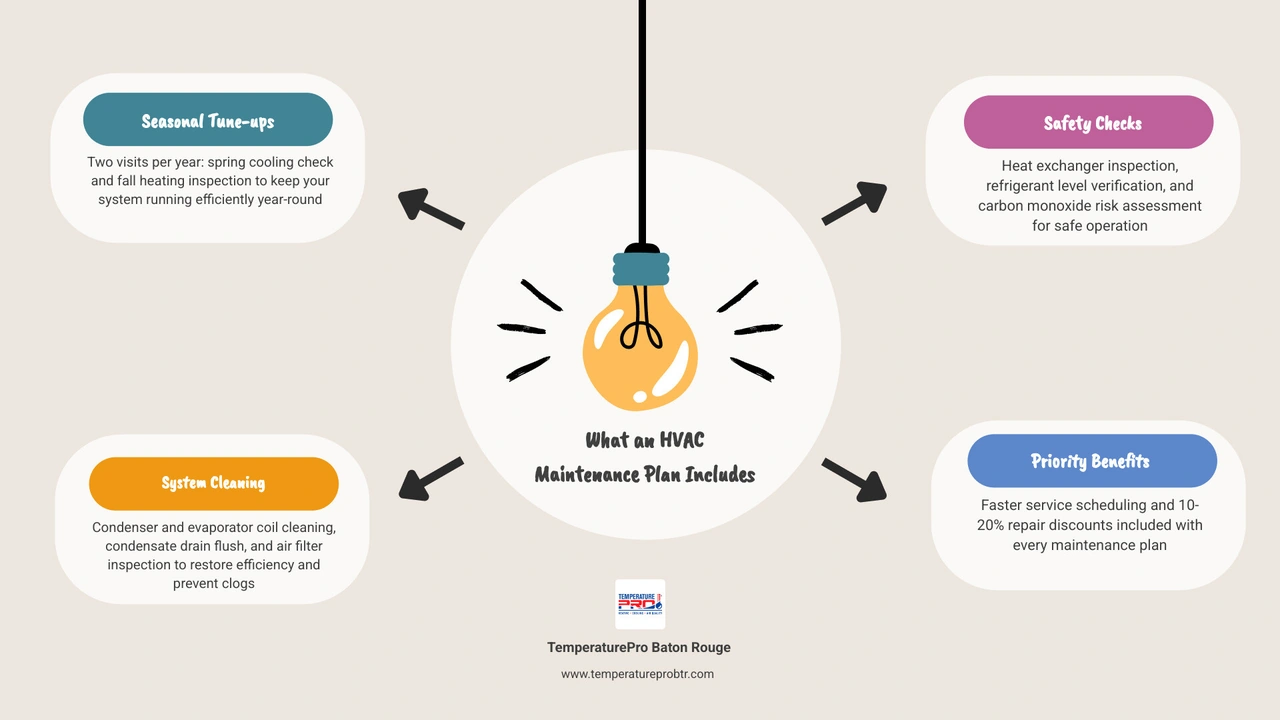
• Seasonal tune-ups — at least two visits per year (spring for cooling, fall for heating)
• Multi-point system inspection — electrical connections, safety controls, thermostat calibration
• Coil cleaning — condenser and evaporator coils cleaned to restore efficiency
• Refrigerant level check — verified and adjusted as needed
• Condensate drain flush — prevents clogs and water damage
• Air filter inspection or replacement — ensures proper airflow
• Heat exchanger inspection — checks for cracks and carbon monoxide risks
• Blower motor and belt check — lubrication and wear assessment
• Priority service scheduling — faster response when you need repairs
• Repair discounts — typically 10–20% off standard labor rates
Louisiana's heat and humidity put serious stress on HVAC systems year-round. As the saying goes, you never think about your system until it breaks down on the hottest day of the summer — and by then, a small maintenance issue has often become a costly emergency repair. A dirty or poorly maintained system can increase energy use by 15% or more, and neglected systems can lose years off their expected lifespan.
A maintenance plan changes that equation. Instead of waiting for something to go wrong, it keeps your system running at its best through scheduled, proactive care — the same logic behind regular oil changes for your car or annual checkups at the doctor.
Understanding HVAC Maintenance Plans vs. Warranties
Before diving into the fine details of what these plans include, let's clear up a common point of confusion. Many homeowners ask us, "I already have a warranty on my system, so why do I need a maintenance plan?"
It helps to understand that a maintenance plan, a manufacturer warranty, and a home warranty are three entirely different forms of protection. They work together, but they serve completely different purposes.
• Manufacturer Warranty: When you install a new heating and cooling system, it typically comes with a manufacturer's warranty. This is governed by federal laws like the Magnuson-Moss Warranty Act. It covers the cost of replacement parts if a component fails due to a factory defect. However, there is a major catch: almost all manufacturers require documented proof of regular professional maintenance to keep the warranty valid. If your compressor fails in year five, and you cannot prove the system was professionally serviced every year, the manufacturer can deny your claim.
• Home Warranty: This is an optional service contract you purchase (often during a home sale) that covers repairs on a wide range of household appliances, from your refrigerator to your water heater and HVAC. While it sounds convenient, home warranties often come with high trade service fees, slow response times from third-party contractors, and strict exclusions. Like manufacturers, home warranty companies will frequently deny coverage if they see signs of wear and tear caused by neglected maintenance.
• HVAC Maintenance Plan: This is a proactive agreement directly with a trusted local service provider. It is designed to prevent breakdowns from happening in the first place. Instead of paying for a breakdown after it happens, you invest in routine seasonal care.
In short, a warranty is your safety net for when parts fail due to manufacturing errors, but a maintenance plan is the actual preventative healthcare that keeps those parts from wearing out prematurely. If you are wondering whether this service is right for your home, you can read our deep dive on Is an HVAC Maintenance Plan Worth It to see how the long-term savings add up.
What Does an HVAC Maintenance Plan Include?
Every home is different, and so is every heating and cooling setup. To accommodate different budgets and system ages, maintenance plans are typically structured in tiers.
Whether you have a brand-new system that just needs basic warranty validation or an older unit that requires extra attention, choosing the right level of protection ensures you aren't paying for services you don't need—or missing out on critical coverage.
• Seasonal Visits — Basic Tune-Up Plan: 1 per year — Standard Maintenance Plan: 2 per year (Spring & Fall) — Premium Total Care Plan: 2–4 per year (Includes Heat Pump checks)
• Multi-Point Inspection — Basic Tune-Up Plan: Visual only — Standard Maintenance Plan: Full mechanical & safety — Premium Total Care Plan: Comprehensive diagnostic & static pressure
• Filter Service — Basic Tune-Up Plan: Inspection only — Standard Maintenance Plan: Replacement/Clean (Standard) — Premium Total Care Plan: Replacement/Clean (High-Efficiency/IAQ)
• Coil Cleaning — Basic Tune-Up Plan: Outdoor rinse — Standard Maintenance Plan: Outdoor rinse & indoor inspection — Premium Total Care Plan: Deep chemical clean of both coils
• Condensate Line Flush — Basic Tune-Up Plan: No — Standard Maintenance Plan: Yes — Premium Total Care Plan: Yes (Plus biological pan treatments)
• Priority Scheduling — Basic Tune-Up Plan: No — Standard Maintenance Plan: Yes — Premium Total Care Plan: Guaranteed 24-hour response
• Repair Discount — Basic Tune-Up Plan: None — Standard Maintenance Plan: 10% to 15% Off — Premium Total Care Plan: 20% Off + Waived Diagnostic Fees
• Parts & Labor Warranty — Basic Tune-Up Plan: Standard — Standard Maintenance Plan: Extended (e.g., 1 year) — Premium Total Care Plan: Lifetime on select repaired parts
To get a sense of how we structure these options to keep your home comfortable year-round, you can view our specific Maintenance Plan details.
Regardless of the tier you choose, a professional maintenance plan is built around a comprehensive multi-point check. This check focuses on three main phases: safety inspections, system cleaning, and mechanical optimization. Let's break down exactly what happens during these seasonal visits.
Cooling Season: What Does an HVAC Maintenance Plan Include for Spring?
In southern Louisiana, our air conditioning systems are the true workhorses of the home. With summer temperatures routinely climbing into the nineties alongside stifling humidity, your AC needs to be in peak condition before the heat waves arrive.
Our spring cooling tune-up is designed to prepare your system for this intense workload. Key tasks include:
1. Condenser Coil Cleaning: The outdoor unit (the condenser) is exposed to grass clippings, dirt, pollen, and leaves. This debris builds up on the coils, insulating them and preventing your system from releasing heat. We rinse and clean the outdoor coil to restore proper heat transfer.
2. Refrigerant Level Verification: If your system is low on refrigerant, it will struggle to cool your home, run constantly, and eventually freeze up or damage the compressor. We measure operating pressures to ensure there are no slow leaks.
3. Condensate Drain Line Flush: As your AC cools the air, it also removes moisture. In our humid climate, an AC can pull gallons of water out of the air daily. This water drains through a small plastic pipe. If algae or mold clogs this line, water will back up, leading to overflow pan leaks that can cause severe drywall and ceiling damage. We flush the line and treat the pan to prevent biological growth.
4. Electrical Component Testing: We inspect and tighten all electrical connections. We also test start capacitors and contactors. A weak capacitor is one of the most common causes of a sudden AC breakdown on a hot afternoon; catching it early prevents a major headache.
For a complete breakdown of how to keep your cooling system running smoothly, check out our AC Maintenance Guide Denham Springs LA and explore our comprehensive Ultimate AC Maintenance Guide Louisiana.
Heating Season: What Does an HVAC Maintenance Plan Include for Fall?
While our winters are relatively mild compared to northern states, we still experience sudden cold snaps that require a reliable, safe heating system. Fall maintenance is heavily focused on safety, especially if you heat your home with a natural gas furnace.
Our fall heating tune-up includes several critical safety and performance checks:
1. Heat Exchanger Inspection: This is the most critical safety check we perform. The heat exchanger keeps combustion gases (like carbon monoxide) separate from the air circulating through your home. If a heat exchanger develops a crack due to age or stress, it can leak deadly carbon monoxide into your living spaces. We inspect the heat exchanger cells thoroughly for any signs of cracking, rust, or soot.
2. Carbon Monoxide Testing: We run combustion analysis and test the air around your furnace to ensure there are no traces of carbon monoxide escaping into your home.
3. Burner and Ignition Assembly Cleaning: Over the summer, dust and spiders can settle in your furnace burners. We clean the burners and the flame sensor to ensure reliable ignition when you turn the thermostat to "heat" for the first time.
4. Flue Venting and Draft Check: We verify that your furnace's exhaust pipe is clear of obstructions (like bird nests) and venting combustion gases safely outside.
To learn more about preparing your heating system for the winter months, read our dedicated Furnace Maintenance Denham Springs LA Guide.
The Key Benefits of Enrolling in a Comfort Agreement
Enrolling in an HVAC maintenance plan is an investment in your home's comfort, safety, and monthly budget. When you keep your system on a consistent schedule of professional care, you unlock several major benefits:
• Improved Energy Efficiency: A dirty system has to work much harder to do its job. When dust covers your coils or clogs your air filter, airflow is restricted, and heat transfer is reduced. According to energy studies, a dirty or poorly maintained HVAC system can increase energy use by 15% or more. Regular cleaning keeps your utility bills as low as possible.
• Extended Equipment Lifespan: Heating and cooling systems are major financial investments designed to last 15 to 20 years. However, without regular maintenance, that lifespan can easily cut in half, leaving you facing an expensive replacement after just 8 to 10 years. Routine lubrication, cleaning, and calibration keep wear and tear to a minimum.
• Better Indoor Air Quality (IAQ): Your HVAC system circulates all the air in your home several times a day. If the inside of your system is coated in dust, mold, or pet dander, those particles are continuously blown into your living spaces. Regular cleaning and filter changes keep your indoor air cleaner and healthier for your family.
• Priority Scheduling and Peace of Mind: When a summer heatwave hits Louisiana, local HVAC companies are flooded with repair calls, often leading to wait times of several days. As a maintenance plan member, you skip to the front of the line with priority scheduling.
To explore these advantages in greater detail, you can read about the Benefits of Regular AC Maintenance.
Professional Maintenance vs. DIY Homeowner Tasks
While a professional maintenance plan is essential for the technical and safety-critical aspects of your system, there are several simple maintenance tasks that you can—and should—handle yourself to keep your system running smoothly between professional visits.
Here is a quick guide to dividing the labor:
What Homeowners Can Do (DIY):
• Replace Air Filters Regularly: This is the single most important task a homeowner can perform. Check your filters every 30 days. If they are dirty, replace them (typically every 1 to 3 months depending on your home, pet ownership, and filter type). A clogged filter restricts airflow, which can cause your system to overheat, freeze up, or consume significantly more energy.
• Maintain Outdoor Unit Clearance: Keep shrubs, plants, weeds, and debris at least two feet away from your outdoor condenser unit. This ensures the system has plenty of room to draw in fresh air and release heat.
• Keep Vents Clear: Make sure that return and supply vents inside your home are not blocked by furniture, curtains, or rugs. Blocking vents disrupts the balanced airflow your system needs to operate efficiently.
What Requires a Professional Technician:
• Refrigerant Handling: Checking, measuring, and adjusting refrigerant levels requires specialized gauges and EPA Section 608 certification. It is illegal and unsafe for unlicensed individuals to handle refrigerant.
• Electrical Testing and Diagnostics: Measuring voltage, testing capacitors, and examining electrical wiring involve high-voltage components that pose serious shock hazards.
• Combustion Analysis and Fuel Connections: Working with natural gas lines, testing gas valves, and checking for carbon monoxide leaks require specialized safety equipment and professional training to prevent fire or poisoning hazards.
• Deep Coil Cleaning: Cleaning delicate evaporator and condenser coils without damaging the aluminum fins requires professional-grade chemical cleaners and specialized tools.
For a comprehensive look at how to balance your DIY efforts with professional care, refer to our Louisiana HVAC Maintenance Guide 2026.
How to Choose the Right Service Agreement for Your Louisiana Home
When shopping for an HVAC maintenance plan, it is important to find an agreement that aligns with your specific home and equipment. Here are a few key factors to consider:
1. The Age of Your System: If your HVAC system is less than five years old, your primary goal is maintaining the manufacturer's parts warranty. A basic or standard plan that provides documented annual or semi-annual maintenance is perfect for this. If your system is older than ten years, you should look for a plan that offers robust repair discounts and waived diagnostic fees, as older systems are naturally more prone to occasional part failures.
2. The Type of System You Have: If you have a traditional split system (a separate gas furnace and outdoor AC), you need two seasonal visits per year. However, if you rely on a heat pump—which handles both heating and cooling year-round—it operates in all seasons and can benefit from more frequent checks to ensure the reversing valve and defrost cycles are working perfectly.
3. Local Climate Considerations: In southern Louisiana, our extreme humidity means that condensate drain line maintenance is incredibly important. Make sure any plan you sign includes regular drain line flushing and pan treatments to prevent biological growth and water damage.
4. Provider Reputation: Look for a local company with deep roots in the community, positive customer reviews, and certified technicians who prioritize safety and thoroughness over quick sales pitches.
If you are ready to secure your home's year-round comfort, you can find expert local service by visiting our HVAC Maintenance Baton Rouge LA page.
Frequently Asked Questions About HVAC Maintenance
How often should HVAC maintenance be performed in Louisiana?
At a minimum, your HVAC system should be professionally serviced twice a year: once in the spring (before the heavy cooling season begins) and once in the fall (before the heating season starts). Because our summers are exceptionally long and humid, your air conditioner works much harder than systems in other parts of the country, making regular professional inspections essential to prevent premature wear.
Can skipping maintenance void my manufacturer warranty?
Yes, absolutely. The vast majority of HVAC manufacturers require proof of annual or semi-annual professional maintenance to honor parts warranty claims. If a major component like the compressor or heat exchanger fails, and you cannot provide documented service records from a professional technician, the manufacturer can deny coverage, leaving you to pay for the replacement out of pocket.
What common issues are prevented by regular maintenance?
Regular maintenance helps prevent several common and costly issues, including:
• Clogged Condensate Drains: Flushing the drain line prevents water backups that can cause extensive ceiling and drywall damage.
• Frozen Evaporator Coils: Cleaning the coils and maintaining proper airflow prevents ice from forming on your indoor unit.
• Premature Compressor Failure: Ensuring proper refrigerant levels and capacitor function keeps your system's most expensive component from burning out.
• Carbon Monoxide Leaks: Checking the heat exchanger for cracks ensures your gas furnace is operating safely.
Conclusion
An HVAC maintenance plan is not a luxury; it is a practical, cost-saving investment in your home's safety, comfort, and efficiency. By staying ahead of wear and tear, you can enjoy lower utility bills, a longer system lifespan, and the invaluable peace of mind that comes from knowing your heating and cooling systems are ready for whatever the Louisiana weather brings.
At TemperaturePro Baton Rouge, we are a family-owned and veteran-owned HVAC company dedicated to treating our customers like family. We proudly serve homeowners across our local communities, including Baton Rouge, Prairieville, Gonzales, Denham Springs, Walker, Central, Zachary, St. Gabriel, and French Settlement, LA.
Our certified technicians focus on thorough, honest preventative care to keep your home comfortable through every season. Ready to protect your investment and enjoy stress-free comfort? Explore our comprehensive Maintenance Plan options or reach out to our friendly team today to schedule your next service!