5 min read
When Your AC Can't Keep Up in Louisiana Heat: Troubleshooting the Fall Transition
Why do fall HVAC startups fail? Apply these home maintenance tips and troubleshooting steps to safely transition your system before winter.


Does a Higher SEER Rating Actually Save Money in a Hot Climate?When comparing high SEER vs standard SEER AC in hot climates, the short answer is: yes, a higher-efficiency unit typically saves money — but how much depends on your specific cl
When comparing high SEER vs standard SEER AC in hot climates, the short answer is: yes, a higher-efficiency unit typically saves money — but how much depends on your specific climate, how long you run your system, and whether EER2 (not just SEER2) is also strong.
Quick Comparison: High SEER2 vs Standard SEER2 in Hot Climates
• Minimum required in Southwest/Southeast — Standard SEER2 (13.4–15): 14.3 SEER2 — High SEER2 (16–20+): Above minimum
• Estimated energy savings vs older 10 SEER — Standard SEER2 (13.4–15): Moderate — High SEER2 (16–20+): Up to 50%
• Savings vs 14 SEER baseline — Standard SEER2 (13.4–15): - — High SEER2 (16–20+): Up to 30–43%
• Best for peak heat (95°F+) — Standard SEER2 (13.4–15): EER2 matters most — High SEER2 (16–20+): EER2 matters most
• Variable-speed compressor — Standard SEER2 (13.4–15): Rarely included — High SEER2 (16–20+): Commonly included
• Humidity control — Standard SEER2 (13.4–15): Basic — High SEER2 (16–20+): Superior
• Ideal for Baton Rouge's hot, humid climate — Standard SEER2 (13.4–15): Acceptable — High SEER2 (16–20+): Recommended
If you live in Baton Rouge, Louisiana — where summers are long, humid, and punishing — your AC runs harder and longer than in most parts of the country. That makes the efficiency gap between a standard and high-efficiency unit far more meaningful here than in a mild northern climate.
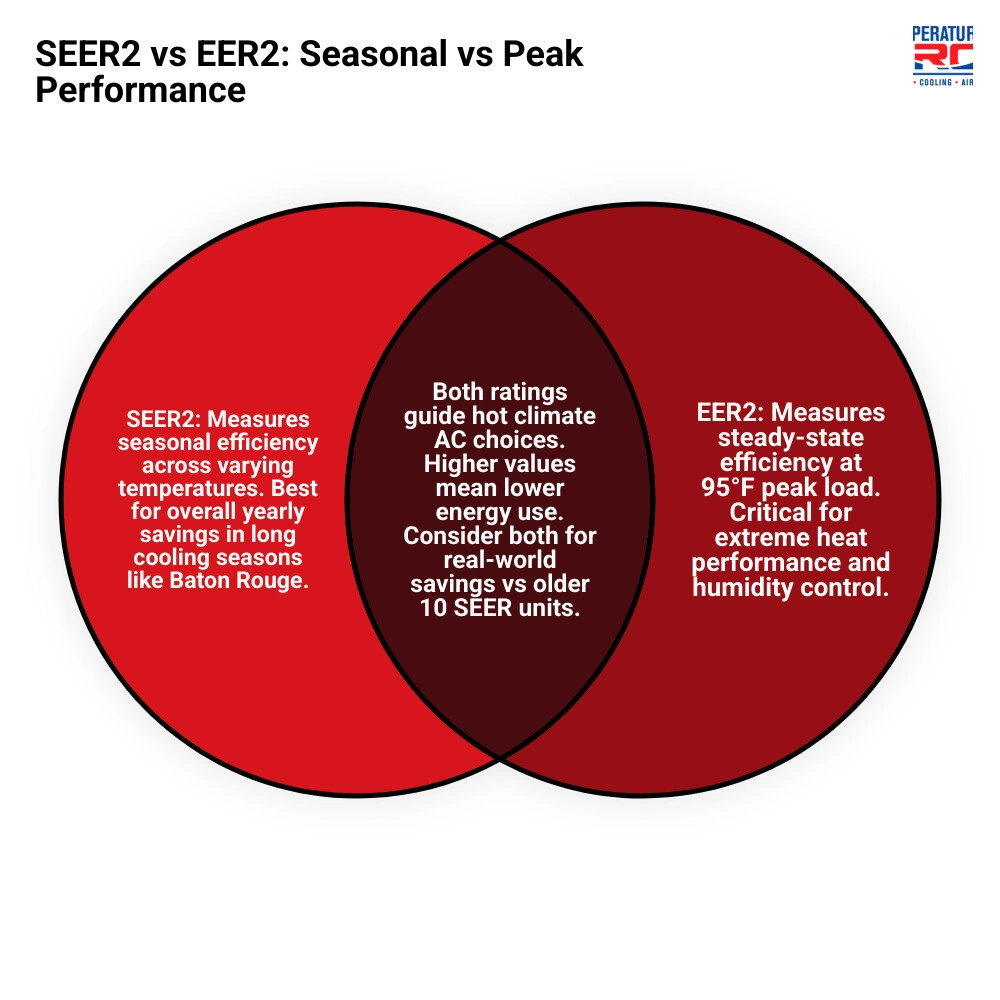
Here's the thing most people miss: SEER2 measures average seasonal efficiency across a range of temperatures. But when it's 98°F outside and your system is running flat out, a metric called EER2 — which measures efficiency at peak conditions — tells you more about real-world performance during a Baton Rouge summer.
Still, high SEER2 units offer real advantages even in extreme heat. They use advanced compressor technology, remove humidity more effectively, and can meaningfully reduce monthly cooling bills over a long cooling season.
This guide breaks down exactly what those differences mean for homeowners in hot climates — so you can make a smart, informed decision about your next AC system.
When shopping for a new air conditioner in places like Prairieville, Gonzales, or Denham Springs, you will immediately run into a wall of acronyms: SEER, SEER2, EER, and EER2. These are not just alphabet soup; they are the standardized metrics used by the Department of Energy to regulate and rate the efficiency of cooling systems.
To make sense of a Standard Efficiency vs High Efficiency AC Comparison, we must first understand how these testing standards changed recently and how they apply to your home.
For decades, the standard metric was SEER (Seasonal Energy Efficiency Ratio). SEER measured the total cooling output of an air conditioner over a typical cooling season divided by the total electrical energy it consumed. However, the old testing procedure had a major flaw: it was conducted under laboratory conditions that assumed a static pressure of only 0.1 inches of water column (w.g.).
In the real world, your home's ductwork creates far more resistance to airflow than that. To address this, the Department of Energy mandated a transition to a new testing standard called the M1 blower testing procedure, which became effective on January 1, 2023. This is where SEER2 comes in.
SEER2 testing is conducted at 0.5 inches w.g. — up to five times higher static pressure than the old test. Because this test is much more rigorous and accurately reflects real-world ductwork resistance, the resulting SEER2 ratings are on average 4.5% to 4.7% lower numerically than the old SEER ratings for the exact same physical equipment. For example, an older 15 SEER system is roughly equivalent to a 14.3 SEER2 system under the new guidelines. When comparing quotes from local HVAC contractors, always make sure you are comparing SEER2 to SEER2 rather than mixing the old and new standards.
While SEER2 is a seasonal average that takes into account outdoor temperatures ranging from 65°F to 104°F, EER2 (Energy Efficiency Ratio 2) is a steady-state measurement. EER2 measures how efficiently an air conditioner operates at a single, fixed, high-load condition: exactly 95°F outdoor temperature, 80°F indoor temperature, and 50% relative humidity.
In subtropical climates like Walker and Central, LA, where summer temperatures routinely hover in the mid-to-high 90s with staggering humidity, peak cooling efficiency is highly critical. If you are choosing between two systems with the same SEER2 rating, but one has a higher EER2 rating, the unit with the higher EER2 will perform more efficiently during the hottest hours of the afternoon. While SEER2 gives you a great picture of your overall seasonal electricity bills, EER2 is the metric that tells you how well your system handles the absolute peak of a Louisiana heatwave.
Choosing the right efficiency level requires balancing regional climate demands, local minimum standards, and your family's comfort needs. What works well in a mild northern state won't necessarily cut it in the deep South. If you are currently researching your options, our guide on Choosing an AC for Louisiana Heat and Humidity offers deeper insights into local climate factors.
Let's look at the actual numbers. In the Southeast region, the minimum allowable standard for a newly installed split-system air conditioner is 14.3 SEER2. Upgrading to a high-efficiency system can yield dramatic reductions in your monthly utility bills:
• Upgrading from 10 SEER (common in older homes) to 20 SEER2 can reduce your cooling energy consumption by roughly 50%.
• Moving from a standard 14 SEER rating to a high-efficiency 20 SEER2 rating can result in energy savings of up to 30% or more.
• A 20 SEER system is roughly 43% more efficient than a basic 14 SEER unit.
• Upgrading from 14 SEER to 16 SEER provides a moderate efficiency boost of approximately 14%.
• An 18 SEER system is generally about 10% to 12% more efficient than a 16 SEER system under identical operating conditions.
Because our local cooling season in places like Zachary and St. Gabriel lasts for six to eight months out of the year, these percentage savings translate to substantial annual dollar amounts. Over the standard 10-to-15-year lifespan of a modern air conditioner, a high-efficiency system can easily pay back its initial equipment premium and continue to put money back into your pocket.
In South Louisiana, heat is only half the battle. The high humidity levels are what make the air feel truly oppressive. This is where the difference between standard and high-efficiency systems becomes a matter of daily comfort, not just dollars.
Standard-efficiency systems typically use single-stage compressors that run at 100% capacity and then shut off completely. In highly humid climates, these systems often cool the air so quickly that they shut down before they have run long enough to pull moisture out of the air. This leaves your home feeling cold and clammy, which often prompts homeowners to lower their thermostats even further, wasting more energy.
High-efficiency systems utilize multi-stage or variable-speed compressors. These units run for longer, gentler cycles at lower speeds. This continuous, low-speed operation allows the evaporator coil to steadily remove moisture (latent heat) from the indoor air without overcooling the home. By maintaining lower relative humidity levels, you can actually set your thermostat a few degrees higher while enjoying the same level of comfort. Managing this moisture is also crucial for system longevity; you can read more about How Louisiana Heat and Humidity Affect AC Lifespan to see how humidity impacts your equipment over time.
The definition of a "good" SEER2 rating depends heavily on whether your hot climate is dry or humid:
• Hot, Dry Climates (e.g., the Desert Southwest): In these regions, EER2 is incredibly important because temperatures regularly exceed 100°F with very low humidity. Homeowners in these areas often prioritize high EER2 ratings to handle dry peak heat loads.
• Hot, Humid Climates (e.g., the Gulf Coast, including Baton Rouge and Gonzales): Here, a SEER2 rating of 16 to 18 is widely considered the "sweet spot" for the average home, offering an excellent balance of upfront cost, high humidity removal, and monthly energy savings. For maximum comfort and long-term savings, ultra-high efficiency systems rated at 20+ SEER2 with fully variable-speed compressors are highly recommended.
The physical difference between a standard-efficiency system and an ultra-high-efficiency system isn't just a larger metal box; it's the advanced technology housed inside the cabinet.
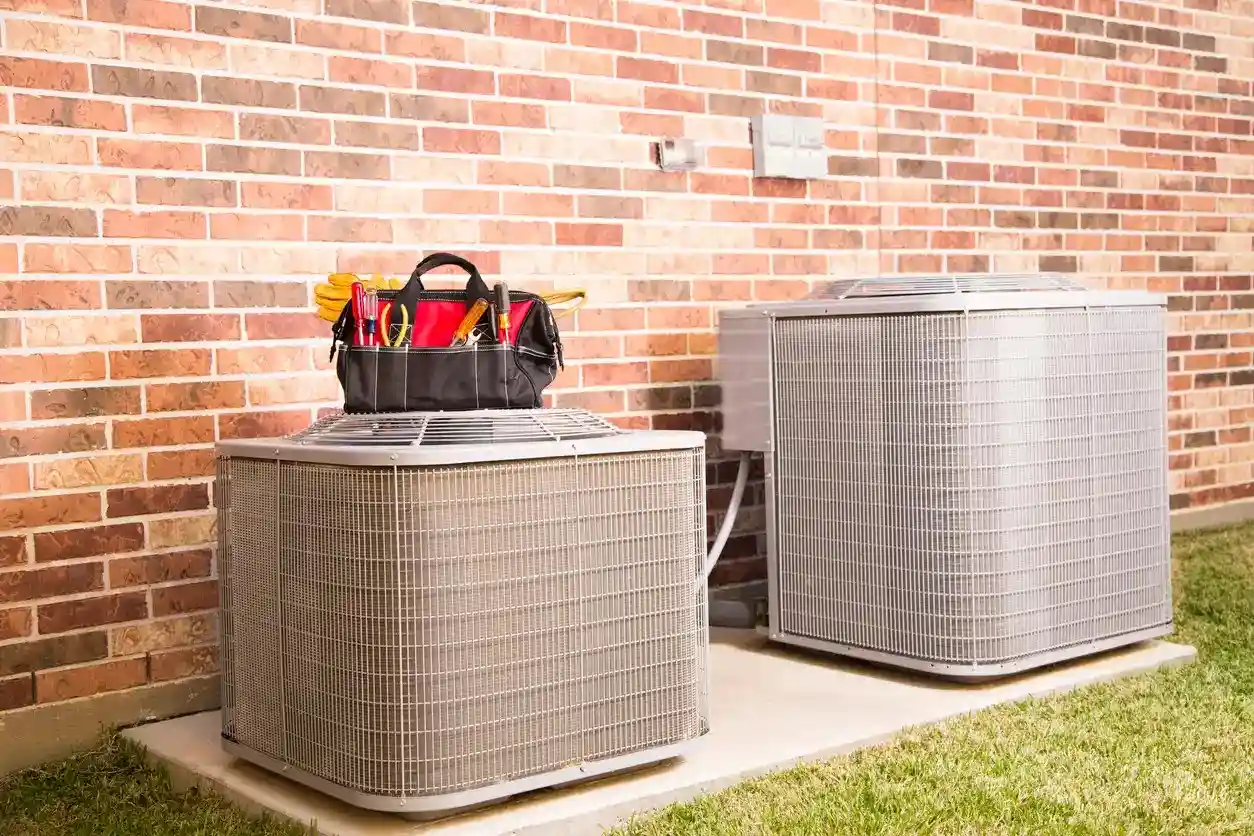
Standard air conditioners are either "all on" or "all off." When your thermostat calls for cooling, the compressor kicks on at 100% capacity, runs until the temperature drops to the target setting, and then shuts off. This frequent cycling on and off is highly inefficient — much like driving a car in stop-and-go city traffic. It also causes noticeable temperature swings and puts extra wear and tear on the electrical components.
Variable-speed systems, powered by inverter technology, act more like a dimmer switch. They can adjust their operating capacity incrementally anywhere from 25% to 100% to match the precise cooling load of your home at any given second. On a mild 82°F day in French Settlement, the system might run continuously at just 35% capacity, using a fraction of the electricity of a standard unit. This continuous operation eliminates temperature swings, reduces indoor humidity levels, and operates so quietly you might not even realize it is running.
A common question among homeowners is whether high-efficiency systems lose their performance advantage when outdoor temperatures soar above 100°F.
At extremely high temperatures, all air conditioning systems must work harder. When the outdoor temperature reaches triple digits, even a variable-speed system will ramp up to 100% capacity to keep your home cool. At that exact peak moment, the efficiency of a high-SEER2 unit and a standard-efficiency unit will begin to converge, as both are running flat out.
However, the high-efficiency unit still retains a distinct advantage. It utilizes more advanced, aerodynamically designed fan blades, larger coil surfaces, and highly efficient electronically commutated motors (ECM) that consume far less electricity than standard motors. Furthermore, temperatures above 100°F only make up a small percentage of the overall cooling season. During the morning hours, late evenings, and shoulder seasons, the variable-speed system will drop back down to its highly efficient part-load operating state, maintaining its massive seasonal efficiency lead.
An air conditioner's SEER2 rating is a laboratory measurement of its potential efficiency. In the real world, your system can only perform as well as the home environment and ductwork allow.
To protect your investment, we recommend reviewing the Average Lifespan of an AC System in the South and learning How to Extend the Life of Your AC in Louisiana through proactive care and proper setup.
You could buy the most advanced, ultra-high-efficiency 22 SEER2 air conditioner on the market, but if it is connected to leaky, poorly designed ductwork, you will never see the energy savings you paid for.
Duct leakage accounts for 20% to 30% of conditioned air loss in typical U.S. homes. In a hot climate, this means you are paying to cool your attic or crawlspace while your living areas remain warm. Furthermore, leaky return ducts can pull hot, dusty, humid air from your attic directly into your breathing air, degrading your indoor air quality and forcing your system to work twice as hard to dehumidify.
Before installing a new high-efficiency system, a professional HVAC team should always evaluate your ductwork, perform a static pressure test, and ensure your system is sized correctly using a precise Manual J Load Calculation. An oversized system will short-cycle constantly, while an undersized system will run endlessly without cooling your home. Both scenarios lead to premature equipment failure and high utility bills.
Upgrading to a high-efficiency system is a major home improvement, but federal and local incentive programs in 2026 can help offset your initial investment.
Under Section 25C of the Internal Revenue Code (established by the Inflation Reduction Act), homeowners can claim federal tax credits of up to $2,000 for qualifying high-efficiency heat pumps or up to $600 for qualifying central air conditioning systems that meet specific SEER2 and EER2 thresholds. To find out exactly which systems qualify, take a look at our detailed guide on Federal Tax Credits for AC and Heat Pump Upgrades.
Additionally, depending on your local utility provider in the Baton Rouge area, you may be eligible for extra savings. You can explore these local opportunities further in our resource on Louisiana Energy Rebates for HVAC Upgrades.
Navigating system replacement can bring up a lot of questions. If you are trying to decide whether to fix your current unit or upgrade, we suggest reading about When Is It Time for AC Replacement, comparing options in Repair vs Replace Your AC in Louisiana, and applying The 5000 Dollar Rule for AC Replacement to make a financially sound decision.
SEER2 (Seasonal Energy Efficiency Ratio 2) measures the average cooling efficiency of an air conditioner over an entire cooling season across a wide range of outdoor temperatures (65°F to 104°F). EER2 (Energy Efficiency Ratio 2) measures the system's efficiency at a single, fixed outdoor temperature of 95°F. SEER2 is best for estimating your overall seasonal energy bills, while EER2 tells you how efficiently the system will perform during the hottest hours of a peak summer afternoon.
Yes, higher SEER2 ratings are highly beneficial in hot regions, provided you also pay attention to the unit's EER2 rating and compressor technology. While the efficiency gap between standard and high-SEER2 units narrows slightly during extreme peak temperatures over 100°F, high-efficiency systems with variable-speed compressors deliver massive savings during the thousands of hours of moderate, high-humidity weather that make up the rest of our long cooling season.
Upgrading from an older, standard 10 SEER system to a modern 20 SEER2 system can reduce your cooling-season electricity consumption by roughly 50%. If you are upgrading from a standard 14 SEER rating to a high-efficiency 20 SEER2 system, you can expect energy savings of up to 30% or more. The exact amount you save depends on your local utility rates, how well your home is insulated, and how diligently you keep up with Benefits of Regular AC Maintenance.
To learn more about when to take the leap, read our guide on When Should You Replace Your AC in a Hot Climate.
Choosing between a high SEER2 and a standard-efficiency air conditioner is one of the most important decisions you will make for your home's comfort and your long-term energy budget. In our warm, subtropical Louisiana climate, an air conditioner isn't a luxury — it is a critical piece of home infrastructure that works hard for most of the year.
At TemperaturePro Baton Rouge, we are a family- and veteran-owned HVAC company dedicated to treating every single customer like family. Whether you live in Baton Rouge, Prairieville, Gonzales, Denham Springs, Walker, Central, Zachary, St. Gabriel, or French Settlement, LA, our team of certified, highly trained technicians is here to help you navigate your options.
We don't believe in high-pressure sales pitches. Instead, we focus on helping you find the system that fits your home's unique layout, your family's comfort needs, and your long-term budget. If you are ready to explore your options, we encourage you to read our guide on Choosing the Right AC Replacement to learn what to look for.
Ready to experience a cooler, more comfortable home with lower energy bills? Contact us today to schedule a professional home comfort assessment, or explore our comprehensive Baton Rouge Air Conditioning Services to learn more about how we can help you stay cool all summer long.
Go With Experience