5 min read
Fall HVAC Troubleshooting: Why Your Heater Smells Like Burning Dust on Startup
Is that burning dust smell normal? Read our home maintenance tips and troubleshooting to see why heating startup odors happen and when to call a professional.


Understanding the Standard Efficiency vs High Efficiency AC ComparisonA standard efficiency vs high efficiency ac comparison is one of the most important decisions Baton Rouge, LA homeowners face when replacing or upgrading their cooling sy
Standard-efficiency AC units use single-stage compressors that run fully on or fully off. High-efficiency units, rated 16 to 30+ SEER2, use two-stage or variable-speed compressors that control humidity better but cost more upfront.
A standard efficiency vs high efficiency ac comparison is one of the most important decisions Baton Rouge, LA homeowners face when replacing or upgrading their cooling system. In Louisiana's brutal heat and humidity, the AC unit you choose directly affects your monthly energy bills, your indoor comfort, and how well your home handles moisture.
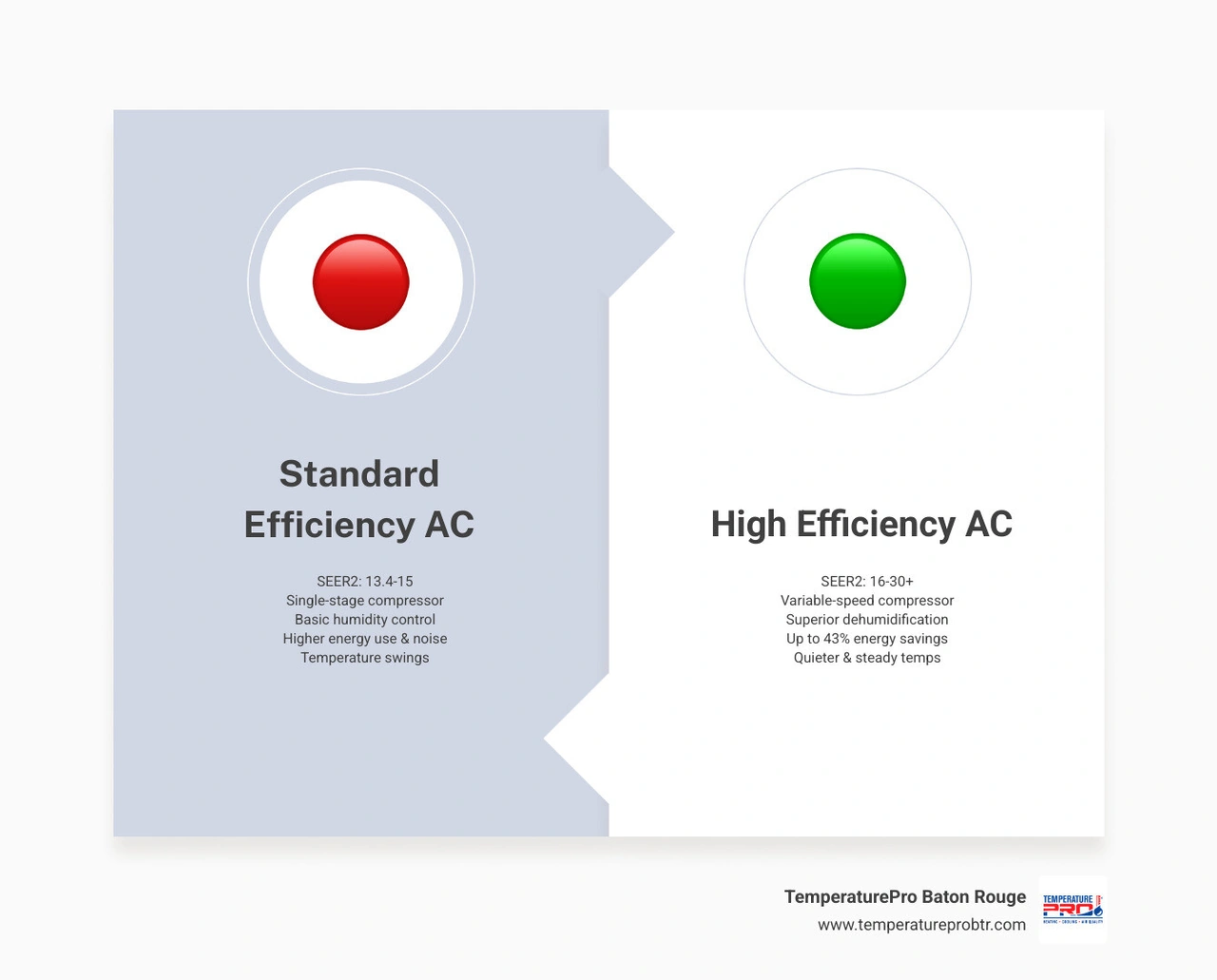
Here's a quick breakdown of the key differences:
• SEER2 Rating — Standard Efficiency: 13.4 - 15 — High Efficiency: 16 - 30+
• Compressor Type — Standard Efficiency: Single-stage (on/off) — High Efficiency: Two-stage or variable-speed
• Humidity Control — Standard Efficiency: Basic — High Efficiency: Superior
• Energy Savings vs. Standard — Standard Efficiency: Baseline — High Efficiency: Up to 43% more efficient
• Noise Level — Standard Efficiency: Higher — High Efficiency: Noticeably quieter
• Upfront Cost — Standard Efficiency: Lower — High Efficiency: Higher
• Long-Term Operating Cost — Standard Efficiency: Higher — High Efficiency: Lower
Standard AC units do one thing: they run at full power until your home hits the target temperature, then shut off. High-efficiency units are smarter. They modulate their output to match what your home actually needs, running longer at lower speeds. That means steadier temperatures, better humidity removal, and less energy wasted.
In a hot, humid climate like Baton Rouge, that difference isn't just a number on a spec sheet — it's something you feel every day.
When we look at a standard efficiency vs high efficiency ac comparison, the most striking difference is how the equipment actually operates. Think of a standard efficiency unit like a light switch: it is either 100% on or 100% off. These units use single-stage compressors. When your thermostat calls for cooling, the compressor kicks on with a loud "thump," blasts cold air at maximum capacity, and then abruptly shuts off once the setpoint is reached.
This "all or nothing" approach creates several issues. First, it leads to significant energy waste because the compressor draws the most power during that initial startup phase. Second, it causes temperature swings. You might feel a chilly blast of air, followed by a period where the air feels stagnant and warm before the system kicks on again.
On the other hand, high-efficiency units utilize variable-speed technology or two-stage compressors. Instead of just "on" and "off," these systems can operate at various capacities—sometimes as low as 25% to 30% of their maximum power. They ramp up and down slowly, maintaining a consistent temperature within 0.5 to 1 degree of your thermostat setting. Because they avoid the constant on-off cycling, they experience less wear and tear over time. If you notice your current system struggling to keep up or cycling constantly, it might be one of the AC system replacement warning signs that it's time to consider an upgrade.
You cannot have a standard efficiency vs high efficiency ac comparison without talking about SEER2. SEER stands for Seasonal Energy Efficiency Ratio, and the "2" represents the updated testing standards implemented in 2023. These new standards are more rigorous and better reflect the actual conditions of a home's ductwork and the humid Louisiana environment.
The Department of Energy (DOE) sets minimum standards that vary by region. As of April 2026, the minimum standard for the southeastern United States—including Baton Rouge, Prairieville, and Denham Springs—is 14.3 SEER2 for residential systems. Any unit below this rating is considered "standard" or even "low" efficiency by modern standards. High-efficiency units typically start at 16 SEER2 and can soar as high as 30+ SEER2 for some advanced heat pumps.
The math behind these ratings is impressive. For instance, a 20 SEER unit is approximately 43% more efficient than a 14 SEER unit. In a climate like ours, where the AC might run for five or more months straight, that efficiency translates into substantial utility bill reductions.
• 14.3 — Efficiency Tier: Standard (DOE Minimum) — Estimated Energy Reduction (vs. 14 SEER2): Baseline
• 16 — Efficiency Tier: Moderate Efficiency — Estimated Energy Reduction (vs. 14 SEER2): ~10-12%
• 18 — Efficiency Tier: High Efficiency — Estimated Energy Reduction (vs. 14 SEER2): ~20-25%
• 20+ — Efficiency Tier: Ultra-High Efficiency — Estimated Energy Reduction (vs. 14 SEER2): ~35-43%
High-efficiency AC systems use variable-speed ECM blower motors instead of single-speed PSC motors. At lower speeds, an ECM motor uses roughly 60% less electricity, which matters because about 80% of the cooling season doesn't need full capacity.
The "magic" behind high-efficiency systems lies in the blower motor and the compressor. Standard units often use PSC (Permanent Split Capacitor) motors, which are basic and only run at one speed. High-efficiency models use ECM (Electronically Commutated Motors). These variable-speed blower motors can adjust their speed dynamically.
At lower speeds, an ECM motor uses roughly 60% less electricity than a standard motor. Because the fan can run at a lower, more consistent speed, it circulates air throughout your home more effectively, eliminating those "hot spots" in the upstairs bedrooms or far corners of the house. This part-load efficiency is crucial because, for about 80% of the cooling season, your AC doesn't actually need to run at 100% capacity to keep you comfortable.
Choosing a system with this technology is a big step, which is why understanding the professional AC installation benefits is so important. A high-tech system requires precision calibration and proper ductwork sizing to ensure you actually get the efficiency promised on the yellow Energy Guide label.
High-efficiency AC units handle Louisiana humidity better because they run longer at lower speeds, pulling more moisture from the air. Standard units often satisfy the thermostat before removing enough moisture, leaving a home cold and clammy.
If you live in Zachary, Gonzales, or Central, you know that heat is only half the battle—the humidity is the real villain. This is where the standard efficiency vs high efficiency ac comparison becomes a matter of comfort rather than just cost.
Your AC has two jobs: lowering the temperature (sensible cooling) and removing moisture (latent cooling). Standard units, with their short "on" cycles, often satisfy the thermostat's temperature setting before they have a chance to remove enough moisture from the air. This leaves you with a home that feels "cold and clammy."
High-efficiency units excel at dehumidification because they run for longer periods at lower speeds. This continuous air circulation allows the evaporator coil to pull significantly more moisture out of the air. When the humidity is lower, you can actually set your thermostat a few degrees higher—say 78°F instead of 72°F—and feel just as comfortable. This further reduces the strain on your system.
In our region, moisture control isn't just about comfort; it's about the health of your home. Excessive humidity can lead to mold growth and can shorten the life of your equipment. Understanding how Louisiana heat and humidity affect AC lifespan is key to protecting your investment. While the average lifespan of an AC system in the South is typically shorter than in the North, a high-efficiency unit that doesn't have to cycle on and off 50 times a day can often outlast a standard model.
We understand that the initial investment for a high-efficiency system is higher than a standard model. However, the long-term value often makes it the smarter financial choice for families planning to stay in their homes for more than five years.
First, there are the monthly savings. In a hot climate like ours, upgrading from an old 14 SEER unit to a 20 SEER unit can save homeowners between $300 and $500 per year in energy costs. Over the typical 12-to-15-year life of a system, that adds up to thousands of dollars back in your pocket.
Second, there are immediate incentives. Under current federal programs (like the Inflation Reduction Act), homeowners can often claim tax credits for installing high-efficiency heat pumps or AC units. Additionally, local utility providers in the Baton Rouge area frequently offer rebates for systems that meet specific SEER2 thresholds. These incentives can bridge the gap between the cost of a standard unit and a high-efficiency one.
When your current system breaks down, you have to weigh these factors carefully. Our guide on how to decide between AC repair and replacement can help you determine if a repair is just throwing good money after bad, or if it's time to invest in a high-efficiency upgrade that pays for itself over time.
The primary difference lies in the compressor and fan technology. Standard units are single-stage, meaning they are either fully on or fully off. High-efficiency units use two-stage or variable-speed technology to adjust their output based on the cooling demand, leading to better efficiency, consistent temperatures, and superior humidity control.
In the Baton Rouge area, the payback period typically ranges from 5 to 10 years. This depends on your usage habits, the efficiency rating of the unit you choose, and available rebates or tax credits. Because our cooling season is so long, homeowners here usually see a faster return on investment than those in milder climates.
Yes, significantly. Standard units make a loud noise when they kick on and produce a constant "whoosh" of high-velocity air. High-efficiency units ramp up slowly and often operate at lower fan speeds, making them almost whisper-quiet. Many high-efficiency outdoor condensers operate at noise levels as low as 55-60 decibels, which is about the volume of a normal conversation.
Standard AC units are a reliable, budget-friendly entry point, while high-efficiency systems offer more comfort, quieter operation and better humidity control in Louisiana heat. The right choice depends on your home, lifestyle and long-term goals.
Choosing between standard and high-efficiency cooling is about more than just numbers—it’s about how you want to live in your home. While standard units offer a reliable, budget-friendly entry point, high-efficiency systems provide a level of comfort, quiet, and humidity control that is hard to beat in the Louisiana heat.
At TemperaturePro Baton Rouge, we are proud to be a veteran and family-owned business serving our neighbors in Prairieville, Gonzales, St. Gabriel, and beyond. We treat every customer like family, which means giving you the honest truth about which system fits your home, your lifestyle, and your long-term goals. Whether you need an emergency repair or a year-round comfort AC installation, our certified technicians are here to help.
Don't let the summer heat catch you off guard. If you’re ready to see how a high-efficiency system can transform your home comfort, we’re ready to help you navigate the options. More info about air conditioning services is just a click away, or you can call us anytime for 24/7 support. We’ll make sure you stay cool without sweating the SEER!
Go With Experience