Is Your AC Worth Saving? How to Decide in Baton Rouge, LA
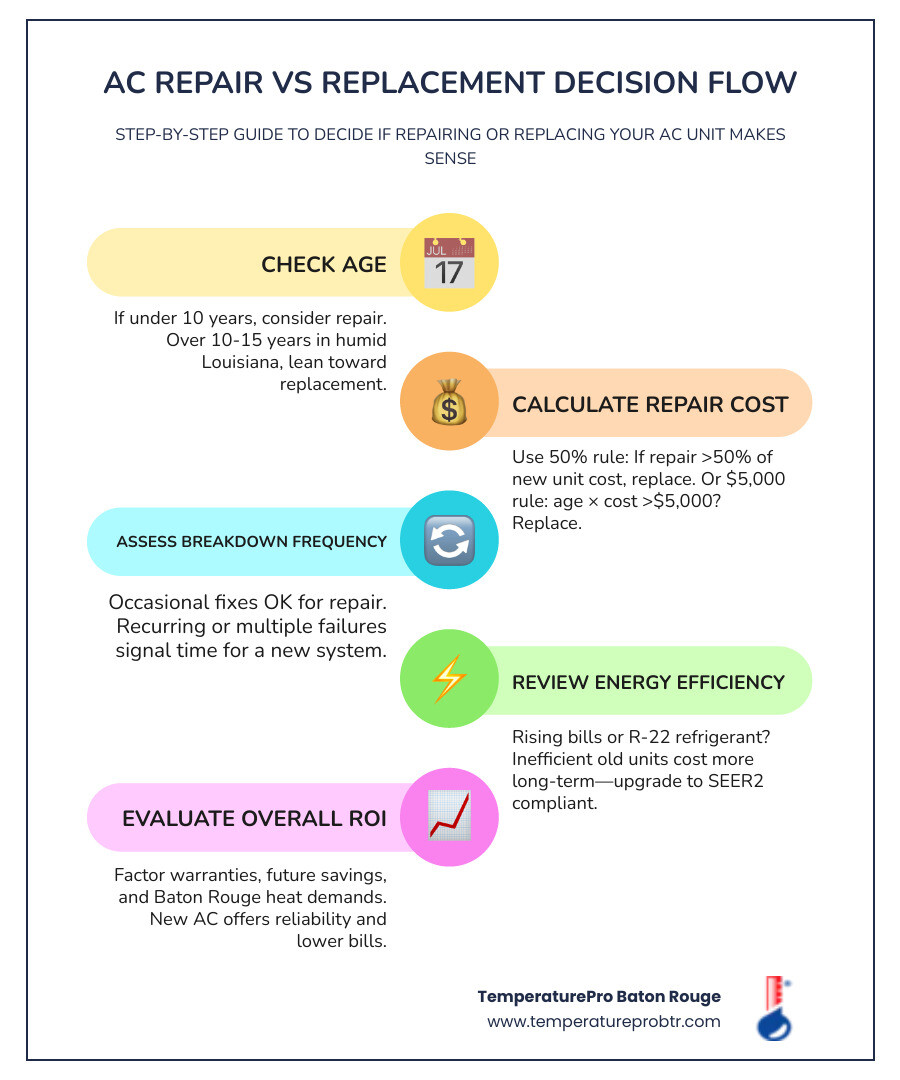
How to decide between AC repair and replacement comes down to a few key factors: the age of your system, the cost of repairs, how often it breaks down, and how efficient it still is.
Here's a quick breakdown to guide your decision:
• System age — Repair: Under 10 years — Replace: 10+ years
• Repair cost — Repair: Less than 50% of new unit cost — Replace: 50% or more of new unit cost
• $5,000 Rule (age × repair cost) — Repair: Result under $5,000 — Replace: Result over $5,000
• Breakdown frequency — Repair: Occasional, isolated issues — Replace: Recurring or multiple failures
• Energy bills — Repair: Stable or normal — Replace: Rising steadily
• Refrigerant type — Repair: R-410A (current standard) — Replace: R-22 (phased out, expensive)
• Warranty — Repair: Still active — Replace: Expired
When Baton Rouge summers push temperatures into the upper 90s, a failing AC unit stops being an inconvenience and starts becoming a real problem. Most homeowners only think about their cooling system when something goes wrong — and by then, they're already facing a tough call: spend money on another repair, or bite the bullet and replace the whole unit?
It's not always an easy answer. A repair might seem cheaper today but cost you more over the next few years. A replacement feels like a big expense up front, but it can pay off through lower energy bills, fewer breakdowns, and better comfort. The right choice depends on your specific system, your budget, and how long you plan to stay in your home.
This guide walks you through exactly how to make that call — with clear rules, real warning signs, and practical advice built for homeowners right here in Baton Rouge.
Understanding the Lifespan of Your Cooling System in Louisiana
Living in Baton Rouge, Prairieville, or Zachary means our air conditioners work significantly harder than units in cooler parts of the country. While the national average lifespan for a central AC unit is often cited as 15 to 20 years, the reality in the Deep South is usually closer to 10 to 15 years.
Why the shorter lifespan? It’s a combination of our brutal heat and relentless humidity. In places like St. Gabriel and Denham Springs, an AC doesn't just cool the air; it has to work overtime to pull moisture out of it. This constant operation leads to faster component fatigue. If your unit is over a decade old, it’s already entered its "senior years."
Environmental factors play a huge role too. High humidity can lead to corrosion on the outdoor condenser coils, and if you live in areas with lots of dust or pollen, your system might be choking on debris. We often see units that have been well-maintained last toward that 15-year mark, but those that skipped their annual checkups often start showing AC System Replacement Warning Signs much sooner.
When a system reaches the 10-year milestone, parts start to wear out simultaneously. You might fix a fan motor one month, only to have a capacitor fail the next. This operational decline is a natural part of the system's life cycle, but in our coastal-adjacent climate, that decline can feel like a steep drop-off.
How to decide between ac repair and replacement using industry rules
Deciding whether to keep patching up an old unit or invest in a new one doesn't have to be a guessing game. As HVAC experts, we use a few tried-and-true economic thresholds to help our neighbors in Walker and Central make the most financially sound choice.
The 50% Rule
This is perhaps the simplest rule in the book. If the cost of a single repair is 50% or more of the cost of a brand-new system, you should almost always choose replacement. Why? Because a major repair on an old unit doesn't reset the clock on the rest of the parts. You could spend a significant amount fixing a compressor today, only to have the evaporator coil spring a leak tomorrow.
The $5,000 Rule
This is a favorite among financial planners and HVAC pros alike. You multiply the age of your unit by the estimated repair cost. If the total is more than $5,000, it’s time to consider a replacement.
For example:
• A 12-year-old unit needing a $300 repair = $3,600. (Repair it!)
• A 12-year-old unit needing an $800 repair = $9,600. (Replace it!)
This rule accounts for the fact that as a unit gets older, even smaller repairs become less "worth it" because the remaining life of the system is so short.
ROI and Long-Term Value
When we look at Key Signs Your HVAC Needs Urgent Repair or Replacement, we aren't just looking at the immediate bill. We’re looking at the Return on Investment (ROI). A new, high-efficiency system can reduce your monthly cooling costs by 20% to 40%. Over five or six years, those savings can actually "pay back" a large portion of the installation cost. If you're constantly calling us for repairs in Gonzales or French Settlement, those service fees add up quickly, often exceeding the monthly payment on a much more reliable, warrantied system.
Telltale Signs Your Unit is Beyond a Simple Fix
Sometimes, your AC unit is trying to tell you it’s done. While we pride ourselves on being able to fix almost anything, there are certain red flags that suggest a "patch" is just a temporary bandage on a terminal problem.
• Frequent Breakdowns: If we’ve seen you more than twice in one summer for different issues, your system is likely in a state of "systemic failure."
• Rising Energy Bills: Have your utility bills in Prairieville been creeping up even though the weather hasn't changed much? This is a sign of extreme inefficiency.
• Uneven Cooling: If the master bedroom is a sauna while the living room is a refrigerator, your ductwork or the unit itself is failing to distribute air properly.
• Excessive Noise: Grinding, squealing, or banging sounds often indicate a failing compressor or a motor that's about to give up the ghost.
• Humidity Issues: If your home feels "sticky" or you notice a musty smell, the unit is no longer effectively dehumidifying your space.
• Dust Buildup: Excessive dust around vents can signal leaky ducts or a system that can no longer filter air properly.
Knowing When Is It Time for AC Replacement can save you from an emergency breakdown in the middle of a July heatwave.
Performance issues are often more subtle than a total breakdown. Short-cycling—where the unit turns on and off every few minutes—is a major red flag. It puts immense strain on the compressor and sky-rockets your energy usage.
Speaking of the compressor, it is the "heart" of your system. If it fails, you're facing one of the most expensive repairs possible. Check out our guide on Signs Your AC Compressor Needs Replacement to see if your unit's heart is still beating strong. Additionally, if your system has persistent refrigerant leaks, it’s often a sign that the coils have corroded. In older units, simply "topping off" the refrigerant is no longer a viable or legal long-term solution.
The Impact of Efficiency and Refrigerant Standards
Technology has come a long way in the last decade. If your current AC was installed when "The Office" was still airing new episodes, it’s likely using outdated technology and refrigerants.
The R-22 Phase-Out
If your unit was manufactured before 2010, it likely uses R-22 refrigerant (commonly known as Freon). As of 2020, the production and import of R-22 became illegal in the United States. This means the only way to get it is from recycled "stockpiles," making it incredibly expensive. If an R-22 unit has a major leak, the cost of the refrigerant alone can sometimes rival the cost of a small repair.
New Refrigerant Standards
We are currently transitioning from R-410A to even newer, more environmentally friendly standards like R-454B. When Choosing the Right AC Replacement, we help you navigate these changing regulations to ensure you're buying a system that will be easy and affordable to service for the next 15 years.
Evaluating efficiency to help you decide between ac repair and replacement
Modern units are measured by SEER2 (Seasonal Energy Efficiency Ratio) ratings. Older units might be as low as 8 or 10 SEER, while new standard models start at 14.3 SEER2, with high-efficiency models going much higher.
Upgrading to an ENERGY STAR certified unit can save you roughly 20% on your heating and cooling costs. For a large home in Zachary or Denham Springs, that’s a significant chunk of change every single month. Beyond the money, modern units have a much smaller carbon footprint and use variable-speed motors to provide more consistent, "soft" cooling rather than the harsh "blast" of older single-stage systems. If you're considering a more versatile option, you might also look at Heat Pump Replacement Signs to see if a high-efficiency heat pump is right for your Louisiana home.
Long-Term Benefits of Upgrading Your Home Comfort
Replacing an AC unit is an investment, but it comes with several "hidden" benefits that go beyond just cold air.
1. Warranty Protection: A new system typically comes with a 10-year parts warranty. This gives you a decade of peace of mind where you won't have to worry about the "cost of the week" for repairs.
2. Matched Systems: When we replace a system, we ensure the indoor evaporator coil and the outdoor condenser are perfectly matched. Using an old indoor coil with a new outdoor unit (or vice versa) kills efficiency and often leads to premature failure.
3. Indoor Air Quality: New systems often feature better filtration and humidity control, which is essential for breathing easy in the Baton Rouge humidity.
4. Smart Home Integration: Modern systems play nice with smart thermostats, allowing you to control your home’s temperature from your phone while you're at a LSU game or out to dinner in Prairieville.
5. Incentives: There are often federal tax credits and local utility rebates available for installing high-efficiency equipment. These can significantly offset the initial investment.
While you’re looking at your cooling, it’s also a great time to check your heating system. We often find that if the AC is failing, the furnace isn't far behind. You can learn more about When to Consider Furnace Replacement and the Furnace Replacement Top Indicators to see if a full HVAC overhaul makes sense for your home.
Frequently Asked Questions about AC Replacement
How long does a central AC unit typically last in Baton Rouge?
In our specific climate, you can expect a well-maintained unit to last between 12 and 15 years. Units that are not serviced annually or are located in particularly harsh environments (like near heavy industrial areas or high-salt environments) may only last 8 to 10 years.
Is it worth repairing an AC unit that is over 12 years old?
It depends on the repair. If it’s a simple fix like a capacitor or a clogged drain line, a repair is usually fine. However, if it’s a major component like the compressor or the evaporator coil, we generally recommend replacement. At 12 years old, the unit is near the end of its life, and you’re likely to see more failures soon.
Should I replace my indoor and outdoor units at the same time?
Yes, absolutely. HVAC systems are designed to work as a "matched set." If you hook a new, high-efficiency outdoor unit to an old, dirty, low-efficiency indoor coil, the system will not perform at its rated SEER level, and you’ll likely burn out the new compressor much faster. It’s like putting a brand-new engine in a car with a 20-year-old transmission.
Conclusion
At TemperaturePro Baton Rouge, we understand that how to decide between AC repair and replacement is a big decision for your family. As a family and veteran-owned business, we don't believe in high-pressure sales. Our goal is to treat you like family, providing honest, professional inspections and the data you need to make the best choice for your budget and your comfort.
Whether you're in Gonzales, Zachary, or right here in Baton Rouge, we're here to help you navigate the heat. A new system isn't just a purchase; it's an investment in your home's value, your family's comfort, and your own peace of mind. If you’re tired of the "repair of the month" club, it might be time to stop pouring money into that old unit and start enjoying the reliability of modern cooling.
Ready to find out where your system stands? Schedule your professional AC evaluation today and let us give you a clear, honest look at your home's cooling future.