Key Signs Your HVAC Needs Urgent Repair or Replacement
Key Signs Your HVAC Needs Urgent Repair or Replacement
Key Signs Your HVAC System Requires Urgent Repair or Complete Replacement TodayRecognizing the difference between an HVAC issue that needs urgent repair and one that requires full replacement can protect your home, budget, and safety. This
Key Signs Your HVAC System Requires Urgent Repair or Complete Replacement Today
Recognizing the difference between an HVAC issue that needs urgent repair and one that requires full replacement can protect your home, budget, and safety. This article explains what “urgent repair” and “replacement” mean, how to spot the most critical warning signs, and what to do immediately when a system shows danger signals. You will learn the most common failure symptoms—unusual noises, leaks, short cycling, high energy bills, and burning odors—along with practical homeowner checks and clear rule-of-thumb replacement tests. The guide also provides a troubleshooting checklist for heating and cooling performance, an age-and-cost comparison table to help you decide, and a benefits comparison showing why modern, energy-efficient systems often pay back over time. Throughout, the content references relevant service options from TemperaturePro Baton Rouge in the context of next steps and on-site assessments without replacing professional diagnosis.
What Are the Most Common Warning Signs Your HVAC System Needs Immediate Attention?
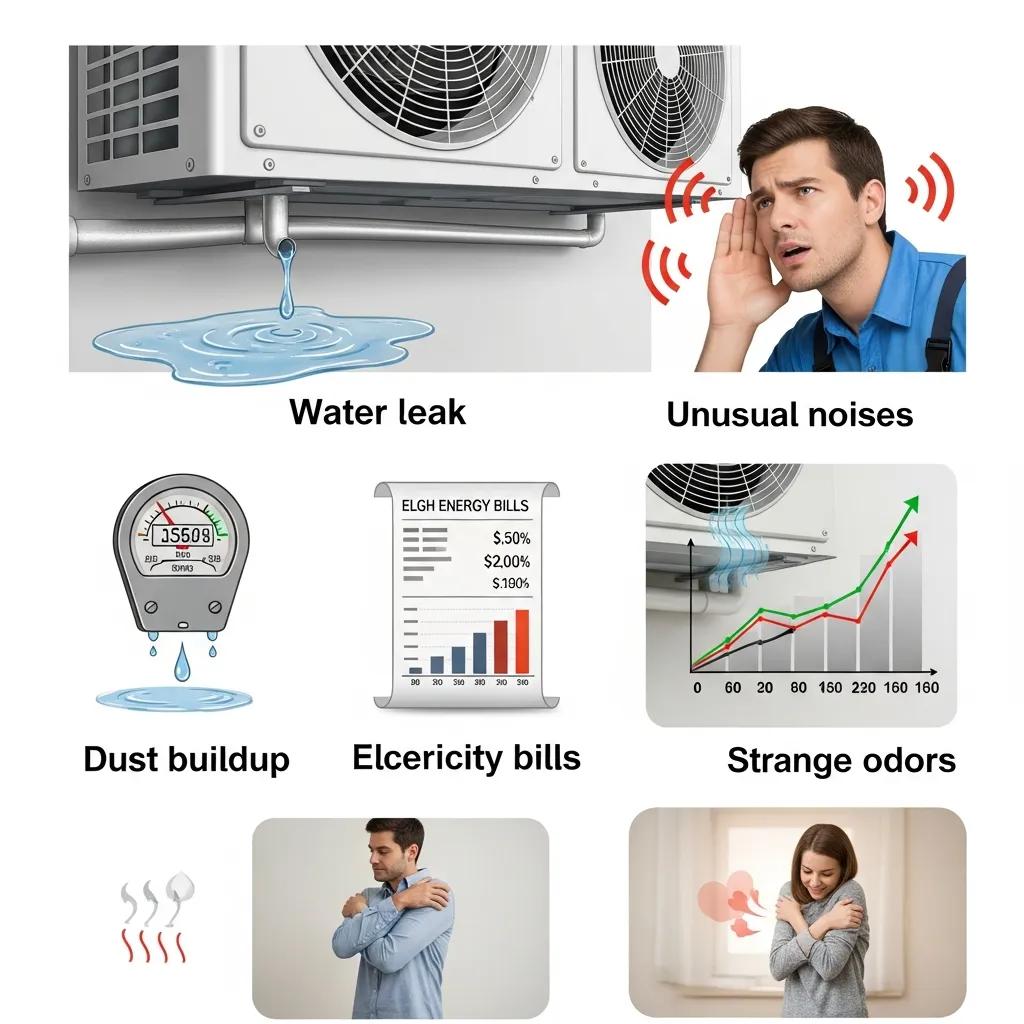
Immediate warning signs are observable system behaviors that indicate component failure, safety hazards, or imminent breakdown. These symptoms exist because core components—compressor, blower motor, refrigerant, condensate drain, or electrical systems—are malfunctioning, creating risk of higher repair cost or unsafe operation. Early detection reduces repair scope and avoids property damage, so homeowners should treat certain signs as urgent. The following list summarizes the primary red flags, explains likely causes in one line each, and gives a homeowner action to take before calling a technician.
Top warning signs to check right away:
• Loud banging or grinding noises: These often indicate loose parts, collapsed fan blades, or motor bearings wearing out, and you should shut the system off to avoid further damage.
• Persistent water leaks or pooled condensate: Blocked condensate drains or corroded drain pans can cause water damage and should be addressed immediately.
• Burning smells or smoke: Electrical arcing or overheated components require immediate shutdown and professional inspection.
• Sharp rise in energy bills without a usage change: Efficiency loss from failing compressors, dirty coils, or low refrigerant suggests urgent evaluation.
• System short cycling or failing to start: Repeated on/off cycles stress components and indicate oversized equipment, low refrigerant, or control failures.
• No cooling or heating during extreme outdoor temperatures: Compressor failure or ignition problems in furnaces can risk home comfort and safety.
Quick homeowner checks can save time: inspect the air filter, verify thermostat settings and batteries, and check the outdoor unit breaker. If basic checks don’t restore normal function, treat the problem as urgent and limit system use to prevent damage. Recognizing these signs early leads directly into targeted diagnostics for cooling and heating performance, discussed next.
How Do High Energy Bills Signal HVAC Inefficiency?
High energy bills are a measurable signal that system efficiency has declined; this happens because components like compressors, motors, coils, and controls no longer operate at original performance levels. Dirty evaporator or condenser coils, low refrigerant, failing compressors, and poor airflow increase runtime and energy consumption, which shows up on utility bills. Comparing seasonal energy use and calculating relative cost increases helps determine whether inefficiency stems from a repairable fault or from overall system age and design.
Homeowners should first change or inspect filters, ensure vents are open, and check for blocked outdoor units; if bills remain high, professional diagnostics can isolate defective components and estimate repair costs. Understanding the efficiency loss leads to quantifiable comparisons such as SEER and AFUE metrics, which are used below when weighing replacement benefits versus repair.
How Can You Identify If Your HVAC System Is Not Cooling or Heating Properly?
Identifying underperformance requires a stepwise diagnostic approach that isolates controls, airflow, and mechanical systems. Start with thermostat settings and simple tests, then inspect airflow and ductwork, and finally consider refrigerant or heat-source failures. This layered method prevents unnecessary service calls and clarifies whether an on-site repair will restore performance or whether replacement is the sensible long-term option. Below is a practical homeowner checklist, followed by focused causes for uneven temperatures and cycling problems that frequently undermine system performance.
Before calling a pro, perform these diagnostic checkpoints:
• Check the thermostat mode and setpoint to ensure correct cooling/heating commands.
• Inspect and replace clogged filters to restore airflow.
• Confirm the outdoor unit is powered and unobstructed, and that vents are open inside.
• Observe run cycles, noting if the system short cycles or runs continuously.
These checks often resolve simple issues or provide clean data to a technician, improving diagnosis speed and accuracy. If these steps don’t restore proper operation, deeper issues like compressor failure, refrigerant leaks, or combustion faults require professional testing.
What Causes Uneven Temperatures and Poor Airflow?
Uneven temperatures commonly result from duct leaks, undersized or blocked ducts, closed or blocked vents, or failing blower motors that reduce airflow. Other causes include poor zoning controls, imbalanced duct insulation, and register obstructions that create hot and cold spots. Duct leakage testing and airflow measurements are the diagnostic tools professionals use to quantify losses and identify repairable sections versus systemic design shortcomings.
Homeowners can help by ensuring vents are open and unobstructed, confirming attic and crawlspace insulation near ducts, and checking for visible duct damage. When uneven temperatures persist despite these checks, a technician can perform blower and duct leakage tests to decide whether targeted duct repair, a blower replacement, or a whole-system upgrade better addresses persistent comfort issues.
How Do Frequent Cycling and Constant Running Affect HVAC Health?
Short cycling—frequent on/off cycles—or constant running both increase wear on key components and reduce system lifespan by stressing compressors, relays, and motors. Short cycling often arises from oversized equipment, thermostat placement near heat sources, or low refrigerant; constant running can result from undersized equipment, refrigerant loss, or severe air restriction. Both behaviors elevate energy use and can signal that repeated repairs will soon outweigh replacement benefits.
A practical rule-of-thumb: if a system short cycles regularly or runs continuously without reaching setpoints, schedule diagnostics promptly. A technician will assess sizing, refrigerant charge, and control settings and then recommend repair or replacement based on age and projected repair costs.
The frequent on-off cycles characteristic of short cycling can significantly decrease a system's overall efficiency.
HVAC Short Cycling: Causes and Impact on Efficiency
Another problem associated with RTUs is short cycling, ie, when an RTU goes through ON and OFF cycles too frequently. Excessive cycling can result in decreased average efficiency
When Should You Consider Repairing Versus Replacing Your HVAC System?
Deciding to repair or replace hinges on system age, repair cost relative to replacement, efficiency loss, refrigerant availability, and safety. Common heuristics include the “50% rule” (if a single repair exceeds 50% of replacement cost) and age thresholds—air conditioners often show diminishing returns after roughly 10–15 years, while furnaces may reach end-of-life around 15–20 years. Consider future energy savings, upcoming refrigerant regulations, and the cumulative cost of recurring repairs when making the decision.
Below is a scannable comparison mapping system age and common symptoms to typical repair and replacement cost estimates and urgency to help homeowners decide.
• AC 5–8 years, minor compressor issue — Typical Repair Cost Estimate: $300–$900 — Typical Replacement Cost & Urgency: Replacement often not needed; repair moderate urgency
• AC 10–15 years, compressor or major leak — Typical Repair Cost Estimate: $1,000–$3,500 — Typical Replacement Cost & Urgency: Replacement recommended if repair >50% of replacement cost; moderate-high urgency
• Furnace 15–20 years, heat exchanger concerns — Typical Repair Cost Estimate: $800–$2,500 — Typical Replacement Cost & Urgency: High replacement urgency due to safety and efficiency concerns
• Repeated electronic control failures — Typical Repair Cost Estimate: $500–$2,000 per event — Typical Replacement Cost & Urgency: Replacement may be cost-effective if failures recur within a few years
Use these estimates as starting points; local labor rates and equipment choices change costs. The decision process typically follows the age-and-cost rule, combined with efficiency goals and safety considerations that can make replacement the better long-term investment.
For homeowners ready to move from evaluation to action, TemperaturePro Baton Rouge offers on-site assessments, repair, and replacement quotes in the Baton Rouge area. The company’s family-owned approach and certified team focus on energy-efficient solutions and customer satisfaction, and they can provide an on-site estimate to compare repair costs versus replacement options tailored to your home.
How Does HVAC System Age Influence Repair or Replacement Decisions?
System age correlates with parts availability, efficiency degradation, and increasing frequency of failures; older units tend to rely on legacy refrigerants and obsolete controls, which drive up repair difficulty and cost. Over time, compressors and heat exchangers show wear that reduces SEER or AFUE performance and increases operating expense. As a system crosses common lifecycle thresholds, the marginal benefit of repairing dwindles compared with the lifetime value of a new, efficient unit.
When age-related decline aligns with higher repair estimates, replacement often yields better comfort, lower bills, and fewer service calls. Homeowners should weigh the remaining expected lifespan after repair against replacement warranties and projected energy savings to make a financially sound decision.
Considering the total cost of ownership, including repairs and warranty implications, is crucial for making informed HVAC decisions.
HVAC System Reliability: Cost, Warranty, and Maintenance Factors
The HVAC system reliability is extended to include both cost and warranty factors, providing a more comprehensive analysis. This paper discusses the impact of enhancement, preventive maintenance, past age and warranty.
What Are the Benefits of Upgrading to a New, Energy-Efficient HVAC System?
Upgrading to a modern system improves energy efficiency, comfort, indoor air quality, and long-term reliability through higher SEER or AFUE ratings, variable-speed compressors, and smarter controls. Reduced energy consumption translates into lower utility bills and a smaller carbon footprint, while improved humidity control and quieter operation enhance daily comfort. New systems also avoid legacy refrigerant issues and often integrate better with solar or home energy systems to optimize overall home efficiency.
The following comparison table quantifies typical differences between older units and new, energy-efficient replacements to aid decision-making and demonstrate potential annual savings and lifespan improvements.
Unit TypeSEER/AFUE Typical RangeEstimated Annual Energy Cost*Expected LifespanOlder AC unitSEER 8–10Higher annual cooling cost10–15 yearsNew high-efficiency ACSEER 16–20+20–40% lower annual cooling cost15–20 yearsOld gas furnaceAFUE 70–80%Higher heating cost15–20 years
Estimated annual energy cost varies by climate and usage; this table illustrates relative differences to inform homeowner choices.
Upgrading can also future-proof homes against refrigerant phase-outs and improve compatibility with smart thermostats and zoning systems. For homeowners considering upgrades, TemperaturePro Baton Rouge can provide energy-efficient installation options and help evaluate local incentives or rebates that may apply, offering cost comparisons and tailored quotes to support the investment decision.
How Do New HVAC Systems Improve Energy Efficiency and Comfort?
Modern HVAC systems use variable-speed compressors and ECM blower motors to match output to load, reducing cycle losses and maintaining stable temperatures with lower energy use. Higher SEER and AFUE ratings reflect these advances, which translate into measurable savings and quieter operation. Smart thermostats and better airflow management improve zone control and humidity management, preventing short cycling and enhancing perceived comfort.
These technological improvements reduce run-time and maintain steadier indoor conditions, delivering both cost and wellness benefits. Homeowners should ask technicians about variable-speed equipment and matching indoor coils and controls to realize the full efficiency gains of a replacement system.
Many building HVAC systems do not operate efficiently due to operational faults, leading to significant energy waste.
HVAC System Faults: Causes of Inefficiency and Energy Savings
Building HVAC systems account for more than 30% of annual energy consumption in United States. However, it has become apparent that only in a small percentage of buildings do HVAC systems work efficiently or in accordance with design intent. Studies have shown that operational faults are one of the main reasons for the inefficient performance of these systems. It is estimated that an energy saving of 5 to 15 percent is achievable simply by fixing faults and optimizing building control systems.
What Safety Concerns Signal the Need for Urgent HVAC Replacement?
Safety concerns require immediate attention because HVAC failures can cause carbon monoxide exposure, electrical fires, and smoke-related hazards. Combustion appliances with cracked heat exchangers, persistent burning smells, visible smoke, or electrical arcing should be shut down and inspected without delay. The following emergency checklist outlines signs that merit immediate shutdown and rapid professional response to protect occupants and property.
Emergency triggers to act on now:
• Carbon monoxide alarms sounding or symptoms of CO exposure: Dizziness, headache, or nausea require immediate evacuation and professional inspection.
• Strong burning or electrical burning smells near the furnace or electrical panel: Shut off the system and seek emergency service.
• Visible smoke or flames from HVAC equipment: Evacuate and call emergency responders, then a professional HVAC technician for inspection.
• Gas odor in homes with gas furnaces: Treat as a gas leak—evacuate and contact emergency services before any HVAC inspection.
These signs are non-negotiable safety priorities; do not attempt DIY repairs in such scenarios. Rapid-response professionals reduce risk of property damage and health consequences.
After evaluating safety-critical situations, homeowners should contact local qualified service providers for immediate inspection. TemperaturePro Baton Rouge’s certified technicians and responsive service model are positioned to provide emergency inspections and rapid response in the Baton Rouge area, prioritizing safety and quick stabilization when risks are detected.
When Is Emergency HVAC Repair Necessary?
Emergency repair is necessary when system faults threaten safety, cause active leaks, or can lead to immediate property damage—examples include refrigerant spraying, severe water leaks, persistent smoke, or total electrical failure accompanied by burning odors. In extreme temperatures, a complete system failure can also become an emergency if vulnerable occupants are at risk from heat or cold exposure. The recommended homeowner response is to power down the system (when safe), evacuate if there is smoke or gas odor, and request emergency service immediately.
Rapid professional response minimizes further damage and can prevent catastrophic outcomes, and effective emergency service includes temporary safe operation measures until permanent repairs or replacement can be completed. Knowing which signs require emergency action helps households avoid dangerous delays.
Why Choose TemperaturePro Baton Rouge for Your HVAC Repair or Replacement Needs?
TemperaturePro Baton Rouge combines local service focus with certified technicians and a family-owned service approach to provide responsive, professional HVAC and solar solutions in the Baton Rouge area. The company emphasizes energy-efficient installations, careful assessment of repair-versus-replace scenarios, and clear, on-site quotes so homeowners can confidently plan investments. Their team’s combination of diagnostic rigor and customer-focused responsiveness helps translate technical recommendations into clear, actionable next steps for safety and savings.
What makes this provider a practical option is the integration of HVAC and solar capabilities—helpful for homeowners considering whole-home energy strategies—and a commitment to energy efficiency and customer satisfaction noted in local service descriptions. If you require an on-site estimate, emergency inspection, or a detailed replacement proposal that factors in efficiency and refrigerant considerations, TemperaturePro Baton Rouge can assess your home and provide the necessary documentation to move forward with an informed decision.
Thank you! Your submission has been received!
Oops! Something went wrong while submitting the form.
Prevent sudden heating breakdowns with these home maintenance tips and troubleshooting insights. Get clear answers on why pre-winter HVAC inspections matter.
Most homeowners think a late-week appointment is the most convenient choice for an HVAC tune-up. Discover why our dispatchers highly recommend booking on a Tuesday morning instead.
A furnace shutting down repeatedly during early fall tests is frustrating, but jumping the safety switch is a dangerous mistake. Understand the severe fire hazards of this DIY workaround.