The Hidden Dangers of Bypassing a Tripped High-Limit Switch on Your Furnace
The Hidden Dangers of Bypassing a Tripped High-Limit Switch on Your Furnace
A furnace shutting down repeatedly during early fall tests is frustrating, but jumping the safety switch is a dangerous mistake. Understand the severe fire hazards of this DIY workaround.
The Temptation of the Quick Fix During Early Fall Test Runs
Your furnace shuts down repeatedly just as you are testing it out for the cooling weather, leaving the house completely chilly. If your system is short-cycling and you are searching for a workaround, you need to understand the hidden dangers of bypassing a tripped high-limit switch on your furnace before making a critical mistake. At TemperaturePro Baton Rouge, our team frequently encounters well-meaning DIYers who are tempted to jump or bypass these safety switches to restore heat quickly, especially during the September pre-heating season when patience runs thin.
In our years serving the Baton Rouge area, we've noticed the transition from heavy summer air conditioning use to initial September furnace test runs often reveals hidden airflow issues. Your system has been moving cold air for months, accumulating dust and restriction. When you finally ask it to generate heat, that restricted airflow prompts sudden, frustrating shutdowns. However, the high-limit switch is not a nuisance keeping you from a warm house. It is a critical thermal failsafe designed to prevent catastrophic mechanical failure and severe safety hazards. If you are dealing with a system that refuses to stay running, reaching out for professional HVAC services is the only safe path forward.
The Danger of the DIY Mindset
It is incredibly common to seek a quick fix when a mechanical system fails. You might watch a quick video or read a forum post suggesting that you can simply bridge the wires on the limit switch to force the burner to ignite. While this will technically force the furnace to run, it completely removes the system's ability to protect itself. You are essentially disabling the smoke alarm while a fire is starting in the kitchen. Understanding exactly what this switch does is the first step in recognizing why it must never be bypassed.
What is a Furnace High-Limit Switch (and Why Does it Trip)?
The Problem: Your furnace runs for a few minutes, the air coming out of the vents gets exceptionally hot, and then the burner suddenly shuts off before the thermostat reaches your desired temperature. This cycle repeats endlessly, leaving your home uncomfortable and placing immense strain on your equipment.
The Cause: The high-limit switch is a temperature-sensing probe that extends directly into the heat exchanger chamber. Its job is to monitor the internal temperature of the furnace. Every heating system is engineered with a maximum safe operating temperature. When the internal heat exceeds those design limits, the limit switch automatically severs the electrical circuit to the gas valve or heating elements. It cuts off the fuel supply to stop the heat generation immediately. If your system is tripping this switch, it means the furnace is actively overheating. The tripped switch is merely a symptom of a larger thermal issue, not the root problem itself.
The Solution: Instead of tampering with the switch, homeowners must recognize that the system is functioning exactly as intended. The failsafe is actively protecting the home. If you want to understand more about the underlying causes of these shutdowns, reading about why your furnace keeps shutting off can provide valuable context.
Normal Operation vs. Overheating Conditions
• Normal Airflow — Limit Switch Status: Closed (Circuit Complete) — System Response: Burners remain lit until thermostat is satisfied. — Safety Implication: System operates safely within designed temperature ranges.
• Restricted Airflow — Limit Switch Status: Open (Circuit Broken) — System Response: Burners shut down immediately; blower continues running to cool the unit. — Safety Implication: Prevents severe heat buildup and mechanical damage.
• Bypassed Switch — Limit Switch Status: Forced Closed (Tampered) — System Response: Burners run continuously despite extreme internal heat. — Safety Implication: Imminent risk of component failure, fire, and toxic gas leaks.
Across the Baton Rouge area, our technicians routinely see systems that have been pushed to their limits because these basic operational facts are misunderstood. The switch is your first line of defense.
The Thermal Physics of Bypassing the Failsafe
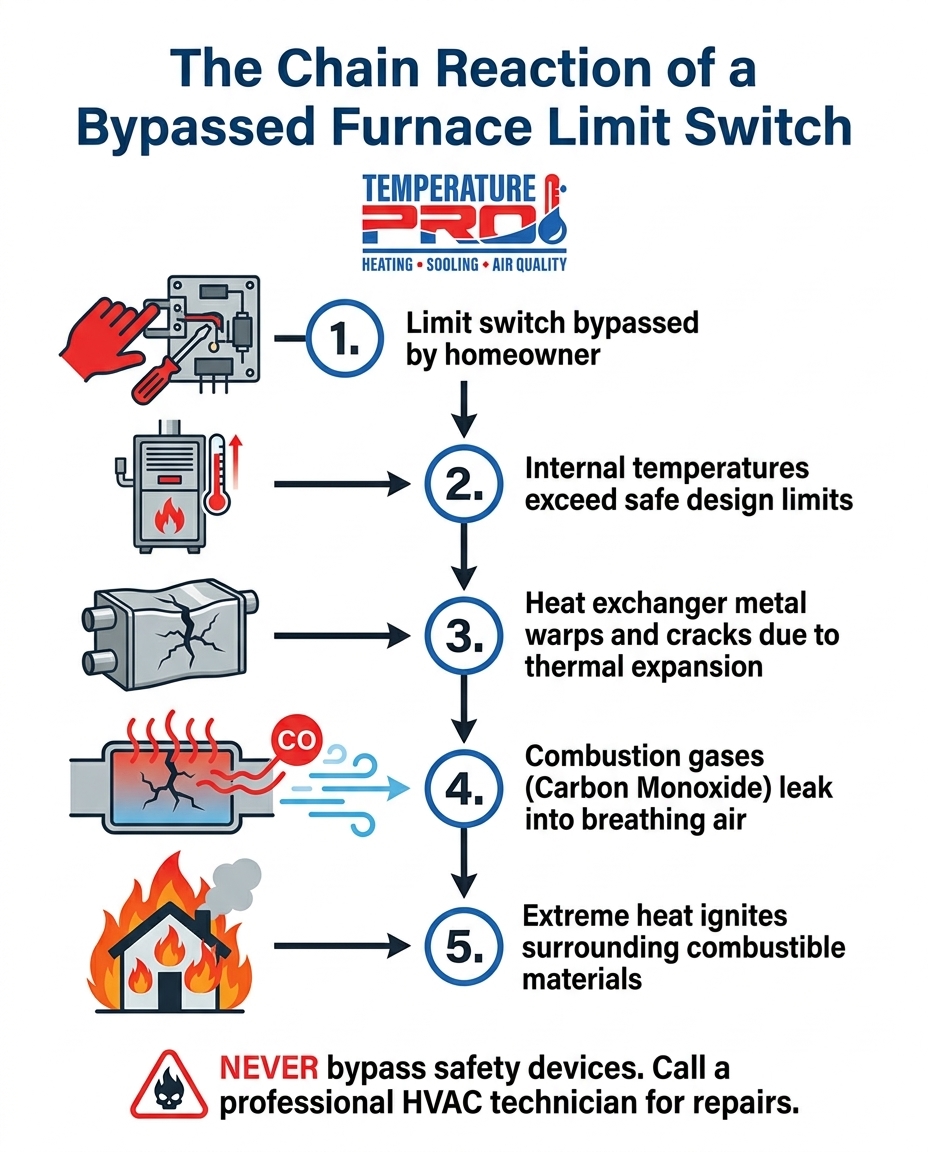
When you force a furnace to run without its high-limit switch, you initiate a dangerous chain reaction governed by thermal physics. Residential heating equipment is meticulously engineered to handle specific, restricted thermal loads. It requires a constant, heavy flow of cool return air to absorb the heat from the heat exchanger and distribute it throughout your home. Without that airflow, and without a limit switch to cut the fuel, the internal temperatures escalate rapidly.
Metal Fatigue and Thermal Expansion are the immediate physical consequences. The heat exchanger is a large metal component that contains the combustion flames and toxic gases. As the internal temperature climbs past the safe threshold, the metal begins to expand far beyond its design parameters. Continuous, excessive heat causes the metal to warp, stress, and eventually fracture. The constant cycle of extreme overheating and sudden cooling weakens the structural integrity of the steel.
The Breaking Point of Metal
During the September pre-heating season, your furnace is waking up from months of dormancy. If you bypass the safety switch during a test run, the heat exchanger absorbs an unrestricted amount of thermal energy. Metal can only expand so much before it reaches its breaking point. Once the heat exchanger warps, it loses its structural shape, placing immense tension on the seams and factory welds. This is not a gradual process; unrestricted heating can destroy a heat exchanger in a surprisingly short amount of time, turning a simple airflow issue into a total system failure.
The Chain Reaction of a Bypassed Furnace Limit Switch
The Immediate Threat: Cracked Heat Exchangers and Carbon Monoxide
The mechanical damage of a ruined furnace is costly, but the health hazards associated with bypassing the switch are life-threatening. The heat exchanger has one primary job: it keeps the toxic gases created by combustion completely separate from the clean air that is blown into your living spaces. When the heat exchanger warps and cracks from severe overheating, that critical seal is breached.
The Invisible Hazard: A cracked heat exchanger allows toxic combustion gases, including carbon monoxide (CO), to mix directly with the breathing air circulated through the home. Carbon monoxide is entirely invisible, tasteless, and odorless. It is a silent threat that often goes completely undetected until occupants begin experiencing severe symptoms like headaches, dizziness, nausea, or worse.
Why the Failsafe Matters: The high-limit switch is specifically calibrated to shut the system down long before the metal gets hot enough to crack. By removing that protection, you are directly facilitating a carbon monoxide leak. If you suspect your system has overheated or you are smelling unusual odors from your vents, you need professional heating repair immediately. Do not run the system. In the Baton Rouge area, our dispatch team prioritizes these calls because a breached combustion chamber is an absolute emergency that requires specialized diagnostic tools to confirm.
Fire Hazards and the Reality of Unrestricted Heating
Beyond carbon monoxide, disabling thermal failsafes introduces a severe and immediate fire risk. The National Fire Protection Association (NFPA) consistently cites heating equipment as a leading cause of home fire deaths. A furnace is essentially a controlled fire inside a metal box. When you remove the controls, the fire dictates the outcome.
Here is exactly how a bypassed switch escalates into a house fire:
1. Unregulated Internal Temperatures: The burners continue firing relentlessly, raising the internal temperature of the cabinet hundreds of degrees above normal operating limits.
2. Casing Overheating: The exterior metal casing of the furnace, which is normally cool or slightly warm to the touch, becomes dangerously hot.
3. Ignition of Surrounding Materials: Furnaces are often located in attics, closets, or basements surrounded by combustible materials like insulation, stored cardboard boxes, wood framing, or dust. The radiant heat from the glowing furnace casing can easily ignite these nearby materials.
4. Electrical Melting: The extreme heat melts the internal wiring insulation, causing electrical shorts and secondary electrical fires within the blower compartment.
During the September pre-heating season, attics are often still holding residual summer heat. Adding an unregulated, overheating furnace to that environment removes the only barrier between normal operation and a catastrophic fire. Bypassing the switch is never worth the risk to your property or your family.
Why Airflow Restriction is Usually the True Culprit
If your high-limit switch is tripping, it is doing its job perfectly. The focus should pivot away from the switch itself and toward the actual root causes of the overheating. In almost every case, a tripping limit switch is caused by severe airflow restriction. The furnace cannot push enough air over the heat exchanger to keep it cool.
Over the long, humid cooling season, your HVAC system processes an enormous amount of air. Dust, pet dander, and debris accumulate rapidly. This accumulation can severely clog filters, causing immediate furnace overheating during the first fall startup. Before you even consider touching internal electrical components, you should investigate these common culprits.
• Deeply clogged air filters: A dirty filter is the number one cause of furnace overheating. If it is caked with summer dust, the blower cannot pull enough air through the system.
• Blocked or closed return vents: Furniture, rugs, or curtains blocking the large return grilles starve the furnace of the air it needs to breathe.
• Closed supply registers: Shutting vents in unused rooms increases static pressure and traps heat inside the ductwork and the furnace cabinet.
• Failing blower motor: If the motor is struggling, covered in dirt, or failing electrically, it will not move the required volume of air to cool the heat exchanger.
• Evaporator coil blockages: The indoor AC coil sits directly above or next to the furnace. If it is packed with dirt, air cannot pass through it, trapping heat below.
One of our local customers discovered this firsthand during a fall startup when their heater refused to work. Our lead technician found an underlying wiring error that was actually affecting the AC fan's performance, severely limiting airflow. Once the wiring was corrected, both the heater and the fan functioned perfectly, proving that airflow and electrical systems are deeply interconnected. This is why investing in routine preventative maintenance is so critical. A professional tune-up addresses these hidden airflow restrictions before they trigger a safety shutdown.
Military-Grade Standards: Why We Never Cut Corners on Safety
As a veteran-owned HVAC provider, TemperaturePro Baton Rouge ensures you receive the same level of discipline, accountability, and strict adherence to protocol that military service demands. We never cut corners on safety, and we strictly refuse to compromise on mechanical standards that put homes at risk. Our professional technicians do not guess, and they certainly do not use dangerous bypasses to silence a safety alert.
Professional Diagnostics vs. DIY Shortcuts: When one of our professionals arrives to diagnose a tripping limit switch, they use digital multimeters, static pressure manometers, and advanced airflow diagnostics to find the exact root cause. True troubleshooting involves testing the entire interconnected system. We measure the temperature rise across the heat exchanger, verify the gas pressure, and ensure the blower motor is pulling the correct amperage.
Our team treats every call with this level of urgency and precision. For example, one local customer called us after 5 p.m. on a Saturday just as Hurricane Ida was approaching. Their home unit was failing due to a severe refrigerant leak. Our technicians deployed late that evening, repaired the leak, and restored the system before the storm made landfall. That dedication to showing up and doing the job right—without taking dangerous shortcuts—is how we operate year-round.
If you are experiencing a system that will not stay running during the September pre-heating season, rely on HVAC troubleshooting performed by certified experts. Silencing an alarm does not put out the fire; it only leaves you vulnerable.
Frequently Asked Questions About Furnace Limit Switches
Can I bypass a furnace limit switch temporarily?
No. Bypassing the switch even temporarily removes the only failsafe preventing the furnace from reaching dangerous temperatures. Doing so creates an immediate fire hazard and risks severely damaging the heat exchanger. There is no safe duration for operating a furnace with a disabled safety control.
What happens if a high limit switch goes bad?
If a switch fails, it typically fails safely in the 'open' position, meaning it breaks the electrical circuit permanently. When this happens, the furnace will not ignite, or the blower fan will run continuously blowing cold air in an attempt to cool a system that it believes is overheating. It requires professional replacement to restore normal function.
Will a furnace run with a bad limit switch?
Usually, no. The furnace's control board requires a closed circuit from the limit switch to initiate the heating cycle. If the switch is bad and stuck open, the burners simply will not light. The system locks out to protect the home from potential overheating.
Why does my furnace high limit switch keep tripping?
The most common cause is restricted airflow due to a dirty air filter, blocked return vents, or a malfunctioning blower motor. When air cannot flow freely over the heat exchanger, heat builds up rapidly inside the unit, causing the switch to trip to prevent a fire.
Can a tripped limit switch cause a carbon monoxide leak?
The tripped switch itself does not cause a leak; it actually prevents one. If the switch is bypassed or fails to trip, the resulting overheating can warp and crack the metal heat exchanger. A cracked heat exchanger is a primary cause of carbon monoxide leaking into the home's breathing air.
Address the Root Cause, Not the Symptom
A tripping limit switch is doing exactly what it was engineered to do: protect your home, your family, and your equipment from catastrophic thermal failure. Bypassing this critical failsafe is never a viable solution, as it instantly introduces severe risks of fire and carbon monoxide exposure.
If your furnace refuses to stay running, always start by checking your air filters and ensuring all vents are fully open and unobstructed. If basic airflow fixes do not resolve the issue, you are dealing with a more complex mechanical or electrical problem. Homeowners in the Baton Rouge area should rely on the experienced team at TemperaturePro Baton Rouge for professional diagnostics to identify and repair the true root cause safely, ensuring a warm and secure home throughout the heating season.
Thank you! Your submission has been received!
Oops! Something went wrong while submitting the form.
As summer ends, you might notice your outdoor AC unit humming at a lower pitch. Discover why cooler September evenings naturally change your system's acoustic profile.
When hot kitchens meet dropping overnight temperatures, commercial coolers are vulnerable to severe ice buildup. Properly adjusting your defrost timers protects perishable inventory this fall.
When autumn weather turns your dining room into a wind tunnel, your heating system likely isn't to blame. Balancing your restaurant's make-up air solves severe negative pressure drafts.