5 min read
Fall HVAC Troubleshooting: Why Your Heater Smells Like Burning Dust on Startup
Is that burning dust smell normal? Read our home maintenance tips and troubleshooting to see why heating startup odors happen and when to call a professional.


Waking up to a sweltering house forces a stressful debate: wait until morning or call for help now? See the exact timeline of an after-hours dispatch so you can decide with confidence.
You wake up drenched in sweat, the ceiling fan is pushing hot air around the room, and you suddenly need to know what actually happens when you call for emergency AC repair at 2 AM in Baton Rouge. The immediate physical discomfort of a sweltering house in the middle of the night forces a stressful internal debate. Do you try to suffer through the heat until standard business hours, or do you seek immediate help and risk waking up a technician?
Many homeowners hesitate to pick up the phone because they simply do not know how the after-hours dispatch process works. The uncertainty of whether someone will actually answer, how long a technician will take to arrive, and what the initial assessment will look like often causes people to delay necessary repairs. Understanding the exact timeline and operational process of a 24/7 emergency service dispatch removes the anxiety of making that late-night call. You are not sending a message into a void; you are triggering a highly structured operational response designed specifically for Louisiana summer nights.
At TemperaturePro Baton Rouge, our team knows firsthand that when the oppressive regional climate turns a broken air conditioner from a mild inconvenience into a safety concern, getting professional HVAC services dispatched to your home is the most logical step. By demystifying the timeline from the moment you dial the number to the moment cool air starts flowing from your vents again, you can confidently make the right decision for your family's comfort and safety.
A common fear regarding late-night breakdowns is that a phone call will just go to an automated voicemail system. In reality, calling for 24/7 emergency service initiates a live, systematic process designed to handle urgent cooling failures promptly. Your call at 2 AM is not routed to an empty desk; it is answered by a trained, live dispatcher who is actively managing the overnight service board.
The Initial Information Gathering Phase
When you call our team at TemperaturePro Baton Rouge, the very first thing our dispatcher will do is collect critical information to understand the severity of your situation. They will confirm your exact address, the type of HVAC system you have, and the specific symptoms your unit is displaying. You will be asked questions like whether the system is making unusual noises, if there is a burning electrical smell, or if the thermostat is completely blank. This is not small talk; these questions allow the dispatcher to prioritize calls based on safety and necessity.
Transparent Communication from the Start
Working with a team that provides a transparent, reliable 24/7 emergency response with clear communication on dispatch times right from the initial phone call changes the entire experience. The dispatcher is trained to give you realistic expectations immediately. They will explain the current call volume, provide an estimated timeframe for when the on-call technician will reach out, and discuss the after-hours dispatch protocols.
Addressing the Fear of Hidden Fees
Homeowners often worry that a 2 AM call will result in surprise charges. Professional dispatchers address this upfront. Before anyone is sent to your home, the diagnostic process and any after-hours service expectations are clearly explained. This level of operational transparency ensures you have all the information you need to proceed, eliminating the stress of the unknown.
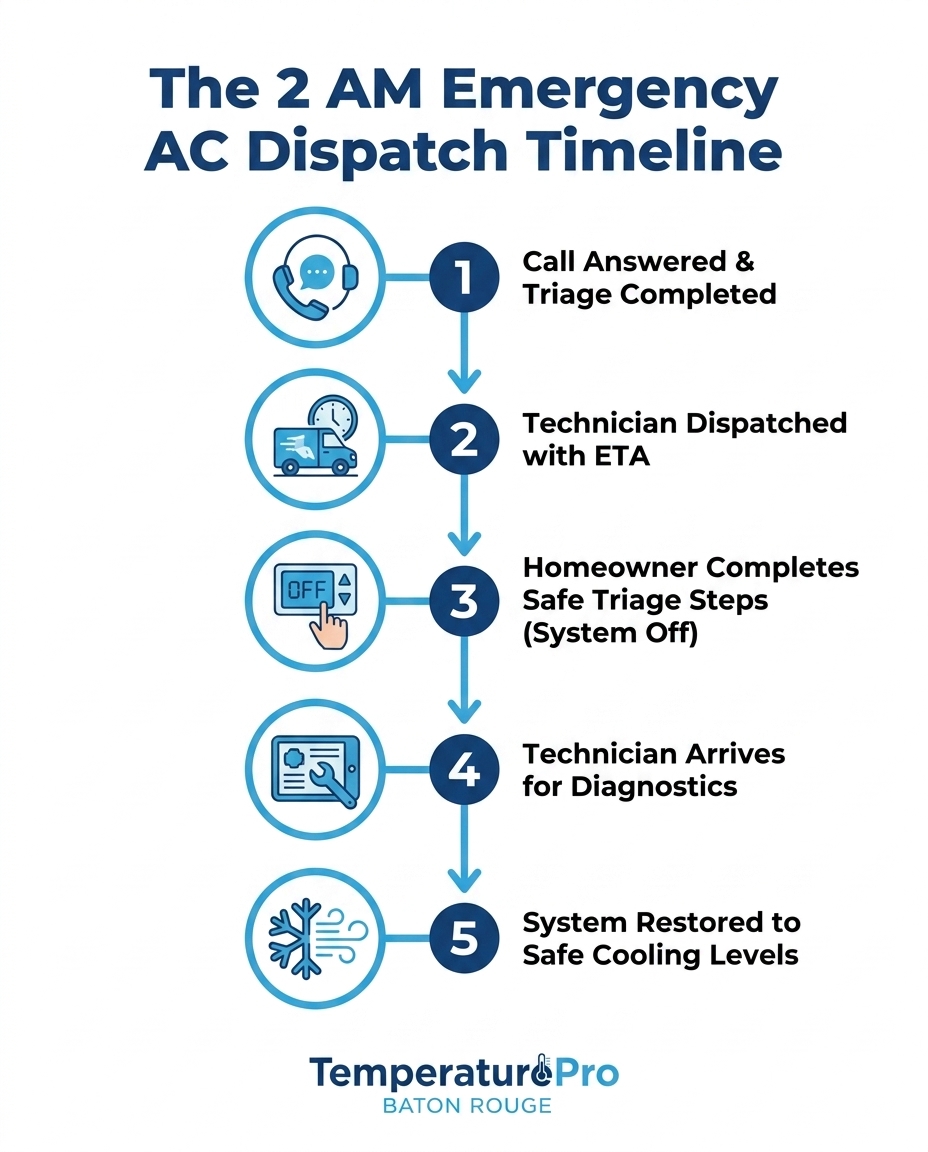
Once you hang up the phone with the dispatcher, a structured sequence of events takes place behind the scenes. Knowing this timeline provides clear expectations on how long you will wait and what the technician is doing before they even pull into your driveway.
1. Technician Notification: The dispatcher immediately contacts the designated on-call technician. The technician receives your address, system details, and the specific symptoms you reported. This allows them to start formulating a diagnostic plan while they are en route.
2. Vehicle Preparation: Because 24/7 emergency service is a core operation for us, our service vehicles are pre-stocked with the most common replacement parts needed for rapid nighttime fixes. Technicians ensure they have universal capacitors, contactors, fan motors, and refrigerant ready to go, minimizing the need to wait for a supply house to open in the morning.
3. Route Optimization: The technician maps the fastest route to your home. Response times for a middle-of-the-night dispatch in the local area generally depend on the technician's starting location and current weather conditions, but the goal is always rapid, safe arrival.
4. ETA Update: You will typically receive a follow-up call or notification from the technician or dispatcher confirming that they are on their way, along with a precise estimated time of arrival.
This systematic approach yields highly reliable results. For example, one local homeowner experienced this rapid response during a Saturday evening when their system stopped cooling properly just as Hurricane Ida was approaching. A technician arrived late that evening, quickly diagnosed a leak, added refrigerant, and restored the system, providing critical relief before the storm made landfall. That level of responsiveness is exactly what our nighttime dispatch protocol is built to achieve.
The Problem: Trapped Ambient Moisture
When an air conditioner fails during Louisiana summer nights, the loss of temperature control is only half the problem. The most immediate threat to your comfort is the rapid accumulation of indoor humidity. Air conditioners naturally dehumidify the air as they cool it. The moment the compressor stops running, the ambient moisture from Baton Rouge's oppressive heat begins to pool inside your home. Because the house is sealed, this humidity remains trapped, accelerating physical discomfort far faster than the rising temperature alone.
The Cause: High Heat Indices Without Sunlight
Baton Rouge is known for its high overnight humidity. Even when the sun goes down, the moisture in the air prevents the environment from truly cooling off. If your indoor temperature reads 78 degrees, but the indoor relative humidity exceeds 80 percent, the heat index—what your body actually feels—will be significantly higher. High humidity prevents your sweat from evaporating, which is the body's natural cooling mechanism. This creates a stifling, heavy environment that makes it nearly impossible to sleep and can be dangerous for vulnerable individuals.
The Solution: Immediate Professional Intervention
Trying to sleep in a rapidly warming, highly humid house often leads to secondary moisture issues, such as condensation forming on windows, walls, and ductwork. When a late-night breakdown transitions from a simple inconvenience to a scenario with climbing indoor humidity, it becomes a true safety necessity to call for 24 hour AC repair in Baton Rouge. Waiting until morning forces your family to endure unsafe heat indices and allows moisture to settle into your home's building materials.
Once you have secured your 24/7 emergency service dispatch, there is a period of waiting while the technician travels to your home. During this time, there are specific, safe actions you can take to protect your equipment and prepare for the repair. It is critical to emphasize that homeowners should never attempt DIY electrical or refrigerant repairs, as these require specialized licensing and pose severe safety risks.
The most important action you can take happens right at your wall.
• Switch the system to "off" at the thermostat: If your AC is blowing warm air, making grinding noises, or rapidly turning on and off, leaving it running will only cause further damage. A struggling compressor can burn itself out, and a restricted airflow issue can cause the indoor evaporator coil to freeze solid into a block of ice. Turning the system completely off protects the internal components.
• Leave the circuit breakers alone: If your air conditioner is repeatedly tripping the circuit breaker, do not keep flipping it back on. A tripping breaker is a critical safety mechanism indicating an electrical short or a grounded compressor. Forcing power back to a failing component is a severe fire hazard.
• Implement temporary cooling measures: Turn on ceiling fans, set up portable oscillating fans, and consider moving your family to a lower floor, as heat naturally rises to the upper levels of the home.
Helping the technician access the equipment safely speeds up the diagnostic process.
• Turn on exterior lights: At 2 AM, finding a specific house address can be difficult. Turning on your porch lights and driveway lights helps the technician locate your home quickly and safely navigate to the front door.
• Clear a path to the equipment: Ensure there is a clear, well-lit walkway to both your indoor air handler (often in a closet, garage, or attic) and your outdoor condenser unit. Remove any clutter, boxes, or lawn furniture that might block access.
• Secure your pets: Even the friendliest dogs can become protective or anxious when a stranger enters the home in the middle of the night. Keep all pets secured in a separate room away from the HVAC equipment areas.
When the technician arrives at your home, the focus immediately shifts to rapid, accurate diagnostics. The arrival process is highly professional; you can expect a uniformed technician with clear identification, ensuring you feel safe opening your door in the middle of the night. They understand that you are stressed, tired, and uncomfortable, and their demeanor will reflect a calm, methodical approach to solving the problem.
The midnight diagnostic process involves a comprehensive evaluation of both the indoor and outdoor units. The technician will typically start at the thermostat to verify the communication signals, then move to the indoor air handler to check the blower motor, control board, and safety switches. From there, they will inspect the outdoor condenser, testing the dual run capacitor, the contactor, the fan motor, and the compressor's electrical draw. They will also check the refrigerant pressures if the system is capable of running.
In our years of serving the Baton Rouge community, we've found that homeowners appreciate honesty and clarity above all else. Before any repair work begins, our technician will provide a clear, plain-English explanation of the problem. You will be shown exactly what failed and why. Whether a system fails in the middle of the night or during the day—just like one local customer who required urgent cooling on a Friday afternoon before out-of-town guests arrived—the diagnostic process remains thorough and prompt. In that specific instance, the technician arrived quickly, identified the faulty component, and had the upstairs cool well before the guests showed up. That same level of precision is applied to every 2 AM dispatch, ensuring you are fully informed before signing off on the repair.
Your call is answered by a live dispatcher who collects your system details and assesses the situation. They will ask for your address, the age of your system, and the specific symptoms you are experiencing to prioritize the response. Once the details are collected, an on-call technician is immediately notified and dispatched to your location. You will receive an estimated time of arrival based on current dispatch volume and drive time, ensuring you are never left guessing when help will arrive.
Yes, immediately turn the thermostat to the off position. Allowing an air conditioner to continue running while blowing warm air forces the system to work overtime without producing any cooling results. Leaving it running can cause severe compressor damage, electrical overheating, or cause the indoor evaporator coil to freeze completely solid. It is always safer to turn the system off and wait for a professional to diagnose the underlying issue.
Yes, especially in regions with extreme overnight humidity like Baton Rouge. High indoor humidity prevents sweat evaporation, drastically increasing the risk of heat-related illness even if the ambient temperature seems moderate. Furthermore, trapped humidity can lead to rapid condensation and moisture issues within the home's drywall and ductwork. Removing that moisture quickly is a primary reason 24/7 emergency service is necessary.
It is considered an emergency if indoor temperatures reach unsafe levels for the occupants of the home. Homes with elderly residents, infants, or individuals with medical conditions should prioritize immediate repair, as they are highly susceptible to heat exhaustion. Additionally, if you notice any signs of electrical failure, such as burning smells, smoke, or sparking from the unit, it is an immediate, absolute emergency that requires rapid intervention.
You can wait if the outdoor temperature is dropping significantly and the interior of the home remains comfortable and well-ventilated. However, if the indoor temperature is rapidly rising and humidity is climbing, waiting can quickly become unsafe. You must carefully consider the health of the occupants, the forecast for the following day, and the current indoor conditions before deciding to delay professional service.
Total system failure during extreme weather conditions is the most common HVAC emergency. Other critical emergencies include signs of electrical issues, such as burning smells, frequent breaker trips, or buzzing noises from the electrical panel. Severe refrigerant leaks, or massive water leaks from the indoor air handler that threaten to damage your ceilings or floors, also require immediate after-hours dispatch to mitigate property damage.
Response times vary based on the technician's starting location, road conditions, and the current nighttime call volume. A reputable company will provide a transparent ETA during the initial phone call so you know exactly what to expect. Technicians are strategically on-call and keep their vehicles fully stocked to minimize wait times and ensure they can resolve the majority of issues during that initial middle-of-the-night visit.
Waking up to a hot house in the middle of the night is incredibly stressful, but understanding the dispatch process removes the anxiety of a 2 AM breakdown. From the moment the live dispatcher answers your call to the thorough midnight diagnostics performed by a uniformed professional, every step is designed to restore your home's comfort as quickly and safely as possible. You do not have to endure the oppressive Louisiana heat and trapped humidity until morning.
Our commitment to transparent, step-by-step communication ensures you are never left in the dark about response times or diagnostic findings. Prioritize your family's comfort and safety without hesitation. If your system has failed and the indoor temperature is climbing, call for emergency AC repair immediately and let the TemperaturePro Baton Rouge 24/7 emergency service team bring the cool air back to your home.
Go With Experience