The New Homeowner's First AC Inspection: What We Look For and Explain
The New Homeowner's First AC Inspection: What We Look For and Explain
Inheriting an unfamiliar, aging AC system can be stressful. We break down exactly what a technician evaluates during your first inspection to establish a reliable baseline for your new home.
Inheriting an Unknown AC: Why a Baseline Assessment Matters
The moving boxes are unpacked and the closing paperwork is signed, but a significant source of anxiety remains—which is why scheduling The New Homeowner's First AC Inspection: What We Look For and Explain is a critical priority. You have just inherited an unfamiliar, potentially aging HVAC system, and you need to understand its baseline condition and immediate maintenance needs without being overwhelmed by technical jargon. Every time the thermostat clicks on, you might wonder if the unit is going to survive the upcoming season or if a massive repair bill is lurking just around the corner. Understanding the specific components a technician checks during a first-time inspection is the only way to establish a reliable baseline maintenance schedule for your inherited system.
Establishing this baseline requires comprehensive HVAC services that go far beyond a simple pass/fail operational check.
Many new buyers assume that because the air conditioner turned on during the final walkthrough, everything is fine. However, turning on and running efficiently are two entirely different concepts. A true baseline assessment is an educational walkthrough. The goal is to translate complex HVAC mechanics into plain English, providing you with a clear picture of what you actually bought. We do not just hand over a checklist with a bunch of checkmarks; we explain exactly what the findings mean for your daily comfort, your monthly energy bills, and your long-term replacement planning.
Why the Standard Home Inspection Misses Critical HVAC Details
A general home inspector has an incredibly difficult job, tasked with evaluating the roof, the foundation, the plumbing, and the electrical panel all in a few hours. Because of this broad scope, their evaluation of the air conditioning system is typically limited to a basic operational check. They will lower the thermostat, wait for the unit to kick on, and hold a hand over a vent to verify that cold air is blowing. While this confirms the system is currently functional, it misses the deeper mechanical details that dictate reliability.
A basic operational check will not reveal if the system is truly prepared to handle the intense, continuous workload of the upcoming Baton Rouge summer cooling season. It does not measure electrical efficiency, refrigerant levels, or internal component wear. Having a dedicated HVAC professional evaluate the internal components provides immense psychological relief. We look for hidden wear and tear that out-of-state or first-time buyers might easily overlook.
• General Home Inspection — Typical Scope of Work: Thermostat test, visual check of outdoor unit, vent temperature check. — What It Tells You: The system turns on and produces cold air today. — Hidden Risks Missed: Failing motors, dirty coils, micro-leaks in refrigerant lines.
• HVAC Baseline Assessment — Typical Scope of Work: Amp draw measurements, coil health analysis, condensate drain clearing, historical wear check. — What It Tells You: The true age, efficiency, and expected remaining lifespan of the system. — Hidden Risks Missed: None. Provides a complete mechanical and electrical profile.
This specialized inspection identifies the difference between a system that is running perfectly and a system that is struggling to survive, allowing you to budget accordingly.
Decoding System Age and Historical Wear
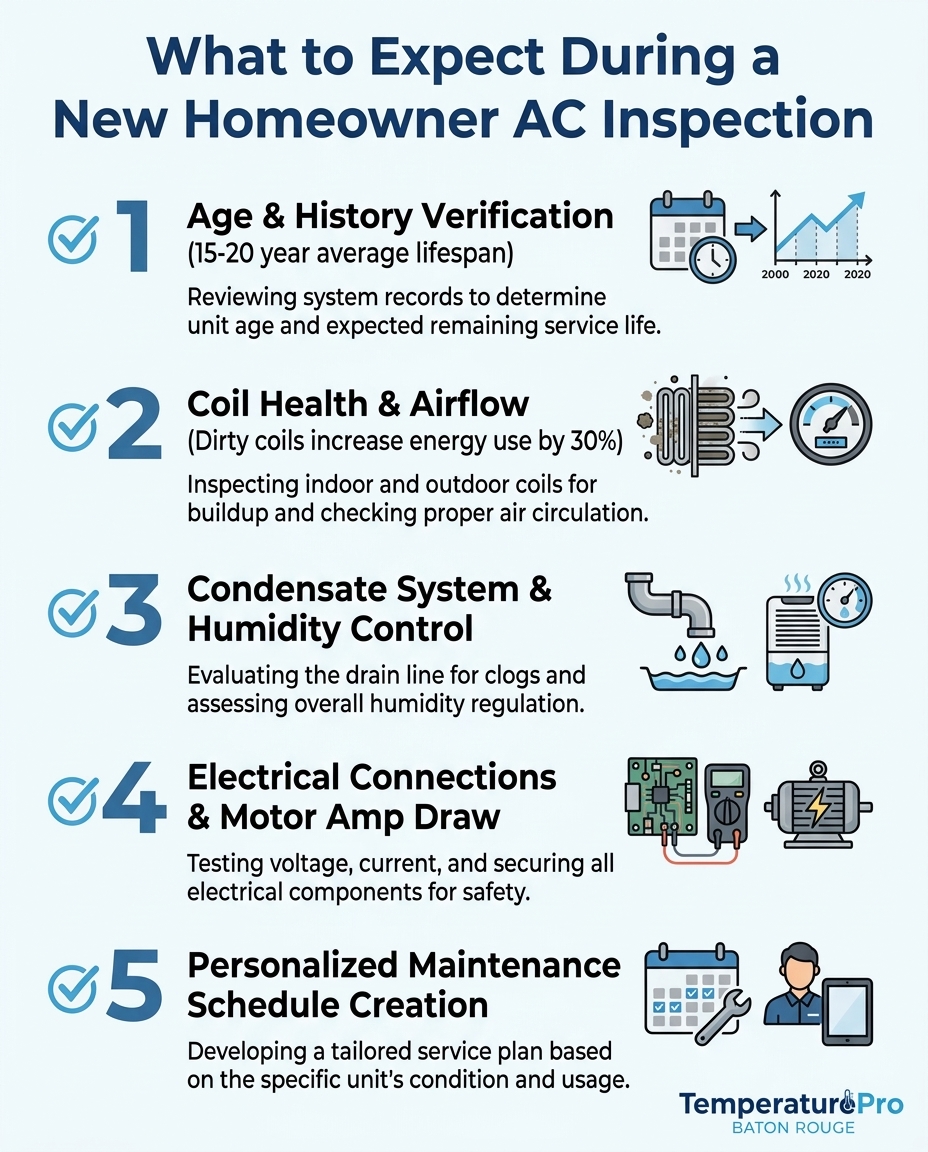
The average lifespan of a central AC unit is roughly 15 to 20 years. When you purchase a previously owned home, establishing the exact age of the equipment is the foundation of your future maintenance strategy. A system that is five years old requires a very different approach than a system that is eighteen years old. Technicians do not just guess the age based on how the metal casing looks; they use specific industry markers to decode the equipment's history.
Reading the Equipment's History
To determine the true condition of the inherited unit, a technician will walk through several specific evaluation steps:
1. Locating the data plate: Every outdoor condenser and indoor air handler has a manufacturer's data plate. This sticker contains the model number, serial number, and manufacturing date. Technicians decode the serial number to tell you exactly what month and year the unit rolled off the assembly line.
2. Identifying signs of previous DIY repairs: We look for mismatched wiring, non-standard screws, or aftermarket parts that suggest the previous homeowner attempted DIY fixes instead of hiring a professional. These anomalies often point to deeper reliability issues.
3. Assessing the condition of the ductwork connections: If the ductwork is sealed with standard duct tape instead of professional mastic, or if there are visible gaps pulling unconditioned attic air into the system, it indicates historical neglect that needs immediate correction.
4. Evaluating excessive dust buildup: A thick layer of dust inside the blower cabinet usually means the previous owner rarely changed their air filters, which forces the motor to work significantly harder over its lifespan.
Translating this age and wear into plain English means giving you realistic expectations. If the system is 12 years old and shows signs of heavy neglect, we will help you prepare for near-future replacement rather than sinking money into endless repairs during the peak of the Baton Rouge summer cooling season.
What to Expect During a New Homeowner AC Inspection
The problem: You notice that the air coming from the vents isn't quite as cold as it should be, or your first utility bill in the new house is shockingly high.
The cause: The issue often traces back to the system's coils. An air conditioner utilizes two primary coils to move heat. The indoor evaporator coil absorbs heat from the air inside your home, while the outdoor condenser coil releases that heat into the outside air. If either of these components is covered in dirt, pet hair, or lawn clippings, the heat transfer process is severely restricted.
The solution: During a baseline inspection, technicians meticulously evaluate both coils. We look for heavy blockages, biological growth on the indoor coil, and bent aluminum fins on the outdoor unit that restrict airflow like breathing through a pinched straw. A dirty condenser coil can increase AC energy consumption by up to 30%. Instead of simply writing "restricted heat transfer" on an invoice, we translate that finding into plain English: your AC is working 30% harder and costing you significantly more money every month. Cleaning these components restores efficiency, improves cooling capacity, and immediately lowers utility costs for the new homeowner.
Battling Local Humidity: Inspecting the Condensate System
Many new homeowners do not realize that an air conditioner performs two distinct jobs: it cools the air, and it removes moisture. In our region, removing moisture is arguably the more taxing job. High relative humidity forces systems to run continuously for six to eight months out of the year, accelerating wear on the equipment. Out-of-state buyers, in particular, might not anticipate the extreme toll that continuous humidity takes on the condensate system during the Baton Rouge summer cooling season.
As the indoor coil pulls humidity from the air, that moisture drips into a condensate pan and flows outside through a PVC drain line. Over time, algae, mold, and dust can create severe clogs in this line. To make sure your AC survives a Louisiana summer, the condensate system must be thoroughly vetted before the heavy heat arrives.
Preventing Water Damage Before It Starts
A clogged drain line is one of the most common causes of unexpected water damage in a newly purchased home. During the baseline assessment, we focus on:
• Checking safety float switches: These small devices are designed to shut the AC unit off automatically if water backs up in the drain pan, preventing it from overflowing through your ceiling or floors.
• Ensuring proper drainage routing: We verify that the water is being routed far enough away from the home's foundation to prevent pooling or structural issues.
• Identifying signs of past overflow: Water stains around the indoor air handler or rusted pan edges indicate that the system has overflowed in the past, signaling that the drain line needs a high-pressure flush.
Translating the risk of a clogged drain line into plain English means helping you avoid waking up to a ruined ceiling just weeks after moving into your new property.
Electrical Health and Motor Efficiency Explained
Air conditioners are heavy-duty electrical machines. Over years of operation, the constant vibration of the compressor and blower motor can cause electrical connections to slowly vibrate loose. An inherited system with loose wiring is a massive safety hazard and a primary cause of sudden breakdowns. This is why electrical testing is a cornerstone of the first-time inspection.
One of the most critical tests performed is measuring the "amp draw" of the motors. While that sounds highly technical, the concept is straightforward. Every motor requires a specific amount of electricity (amps) to run. If a blower motor or compressor is pulling significantly more amps than it is rated for, it means the internal bearings are wearing out and the motor is struggling to spin. Instead of just saying "the amp draw is high," the technician explains that the motor is tired and provides a clear, realistic timeline for when it might need replacement.
We also inspect the capacitors and contactors. A capacitor acts like a large battery that gives the motors a jolt of energy to start up. When a capacitor weakens, the motor struggles to turn on, which can eventually burn out the compressor. Identifying a struggling, inexpensive part like a weak capacitor now prevents a catastrophic, expensive system failure later in the Baton Rouge summer cooling season.
The Educational Handover: Building Your Maintenance Schedule
The final step of the baseline assessment is the educational handover. This is where the technician synthesizes all the inspection findings into an actionable, jargon-free plan that empowers you as the homeowner. We walk you through the system in person, ensuring you know exactly how to operate and maintain your equipment.
During this handover, we focus on the practical details:
• Locating and sizing air filters: We show you exactly where every filter is located, what MERV rating is appropriate for your specific system, and how often they need to be changed based on your household (pets, allergies, etc.).
• Thermostat calibration: We verify that the thermostat is accurately reading the room temperature and help you program energy-saving schedules.
• Establishing a maintenance baseline: Based on the system's age, historical wear, and coil health, we create a personalized maintenance schedule.
• Sound and feel expectations: We provide a summary of what a healthy, well-maintained system should sound and feel like, so you know exactly when something is off in the future.
The ultimate goal is to eliminate surprises and give you complete confidence in your new property.
Frequently Asked Questions About First-Time AC Inspections
What is included in a professional AC inspection for a new home?
A professional inspection includes a comprehensive mechanical and electrical evaluation of the entire HVAC system. Technicians check the age and condition of the equipment, measure motor amp draws, inspect the evaporator and condenser coils for blockages, test safety switches, and clear the condensate drain lines. The process concludes with an educational walkthrough to explain the findings in plain English.
How do I know if my AC is working efficiently in my new house?
The most accurate way to determine efficiency is through professional electrical testing and temperature drop measurements. While cold air coming from the vents is a good start, a technician will measure the exact temperature difference between the return air and the supply air. They will also verify that the system is not pulling excessive electricity to achieve that cooling.
What specific HVAC red flags should I look for when buying an older home?
Keep an eye out for mismatched indoor and outdoor units, which often indicate corner-cutting by the previous owner. Other red flags include heavy rust around the indoor air handler, water stains on the ceiling beneath attic units, excessive noise during startup, and a manufacturing date that is more than 15 years old.
How often should a home AC unit be serviced after the initial inspection?
Most manufacturers and HVAC professionals recommend servicing your air conditioning system at least once a year, ideally in the spring before the heavy cooling season begins. If your home also has a dedicated heating system, that should be inspected once a year in the fall. This biannual schedule keeps warranties valid and prevents minor wear from becoming major damage.
What is the difference between a home inspector's HVAC check and an HVAC technician's assessment?
A home inspector performs a basic visual and operational check to ensure the unit turns on and blows air. An HVAC technician performs a deep diagnostic assessment, measuring electrical loads, checking refrigerant pressures, and inspecting internal components to determine the system's true lifespan and efficiency.
How can I tell the age of the AC unit I just inherited?
You can determine the age by locating the manufacturer's data plate, which is a sticker or metal tag usually found on the side of the outdoor condenser unit. This plate lists the serial number and manufacturing date. If the date is not explicitly printed, a technician can decode the serial number to reveal the exact month and year of production.
Take Control of Your New Home's Comfort
Moving into a new house is stressful enough without worrying about a sudden air conditioning failure. Understanding the exact condition of your inherited equipment provides invaluable peace of mind. By establishing a healthy baseline before the heavy heat arrives, you can budget for future needs and avoid emergency breakdowns. If you are ready to take control of your home's comfort, it is time to schedule your first AC inspection. You deserve a clear, jargon-free breakdown of exactly what a technician looks for, what those components do, and how to maintain the system moving forward.
Thank you! Your submission has been received!
Oops! Something went wrong while submitting the form.
Prevent sudden heating breakdowns with these home maintenance tips and troubleshooting insights. Get clear answers on why pre-winter HVAC inspections matter.
Most homeowners think a late-week appointment is the most convenient choice for an HVAC tune-up. Discover why our dispatchers highly recommend booking on a Tuesday morning instead.
A furnace shutting down repeatedly during early fall tests is frustrating, but jumping the safety switch is a dangerous mistake. Understand the severe fire hazards of this DIY workaround.