Chemical Coil Cleaning vs. Water Rinsing: Diagnosing What Your AC Condenser Needs
Chemical Coil Cleaning vs. Water Rinsing: Diagnosing What Your AC Condenser Needs
A quick hose spray isn't always enough to clear baked-on grime from your outdoor AC unit. We break down the visual criteria separating a simple water rinse from a heavy-duty chemical clean.
The Dirty Truth About Your AC Condenser: Is a Hose Enough?
A persistent myth among homeowners is that a quick spray with a garden hose is all it takes to maintain an outdoor unit, but when it comes to Chemical Coil Cleaning vs. Water Rinsing: Diagnosing What Your AC Condenser Needs, the reality requires a much closer look. Many people assume that if the metal box sitting outside their house looks relatively clear of leaves, it is functioning perfectly. However, the true condition of your condenser coils dictates how efficiently your entire cooling system operates. When those delicate aluminum fins become coated in sticky grime, the system suffers from severely restricted airflow. This invisible barrier acts as a blanket, trapping heat inside the condenser rather than allowing it to dissipate into the outside air. As a result, your cooling efficiency can plummet by up to 30 to 40 percent, forcing your compressor to run longer, consume more electricity, and endure unnecessary mechanical wear.
The central decision point for any homeowner in Baton Rouge is knowing when a gentle water rinse is sufficient to clear away superficial debris versus when a heavy-duty chemical clean is required to strip away stubborn, baked-on buildup. Making the correct diagnosis is critical. Applying harsh chemicals when they aren't needed can prematurely degrade your equipment, while relying solely on water for a deeply fouled coil leaves the root problem completely unresolved. The good news is that understanding these diagnostic criteria allows you to protect the delicate components of your unit while saving significantly on monthly energy bills. If you are unsure where your system stands, reaching out for professional HVAC services is the safest way to establish a baseline. You can easily schedule an AC condenser inspection to get a clear, honest evaluation of your equipment's health.
Understanding Baked-On Louisiana Grime vs. Standard Dust
To accurately diagnose your condenser's needs, you must first understand the specific environmental factors attacking it. In arid, dry climates, outdoor HVAC units primarily collect loose dust and sand. This type of particulate matter sits lightly on the surface of the aluminum fins and usually washes away with minimal effort. However, the deep south presents an entirely different chemical and biological challenge. The continuous high rainfall, extreme heat, and severe moisture create a breeding ground for a specific type of organic buildup on your coils.
This localized phenomenon is what industry professionals refer to as baked-on Louisiana grime. It is not just dirt; it is a matted, sticky combination of local pollen, airborne pollutants, decaying organic matter, and moisture. When this slurry coats the warm condenser coils, the intense summer sun bakes it into a hardened, insulating crust. Because this grime is infused with biological elements like mold and mildew spores, it actively clings to the metal surfaces, resisting standard water pressure. Understanding this difference is a critical part of surviving a Louisiana summer with a reliable AC, as ignoring this specific type of buildup guarantees a mid-season breakdown.
The Anatomy of Gulf Coast Coil Buildup
The lifecycle of this sticky buildup follows a predictable and destructive pattern over the course of a Louisiana high-humidity summer. Here is exactly how the grime forms and solidifies on your equipment:
1. Moisture Accumulation: High overnight humidity and frequent afternoon thunderstorms leave the condenser coils perpetually damp, creating an adhesive surface.
2. Organic Capture: Airborne debris, particularly heavy spring and summer pollen, sticks instantly to the damp aluminum fins, forming a microscopic paste.
3. Biological Growth: The combination of persistent moisture, trapped organic food sources, and ambient heat allows mold and algae to take root within the narrow spaces between the fins.
4. Thermal Baking: As the AC unit runs, the condenser coils reject heat from inside the home. This internal heat, combined with direct sunlight, bakes the wet paste into a hardened, restrictive crust that standard water pressure cannot easily penetrate.
When a Simple Water Rinse Will Do the Job
Despite the severity of southern weather, there are many instances where a simple water rinse is the absolute best course of action for your AC condenser. The goal of routine maintenance is to use the least invasive method necessary to restore optimal airflow. When a unit has been consistently maintained, or if the property is relatively sheltered from heavy debris, water is often more than enough. The key is identifying the specific visual and performance criteria that indicate a low-impact cleaning is appropriate.
Homeowners in Baton Rouge should look for light, dry dust, loose leaves, or recent grass clippings resting on the outer surface of the unit. If the debris has not had time to solidify or mix with heavy moisture, it will typically brush off easily. However, even when water is the right choice, the application method matters immensely. There is a significant mechanical risk associated with using high-pressure water, such as a power washer or a high-intensity hose nozzle. The aluminum fins on a condenser coil are incredibly thin—often no thicker than a few sheets of heavy foil. Hitting them with high-pressure water can instantly flatten them, completely blocking airflow and causing catastrophic compressor failure. The proper technique involves a gentle, low-pressure flow directed at a specific downward angle to push debris out without lodging it deeper into the coil bed.
Visual Signs for a Water-Only Diagnosis
Before any cleaning begins, a quick visual inspection can confirm if a water rinse is the correct path. A water-only approach is appropriate when:
• Surface-level debris: The dirt or pollen brushes off easily with a soft touch or a gentle swipe of a gloved finger.
• No biological presence: There is no visible biological growth, such as green algae, black mold spotting, or slimy residue on the metal.
• Clear airflow: When placing a hand above the exhaust fan while the unit is running, the airflow feels strong, hot, and unobstructed.
• Visible metal: You can clearly see the distinct silver lines of the aluminum fins beneath the light layer of dust.
The value of a professional assessment cannot be overstated here. For example, during spring tune-ups for a multi-unit A/C system, technicians often find that a gentle water cleaning of the coils is completely sufficient. By carefully washing the fins, they restore efficiency while simultaneously identifying potential future issues and explaining them to the homeowner. This ensures the system is tuned up properly and potential future problems are communicated long before they turn into expensive mid-summer emergencies.
The Heavy-Duty Solution: When Chemical Coil Cleaning is Mandatory
There comes a point in the lifespan of an HVAC system where water simply cannot break the bond of accumulated grime. When a condenser has been neglected for multiple seasons, or when it has endured a particularly brutal Louisiana high-humidity summer without intermediate care, chemical coil cleaning transitions from an optional add-on to a mandatory intervention. The visual signs demanding this level of service are stark: matted, sticky grime that bridges the gaps between the fins, visible biological growth thriving in the dark crevices, or coils that are completely blocked by hardened, black debris. When the condenser reaches this state, water will only bounce off the crust, leaving the insulating barrier completely intact.
Chemical cleaners are engineered to break down the specific molecular bonds of this organic buildup. However, the chemistry involved is highly specialized. Professional HVAC technicians utilize different formulations—primarily acidic or alkaline cleaners—depending on the exact nature of the grime and the age of the equipment. Alkaline cleaners (often foaming) are highly effective at degreasing and pushing dirt out from deep within the coil bed as the foam expands. Acidic cleaners are more aggressive, often used for extreme brightening and mineral deposit removal. Selecting the wrong pH balance for your specific unit can lead to disastrous consequences, including stripping the vital protective coating right off the aluminum fins.
The Hidden Dangers of DIY Chemical Cleaners
Because chemical cleaners are readily available at hardware stores, many homeowners attempt this heavy-duty maintenance themselves. This is a profound risk that routinely leads to premature system replacement. The dangers of DIY chemical application include:
• Rapid Corrosion: If the chemical agent is not perfectly neutralized and rinsed away after the exact recommended dwell time, the residual acid or alkaline solution will continue eating away at the aluminum, causing micro-pitting and eventual refrigerant leaks.
• Environmental Hazards: Improper runoff of harsh industrial chemicals can contaminate local soil, destroy landscaping around the unit, and pose a danger to pets.
• Warranty Voidance: Most major HVAC manufacturers explicitly state that the use of unauthorized chemical cleaners by unlicensed individuals will immediately void the equipment's warranty.
Chemical application fundamentally requires a licensed professional who understands the precise dwell times, the necessary neutralization agents, and the specific rinsing techniques required to protect the integrity of the condenser.
Side-by-Side Diagnosis: Water Rinse vs. Chemical Clean
To help you better understand the state of your equipment before calling a professional, it helps to look at the diagnostic criteria side-by-side. The differences between a coil that needs a quick wash and one that requires chemical intervention are usually quite visible to the naked eye. By evaluating the type of buildup and the current performance of your unit, you can set realistic expectations for your next maintenance visit.
Keep in mind that the environment around your home plays a massive role. A condenser located under a heavily shedding oak tree in Baton Rouge will require drastically different care than one sitting on a clear, concrete patio. Use the following diagnostic comparison to assess the current state of your outdoor unit.
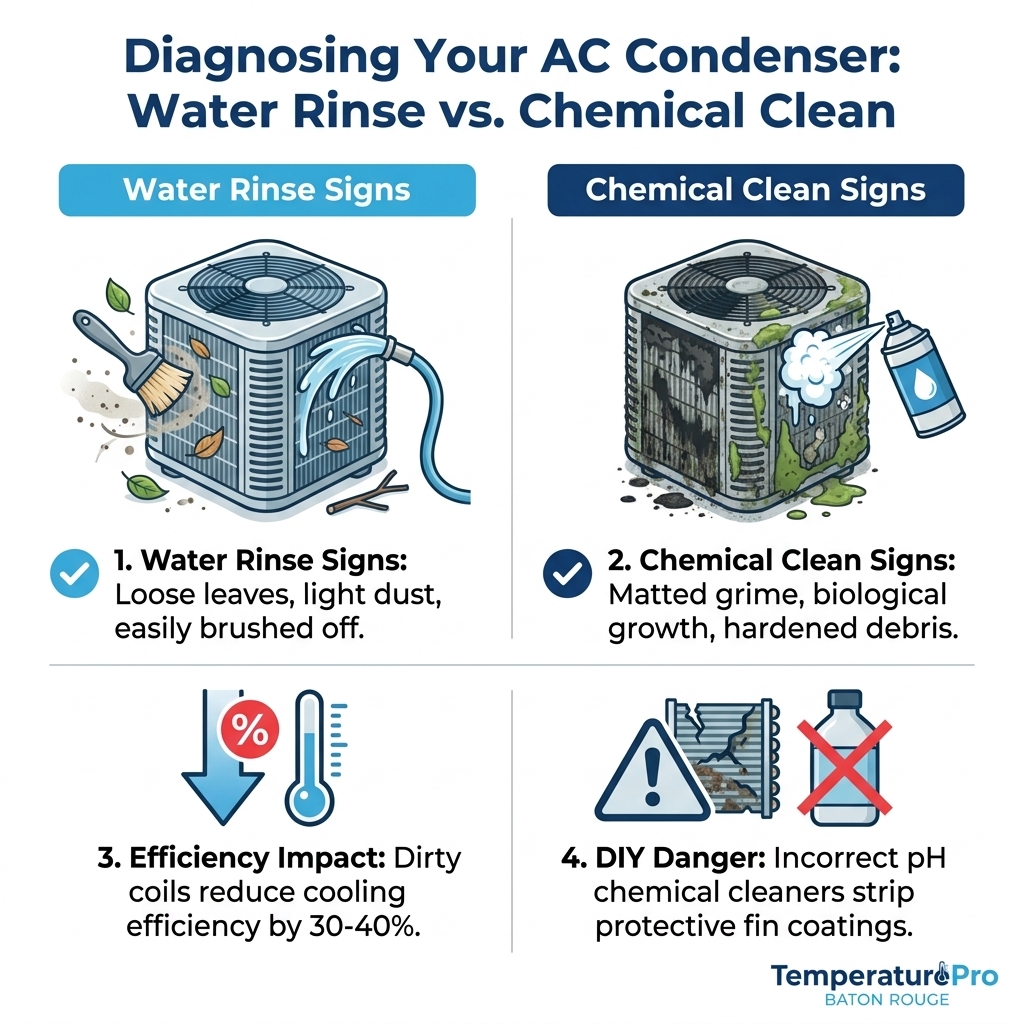
• Visual Appearance — Water Rinse Sufficient: Fins are mostly visible; light, uniform dust coating. — Chemical Clean Required: Fins are obscured; dark, matted, or fuzzy buildup present.
• Debris Texture — Water Rinse Sufficient: Dry, loose, easily brushed away (leaves, dry grass, light dirt). — Chemical Clean Required: Sticky, hardened, greasy, or biological (mold, heavy pollen crust).
• Airflow Restriction — Water Rinse Sufficient: Minimal; exhaust fan pushes air strongly upward. — Chemical Clean Required: Severe; exhaust air feels weak or the fan motor sounds strained.
• Equipment Risk Level — Water Rinse Sufficient: Low (if using gentle pressure); high risk of fin damage if using a power washer. — Chemical Clean Required: High; requires precise pH balancing and thorough chemical neutralization to prevent corrosion.
• Maintenance Frequency — Water Rinse Sufficient: Can be performed multiple times a year to maintain peak efficiency. — Chemical Clean Required: Typically needed every 1 to 3 years depending on neglect and local climate severity.
Diagnosing Your AC Condenser: Water Rinse vs. Chemical Clean
Honest Assessments: The Integrity Behind Professional Maintenance
One of the most frustrating aspects of navigating home maintenance is the fear of being sold a service you do not actually need. In the HVAC industry, it is an unfortunate reality that some companies default to upselling chemical cleans on every single service call, even when a gentle water rinse is perfectly sufficient. This practice not only costs homeowners unnecessary money, but it also repeatedly exposes the equipment to harsh chemicals that can degrade the aluminum fins over time. True professional maintenance is rooted in diagnostic accuracy, not high-pressure sales tactics.
Working with a veteran-owned company means you are getting the same level of discipline, integrity, and accountability that military service demands. The commitment to honest diagnostics means a technician will only recommend a chemical clean when the sticky, baked-on grime explicitly demands it. A thorough inspection determines the exact level of cleaning required, and a reputable technician will always take the time to explain the 'why' behind their recommendation.
For instance, when a homeowner schedules their first AC tune-up since moving into a new property, they often don't know the maintenance history of the unit. A professional will perform a thorough cleaning and tune-up, carefully explaining the entire process. They will note future maintenance needs and ensure the system is cleaned and checked properly, providing sound advice for the future health of the unit rather than pushing an immediate, unneeded chemical wash just to inflate the invoice. Protecting the longevity of your equipment through a grueling Louisiana high-humidity summer is always the ultimate priority, and that starts with absolute transparency.
Frequently Asked Questions About AC Coil Maintenance
Can I just spray my outside AC unit with a hose?
Yes, you can gently spray your outside unit with a garden hose to remove light dust and loose debris. However, you must use a standard nozzle on a gentle setting, aiming at a downward angle to avoid pushing dirt deeper into the unit. Never use a high-pressure nozzle or a power washer, as the intense force will instantly bend and flatten the delicate aluminum fins, destroying the unit's ability to transfer heat.
Do I really need AC coil cleaner?
AC coil cleaner is only genuinely necessary when the condenser is coated in sticky, hardened grime, grease, or biological growth that water cannot remove. If your unit in Baton Rouge has been neglected for several years and has accumulated a thick crust of pollen and mold, a chemical cleaner is required to break those molecular bonds. For routinely maintained systems with only light dust, water is usually enough.
What happens if you don't clean AC condenser coils?
If you leave your condenser coils dirty, the grime acts as a thick insulating blanket that traps heat inside the system. This forces the compressor to work much harder and run much longer to cool your home, which can increase your energy consumption by up to 40 percent. Over time, this constant strain leads to overheating, skyrocketing utility bills, and eventual premature failure of the compressor.
Will coil cleaner damage aluminum fins?
Coil cleaner can severely damage aluminum fins if the wrong pH formula is used or if it is left on the metal for too long. Harsh acidic or alkaline cleaners can strip the protective factory coating off the fins, leading to rapid corrosion and micro-leaks. This is exactly why chemical coil cleaning should always be performed by a licensed professional who knows how to properly apply and neutralize the agents.
How often should condenser coils be cleaned in a high-humidity climate?
In high-humidity climates where moisture and pollen create sticky buildup rapidly, condenser coils should be inspected and lightly cleaned at least once a year, ideally during a spring tune-up. Depending on the proximity of trees, foliage, and heavy storms, some units may benefit from a gentle water rinse twice a year to ensure optimal airflow during the peak heat of summer.
Make the Right Call for Your Condenser's Health
Ultimately, determining the right cleaning method for your air conditioning unit comes down to accurately identifying the specific type of buildup coating your coils. While a gentle water rinse is perfect for clearing away dry dust and loose leaves, it simply cannot break down the stubborn, baked-on grime that accumulates during a brutal Louisiana high-humidity summer. By understanding the clear visual criteria and performance indicators we have outlined, you can confidently separate a routine water-only job from a scenario where heavy-duty chemical intervention is absolutely mandatory.
Your comfort and the longevity of your equipment depend on making the right diagnostic call. Guessing at the condition of your condenser or attempting a risky DIY chemical wash can lead to severe mechanical damage and voided warranties. Instead, rely on transparent, honest expertise to evaluate your system. Schedule a professional inspection today to get a clear, accurate assessment of your unit, ensuring your home stays cool, efficient, and protected all season long.
Thank you! Your submission has been received!
Oops! Something went wrong while submitting the form.
Prevent sudden heating breakdowns with these home maintenance tips and troubleshooting insights. Get clear answers on why pre-winter HVAC inspections matter.
Most homeowners think a late-week appointment is the most convenient choice for an HVAC tune-up. Discover why our dispatchers highly recommend booking on a Tuesday morning instead.
A furnace shutting down repeatedly during early fall tests is frustrating, but jumping the safety switch is a dangerous mistake. Understand the severe fire hazards of this DIY workaround.