What Louisiana Homeowners Need to Know About Federal Tax Credits for AC and Heat Pump Upgrades
Federal tax credits for AC and heat pump upgrades are available to Louisiana homeowners right now — and they can significantly reduce what you pay out of pocket for a new high-efficiency system.
Here is a quick summary of what is currently available:
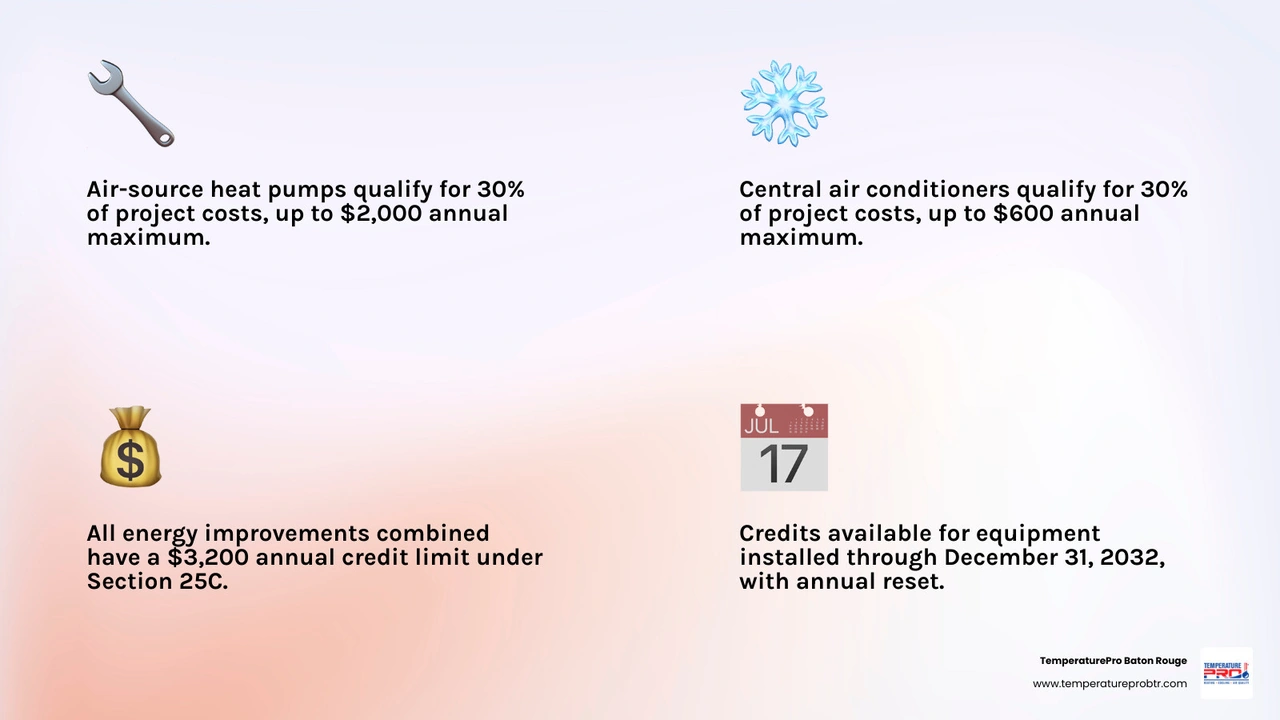
• Air-source heat pump — Credit Amount: 30% of project cost — Maximum Annual Credit: $2,000
• Central air conditioner — Credit Amount: 30% of project cost — Maximum Annual Credit: $600
• All energy improvements combined — Credit Amount: 30% of project cost — Maximum Annual Credit: $3,200
• Credits apply to equipment installed between January 1, 2023, and December 31, 2025
• Heat pumps fall under Section 25C of the tax code (Energy Efficient Home Improvement Credit)
• Geothermal heat pumps fall under Section 25D (Residential Clean Energy Credit) — a separate program with no annual dollar cap
• Credits are nonrefundable, meaning they reduce your tax bill but cannot exceed what you owe
• Starting in 2025, you must include a Qualified Manufacturer Identification Number (QMID) on your tax return for eligible equipment
• You claim these credits using IRS Form 5695
The Inflation Reduction Act of 2022 made these credits far more valuable than they used to be. Before 2023, homeowners were limited to a $500 lifetime cap. Now there is no lifetime limit — just an annual one — which means you can claim the maximum credit every year you make eligible improvements through 2025.
In 2024 alone, more than 2.3 million American families claimed over $2 billion in energy efficiency credits, averaging around $880 per household. For Baton Rouge homeowners dealing with intense Louisiana summers, upgrading to a high-efficiency AC or heat pump is one of the smartest financial moves available right now.
Understanding Federal Tax Credits for AC and Heat Pump Upgrades
Navigating tax law can feel like trying to find your way through a swamp without a map, but we are here to help clear things up. The current incentives are part of the Energy Efficient Home Improvement Credit. Under this program, you can claim 30% of the total cost of your project, including labor for certain mechanical systems.
There is an important distinction to make between the two main sections of the tax code. Section 25C covers standard home improvements like air-source heat pumps and central air conditioners. Section 25D, on the other hand, covers "Residential Clean Energy," which includes geothermal systems and solar power. While Section 25C has specific annual dollar caps, Section 25D allows for a straight 30% credit with no maximum limit.
When choosing between systems, many of our neighbors in Prairieville and Denham Springs ask about the difference in savings. While a central AC has a $600 cap, a heat pump offers a much larger $2,000 annual limit. To dive deeper into which technology is right for your home, check out our guide on Heat Pump vs AC Only System: Which is Better.
How Federal Tax Credits for AC and Heat Pump Upgrades Apply to Heat Pumps
Heat pumps are the "stars" of the Inflation Reduction Act. Because they provide both heating and cooling in one energy-efficient package, the government offers a much higher incentive to install them. You can claim 30% of the cost, up to $2,000 per year. This credit is separate from the $1,200 limit applied to other home improvements, meaning you could potentially claim up to $3,200 in a single year if you combine a heat pump with other upgrades like insulation or windows.
In our humid South Louisiana climate, heat pumps are incredibly effective. They don't just cool your home; they are masters of dehumidification. For a full breakdown of why these systems are a perfect fit for our local weather, see our article on Heat Pump Benefits for Louisiana Homeowners.
Claiming Federal Tax Credits for AC and Heat Pump Upgrades for Central Air
If you prefer a traditional central air conditioner, you can still take advantage of federal tax credits for ac and heat pump upgrades. The maximum credit for a central AC unit is $600. To qualify, the unit must meet specific high-efficiency standards set by the Consortium for Energy Efficiency (CEE).
Living in places like Central or Zachary, we know that our AC units work overtime. The intense humidity and heat can take a toll on equipment. Choosing a high-efficiency unit not only nets you a tax credit but also helps your system stand up to the local environment. Learn more about How Louisiana Heat and Humidity Affect AC Lifespan to see why efficiency is about more than just tax savings.
Efficiency Requirements for 2025 and 2026 Claims
Not every unit you see at a big-box store qualifies for a credit. To protect the environment and your wallet, the IRS requires systems to meet strict efficiency metrics. You will see terms like SEER2, EER2, and HSPF2. These are simply measurements of how much cooling or heating the unit provides per watt of electricity used.
For 2025 and 2026 claims, the equipment must generally meet the "highest non-advanced tier" established by the CEE.
• Split System AC — SEER2 Requirement: ≥ 17.0 — EER2 Requirement: ≥ 12.0 — HSPF2 Requirement: N/A
• Packaged AC — SEER2 Requirement: ≥ 16.0 — EER2 Requirement: ≥ 11.5 — HSPF2 Requirement: N/A
• Heat Pump (Ducted) — SEER2 Requirement: ≥ 15.2 — EER2 Requirement: ≥ 10.0 — HSPF2 Requirement: ≥ 7.8
• Heat Pump (Ductless) — SEER2 Requirement: ≥ 16.0 — EER2 Requirement: ≥ 9.0 — HSPF2 Requirement: ≥ 9.0
2025 Standards for Split System AC
As of January 1, 2025, the bar has been raised. For a split system central air conditioner to qualify for the $600 credit, it must meet a SEER2 rating of at least 17.0 and an EER2 of 12.0. These ratings ensure that the system is significantly more efficient than the standard models installed a decade ago. Given that systems in the South often have a shorter lifespan due to heavy use, investing in a high-efficiency model can pay off in lower monthly bills. For more on this, read about the Average Lifespan of an AC System in the South.
For heat pumps, the 2025 requirements offer two pathways: the "Cold Climate" pathway and the "Cooling-Dominated" pathway. Since we are definitely in a cooling-dominated region in Louisiana, our focus is on units that excel at removing heat and moisture.
Whether you choose a ducted system or a ductless mini-split, the equipment must be ENERGY STAR "Most Efficient" certified to qualify for the $2,000 credit. Because these systems are more complex, they often last longer when properly maintained. You can check out How Long Does an AC System Last in Louisiana to see how heat pumps compare to traditional units in terms of durability.
Maximizing Your Savings: Annual Limits and Strategic Planning
One of the most powerful aspects of the Inflation Reduction Act is that the credits reset every year. The total annual limit is $3,200. This is broken down into two distinct "buckets":
1. The $2,000 Bucket: Specifically for heat pumps, heat pump water heaters, and biomass stoves.
2. The $1,200 Bucket: For central AC ($600 max), furnaces ($600 max), attic insulation, windows, and doors.
A "pro tip" for maximizing these federal tax credits for ac and heat pump upgrades is to spread your projects out. For example, you could install a new heat pump this year and claim $2,000. Next year, you could replace your windows and add attic insulation to claim another $1,200. This multi-year strategy allows you to bypass the annual caps and get the government to pay for a larger portion of your total home renovation.
If you are unsure if your current system needs a full replacement or just a tune-up, our guide on When to Repair vs Replace Your HVAC System can help you decide the best timing for your tax strategy.
Combining Upgrades in Baton Rouge
To get the most out of a new heat pump, your home's infrastructure needs to be up to the task. If your home in St. Gabriel or French Settlement has an older electrical panel, you might need an upgrade to handle the new equipment. The good news? Electrical panel upgrades of 200 amps or more qualify for a $600 tax credit if they are installed in conjunction with energy-efficient property like a heat pump.
We also highly recommend "envelope first" upgrades. Sealing air leaks and adding insulation in your attic reduces the load on your new HVAC system, allowing you to potentially install a smaller, less expensive unit. If you're looking at the total cost of these improvements, we offer HVAC Financing Prairieville LA to help bridge the gap.
Stacking with HEEHRA and Utility Rebates
In addition to federal tax credits, there are other ways to save. The High-Efficiency Electric Home Rebate Act (HEEHRA) provides point-of-sale rebates for low-to-moderate-income households. These can be as high as $8,000 for a heat pump installation.
Furthermore, local utilities like Entergy Louisiana often offer their own incentives for high-efficiency equipment. When you combine federal credits, state-administered rebates, and utility incentives, the "net cost" of a premium system can become very affordable. For more information on how to manage these costs, visit our Financing page.
Eligibility and Documentation: Who Qualifies in Louisiana?
Who can claim these credits? Most residents in our service area, from Walker to Gonzales, will qualify.
• Principal Residences: Owners of existing homes used as a primary residence qualify for all credits.
• Second Homes: You can claim credits for HVAC equipment (AC and heat pumps) in a second home you use as a residence, but you cannot claim credits for "envelope" improvements like insulation or windows on a second home.
• Renters: If you are a renter and you pay for an eligible upgrade (like a portable heat pump or an energy audit) for your primary residence, you can claim the credit!
• Landlords: Unfortunately, landlords who do not live in the property cannot claim these credits.
To ensure your claim is successful, you must keep your receipts and a copy of the Manufacturer Certification Statement. This is a document from the brand (like Carrier or Trane) that proves the specific model number meets the IRS requirements. For 2025 and 2026 filings, you will also need the Qualified Manufacturer Identification Number (QMID) or a specific PIN provided by the manufacturer.
If you are currently debating whether to fix an old unit or pull the trigger on a new one to get these credits, check out our advice on Repair vs Replace Your AC in Louisiana.
Filing Your Claim in 2026
When you file your 2025 taxes in early 2026, you will use IRS Form 5695. It is important to remember that these are credits, not deductions. A deduction lowers the amount of income you are taxed on, but a credit is a dollar-for-dollar reduction of the tax you owe.
Because these credits are nonrefundable, they can only bring your tax liability down to zero. They cannot be carried forward to future years (unless you are claiming the Section 25D Residential Clean Energy Credit for geothermal or solar). To stay updated on our latest offers that can be paired with these credits, visit our Promotions page.
Frequently Asked Questions
Can I combine federal credits with Louisiana utility rebates?
Yes, you can "stack" incentives, but there is a specific way to do the math. If you receive a subsidized utility rebate (money paid directly to you or the contractor by the utility company), you must subtract that amount from the total project cost before calculating your 30% federal tax credit. For example, if a heat pump costs $10,000 and Entergy gives you a $500 rebate, you would calculate your 30% credit based on $9,500.
Do labor and installation costs qualify for the credit?
For "Residential Energy Property" (which includes central AC and heat pumps), the answer is yes! The 30% credit applies to both the equipment and the professional labor required to install it. However, for "Building Envelope Components" like windows, doors, and insulation, the credit only applies to the cost of the materials, not the labor. This makes the HVAC credit particularly valuable since installation is a significant part of the total investment.
Is there a lifetime limit on these tax credits?
No! This is the biggest change brought by the Inflation Reduction Act. The old $500 lifetime limit is gone. It has been replaced by annual limits ($3,200 total) that reset every January 1st. This allows for strategic multi-year retrofits. You can upgrade your home in stages through 2032 and receive thousands of dollars in total credits over that decade.
Conclusion
At TemperaturePro Baton Rouge, we aren't just HVAC experts; we are your neighbors. As a family and veteran-owned company, we take pride in helping families across Baton Rouge, Prairieville, Gonzales, and the surrounding areas stay comfortable while saving money.
The federal tax credits for ac and heat pump upgrades represent a rare opportunity to have the government help pay for a major home improvement that will lower your energy bills for years to come. Whether you are in Zachary, Denham Springs, or St. Gabriel, our team is ready to help you select a qualifying system and provide the documentation you need for your tax return.
Don't let these credits go to waste. Contact us today to schedule a consultation and see how much you can save. And don't forget to check our Promotions page for even more ways to keep your home comfort affordable!