5 min read
Common Homeowner Questions Answered: Why Your Heater Smells Like Burning Dust
Why does your heater smell like burning dust in fall? See how to spot normal burn-off versus a real hazard in these common homeowner questions answered.


How Long Does an AC System Last in Louisiana? (The Short Answer)How long does an ac system last in louisiana depends on your system type and how well you maintain it — but the heat and humidity here take a real toll compared to the rest of
How long does an ac system last in louisiana depends on your system type and how well you maintain it — but the heat and humidity here take a real toll compared to the rest of the country.
• Central Split-System AC — National Average Lifespan: 15-20 years — Louisiana-Adjusted Lifespan: 10-15 years
• Heat Pump (Air-Source) — National Average Lifespan: 10-15 years — Louisiana-Adjusted Lifespan: 8-12 years
• Package Unit (Rooftop/Slab) — National Average Lifespan: 12-15 years — Louisiana-Adjusted Lifespan: 8-12 years
• Mini-Split (Ductless) — National Average Lifespan: 12-20 years — Louisiana-Adjusted Lifespan: 10-16 years
• Geothermal System — National Average Lifespan: 20-25 years — Louisiana-Adjusted Lifespan: 18-24 years
Most Louisiana homeowners can expect 10 to 15 years from a central AC system with regular maintenance. Without it, that number drops fast.
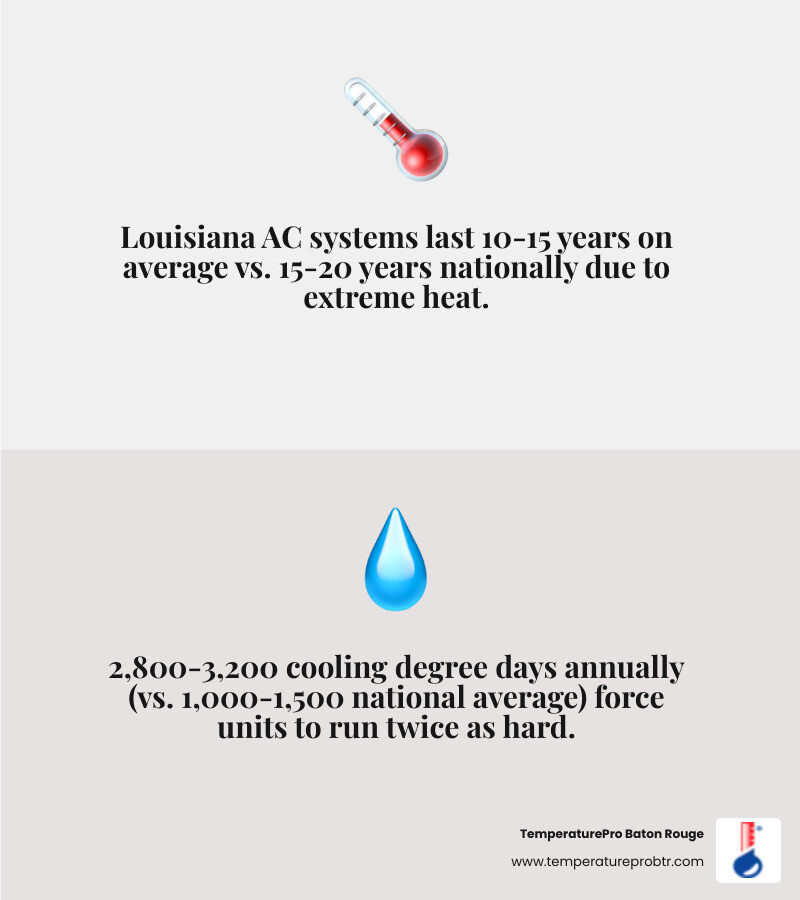
Here's why: Louisiana racks up 2,800 to 3,200 cooling degree days every year. The national average is only 1,000 to 1,500. That means your system is running almost twice as hard as one in, say, Indianapolis — and wearing down at roughly the same rate.
Add in humidity levels that regularly top 80%, salt air in coastal parishes, and the occasional flood or tropical storm, and it's no surprise that systems here don't make it to the national benchmarks listed on the box.
If your unit is pushing 10 years old and starting to act up, it's worth understanding what's really going on — and what your options are.
When we talk about the lifespan of an air conditioner in places like Baton Rouge or Gonzales, we have to look at the "mileage" rather than just the years. Think of your AC like a work truck. A truck driven 10,000 miles a year in a mild climate will last much longer than one driven 30,000 miles a year through swampy, humid terrain.
In Louisiana, our "mileage" is measured in Cooling Degree Days (CDD). This is a technical way of saying how often and how hard your AC has to work to keep you comfortable. With our local range of 2,800–3,200 CDDs annually, our systems face massive mechanical wear. The national average is often less than half of that. This high run-time means the compressor, fan motors, and capacitors reach their "end of life" much sooner than a manufacturer’s brochure might suggest.
Furthermore, thermal stress plays a huge role. During a typical July in Prairieville or Denham Springs, the temperature swings between the scorching afternoon sun and the humid evening air create constant expansion and contraction in the metal components. Over a decade, this leads to refrigerant leaks and electrical failures. If you are noticing that your system is struggling to keep up with the afternoon heat, it might be time to look into AC Replacement Baton Rouge.
Not all cooling systems are built the same, and their "survival rate" in the Bayou varies:
• Central Split-Systems: These are the most common units in our area. While they can technically last 15–20 years in cooler states, the Louisiana-adjusted range is 10–15 years.
• Heat Pumps: Because these units handle both heating and cooling, they run year-round. In our climate, they usually last 8–12 years.
• Mini-Splits (Ductless): These often fare slightly better due to advanced inverter technology, lasting 10–16 years.
• Package Units: Often found on rooftops or slabs, these are entirely exposed to the elements, leading to a shorter lifespan of 8–12 years.
• Geothermal Systems: These are the "marathon runners" of HVAC, with indoor units lasting 18–24 years and underground loops lasting 50+ years.
For those living in areas like St. Gabriel, choosing the right type of system for your home's specific footprint is essential. You can learn more about local options at AC Replacement St. Gabriel LA.
Humidity is the silent killer of HVAC systems in the South. When relative humidity levels exceed 80%, your AC isn't just cooling the air; it is working overtime as a giant dehumidifier. This constant moisture creates a breeding ground for mold and biological growth on the evaporator coils.
Moreover, moisture leads to corrosion. In coastal parishes or even inland areas with high moisture, "pitting" occurs on the copper coils. This creates microscopic holes that lead to refrigerant leaks. For homeowners in Walker or Central, the combination of high humidity and organic debris (like pollen and dust) can create a "sludge" that clogs drain lines and rusts out the internal components of the air handler. If your system is starting to show signs of age due to moisture, it might be time to consider Central AC System Upgrades.
How do you know if your AC is just having a "bad day" or if it’s truly on its last legs? In our experience serving the Baton Rouge area, there are several red flags that suggest retirement is imminent.
One of the most obvious signs is frequent repairs. If you’ve had to call a technician three times in the last two summers, you aren't just paying for maintenance; you are "limping" a dying system along. Another major indicator is rising utility bills. If your routine hasn't changed but your electricity bill is 20% higher than last year, your system has lost its efficiency.
Other warning signs include:
• Inconsistent Cooling: Some rooms are ice-cold while others are stifling.
• Strange Noises: Squealing, grinding, or banging sounds often indicate a failing motor or compressor.
• Odors: A "dirty sock" smell suggests mold growth, while a burning electrical smell is a serious emergency that requires an immediate shutdown.
For a deeper dive into these symptoms, check out our guide on AC System Replacement Warning Signs.
If your AC was installed before 2010, there is a high chance it uses R-22 refrigerant, commonly known as Freon. The EPA has phased this out entirely due to environmental concerns. This means that if your older unit develops a leak, the cost to "recharge" it is astronomically high because the supply is so scarce.
In many cases, a single refrigerant leak in an R-22 system makes the unit "economically totaled." It simply doesn't make sense to pour money into an obsolete refrigerant when that could be a down payment on a modern, high-efficiency system. If you suspect your compressor is failing on an older unit, see our tips on Signs Your AC Compressor Needs Replacement.
An aging AC system doesn't just fail to cool; it fails to clean the air. Older units often struggle with dust accumulation and musty smells. As components degrade, they lose their ability to manage humidity, leaving your home feeling "clammy" even when the air is technically cool.
Short cycling—where the AC turns on and off every few minutes—is another performance issue that kills longevity. It puts massive strain on the electrical components and prevents the system from properly dehumidifying the house. If you are experiencing these issues, our AC System Upgrade Guide can help you understand the benefits of newer technology.
Deciding whether to fix your current unit or buy a new one is a big financial choice. We recommend using two industry-standard "rules of thumb":
1. The $5,000 Rule: Multiply the age of your unit by the cost of the repair. If the total is more than $5,000, it is usually better to replace it. (For example, a 10-year-old unit needing a $600 repair = $6,000. Replace it!)
2. The 50% Rule: If the cost of the repair is more than 50% of the value of a new system, replacement is the smarter long-term investment.
Newer systems must meet SEER2 (Seasonal Energy Efficiency Ratio) standards, which are significantly higher than the units built a decade ago. Upgrading can often slash your cooling costs by 20% to 40%. You can find more help with this decision in our article When Is It Time for AC Replacement.
While the Louisiana climate is harsh, you aren't powerless. You can significantly extend the life of your system with a few disciplined habits:
• Filter Changes: Change your filters every 1–3 months. A clogged filter forces the motor to work harder, shortening its life.
• Coil Cleaning: Have a professional clean your evaporator and condenser coils annually to prevent corrosion and improve heat transfer.
• Clear Debris: Keep at least two feet of clearance around your outdoor unit. Cut back any Bayou foliage or weeds that might restrict airflow.
• Annual Tune-Ups: A professional inspection in the Spring can catch a small issue (like a $20 capacitor) before it kills a $2,000 compressor.
When it does come time to choose a new unit, making the right choice for our local climate is key. Read more on Choosing the Right AC Replacement.
Yes, absolutely. The extreme temperatures cause "thermal cycling," where parts expand and contract daily. Because our cooling season lasts from March through October (and sometimes into November), our systems accumulate operational hours much faster than systems in the North. This sustained stress leads to faster component fatigue.
Both work well, but they wear differently. A central AC only runs during the warm months, while a heat pump runs year-round to provide heat in the winter. Because a heat pump never gets a "break," it typically has a shorter lifespan (8–12 years) compared to a dedicated central AC unit (10–15 years). However, heat pumps are incredibly efficient for our mild winters in places like French Settlement and Zachary.
Generally, yes. HVAC components are designed to work as a "matched system." If you pair a brand-new, high-efficiency AC with a 20-year-old furnace, the AC won't be able to reach its rated efficiency. Plus, replacing both at once often makes you eligible for better rebates and ensures that all parts are under the same warranty.
At TemperaturePro Baton Rouge, we understand that your air conditioner is the heart of your home’s comfort. As a family and veteran-owned company, we treat our neighbors in Baton Rouge, Prairieville, Gonzales, and the surrounding areas like family. We know the unique challenges our climate poses, and we are dedicated to providing the reliable service you need to stay cool.
Whether your system needs a precision tune-up to squeeze out a few more years of life or you are ready to explore a high-efficiency replacement, we are here to help 24/7. Don't wait for a total breakdown in the middle of a July heatwave. Schedule your professional AC evaluation today and let us help you stay comfortable all year long.
Go With Experience