5 min read
Why Your Heater Smells Like Burning Dust During the October Startup
Alarmed by a burning dust smell during your fall heating startup? Use these home maintenance tips and troubleshooting facts to determine when to call a pro.


Why Choosing an AC for Louisiana Heat and Humidity Feels Like a Different Problem EntirelyChoosing an AC for Louisiana heat and humidity is not the same decision homeowners face in most other states — and getting it wrong means months of st
Choosing an AC for Louisiana heat and humidity is not the same decision homeowners face in most other states — and getting it wrong means months of sticky, uncomfortable air and sky-high energy bills.
Here's what matters most when selecting a cooling system for Louisiana's subtropical climate:
• Prioritize humidity control — Look for variable-speed compressors that run longer at lower capacity to pull moisture out of the air
• Get the sizing right — An oversized unit will short-cycle and leave your home feeling cold and clammy
• Target 16+ SEER2 efficiency — Louisiana's long cooling season means efficiency pays back faster here than anywhere else
• Match the system to your home — Central AC for ducted homes, ductless mini-splits for additions or older homes without ducts, heat pumps for year-round efficiency
• Plan for latent heat — In Louisiana, roughly 30% or more of your AC's energy goes toward removing moisture before it ever lowers the temperature
Louisiana is in a league of its own when it comes to residential cooling demands. The state logs between 2,800 and 3,200 cooling degree days per year — nearly double the national average of 1,000 to 1,500. Homes here use roughly 46% more electricity than the U.S. average, and a standard central AC unit that lasts 15 to 20 years in a drier state may only survive 10 to 15 years in Baton Rouge's relentless heat and moisture.
The air in Louisiana doesn't just feel hot. It feels heavy. That thickness is latent heat — the moisture suspended in the air that your AC must remove before it can meaningfully lower the temperature inside your home. Most AC guides skip right past this. This one won't.
Whether you're replacing an aging system in Baton Rouge, outfitting a new build in Zachary, or adding comfort to a room addition in Prairieville, this guide covers everything you need to make a confident, informed decision.
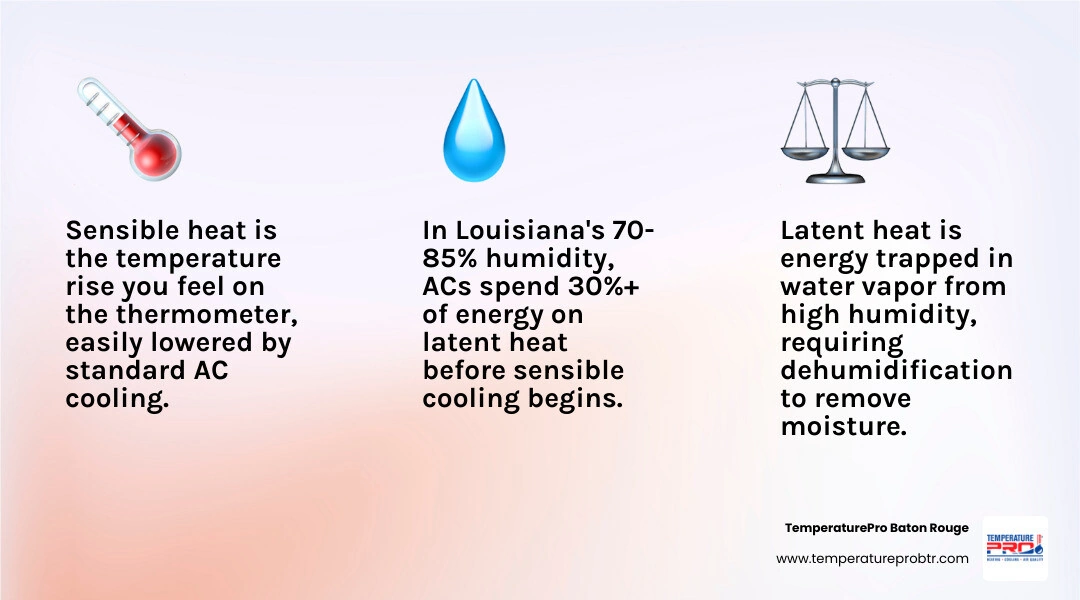
In many parts of the country, an air conditioner has one primary job: lower the temperature. In Louisiana, that’s only half the battle. Our climate is classified as subtropical, meaning we deal with extreme heat and extreme moisture simultaneously. When you are choosing an AC for Louisiana heat and humidity, you aren't just buying a cooler; you are buying a "moisture manager."
The fundamental difference lies in Sensible vs. Latent heat. Sensible heat is what you see on the thermometer. Latent heat is the energy stored in water vapor. Because our relative humidity often hits 70–85% during the cooling season, your AC has to work significantly harder to "wring out" the air before the temperature can actually drop. This is why how Louisiana heat and humidity affect AC lifespan is such a critical topic—the sheer volume of water our systems process leads to faster wear and tear on components.
If your AC system isn't designed to handle high latent loads, your home will feel like a swamp even if the thermostat says it's 72 degrees. Ideally, indoor relative humidity should stay around 50%. When it climbs above 60%, you face more than just discomfort; you risk mold growth and the development of "evaporator coil biofilm." This sludge-like substance acts as insulation on your coils, forcing the system to run longer and hotter to achieve the same results.
Keeping an eye out for signs your AC needs repair in Louisiana heat, such as musty odors or a "sticky" feeling in the air, can help you catch moisture-related issues before they lead to a total system breakdown.
One of the biggest mistakes we see in areas like Denham Springs and Walker is the "bigger is better" mentality. Homeowners often think a 5-ton unit will cool a 3-ton house faster. In reality, this leads to the oversizing trap.
An oversized AC unit will "short-cycle," meaning it reaches the target temperature in five or ten minutes and then shuts off. However, it takes at least 10 to 15 minutes of continuous running for the evaporator coil to get cold enough to start removing significant moisture from the air. Short-cycling leaves that moisture behind, resulting in "cold and clammy" air. To avoid this, we perform a Manual J load calculation, which accounts for your home's square footage, insulation, window orientation, and even local humidity levels. If you're currently dealing with a system that cycles too often, it might be time to learn how to decide between AC repair and replacement.
Not every AC system is built to survive a July afternoon in Gonzales or St. Gabriel. When choosing an AC for Louisiana heat and humidity, you generally have three main paths.
• Best For — Central AC: Whole-home cooling with existing ducts — Heat Pump: Year-round efficiency in mild winters — Ductless Mini-Split: Additions, historic homes, or "hot spots"
• Humidity Control — Central AC: Excellent (with variable-speed) — Heat Pump: High (often includes "Dry Mode") — Ductless Mini-Split: Superior (zoned precision)
• Installation — Central AC: Uses existing ductwork — Heat Pump: Uses existing ductwork — Ductless Mini-Split: No ducts required
• Efficiency — Central AC: High (Up to 20+ SEER2) — Heat Pump: Very High (Dual-purpose) — Ductless Mini-Split: Maximum (No duct energy loss)
The most important technology for our region is the variable-speed compressor (or inverter technology). Unlike traditional units that are either "on" or "off," variable-speed systems adjust their output based on the cooling demand. They can run at 30% or 40% capacity for long periods, providing constant dehumidification and rock-steady temperatures. This is a key factor when looking at Central AC vs. Heat Pump for Louisiana homes.
Many people in Louisiana hear the term "heat pump" and assume it's only for cold climates. In reality, a heat pump is essentially an air conditioner with a reversing valve. In the summer, it works exactly like a standard AC. In our mild winters, it reverses the process to pull heat from the outside air and move it indoors.
Because we rarely see sustained sub-freezing temperatures in Prairieville or Central, heat pumps are incredibly efficient here. Some homeowners opt for dual-fuel systems, which combine a high-efficiency heat pump with a gas furnace for the few nights a year when the temperature truly plunges. If you're weighing your options, check out our breakdown on heat pump vs AC only system - which is better.
If you live in a historic home in Baton Rouge that lacks ductwork, or if you've recently converted a garage or added a sunroom, a ductless mini-split is often the "smart pick." These systems eliminate the energy loss associated with leaky ducts—which can waste 20% to 30% of your conditioned air.
Mini-splits allow for zoned cooling, meaning you can keep your bedroom at 68 degrees while leaving the rest of the house at 75. This flexibility is a lifesaver for families with different temperature preferences. If your current central system is struggling to reach a specific room, it might be when is it time for AC replacement or at least time to consider a supplemental mini-split.
As of May 2026, the standards for AC efficiency have become even stricter. Louisiana is part of the Department of Energy’s "South" region, which carries higher minimum requirements than northern states.
The current minimum for a split-system AC in Louisiana is 14.3 SEER2. You might notice that SEER2 ratings look slightly lower than the old SEER ratings you remember. This is because the new testing procedure uses higher static pressure (0.5 inches instead of 0.1), which more accurately reflects real-world duct conditions.
While 14.3 is the legal minimum, we often recommend 16 or 18 SEER2 for Louisiana homeowners. Because our cooling season lasts nearly nine months, the energy savings from a more efficient unit can pay for the upgrade much faster than in other regions. Considering the average lifespan of an AC system in the South is only 10 to 15 years, maximizing efficiency from day one is essential for your long-term budget.
When you are choosing an AC for Louisiana heat and humidity, the "bells and whistles" actually serve a vital purpose.
1. Variable-Speed Blowers: These allow the fan to ramp up and down slowly, which helps maintain a consistent "wind-chill effect" and keeps the air moving through the filtration system longer.
2. Whole-Home Dehumidifiers: Sometimes, even the best AC needs help. A dedicated dehumidifier can be integrated into your ductwork to pull 70–100 pints of moisture out of the air daily without over-cooling your home.
3. Smart Thermostats: Modern thermostats do more than just set the temperature. They can target specific relative humidity percentages. If the humidity rises, the thermostat can tell the AC to run a specialized dehumidification cycle.
If your current system lacks these features and you're constantly adjusting the dial to feel comfortable, it’s worth weighing the repair vs replace your AC in Louisiana debate. Sometimes, upgrading to a system with better moisture control is the only way to truly "beat the stickiness."
Because our systems work roughly 46% harder than the national average, maintenance isn't a luxury—it's a survival strategy for your equipment.
• Monthly Filter Changes: In high humidity, dust sticks to filters more easily, creating a damp mat that restricts airflow. Check yours every 30 days.
• Coil Cleaning: Louisiana's pollen and moisture create a "biofilm" on coils. Professional cleaning prevents this from suffocating your system.
• Corrosion Protection: For homes near the coast or Lake Pontchartrain, salt air can eat through aluminum fins. We recommend systems with factory-applied epoxy or phenolic coatings to prevent "coil pitting."
• Clear the Drains: Algae loves Louisiana heat. Regularly clearing your condensate drain line prevents backups that can shut down your system or damage your ceiling.
Understanding how long does an AC system last in Louisiana can help you set a realistic expectation and budget for a replacement before an emergency occurs in the middle of a heatwave.
For our specific climate (Climate Zone 1A), we generally recommend a 16 to 18 SEER2 rating. While the legal minimum is 14.3, the high number of cooling degree days in Baton Rouge means you will see a much faster return on investment with a higher-efficiency unit. If you're wondering when should you replace your AC in a hot climate, looking at your monthly energy bills compared to a high-efficiency model is a great place to start.
This is almost always due to short-cycling or an oversized unit. If the AC cools the air too quickly and shuts off, it hasn't had time to remove the moisture. It can also be caused by improper airflow calibration. A professional should check your "CFM per ton" settings to ensure the air is moving slowly enough over the cold coils to dump its moisture.
Absolutely. Modern heat pumps are excellent at dehumidification, especially those with a dedicated "Dry Mode." They provide year-round comfort and are often more energy-efficient than traditional furnace/AC combos for our specific weather patterns. Many models carry Energy Star certification, which can also qualify you for federal tax credits.
Choosing an AC for Louisiana heat and humidity doesn't have to be a stressful process. By focusing on moisture management, proper sizing, and high-efficiency technology, you can turn your home into a true sanctuary from the Gulf Coast swelter.
At TemperaturePro Baton Rouge, we are a family and veteran-owned company that understands exactly what our neighbors in Prairieville, Gonzales, Zachary, and beyond are up against. We treat every customer like family and offer 24/7 support to ensure you never have to "sweat it" for long. Whether you need a precision Manual J calculation for a new installation or a tune-up to extend the life of your current unit, trust our experts for your next air conditioning installation. We’re here to keep Baton Rouge cool, one home at a time.
Go With Experience