5 min read
Home Maintenance Tips and Troubleshooting for Your Fall HVAC Switchover
Smelling burning dust when the heat kicks on? Decide with confidence using vital home maintenance tips and troubleshooting steps for fall HVAC switchovers.


Why Humidity and Pollen in Baton Rouge, LA Make Filter Replacement More Urgent Than You ThinkUnderstanding how humidity and pollen affect filter replacement timing is especially critical for homeowners in Baton Rouge, LA — where the Gulf Co
Understanding how humidity and pollen affect filter replacement timing is especially critical for homeowners in Baton Rouge, LA — where the Gulf Coast climate delivers some of the most demanding air quality conditions in the country. Between relentless spring pollen seasons and humidity levels that regularly push past 60% RH, your HVAC filter faces a double threat that standard 90-day replacement advice simply doesn't account for.
Quick Answer: How Humidity and Pollen Affect Filter Replacement Schedule
• Standard home, mild climate — Recommended Replacement Interval: Every 60–90 days
• High pollen season (spring/fall) — Recommended Replacement Interval: Every 30–60 days
• Indoor humidity above 50% RH — Recommended Replacement Interval: Every 45–60 days
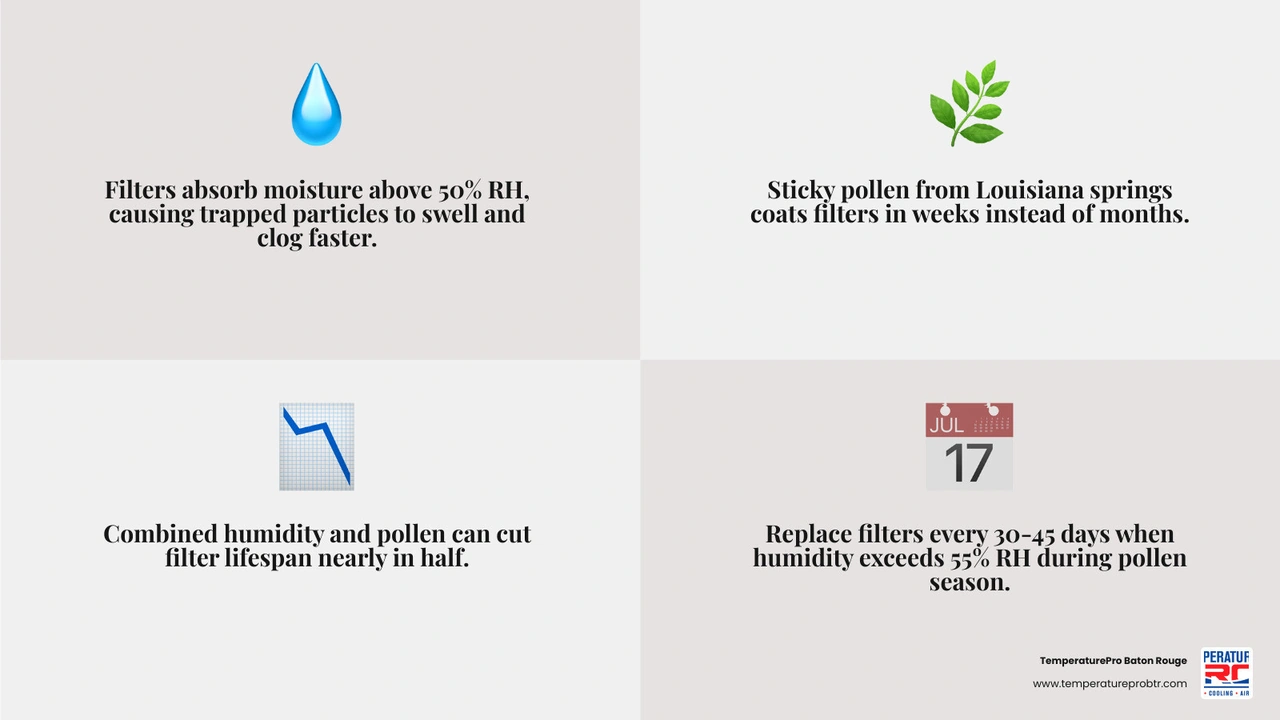
• High pollen + humidity above 55% RH — Recommended Replacement Interval: Every 30–45 days
• Allergy sufferers or pets added — Recommended Replacement Interval: Every 20–30 days
Here's the core issue: high humidity causes filter fibers to absorb moisture, which makes trapped particles swell and clump together — clogging the filter much faster than normal. At the same time, pollen (especially the sticky, heavy tree and grass pollen common across Louisiana in spring) coats filter surfaces quickly, restricting airflow within weeks rather than months. Together, these two factors can cut your filter's effective lifespan nearly in half.
According to the EPA, indoor pollutant concentrations are often 2 to 5 times higher than outdoor levels — and Americans spend roughly 90% of their time indoors. In a city like Baton Rouge, where you're sealing the house to run the AC for much of the year, the air your family breathes is only as clean as your filter allows.
If you've noticed your energy bills creeping up, more dust settling on surfaces, or allergy symptoms flaring when the HVAC runs, your filter schedule may already be falling behind.
When you purchase an air filter at a local store in Prairieville or Denham Springs, the packaging often boasts a "lasts up to 90 days" guarantee. While that 3-month baseline might hold true in a dry, low-pollen climate, it is highly unrealistic for homes along the Gulf Coast. Environmental factors dictate the true lifespan of your filtration media, and ignoring these factors can lead to poor indoor air quality, restricted airflow, and unnecessary wear on your air conditioner.
In Louisiana, we experience distinct seasonal shifts that completely alter how your heating and cooling system operates. During peak pollen periods, trees, grasses, and weeds release massive amounts of microscopic spores into the air. Even with your windows closed, these tiny particles find their way indoors on your clothing, shoes, and pets. Once inside, they are pulled directly into your return vents.
If your system is running constantly to fight the Louisiana heat, it acts as a giant vacuum cleaner, scrubbing the air and loading the filter with yellow pollen dust. When you combine this heavy biological load with our regional moisture levels, the standard replacement timeline completely falls apart. To keep your system running smoothly, it is essential to understand How Often Should You Change Your AC Filter in Louisiana so you can adjust your habits before a minor clog turns into an expensive system breakdown.
To understand why moisture and pollen are such a destructive pairing for your HVAC system, we have to look at the physical properties of the filter media and the particles themselves. Most residential air filters are made of pleated paper, synthetic fibers, or fiberglass. These materials are designed to create a maze-like path that traps airborne debris while allowing clean air to pass through relatively unimpeded.
When relative humidity (RH) levels inside your home rise—particularly when they climb above the recommended 50% threshold—the filter fibers begin to absorb moisture from the air. As the filter media becomes damp, several physical changes occur:
1. Particle Swelling: Dust, skin cells, and organic fibers trapped on the filter absorb this moisture as well. This causes the individual particles to swell in size, physically blocking the microscopic gaps in the filter media much faster than dry dust would.
2. The "Glue" Effect: Pollen grains, especially from Louisiana oak and pine trees, have sticky outer shells designed to adhere to plant surfaces. When these grains contact a damp filter, they stick instantly and create a dense, non-porous glaze over the pleats.
3. Clumping and Matting: Instead of settling loosely across the filter surface, damp dust and pollen clump together to form a thick, paper-like mat.
This physical transformation triggers a sharp increase in what HVAC professionals call "pressure drop"—the resistance to airflow created by the filter. A damp, pollen-glazed filter can experience a 10% to 15% increase in pressure drop even if it does not look completely covered in dirt. This restricts the volume of air your blower motor can move, forcing your system to run longer cycles to cool your home. Over time, this constant strain can significantly impact your equipment, which is why understanding How Louisiana Heat and Humidity Affect AC Lifespan is so vital for local homeowners looking to protect their investments.
Because our local weather conditions are so unique, we recommend that homeowners in Baton Rouge, Gonzales, and Zachary throw out the generic calendar-based replacement schedules. Instead, your filter maintenance routine should be directly tied to the actual pollen and moisture levels inside and outside your home.
During the spring and fall pollen spikes, we highly recommend inspecting your filter every 2 to 3 weeks. If you live near heavily wooded areas in Central or Walker, or if you have outdoor pets that carry pollen indoors, you will likely need to swap your filter every 30 days.
During the peak humid summer months, even if pollen counts have dropped, the sheer volume of moisture in the air continues to compromise filter performance. If your indoor relative humidity levels consistently hover above 50%, a 45-day replacement cycle is ideal. By keeping a close eye on your indoor climate and implementing proactive AC and Humidity Control Tips for Gulf Coast Homes, you can keep your air flowing freely and prevent your system from working itself to death.
Many modern homes in our service areas utilize non-standard filter sizes, such as the 17.25x23.25x2 filter. These 2-inch deep pleated filters are fantastic because they offer significantly more surface area than standard 1-inch retail filters. In theory, this extra depth allows them to capture more dust and last longer before needing a replacement. However, high humidity acts as an equalizer, neutralizing much of the advantage that deeper filters provide.
When a 17.25x23.25x2 filter is exposed to high humidity, the deep pleats can actually trap and hold moisture inside the filter cabinet. Because the filter is located in the return duct—often in a dark closet, attic, or utility room—it becomes the perfect environment for biological growth.
Mold spores are microscopic and exist naturally in almost all air. Under normal, dry conditions, your filter simply traps these spores harmlessly until you throw the filter away. However, if your indoor humidity rises above 60% RH, the organic dust, dander, and pollen trapped on the filter surface become a banquet for mold.
Once mold colonizes the damp filter media, the HVAC system's blower motor will pull air directly through this active growth. Instead of cleaning your air, your filter begins distributing mold spores throughout your ductwork and into every room of your home, including bedrooms and living spaces. This is why managing relative humidity and choosing high-quality filtration is so critical. To protect your family's health and prevent musty odors from taking over your home, it is worth exploring How Air Filtration and Purification Reduce Mould Risk in damp environments.
Choosing the right Minimum Efficiency Reporting Value (MERV) rating is a balancing act. You want a filter that is efficient enough to trap tiny pollen grains and mold spores, but not so restrictive that it chokes your air conditioner's airflow. When you add high humidity to the equation, this choice becomes even more critical.
• MERV 8 — Pollen Capture Efficiency: Captures large pollen grains (70-85% efficiency) — Moisture Performance: Maintains decent airflow even when damp; low risk of severe pressure drop — Recommended Replacement: Every 45–60 days — Best Suited For: Standard homes with no severe allergies or indoor pets
• MERV 11 — Pollen Capture Efficiency: Captures fine pollen, mold spores, and pet dander (85%+ efficiency) — Moisture Performance: Sweet spot for filtration; moderate airflow resistance when damp — Recommended Replacement: Every 30–45 days — Best Suited For: Allergy sufferers, pet owners, and homes in high-pollen areas
• MERV 13 — Pollen Capture Efficiency: Captures bacteria, smoke, and microscopic allergens (90%+ efficiency) — Moisture Performance: High risk of severe airflow restriction and high static pressure when damp — Recommended Replacement: Every 30 days (monitor closely) — Best Suited For: Severe asthma sufferers; requires a modern HVAC system with strong static pressure tolerance
Using a MERV 13 filter in a highly humid environment requires vigilance. Because the weave of a MERV 13 filter is incredibly tight, even a small amount of moisture-swollen dust can completely block airflow. If your blower motor has to fight against a damp, clogged MERV 13 filter, the static pressure inside your system will spike. This can lead to frozen evaporator coils, weak airflow from your registers, and a noticeable drop in cooling performance. To avoid these issues, it is helpful to understand How Humidity Affects Your AC Performance so you can pair the right filter rating with your home's unique moisture levels.
How do you know if your filter is struggling before your air conditioner shuts down completely? Fortunately, your home will give you several clear warning signs if humidity and pollen are taking a toll on your filtration system.
• The Visual "Light Test": Pull your filter out of the return grate and hold it up to a bright light or flash a flashlight behind it. If light cannot easily penetrate the pleats, the filter is loaded with fine pollen and dust and needs to be replaced, even if it doesn't look completely black or gray.
• Musty Odors: If you notice a damp, earthy, or musty smell the moment your AC fan kicks on, this is a strong indicator that your filter is holding moisture and may have active mold or bacterial growth.
• Increased Dusting: When a filter becomes completely saturated, the air pressure can cause the filter frame to bow or buckle. This creates gaps around the edges, allowing unfiltered, pollen-rich air to bypass the filter entirely and settle on your furniture.
• Longer AC Cycles: If your air conditioner seems to run continuously without ever reaching the set temperature on your thermostat, a moisture-clogged filter is often the culprit.
To combat these issues and extend the life of your filter during heavy pollen seasons, we recommend using a digital hygrometer to monitor your indoor air. Placing a hygrometer near your main return vent allows you to track your indoor relative humidity. If you notice your indoor RH consistently climbing above 50%, running a whole-home dehumidifier or adjusting your AC settings can help pull excess moisture out of the air before it ruins your filter. For more practical advice on keeping your home comfortable and dry, check out our guide on How to Improve Indoor Air Quality in Humid Climates.
When your indoor relative humidity levels consistently stay above 50%, the organic matter trapped on your air filter—such as skin flakes, pet dander, and pollen—begins to absorb moisture. Once the humidity in the filter cabinet reaches the 60% RH threshold, mold spores find the ideal conditions to colonize and grow. Because the filter is located directly in your home's main airflow path, any mold growing on the filter media can easily distribute spores throughout your entire living space, worsening respiratory issues and creating persistent musty odors.
The easiest way to stay ahead of environmental filter clogging is to use a combination of local weather apps and indoor tools. Check your favorite weather app daily for regional pollen count forecasts in your part of Baton Rouge or Prairieville. When tree or grass pollen counts are labeled "high," plan to inspect your filter weekly. Indoors, use a simple, inexpensive digital hygrometer to monitor your relative humidity. If your indoor humidity consistently climbs above 50%, you should prepare to replace your filter more frequently to prevent moisture-related clumping.
During a Louisiana summer, your air conditioner runs for hours on end to combat the intense heat and humidity. This high runtime means your system is constantly pulling air—and the dust, dander, and pollen suspended in it—through your filter. Additionally, high summer humidity makes the airborne dust damp, causing it to clump and mat together on the filter surface. In contrast, winter heating cycles are typically shorter, and the indoor air is naturally drier, allowing filters to last longer. To keep your system running efficiently year-round, investing in the Benefits of Regular AC Maintenance is the best way to prevent unexpected summer breakdowns.
At TemperaturePro Baton Rouge, we know that managing your home's indoor air quality is a year-round job. As a family and veteran-owned HVAC company, we treat every customer in Baton Rouge, Prairieville, Gonzales, Denham Springs, Walker, Central, Zachary, St. Gabriel, and French Settlement like family. We understand exactly how our heavy Louisiana humidity and intense seasonal pollen counts impact your home comfort and system performance.
If you want to make sure your air conditioner is prepared to handle whatever the Louisiana weather throws its way, we invite you to check out our Ultimate AC Maintenance Guide Louisiana for expert tips on keeping your system in peak condition.
Don't wait for a clogged filter to cause an unexpected system breakdown during a summer heatwave. You can protect your home with a professional HVAC maintenance plan designed to keep your system clean, efficient, and running smoothly all year long. Give us a call today to schedule your seasonal tune-up!
Go With Experience