5 min read
Why Your AC Struggles in October: A Louisiana Seasonal Home Maintenance Checklist
Why shifting from heavy summer AC use to heating causes breakdowns. Use this seasonal home maintenance checklist to decide when to call a pro.


Why Mold Is a Serious Indoor Air Problem in Baton Rouge, LAHow air filtration and purification reduce mould risk is one of the most important things Baton Rouge homeowners can understand — especially in a region where heat and humidity crea
How air filtration and purification reduce mould risk is one of the most important things Baton Rouge homeowners can understand — especially in a region where heat and humidity create near-perfect conditions for mold to thrive indoors.
Mold is more common than most people realize. About 47% of residential buildings in the United States have mold issues, and with indoor air already up to five times more polluted than outdoor air, the stakes are high. Mold spores are microscopic — many measuring just 2 to 10 microns — and they travel invisibly through the air you breathe every day. Exposure is linked to a 30–50% increase in respiratory illness rates, and for the 26+ million Americans with asthma, airborne spores can trigger serious attacks.
Here is a quick summary of how air filtration and purification reduce mould risk:
• Captures airborne spores — True HEPA filters trap up to 99.97% of particles as small as 0.3 microns, well within the range of most mold spores
• Reduces spore settlement — Airborne fungi decrease 1.5 to 6 times faster when HEPA purifiers are running versus natural air settling
• Neutralizes musty odors — Activated carbon filters absorb the volatile organic compounds (VOCs) that cause that damp, musty smell
• Slows mold spread — By continuously pulling spores out of the air, purifiers reduce the chance of spores landing and colonizing new surfaces
• Supports a layered strategy — Filtration works best alongside moisture control, proper ventilation, and surface cleaning
One important thing to understand upfront: air purifiers are a powerful tool, but they are not a standalone fix. As one industry expert put it, if you don't filter your air, your lungs become the filter. Filtration manages what is already in the air — but controlling humidity and fixing moisture sources is what stops mold from growing in the first place.
To understand how air filtration and purification reduce mould risk, we first have to look at the "enemy" under a microscope. Mold isn't just a fuzzy patch on a wall; it is a living fungus that reproduces by releasing thousands of microscopic spores into the air.
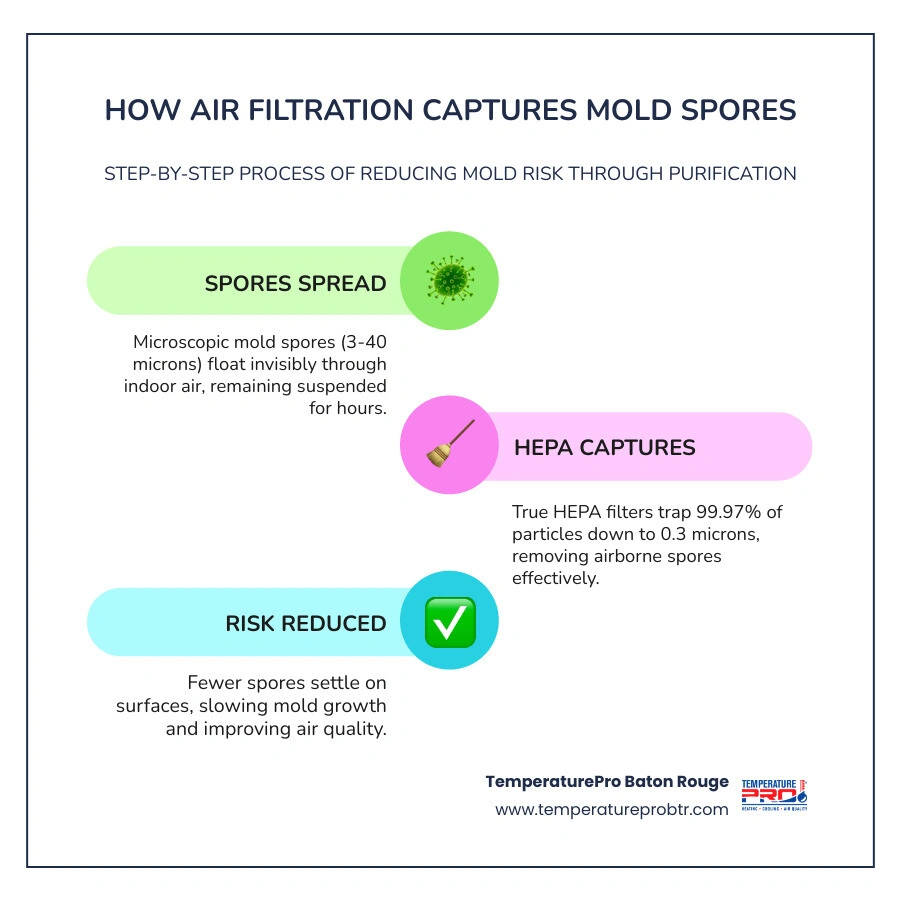
In our humid Louisiana climate—from Baton Rouge to Prairieville—these spores act like opportunistic squatters. They float through your home, looking for a damp surface to call home. Most mold spores measure between 3 and 40 microns in diameter. To give you some perspective, a human hair is about 50 to 70 microns wide. These spores are so light that they can remain suspended in the air for hours or even days, penetrating deep into the respiratory system when inhaled.
When we talk about Indoor Air Quality, we are looking at how to interrupt this cycle. Without an active filtration system, these spores eventually settle on your carpets, furniture, and walls. If those surfaces are damp, mold can start forming within a mere 24 to 48 hours. By using advanced filtration, we essentially "scrub" the air, removing these seeds before they can plant themselves.
The heavy hitter in air cleaning is True HEPA (High-Efficiency Particulate Air) technology. You might hear this term thrown around a lot, but its impact on mold is backed by rigorous science.
A True HEPA filter is designed to capture 99.97% of particles as small as 0.3 microns. Since most mold spores are at least 2 microns wide, they are easily snared by the dense web of fibers within a HEPA filter. This mechanical filtration process works through three main methods:
1. Interception: Spores following the airflow come within one particle radius of a fiber and stick to it.
2. Impaction: Larger spores crash directly into the fibers because they are too heavy to follow the curving air path.
3. Diffusion: The smallest particles bounce around (Brownian motion) until they eventually hit a fiber.
In a controlled test, high-quality air purifiers were able to catch 87% of mold spores within just one hour of operation. By constantly cycling the air through this media, you drastically reduce the concentration of airborne fungi, making it much harder for mold to spread from one room to another.
If you have ever walked into a basement in Gonzales or a laundry room in Denham Springs and smelled that telltale "musty" scent, you are smelling Microbial Volatile Organic Compounds (MVOCs). These are gases released by mold as it grows and "digests" organic material like drywall or wood.
Standard filters cannot catch these gases because they are molecular in size—far smaller than a physical spore. This is where activated carbon comes in. Activated carbon filters use a process called adsorption (not absorption) to trap these gas molecules in millions of tiny pores.
By neutralizing these odors, air purification does more than just make your home smell better; it removes the chemical byproducts of mold that can cause headaches, dizziness, and nausea. It’s a vital part of a comprehensive Indoor Air Quality plan for any home in the humid South.
Not all air cleaners are created equal. If you are serious about mold prevention in places like Central or Zachary, you need to look at specific ratings and technologies.
• True HEPA — Effectiveness Against Spores: Excellent (99.97%) — Effectiveness Against Odors: None — Best Use Case: Capturing physical spores
• Activated Carbon — Effectiveness Against Spores: None — Effectiveness Against Odors: Excellent — Best Use Case: Neutralizing musty smells
• UV-C Light — Effectiveness Against Spores: Good (Neutralizes) — Effectiveness Against Odors: None — Best Use Case: Killing spores inside HVAC ducts
• PECO — Effectiveness Against Spores: Excellent (Destroys) — Effectiveness Against Odors: Good — Best Use Case: Breaking down spores at a molecular level
When selecting a system, pay close attention to the MERV (Minimum Efficiency Reporting Value) rating. For effective mold control, we recommend filters with a minimum of MERV 13 or 14.
• MERV 14/14A filters eliminate an average of 75% of particles larger than 0.3 microns.
• MERV 16/16A filters target 95% removal, providing hospital-grade air for your family.
You should also check the Clean Air Delivery Rate (CADR). This tells you how much clean air the unit can produce. Ideally, you want a system that provides 4 to 5 Air Changes Per Hour (ACH). This means all the air in the room is scrubbed every 12 to 15 minutes. To Enhance Air Quality with Advanced Purifiers, it is often best to integrate these systems directly into your central HVAC unit for whole-home protection.
Even the best air purifier will struggle if it is tucked away in a corner behind a sofa. To maximize how air filtration and purification reduce mould risk, you need to think about airflow and high-risk zones.
Where to place your purifiers:
• High-Moisture Areas: Basements, bathrooms, and kitchens are the "front lines" of the mold war.
• Central Locations: Place portable units in the center of the room or at least 2 feet away from walls to ensure 360-degree air intake.
• Bedrooms: Since we spend about 90% of our time indoors and a third of that sleeping, the bedroom is a priority for reducing respiratory triggers.
Maintenance is non-negotiable:A clogged filter isn't just ineffective—it can actually become a breeding ground for mold if it stays damp.
• HEPA Filters: Generally need replacement every 6 to 12 months.
• Carbon Filters: These "fill up" faster and often need changing every 3 to 6 months.
• Pre-filters: If your unit has a washable pre-filter, clean it monthly to prevent larger dust bunnies from choking the HEPA media.
We always tell our neighbors in St. Gabriel and Walker: an air purifier is a tool in your arsenal, not the whole army. Mold requires three things to grow: food (drywall, dust), the right temperature, and—most importantly—moisture.
Indoor humidity levels above 50% create a literal breeding ground for mold. In Louisiana, our outdoor air is often like a "petri dish in the sky," so your HVAC system has to work overtime to dehumidify.
Comprehensive Strategies:
1. Maintain Humidity: Use your AC or a whole-home dehumidifier to keep indoor relative humidity between 30% and 50%.
2. Improve Ventilation: Use exhaust fans in the bathroom and kitchen to vent steam directly outside. You can Breathe Easier with Ventilation Services that bring in filtered fresh air without the swampy humidity.
3. Fix Leaks Immediately: Mold starts in 24-48 hours. If you have a pipe leak or a roof drip, fix it and dry the area completely before the spores have a chance to settle.
4. Monitor: Use a simple hygrometer to keep an eye on your home's "weather." If you see the numbers creeping above 55%, it’s time to take action.
No. This is a common misconception. Air purifiers are designed to capture airborne spores. If you already have visible mold growing on your walls, ceiling, or baseboards, that is a colony that must be physically cleaned or removed. You need to fix the moisture source and use a mold-killing solution (like vinegar or hydrogen peroxide) or call a professional for remediation. However, running a purifier during cleaning is a great idea, as it catches the spores you stir up.
It happens faster than you might think! High-quality units can reduce airborne mold spores by up to 87% within the first hour. For the best results, however, you should run your purification system 24/7. Mold doesn't take a day off, and neither should your air cleaning. Continuous operation ensures that as soon as a spore is released, it is filtered out before it can settle.
They are two different tools for two different jobs. A dehumidifier addresses the cause of mold (moisture), while an air purifier addresses the symptoms (airborne spores and odors). If you live in a very damp home, you likely need both. The dehumidifier stops new mold from growing, and the purifier cleans up the spores that are already floating around. It’s a layered strategy that provides the best protection for your health.
At TemperaturePro Baton Rouge, we understand that your home is your sanctuary. As a family and veteran-owned company, we take pride in helping our neighbors in Baton Rouge, French Settlement, and across the region breathe cleaner, safer air.
Understanding how air filtration and purification reduce mould risk is the first step toward a healthier home. Whether you are dealing with seasonal allergies, asthma, or just that persistent musty smell, we are here to help. From installing hospital-grade HEPA filtration to optimizing your home's ventilation, our team provides 24/7 support to ensure your indoor environment is second to none.
Don't let mold spores take over your air. If you're concerned about your home's air quality, we invite you to learn more about our IAQ Indoor Air Quality Baton Rouge LA services. We treat every customer like family, providing reliable solutions that help you breathe easier every single day.
Go With Experience