Why Louisiana Businesses Can't Afford to Skip a Commercial HVAC Maintenance Schedule
Following a commercial HVAC maintenance schedule for Louisiana is one of the most important things a business owner can do to protect their building, their people, and their bottom line. Louisiana's climate is unlike almost anywhere else in the country — with humidity that stays above 70% for months at a time, heat indexes regularly topping 100°F, and a hurricane season that can stress or damage equipment overnight. Commercial HVAC systems here run 3,000 to 4,000 hours every year — two to three times the wear of systems in cooler, drier states. Without a structured maintenance plan, that kind of workload catches up fast.
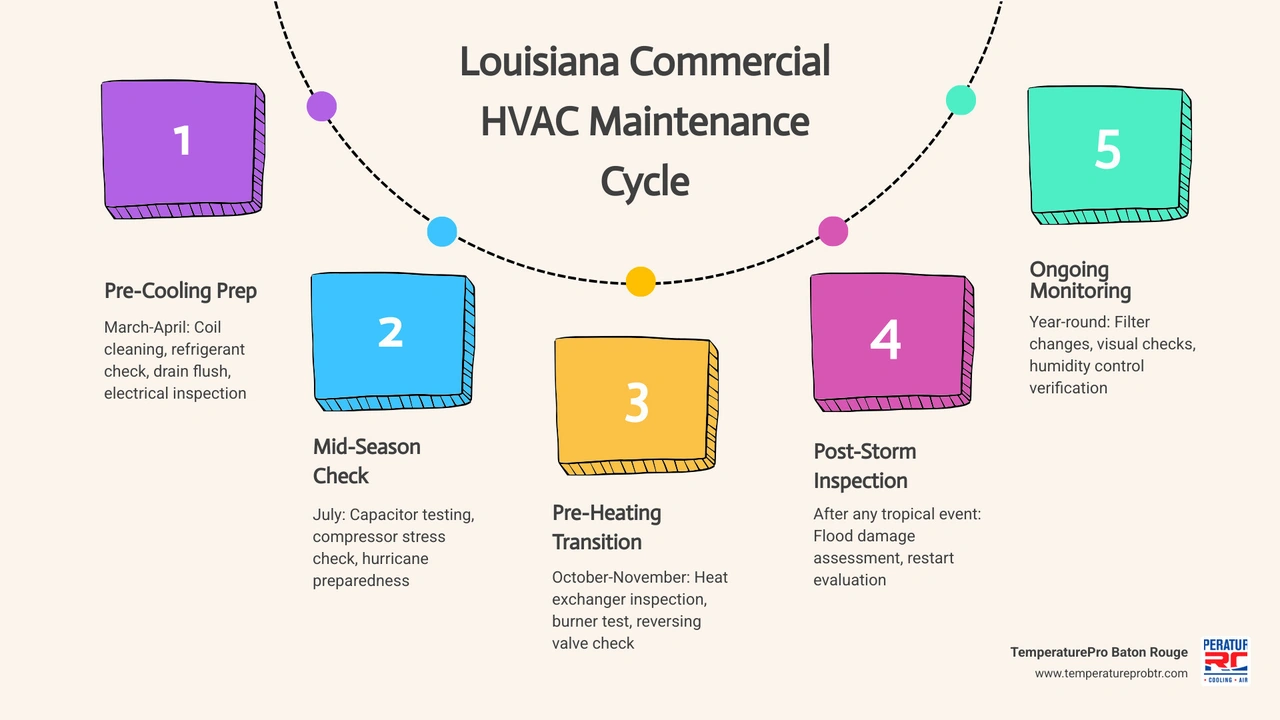
Here is a quick overview of the recommended commercial HVAC maintenance schedule for Louisiana:
• Pre-Cooling Prep — Timing: March–April — Key Tasks: Coil cleaning, refrigerant check, drain flush, electrical inspection
• Mid-Season Check — Timing: July — Key Tasks: Capacitor testing, compressor stress check, hurricane prep
• Pre-Heating Transition — Timing: October–November — Key Tasks: Heat exchanger inspection, burner test, reversing valve check
• Post-Storm Inspection — Timing: After any tropical event — Key Tasks: Flood damage assessment, restart evaluation
Most national maintenance guides are written for climates where air conditioning gets a six-month break. Louisiana does not work that way. A commercial system in Baton Rouge or the surrounding area may run nearly year-round, accumulating wear that demands more frequent attention than a standard twice-yearly schedule can address. On top of that, roughly 55% of businesses still practice reactive maintenance — waiting for a breakdown before calling a technician — which almost always costs more and causes more disruption than regular preventive care.
The sections below walk through exactly what a Louisiana-specific commercial HVAC maintenance schedule looks like, why each interval matters, and what tasks belong to your facility team versus a licensed contractor.
Why Louisiana Demands a Unique Commercial HVAC Maintenance Schedule
When you operate a commercial property in the Gulf South, your heating, ventilation, and air conditioning systems are subjected to a relentless operational workload. In temperate northern climates, a typical commercial HVAC system runs for about 1,500 to 2,000 hours annually. In South Louisiana, that number easily doubles to 3,000 or 4,000 hours. The sheer volume of run time means that components age, loosen, and degrade at an accelerated rate.
Our subtropical climate presents two major challenges that standard national maintenance guidelines simply do not account for:
• Extreme Latent Heat Load: Air conditioning is not just about lowering the temperature (sensible cooling); it is also about removing moisture from the air (latent cooling). With relative humidity levels regularly exceeding 70% to 75% for eight months of the year, Louisiana cooling systems must work twice as hard to squeeze water out of the indoor air. If a system's coils are dirty or its airflow is restricted, it cannot manage this latent load, leaving your indoor spaces feeling sticky, clammy, and uncomfortable.
• Corrosive Salt Air and Moisture: Even miles inland from the Gulf Coast, our air carries high moisture levels and trace salts that accelerate the corrosion of delicate aluminum fins, copper tubing, and electrical connections. Without regular rinsing and protective inspections, outdoor condensing units degrade rapidly.
Because of these regional factors, Louisiana has adopted specific standards to keep commercial properties safe and efficient. Effective January 1, 2023, Louisiana adopted the ASHRAE 180 standard for the inspection and maintenance of commercial HVAC systems without amendments. This regulatory framework, alongside the International Mechanical Code (IMC) and the National Electrical Code (NFPA 70), dictates precise maintenance and ventilation compliance rules for commercial facilities.
Whether you are managing a retail space requiring Commercial HVAC Baton Rouge, an office building needing Commercial HVAC Denham Springs, or a high-demand facility looking for Commercial HVAC Zachary, your maintenance schedule must be calibrated to these local realities.
Establishing a Commercial HVAC Maintenance Schedule for Louisiana
To protect your equipment and keep your utility bills from skyrocketing, you need to transition from a "call when it breaks" mentality to a structured, preventative maintenance interval system. While residential systems can often get by with twice-yearly visits, commercial buildings require a more robust quarterly approach.
Regularly scheduled checkups ensure that minor issues—like a slightly worn belt or a degrading capacitor—are caught before they snowball into a catastrophic system failure during a July heatwave. Implementing a structured schedule directly impacts system longevity. While a neglected commercial system might fail completely in 7 to 10 years, a well-maintained system can easily last 15 years, saving your business massive capital replacement expenses.
Understanding the Commercial HVAC Maintenance Importance is the first step toward building a predictable operational budget. To help visualize how these service intervals are structured, consider the differences in task distribution between standard quarterly checkups and deep biannual tune-ups:
• Air Filter Replacement (MERV 8-13) — Quarterly Inspection: Yes — Biannual / Seasonal Tune-Up: Yes
• Condensate Drain Flush & Treatment — Quarterly Inspection: Yes — Biannual / Seasonal Tune-Up: Yes
• Visual Belt & Pulley Inspection — Quarterly Inspection: Yes — Biannual / Seasonal Tune-Up: Yes
• Outdoor Debris & Vegetation Clearing — Quarterly Inspection: Yes — Biannual / Seasonal Tune-Up: Yes
• Chemical Coil Cleaning (Evaporator & Condenser) — Quarterly Inspection: No — Biannual / Seasonal Tune-Up: Yes
• Refrigerant Charge & Leak Testing — Quarterly Inspection: No — Biannual / Seasonal Tune-Up: Yes
• Electrical Terminal Tightening & Amperage Diagnostics — Quarterly Inspection: No — Biannual / Seasonal Tune-Up: Yes
• Heat Exchanger & Combustion Safety Analysis — Quarterly Inspection: No — Biannual / Seasonal Tune-Up: Yes (Fall Only)
• Thermostat Calibration & Sensor Verification — Quarterly Inspection: No — Biannual / Seasonal Tune-Up: Yes
Key Milestones in a Commercial HVAC Maintenance Schedule for Louisiana
To keep your business running smoothly, your commercial service calendar should be broken down into key seasonal milestones. Each milestone aligns with specific operational demands and equipment wear patterns. By scheduling your service visits around these milestones, you ensure your heating and cooling systems are always prepared for the next shift in Louisiana's weather. You can learn more about how these services fit into your overall building care by reviewing our HVAC Services Overview.
Pre-Cooling Season Prep (March–April)
The pre-cooling season window of March to April is the most critical maintenance period of the year. This is your opportunity to prepare your cooling equipment for the grueling six-to-eight-month summer stretch.
During this visit, a professional technician will focus heavily on cleaning the heat transfer surfaces. Even a tiny layer of grime—as thin as 0.042 inches—on your condenser coils can cause a 21% drop in cooling efficiency because the system cannot shed heat effectively. Technicians will chemically clean the coils, flush the condensate drain lines to prevent biological blockages, verify the refrigerant charge using precise digital manifolds, and perform comprehensive electrical diagnostics.
For businesses in Prairieville, getting a professional HVAC Tune-Up Prairieville during this spring window ensures that your system starts the high-demand season running at peak efficiency.
Mid-Season High-Heat Check (July)
July in Louisiana brings sustained heat indexes well over 100°F. This extreme heat places immense, continuous stress on your commercial system's electrical components. The leading cause of compressor failure during peak demand is capacitor degradation. When a capacitor begins to lose its charge under high temperatures, the compressor draws more amperage, overheats, and can eventually burn out.
A mid-season check in July is designed to prevent these peak-summer emergencies. Technicians measure capacitor ratings, check motor amp draws, and inspect contactor points for pitting. This is also the perfect time to review your hurricane preparedness plans. Ensuring your rooftop units are securely anchored and that your outdoor units are clear of loose debris can save your equipment from severe storm damage. For a complete guide on safeguarding your system during the height of the storm season, refer to our Hurricane Season HVAC Preparation Guide.
Pre-Heating Season Transition (October–November)
While Louisiana winters are generally mild, we still experience sudden cold fronts that can drop temperatures by 40 degrees overnight. When those cold snaps hit, your commercial heating system must be ready to fire up safely and reliably.
The transition period in October and November is dedicated to heating safety and performance. Technicians will perform a detailed heat exchanger inspection to check for cracks that could leak dangerous carbon monoxide into your building. They will also test gas burners, clean igniter assemblies, inspect the flue for obstructions, and calibrate heat pump reversing valves to ensure seamless switching from cooling to heating.
Scheduling professional HVAC Maintenance Baton Rouge during the autumn transition guarantees that your building remains warm, safe, and code-compliant all winter long.
Proactive vs. Reactive Commercial HVAC Maintenance for Louisiana Businesses
Too many commercial facilities operate on a reactive "run-to-failure" model. In fact, statistics show that 55 percent of companies practice reactive maintenance, waiting until a critical system breaks down before calling in professionals. In Louisiana's demanding climate, this approach is a recipe for high utility bills, lost business, and premature equipment replacement.
When you compare the two approaches, the business case for proactive, preventive maintenance is clear:
• Substantial Energy Savings: Regular maintenance keeps your system clean and properly adjusted, reducing commercial energy consumption by 10% to 20% annually.
• Extended Equipment Lifespan: Catching wear early and keeping components lubricated can extend the operational life of your commercial system by 5 to 10 years.
• Fewer Disruptions: Preventive care addresses minor issues before they cause a system shutdown, successfully preventing approximately 85% of commercial HVAC breakdowns.
• Predictable Budgets: Instead of facing expensive emergency repairs during peak summer demand, proactive maintenance plans turn your HVAC upkeep into a predictable, manageable operating expense.
Professional vs. In-House Maintenance Tasks
To keep your commercial system running safely and maintain your manufacturer warranties, it is important to understand the boundary between tasks your in-house facility team can handle and those that require a licensed professional.
In Louisiana, the Louisiana State Licensing Board for Contractors (LSLBC) and federal EPA Section 608 regulations dictate who can legally perform specific types of HVAC work. Working with a qualified HVAC Contractor Prairieville ensures that all advanced diagnostic and repair work is completed safely and in full compliance with local and federal codes.
In-House Tasks for Facility Managers
Your on-site facility team can perform several simple, high-impact maintenance tasks to keep the system running smoothly between professional visits:
• Filter Replacements: Air filters should be checked and replaced every 30 days during peak cooling seasons. Using MERV 8 to MERV 13 filters balances excellent indoor air quality with proper system airflow.
• Outdoor Clearance: Maintain a minimum 24-inch clear zone around all outdoor condensing units. Keep weeds, grass, and bushes trimmed back, and clear away any blown trash or leaves.
• Visual Inspections: Walk the property monthly to check for visible issues, such as standing water near indoor units, unusual vibrations, or damaged outdoor fan grilles.
• Drain Pan Treatments: Placing approved pan treatment tablets in your condensate pans can help prevent algae and biofilm from clogging your drain lines between professional flushes.
Tasks Requiring a Licensed Commercial HVAC Contractor in Louisiana
For safety, legal, and warranty reasons, the following tasks must always be performed by an EPA-certified, licensed commercial HVAC contractor:
• Refrigerant Handling: Any task that involves checking refrigerant pressures, adding refrigerant, or testing for leaks requires EPA Section 608 certification.
• High-Voltage Electrical Testing: Working with electrical components above 50V—including testing capacitors, measuring compressor amp draws, and replacing contactors—poses severe safety risks and must be handled by trained professionals.
• Combustion and Heat Exchanger Diagnostics: Performing combustion analysis, checking gas valves, and inspecting gas furnace heat exchangers for microscopic cracks requires specialized diagnostic equipment and training.
• Chemical Coil Cleaning: Cleaning delicate evaporator and condenser coils with professional-grade chemical rinses requires precise techniques to avoid bending the metal fins or pushing dirt deeper into the system.
Key Elements of a Commercial HVAC Maintenance Agreement
If you want to take the guesswork out of facility management, enrolling in a commercial HVAC maintenance agreement is the smartest move you can make. These agreements are structured service contracts designed to keep your systems running efficiently while keeping your operating costs predictable.
When choosing a plan, it is helpful to understand the difference between an Annual Maintenance Contract (AMC) and a Comprehensive Annual Maintenance Contract (CAMC). An AMC typically covers the labor and materials for scheduled preventative visits, while repairs and parts are billed separately. A CAMC is a more inclusive agreement that covers both scheduled maintenance and the cost of most repairs and replacement parts, offering the highest level of budget predictability.
A high-quality commercial maintenance agreement should always include:
• A customized facility assessment and risk mapping to identify high-priority zones.
• Guaranteed priority scheduling and rapid emergency response times.
• Detailed digital service reports showing baseline performance metrics and completed tasks.
• A clear schedule for coil cleaning, electrical testing, and safety inspections.
To set up a customized plan that fits your business's unique layout and operational demands, explore our tailored Commercial HVAC Services programs.
Frequently Asked Questions About Commercial HVAC Maintenance
For quick answers to common questions about commercial heating, cooling, and ventilation, you can always visit our comprehensive HVAC FAQs page. Below are some of the most frequent questions we receive from local business owners:
Why is a specialized commercial hvac maintenance schedule for louisiana necessary?
National maintenance guides are designed for moderate climates. Louisiana's extreme humidity, high heat index, long cooling seasons, and salt-laden air place double the workload on your HVAC equipment. A specialized schedule ensures your system receives the deep cleaning and electrical testing required to handle these harsh local conditions without breaking down.
You should contact a licensed technician immediately if you notice any of the following warning signs:
• An unexplained spike in your monthly utility bills of 25% or more.
• The system is short-cycling (turning on and off more than 6 to 8 times per hour).
• Unusual grinding, squealing, or rattling noises coming from your units.
• Poor humidity control, leading to a sticky or musty indoor environment.
• Inconsistent temperatures across different zones or offices.
After any major storm, always perform a visual check of your outdoor units before restarting your system. Look for standing water, physical impact damage from flying debris, or shifted outdoor units. If your equipment was inundated by floodwaters, do not attempt to turn it back on. Schedule a professional inspection immediately to test electrical circuits and clean out silt or debris. For a complete step-by-step recovery guide, review our Post-Storm HVAC Checklist.
Conclusion
Keeping your business comfortable, safe, and energy-efficient requires a proactive approach to your commercial heating and cooling equipment. Louisiana's climate is tough on HVAC systems, but with a structured seasonal maintenance schedule, you can protect your investment, prevent expensive emergency breakdowns, and keep your operational costs completely predictable.
At TemperaturePro Baton Rouge, we specialize in building customized commercial maintenance agreements tailored to the unique needs of local businesses. Whether you are operating an office in Prairieville, a retail space in Gonzales, or a facility in Zachary, our team of certified technicians is here to provide the expert care your business deserves.
Ready to protect your bottom line and ensure year-round indoor comfort? Contact us today to schedule a comprehensive facility assessment and learn more about our professional Commercial HVAC Services.