Why Late Summer Power Surges in Central LA Wreak Havoc on HVAC Circuit Boards
Why Late Summer Power Surges in Central LA Wreak Havoc on HVAC Circuit Boards
August thunderstorms deliver invisible micro-surges that silently degrade and fry delicate AC control boards. See why relying on standard circuit breakers leaves your cooling system vulnerable.
The Hidden Threat of Late-Summer Storms to Your Home's Cooling
August in Louisiana brings a volatile collision of extreme, unrelenting heat and sudden, violent weather. Before the next afternoon thunderstorm rolls in, understanding why late summer power surges in Central LA wreak havoc on HVAC circuit boards is critical for any homeowner looking to avoid an unexpected breakdown. When temperatures peak and the local electrical grid is pushed to its absolute limits, your cooling equipment is at its most vulnerable. Invisible micro power surges silently degrade and fry delicate control boards, leaving homes sweltering without relief when they need it most.
Our team at TemperaturePro Baton Rouge frequently sees this firsthand. We recently had a local homeowner reach out late on a Saturday night as a hurricane approached because their unit had suddenly stopped cooling properly. One of our technicians arrived around 8 p.m., identified a refrigerant leak, and restored the system before the storm hit. While that physical damage was visible and repairable, the hidden electrical damage caused by severe weather is often much more insidious. This leaves homeowners facing a critical decision point: continue relying on standard, inadequate circuit breakers, or invest in a whole-system surge protector to defend their most expensive appliance.
If you are concerned about your equipment surviving the season, securing your HVAC system with proper electrical defenses is just as important as scheduling routine air conditioning repair services when things go wrong. To understand why this protection is necessary, we have to look at the technical reality of how these late-summer storms attack the electrical grid.
How Invisible Voltage Spikes Bypass Standard Defenses
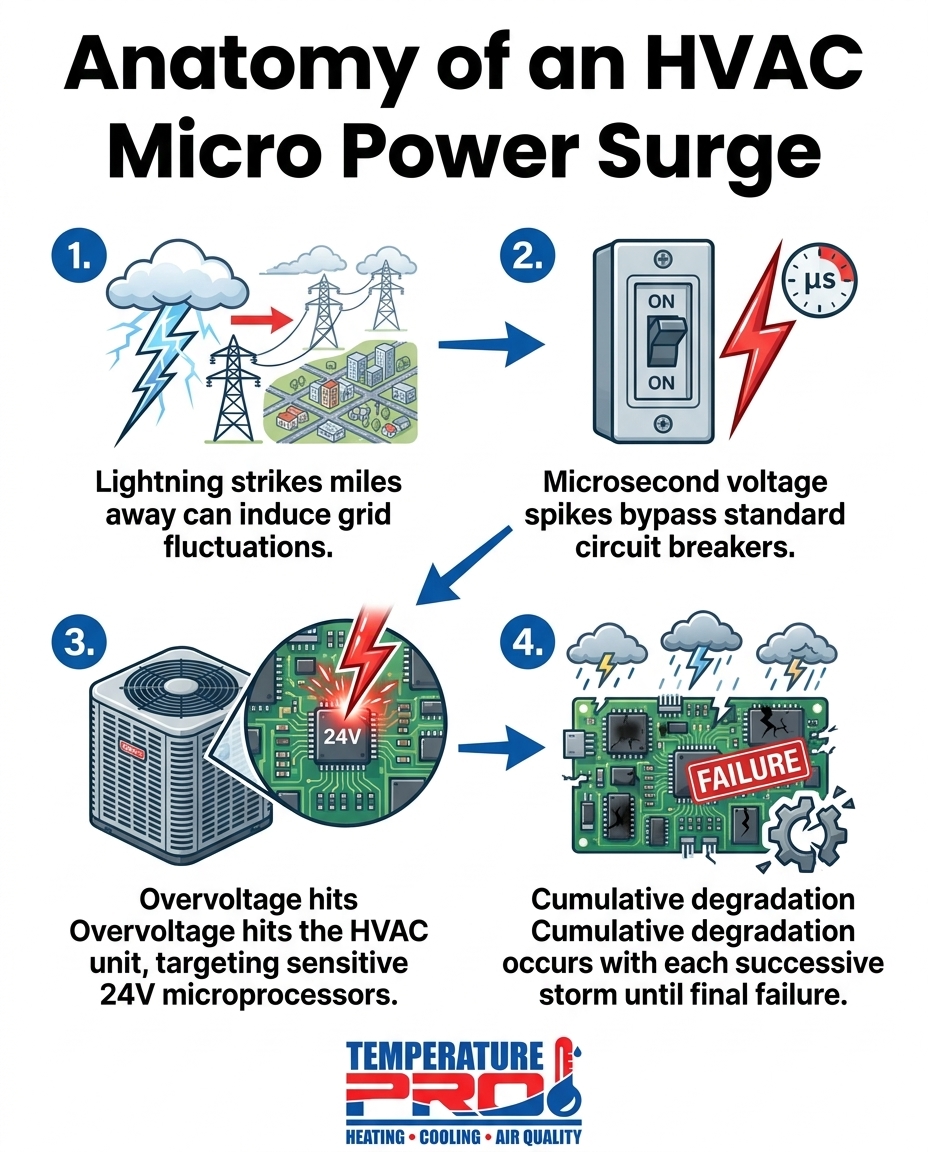
When most people think of storm damage, they picture a direct lightning strike hitting a transformer, causing a massive explosion of sparks and an immediate neighborhood blackout. While catastrophic, direct strikes are relatively rare. The far more common—and equally destructive—threat is the micro power surge. A micro-surge is a brief, microsecond voltage spike often caused by nearby lightning or rapid grid fluctuations as the utility company struggles to balance heavy summer loads.
Because of our regional climate, we know all too well that Louisiana consistently ranks among the top states for lightning flash density. This creates a uniquely hostile environment for local grid infrastructure. Every time lightning strikes miles away, or every time a major facility down the road powers up or shuts down, it sends ripples of excess electrical energy through the local power lines. These voltage spikes easily enter your home's electrical system, rapidly seeking the path of least resistance. Unfortunately, that path often leads straight to your major appliances, with your outdoor condenser unit sitting right in the line of fire.
The danger lies in the speed of these events. These surges happen in fractions of a second—much faster than standard home defenses can react. A surge pushes excess voltage into the home, flooding sensitive components with energy they were never designed to handle.
The Difference Between Direct Strikes and Grid Fluctuations
• Direct Strikes: These cause catastrophic, visible damage. A direct hit can melt wires, blow electrical panels off walls, and start severe electrical fires. No residential surge protector can entirely stop a direct, localized lightning strike.
• Grid Fluctuations: These are the invisible killers. Micro-surges push just a few extra volts into the system. You might not even see the lights flicker, but that minor bump in voltage is more than enough to permanently harm sensitive electronics over time.
Anatomy of an HVAC Micro Power Surge
Why Today's Smart AC Units Are Highly Susceptible to Electrical Damage
If you grew up in a house with an older AC unit, you might wonder why power surges seem like a bigger deal today than they did twenty years ago. The answer lies in the massive technological leap cooling equipment has taken. Older, electro-mechanical AC units were essentially massive, simple motors controlled by heavy-duty relays and contactors. If a minor voltage fluctuation hit an old single-stage compressor, the rugged mechanical parts could usually absorb the impact and keep running without skipping a beat.
Modern, high-efficiency systems are completely different machines. Today's variable-speed HVAC equipment relies on sensitive microprocessors, complex printed circuit boards (PCBs), and inverter drives to achieve incredible energy efficiency and precise temperature control. These units act more like advanced computers than simple fans and pumps. The control boards inside these modern units are responsible for monitoring ambient temperature, adjusting motor speeds in real-time, and communicating with your smart thermostat.
Here is the critical vulnerability our technicians see constantly: these microprocessors operate on very low voltage—typically around 24 volts. When a micro-surge pushes even a seemingly small spike of 50 or 60 extra volts through the line, it can instantly fry the delicate silicon pathways on the control board. The microscopic circuits literally melt under the sudden influx of heat and energy.
The immediate aftermath of a fried board is highly stressful for a homeowner. You might notice a completely dead system, a blank thermostat that refuses to wake up, or an outdoor unit that hums but refuses to engage the compressor. When our team arrives during the late-summer back-to-school rush, we are often greeted by post-storm diagnostic error codes indicating control board failure—a complex problem that requires complete component replacement rather than a simple wire repair.
The Circuit Breaker Myth: Overcurrent vs. Overvoltage
One of the most dangerous misconceptions we hear from homeowners is the belief that their standard electrical panel protects their appliances from storm surges. It is incredibly common for our customers to say, "I'm not worried about lightning; my breakers will trip." This is a fundamental misunderstanding of what a circuit breaker is actually built to do.
Standard electrical panels are designed to protect your home from overcurrent, not overvoltage. Overcurrent happens when a device (like a faulty motor or a shorted wire) tries to pull too much power from the grid. If a wire rated for 15 amps suddenly has 30 amps pulled through it, the wire will rapidly heat up and start a fire. The circuit breaker is a thermal or magnetic switch designed to physically trip and break the connection before that fire can start. It is a slow, mechanical reaction to an internal problem.
Overvoltage, on the other hand, is an external problem. Surges push too much power into the home from the outside grid. Standard breakers physically cannot trip fast enough to stop a microsecond voltage spike. By the time the mechanical switch inside the breaker flips, the micro-surge has already raced past the panel, traveled down the wires, and struck your HVAC control board.
• Primary Purpose — Standard Circuit Breaker (Overcurrent): Prevents electrical fires by stopping appliances from pulling too much power. — HVAC Surge Protector (Overvoltage): Protects sensitive electronics by blocking excess power from entering.
• Direction of Threat — Standard Circuit Breaker (Overcurrent): Internal (faulty appliance or overloaded circuit). — HVAC Surge Protector (Overvoltage): External (lightning, grid fluctuations, downed lines).
• Reaction Time — Standard Circuit Breaker (Overcurrent): Milliseconds to seconds (mechanical switch). — HVAC Surge Protector (Overvoltage): Nanoseconds (solid-state electronic shunting).
• HVAC Protection Level — Standard Circuit Breaker (Overcurrent): Zero protection against micro-surges. — HVAC Surge Protector (Overvoltage): High protection against grid spikes and storm surges.
Relying on a standard breaker during severe August thunderstorms leaves your expensive, variable-speed HVAC control board completely exposed to the elements.
The Silent Degradation of Control Boards Before Total Failure
When discussing power surges, we often focus on the catastrophic, single-event failures. However, our field experience throughout Baton Rouge and Central LA shows that the reality of electrical damage is usually much more gradual. This brings us to the concept of "electronic rust."
Just as a car frame doesn't rust out after a single rainstorm, a circuit board doesn't always fail after a single micro-surge. Instead, repetitive, small surges degrade the microscopic pathways on a printed circuit board over time. Every time a minor voltage spike hits the board, it creates a tiny amount of heat and micro-arcing. This slowly breaks down the insulation and the conductive traces on the board. The damage is cumulative.
Because of this silent degradation, a control board might survive several severe storms in June and July, only to fail completely on a random, sunny Tuesday in late August. This delayed failure often confuses homeowners, who don't intuitively connect today's breakdown to the severe thunderstorms from three weeks prior. They assume the unit simply gave out from the end-of-summer heat, not realizing the board's integrity had been compromised long ago.
Before a total failure occurs, you might notice erratic system behavior indicating a compromised board. Symptoms include the system short-cycling (turning on and off rapidly), the blower fan running continuously even when the AC is off, or the thermostat losing connection with the outdoor unit intermittently. If you notice these warning signs, we recommend reviewing what to do when your AC stops working in summer and having one of our professionals evaluate the electrical components before the compressor is damaged.
Decoding Post-Storm Diagnostics with Honest Expertise
The environment following a major storm or hurricane is often chaotic. Homeowners are understandably panicked about a dead AC, facing rising indoor temperatures, and desperate for immediate relief. Unfortunately, this post-storm panic can sometimes lead to rushed diagnostics or misdiagnoses by inexperienced technicians.
Consider a real scenario our team handled in the aftermath of Hurricane Ida: A local homeowner was left without cooling and reached out to us for help four days after the storm hit. One of our technicians arrived just 3 hours after the call, carefully diagnosed the problem, and fixed the system quickly by replacing a specific damaged part. This level of precision is only possible through a disciplined, methodical approach to troubleshooting.
Reading post-storm diagnostic error codes requires patience and expertise. Modern units will flash a specific sequence of LED lights on the control board to indicate where the fault lies. However, an error code indicating a communication failure doesn't automatically mean the entire board is fried. It could be a damaged low-voltage wire, a blown 3-amp fuse, or a tripped safety switch.
As a Veteran-owned HVAC company, TemperaturePro Baton Rouge brings a disciplined, honest approach to post-storm diagnostics. Our focus is on finding the exact point of failure through rigorous testing, ensuring homeowners aren't told they need a costly new control board when a simpler, less expensive electrical fix is available. Honest expertise builds trust, separating true catastrophic damage from minor electrical faults.
Securing Your Cooling System with Whole-Home HVAC Surge Protectors
The definitive solution to the concrete problem of August thunderstorms frying your equipment is proactive protection. We strongly advise that a whole-system HVAC surge protector is rapidly becoming a mandatory safeguard for modern, variable-speed units. Unlike flimsy, point-of-use power strips you use for your television, these heavy-duty devices are hardwired directly into your home's electrical infrastructure.
These devices work by acting as an electrical pressure relief valve. When they detect an overvoltage event, they react in nanoseconds, shunting the excess electrical energy safely into the earth's ground before it ever has a chance to reach your HVAC control board.
The Professional Installation Process (What Our TemperaturePro Team Does):
1. System Assessment: Our technician evaluates the electrical load of your specific condenser and air handler to select the appropriately rated surge protection device.
2. Panel or Disconnect Integration: The device is hardwired either directly at the main electrical panel or at the outdoor disconnect box near the AC unit.
3. Grounding Verification: We thoroughly test the home's grounding rod and grounding wires. A surge protector is entirely useless if it doesn't have a clear, highly conductive path to shunt the excess voltage into the earth.
4. Diagnostic Testing: Once installed, the system is tested to ensure the protection indicator lights are active and the HVAC unit is receiving clean, stable power.
A Critical Safety Warning: Installing these devices involves working directly with 240-volt high-voltage electrical lines. This work must be performed by a licensed professional. Never attempt a DIY installation of a whole-home or HVAC surge protector, as a mistake can lead to severe injury, fatal shock, or catastrophic electrical fires.
Integrating surge protection checks into your routine HVAC maintenance plan ensures that your defenses remain active year after year, as surge protectors do wear out over time after absorbing multiple hits.
Frequently Asked Questions About HVAC Power Surges
Can a power surge completely ruin an AC unit?
Yes, in our experience, a severe power surge can completely ruin an AC unit, especially the sensitive electronic control boards and the compressor motor. When high voltage bypasses the unit's tolerances, it can melt the internal wiring of the compressor or shatter the microprocessors on the printed circuit board. In many cases, the damage is so extensive that complete component replacement is required to restore functionality.
How do you tell if your AC circuit board is fried?
The most common sign of a fried circuit board is a completely unresponsive system. Look for a blank thermostat, a system that won't turn on despite the breaker being properly set, or the distinct smell of burning ozone near the indoor or outdoor unit. Additionally, a professional technician will look for specific diagnostic error codes flashing on the unit's diagnostic LED, which pinpoint communication failures on the board.
Will a standard circuit breaker protect against power surges?
No, standard circuit breakers will not protect against power surges. Circuit breakers are strictly designed to protect against overcurrent—meaning they trip when an appliance draws too much power, preventing wire fires. They react far too slowly to stop the microsecond overvoltage spikes caused by lightning or grid surges from entering your equipment.
Is a whole-home surge protector worth the investment for an HVAC system?
Absolutely. Compared to the steep cost of replacing a variable-speed control board or an entirely ruined compressor, a professionally installed surge protector is a highly cost-effective insurance policy. We consider it the only reliable defense against the unpredictable grid fluctuations and severe weather patterns common in our region.
Can I install an HVAC surge protector myself?
No, you should never attempt to install an HVAC surge protector yourself. Installation requires working directly with high-voltage panels, outdoor disconnects, and heavy-gauge wiring. It must be completed by a licensed professional to ensure absolute safety, proper grounding, and compliance with local electrical codes.
Protect Your Comfort Before the Next Storm Hits
The intense weather patterns of Baton Rouge and Central LA are unavoidable, but catastrophic damage to your cooling system is not. Moving beyond the false security of standard circuit breakers is essential for protecting the sensitive microprocessors inside modern cooling equipment. A professionally installed surge protector acts as a vital shield, stopping micro-surges before they can silently degrade or instantly fry your control boards.
If your system is acting erratically following a recent storm, or if you want to proactively secure your equipment before the next severe weather event strikes, do not wait for a total failure. Schedule a comprehensive diagnostic with TemperaturePro Baton Rouge today to get an honest assessment of your system's health and ensure your home's comfort remains protected all season long.
Thank you! Your submission has been received!
Oops! Something went wrong while submitting the form.
Prevent sudden heating breakdowns with these home maintenance tips and troubleshooting insights. Get clear answers on why pre-winter HVAC inspections matter.
Most homeowners think a late-week appointment is the most convenient choice for an HVAC tune-up. Discover why our dispatchers highly recommend booking on a Tuesday morning instead.
A furnace shutting down repeatedly during early fall tests is frustrating, but jumping the safety switch is a dangerous mistake. Understand the severe fire hazards of this DIY workaround.