How We Safely Clean Evaporator Coils Without Damaging Aging Aluminum Fins
How We Safely Clean Evaporator Coils Without Damaging Aging Aluminum Fins
Pressure washing often destroys the fragile metal inside older AC systems. We explain the precise chemical-foaming process used to dissolve late-summer grime and protect delicate indoor coils.
The Hidden Threat to Your Aging AC System in Late Summer
Your air conditioner has been running nonstop since May, but the house still feels warm and clammy. You might assume the equipment is just struggling to keep up with the intense heat, but the real culprit is often buried deep inside your indoor air handler. Learning how we safely clean evaporator coils without damaging aging aluminum fins is the first step to restoring your system's cooling power without risking a catastrophic breakdown. As your unit ages, the internal components become increasingly delicate, turning routine maintenance into a highly specialized task.
If you are ready to protect your equipment and improve efficiency, our professional air conditioning services are designed to handle delicate, older units with the exact level of care they require.
The indoor evaporator coil is the unsung hero of your home's comfort. Its primary job is to absorb heat and extract humidity from the warm air circulating through your ductwork. To do this efficiently, the coil relies on hundreds of tightly packed aluminum fins that maximize the surface area for heat transfer. However, these fins are incredibly fragile. When dealing with older 10+ year HVAC systems, the metal has endured a decade of thermal stress, making it highly susceptible to mechanical damage during routine maintenance.
This creates a critical decision point for homeowners. When that indoor coil becomes caked with dirt and debris, how do you remove the blockage without crushing the delicate metal underneath? Choosing a safe, professional chemical-foaming method over destructive high-pressure washing is often the difference between reviving an older unit and accidentally sending it to the scrapyard. Proper maintenance must prioritize equipment protection right alongside cleanliness, ensuring your aging investment survives the hottest months of the year.
Understanding the Extreme Fragility of Aging Aluminum Fins
To understand why older air conditioners require such careful handling, you have to look closely at the mechanical anatomy of the evaporator coil. The aluminum cooling fins attached to the copper tubing are incredibly thin—often measuring less than 0.1 millimeters thick. For comparison, that is roughly the thickness of a standard sheet of printer paper. This ultra-thin design is entirely intentional. The thinner the metal, the faster it can transfer heat from the air into the cold refrigerant flowing through the pipes.
While this design is great for energy efficiency, it makes the fins incredibly delicate. Over a decade of operation, these components undergo constant thermal expansion and contraction. Every time the system cycles on, the metal gets cold and contracts; when it shuts off, it warms up and expands. Combined with constant moisture exposure, this endless cycle gradually makes the aluminum brittle. By the time you are dealing with older 10+ year HVAC systems, the fins have lost much of their original structural integrity.
The Aging Process of Evaporator Fins:
• 1–3 Years — Fin Condition: Flexible and resilient. Can withstand minor physical contact. — Vulnerability Level: Low
• 4–7 Years — Fin Condition: Beginning to oxidize. Micro-stresses reduce metal flexibility. — Vulnerability Level: Moderate
• 8–10+ Years — Fin Condition: Highly brittle from years of thermal cycling and moisture. — Vulnerability Level: Severe
The dense spacing of these fins further complicates matters. They are packed tightly together to force the air to weave through narrow channels, maximizing contact with the cold metal. Because they are so close together, even a slight impact can cause multiple fins to fold over like a row of dominoes. Once these aging fins are crushed or bent flat, repairing them without snapping the brittle metal is extremely difficult. A heavy-handed cleaning approach can permanently choke off the system's ability to breathe.
How Severe Humidity Turns Airborne Dust Into Cement-Like Sludge
You might wonder how an indoor component gets so filthy in the first place, especially if you regularly change your air filters. The answer lies in the intense environmental conditions inside the air handler. During the peak cooling months, the evaporator coil undergoes a continuous condensation cycle. As warm household air blows across the freezing cold metal, the humidity in the air condenses into liquid water, much like a cold glass of lemonade sweating on a hot patio.
Living in Baton Rouge means dealing with extreme heat and relative humidity that regularly exceeds 70 percent. This drastic moisture level drastically increases the coil's sweating capacity compared to drier climates. The coil essentially acts as a massive, wet magnet. Even with a good filter in place, microscopic airborne dust, pet dander, cooking oils, and other particulates inevitably slip through and stick to the wet metal.
What makes up this stubborn buildup?
• Microscopic dust: Fine particles that bypass standard fiberglass filters.
• Pet dander and hair: Sticky organic matter that clings to wet surfaces.
• Cooking aerosols: Vaporized oils that travel through return vents.
• Biological matter: Spores that thrive in dark, damp environments.
This creates a compounding effect. Month after month, the system cycles on and off, creating wet-dry cycles that slowly bake this debris onto the aluminum fins. By the time we reach the end of the season, what started as a light dusting has transformed into a thick, sticky August late-summer grime. This cement-like sludge severely insulates the coil, preventing it from absorbing heat. Because it is baked onto the metal, this late-summer grime cannot be simply brushed away with soft DIY tools or a gentle wipe-down. It requires a heavy-duty, professional intervention.
The Hidden Dangers of High-Pressure Washing on Older Coils
When faced with a coil caked in stubborn sludge, a common misconception is that more water pressure equals a better clean. Homeowners and inexperienced handymen often assume that blasting the coil with a high-pressure water stream or a heavy-duty spray wand is the fastest way to blast the grime away. While this might work for a concrete driveway, it is catastrophic for delicate HVAC components.
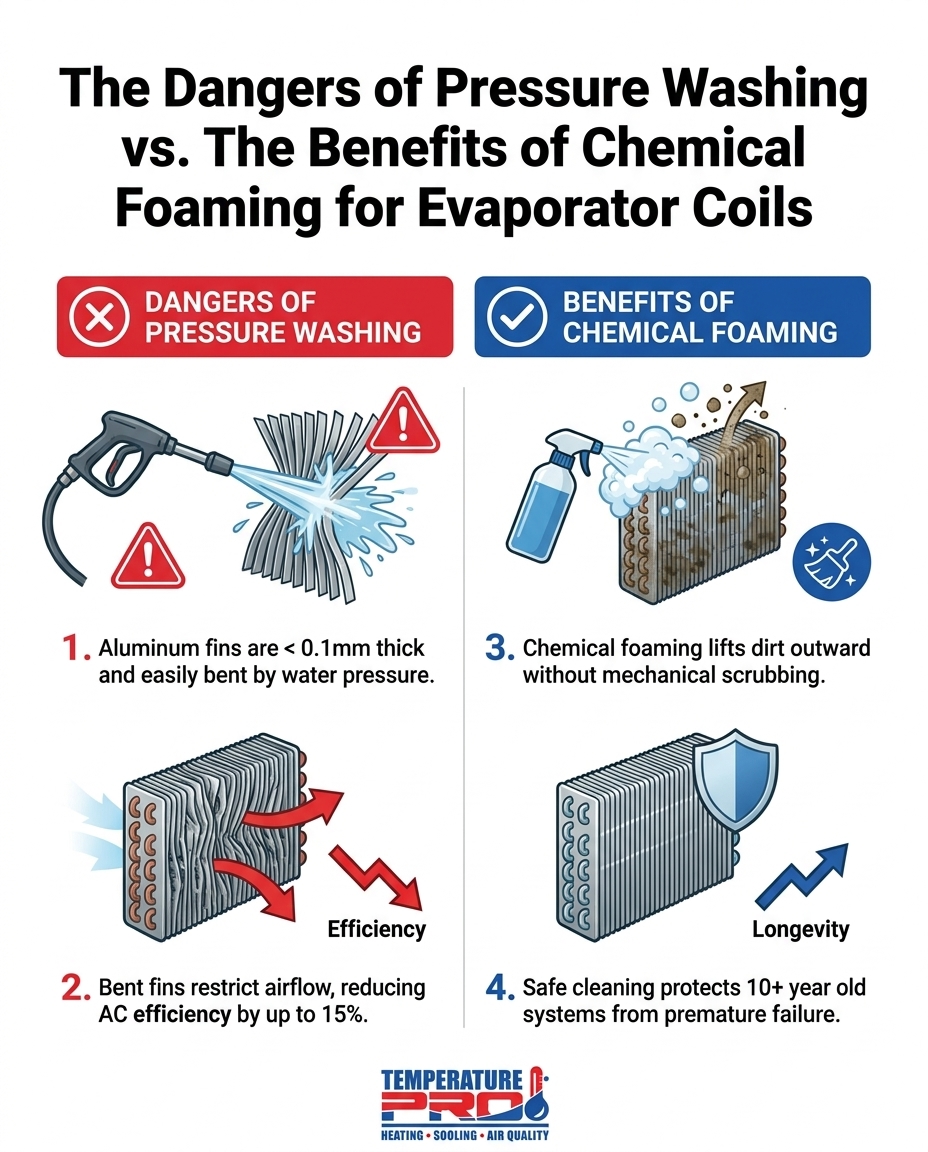
The mechanical reality is that high-pressure water streams exert massive kinetic force. When that concentrated force hits aluminum fins that are less than 0.1mm thick, it easily folds them flat against each other. For older 10+ year HVAC systems, the brittle metal doesn't just bend—it often tears or snaps entirely. We see this pattern frequently in our local area. One homeowner reached out for help when their 10-year-old AC system stopped cooling the house properly in the middle of a heatwave. A previous contractor had used harsh, aggressive methods to clean the unit, which compressed the fins and choked the system. Our technician thoroughly explained the fragility of their aging unit, carefully inspected the damage, and utilized a methodical cleaning approach to open the airways back up. Once the coils were properly treated, the AC system was working properly and the house was cold again.
Airflow Restriction and Frozen Coils
When fins are bent flat by high-pressure washing, the consequences go far beyond cosmetic damage. It triggers a dangerous chain reaction that can destroy the entire system.
1. Blocked Air Pathways: The flattened fins act like a closed set of blinds, physically preventing warm household air from passing through the coil to deposit its heat.
2. Ice Formation: Because the refrigerant inside the coil is no longer absorbing heat from the air, its temperature drops below freezing. The ambient condensation instantly freezes, turning the entire coil into a solid block of ice.
3. Compressor Strain: The outdoor compressor unit is forced to work overtime to push refrigerant through a frozen, restricted system, leading to massive energy spikes and, eventually, premature compressor failure.
This is why you must avoid blow-and-go contractors who use fast, damaging methods. A quick blast of water might take ten minutes, but it can easily reduce your system's efficiency by up to 15 percent or cause a fatal breakdown.
The Dangers of Pressure Washing vs. The Benefits of Chemical Foaming for Evaporator Coils
The Science Behind Our Safe Chemical-Foaming Treatment
If high-pressure washing is off the table, how do we safely remove months of baked-on sludge? The answer lies in professional-grade chemical foaming agents designed specifically for delicate HVAC metals. This is a highly specialized process that relies on chemistry rather than brute mechanical force to achieve a deep clean.
The scientific process is fascinating to watch. A licensed technician carefully applies a specialized liquid solution directly to the surface of the dirty coil. Within seconds, a chemical reaction occurs, causing the liquid to rapidly expand into a thick, active foam. This expanding foam penetrates deep into the dense fin bed—reaching areas that a brush or water spray could never touch. As the foam expands, it actively dissolves the August late-summer grime, breaking the bond between the sticky sludge and the aluminum metal. The foam then literally pushes the suspended dirt outward from the inside of the coil.
Why this method is vastly superior for older units:
• Zero mechanical force: There is no heavy scrubbing, stiff brushing, or high-pressure water blasting required, entirely preserving the fragile fin structure.
• Deep penetration: The foam reaches the very center of the coil slab, removing hidden blockages.
• Safe dissolution: The chemicals are specifically balanced to break down organic matter and dust without corroeding the copper or aluminum.
Using this precise chemical-foaming process demonstrates our commitment to careful, professional service that protects your aging investment over quick, damaging fixes. It is important to reiterate that this is a precise, licensed professional procedure. Store-bought foaming sprays often lack the correct pH balance and can leave corrosive residue behind if not neutralized properly. This is never a DIY spray-and-forget task; it requires an expert hand to ensure the equipment is protected.
Beyond Cooling: How Clean Coils Improve Breathable Air
While the primary goal of cleaning your evaporator coil is to restore heat transfer and prevent mechanical failure, there is a significant secondary benefit that impacts your daily life. The state of your indoor coil directly affects the quality of the air you breathe every single day. A dirty, sludgy coil acts as an ideal breeding ground for biological growth.
Think about the environment inside your air handler: it is completely dark, constantly damp from condensation, and, when dirty, full of organic food sources like pet dander and dust. As air passes through this contaminated coil, it picks up microscopic spores and distributes stale, musty odors throughout your living space. If you have ever noticed a "dirty sock" smell coming from your vents when the AC kicks on, a heavily soiled evaporator coil is usually the culprit.
By safely dissolving this grime at the source with our foaming treatment, we remove the breeding ground entirely. This drastically improves the home's overall air freshness, making the environment healthier for your family. Residents in Baton Rouge know how quickly a damp environment can lead to indoor air quality issues during the humid summer months. Once the source of the contamination is removed, exploring comprehensive indoor air quality solutions—such as UV lights or advanced filtration—is the perfect next step for maintaining a pristine, healthy home environment year-round.
Extending the Lifespan of Your AC Unit Through Methodical Care
Proper, non-damaging cleaning sets the stage for long-term system health and significantly lower operational costs. When an evaporator coil is suffocating under a blanket of dirt, every other component in the system has to work harder to compensate. The blower motor draws more electricity trying to push air through the blockage, and the compressor runs longer cycles trying to meet the thermostat's demands.
By restoring unimpeded airflow through safe chemical foaming, we immediately reduce the electrical load on these expensive components. This is why consistent, careful maintenance is the absolute key to reducing cooling costs without sacrificing your indoor comfort. Furthermore, a methodical cleaning process allows our technicians to clearly inspect the bare metal of the coil. When the sludge is gone, we can spot micro-leaks, rust spots, or other emerging issues that were previously hidden by the dirt.
We experience the value of this thoroughness firsthand. Another local homeowner called us for a spring tune-up on a multi-unit system that had not been cleaned in years. By taking the time to safely clean the coils and perform a methodical inspection, our technician restored the system's efficiency and identified potential future issues before they could escalate. Documenting the health of aging parts on older 10+ year HVAC systems is vital. It prevents surprise breakdowns during the hottest weeks of the year and gives you the peace of mind that your equipment is being managed by professionals who truly care about extending its lifespan.
Frequently Asked Questions
Why shouldn't I pressure wash my AC coils?
High-pressure washing exerts massive kinetic force that easily bends or crushes delicate aluminum fins. Because the fins on an evaporator coil are incredibly thin, the water pressure folds them flat, which permanently blocks airflow. This restricted airflow forces the system to work harder, severely reduces cooling efficiency, and often leads to the coil freezing over completely. For older systems with brittle metal, pressure washing can cause irreversible damage.
How do professionals clean evaporator coils safely?
Professionals utilize a specialized chemical-foaming treatment that dissolves dirt without requiring mechanical force. A licensed technician applies a balanced chemical solution that rapidly expands into a thick foam, penetrating deep into the coil bed. This foam breaks down the baked-on sludge and pushes the debris outward from the inside. The process safely removes heavy buildup while entirely preserving the fragile structure of the aluminum fins.
What happens if AC fins are bent during cleaning?
Bent fins act like a closed barrier, preventing warm household air from passing through the coil to be cooled. This blockage disrupts the heat transfer process, causing the refrigerant inside the coil to drop below freezing and turn ambient condensation into solid ice. A frozen coil places immense strain on the outdoor compressor, which can lead to massive energy spikes and eventual, costly system failure.
What is the best way to clean aluminum AC fins on an older unit?
The safest and most effective method for older units is professional chemical foaming. Because the metal on systems over ten years old becomes highly brittle from years of thermal expansion and contraction, any heavy scrubbing or brushing can snap the fins. Chemical foaming relies on a scientific reaction to lift the dirt away gently, avoiding the physical stress that would otherwise destroy aging components.
How often should an evaporator coil be professionally chemically cleaned?
Most evaporator coils should be professionally cleaned at least once a year as part of a comprehensive seasonal maintenance schedule. However, homes with multiple pets, high indoor dust levels, or those located in extremely humid climates may require more frequent attention. Regular inspections by a licensed technician will determine exactly when the buildup is severe enough to warrant a full chemical foaming treatment.
Can a dirty evaporator coil cause my AC to freeze up in late summer?
Yes, a heavily soiled coil is one of the leading causes of late-summer freeze-ups. As months of dust, dander, and condensation bake into a thick sludge, the grime insulates the coil and blocks airflow. Without sufficient warm air blowing across the metal to absorb the cold, the refrigerant temperature plummets, causing the surrounding moisture to freeze into a solid block of ice inside your air handler.
Protect Your Equipment with Professional, Damage-Free Maintenance
Don't let aggressive cleaning methods destroy the fragile components inside your aging air conditioner. By relying on precise, science-backed chemical foaming, you can restore your system's efficiency while fully protecting your investment. Secure your comfort and prevent unexpected late-summer breakdowns by enrolling in a comprehensive AC maintenance plan today.
Thank you! Your submission has been received!
Oops! Something went wrong while submitting the form.
Prevent sudden heating breakdowns with these home maintenance tips and troubleshooting insights. Get clear answers on why pre-winter HVAC inspections matter.
Most homeowners think a late-week appointment is the most convenient choice for an HVAC tune-up. Discover why our dispatchers highly recommend booking on a Tuesday morning instead.
A furnace shutting down repeatedly during early fall tests is frustrating, but jumping the safety switch is a dangerous mistake. Understand the severe fire hazards of this DIY workaround.