Adjusting Your Programmable Thermostat for the Back-to-School Empty House
Adjusting Your Programmable Thermostat for the Back-to-School Empty House
Turning off your AC while the kids are at school often leads to extreme late-summer humidity buildup. A simple 3-degree setback safely balances daytime energy savings with afternoon comfort.
The Late-Summer Shift: Rethinking Your Empty House Cooling Strategy
As the August back-to-school season arrives and daily routines shift, adjusting your programmable thermostat for the back-to-school empty house is one of the most effective ways to manage your utility bills. However, this transition often introduces a frustrating concrete problem: homeowners turn their cooling systems off for the day, only to find the air conditioner falling dangerously behind on extreme late-summer humidity control by 3 PM. You are left facing a critical decision point: determining the exact temperature setback during school hours that balances daily energy savings with your system's ability to actually recover before the family returns.
To help you navigate this transition, we recommend evaluating your primary air conditioning systems to ensure they are prepared for the unique demands of a late-summer schedule change.
The sudden schedule shift: When a house goes from being occupied all day to sitting completely empty for eight hours, the immediate temptation is to shut the cooling system down entirely. In theory, cooling an empty house seems wasteful. In reality, late-summer in the Deep South brings extreme heat indexes and staggering humidity levels, making generic, national energy advice actively dangerous for local homes. If you turn your system off at 7:30 AM, you are essentially turning your home into a sealed greenhouse.
A disciplined approach: As a veteran-owned company, we believe in establishing a disciplined, practical operating procedure for your home's energy load rather than relying on guesswork. Managing your indoor climate requires understanding how your equipment actually functions under stress. Instead of drastic temperature swings, success lies in finding a precise, moderate setting that keeps the air moving, the moisture levels down, and the equipment operating within a safe, efficient threshold.
Why the Standard 10-Degree Setback Fails in Late Summer
If you search for general energy-saving advice, you will almost always encounter the Department of Energy's standard recommendation: set your thermostat back by 7 to 10 degrees for the eight hours you are away at work or school. While this is excellent advice for a dry climate like Arizona or a mild climate like Northern California, applying this rule during an August back-to-school timeframe in Baton Rouge is a recipe for disaster.
To understand why this standard advice fails locally, we need to look at the mechanics of how your cooling system actually operates. Air conditioners do not just lower the air temperature; they pull moisture out of your indoor air. However, they only remove humidity when they are actively running. If you raise your thermostat by 10 degrees, your system will sit idle for hours.
The problem-cause-solution breakdown:
• The Problem: You return home at 4 PM to a house that feels sticky, stuffy, and overwhelmingly warm, even if the thermostat says it is only 80 degrees.
• The Cause: Long off-cycles during the day allow indoor moisture levels to spike. Because the system has not run since morning, the humidity has settled into your carpets, furniture, and drywall.
• The Solution: Maintaining a tighter temperature window that forces the system to cycle on periodically, actively removing moisture throughout the day.
To keep your system running efficiently through these demanding cycles, staying current with a comprehensive HVAC maintenance plan is absolutely vital.
The Hidden Cost of Deep Afternoon Setbacks
Beyond the immediate discomfort of a humid house, deep afternoon setbacks carry a significant mechanical cost. When you allow your home to reach 82 degrees by mid-afternoon, you are forcing the compressor to run continuously during the absolute hottest part of the day—typically between 2 PM and 4 PM—just to catch up. This places immense strain on your capacitors, motors, and compressor. The increased wear and tear from these extreme temperature swings often leads to premature component failure, entirely erasing any utility savings you might have gained during the morning hours.
The Golden Standard: Implementing a Humidity-First Strategy
Because deep setbacks are counterproductive in subtropical climates, Baton Rouge homeowners need a different approach. The golden standard for our region is implementing a 3 to 4 degree maximum setback. This specific temperature range perfectly balances acceptable energy savings with rigorous moisture control.
How the 3-degree rule works: If your preferred evening temperature is 72 degrees, you should set your daytime away temperature to no higher than 75 or 76 degrees. This slight adjustment prevents your system from having to overcome a massive heat and humidity deficit later in the afternoon. More importantly, in Baton Rouge's specific climate, maintaining this tight temperature window is the only way to actively manage indoor moisture.
The benefits of a moderate setback:
• Consistent dehumidification: A 3 to 4 degree maximum setback ensures your system cycles on just enough to pull latent heat (humidity) out of the air, keeping your indoor humidity within the recommended 50-60% threshold.
• Thermal mass protection: By keeping the air relatively cool, your furniture, walls, and floors do not absorb excess heat, making the afternoon recovery process significantly faster.
When you prioritize humidity control first, the sensible temperature (what you read on the thermostat) matters slightly less, because dry air inherently feels cooler and more comfortable than damp air.
Managing Indoor Air Quality When the House is Empty
Your thermostat settings dictate more than just the temperature; they directly impact the overall health of your home's environment. There is a direct correlation between how often your system runs and your indoor air quality. Every time your system cycles on, it pulls air through the return vents and pushes it through your air filter.
When you use a deep setback and the system sits idle for eight hours, the air inside your home becomes completely stagnant. Stagnant air during long off-cycles allows dust, pet dander, and airborne allergens to settle onto your surfaces rather than being captured by the filter. Furthermore, if the house is allowed to stay warm and damp for the majority of the day, you risk severe moisture issues. Mold spores and dust mites thrive in environments where the humidity exceeds 60%.
To combat this while utilizing a 3 to 4 degree maximum setback, you must ensure your system is configured correctly to manage your indoor air quality. We strongly recommend keeping your thermostat fan setting on "Auto" rather than "On." If you leave the fan set to "On," it will blow continuously, even when the outdoor compressor is not running. In a humid climate, this continuously blowing fan will actually sweep the condensed moisture right off the indoor evaporator coil and blow it back into your living space, undoing all the dehumidification work the system just performed.
Scheduling the Afternoon Recovery Cycle Before the Bus Arrives
Knowing the correct temperature is only half the battle; knowing exactly when to trigger the recovery cycle is just as important. Peak daily outdoor temperatures typically occur between 2:00 PM and 4:00 PM. If you program your thermostat to begin cooling the house down at 3:30 PM—right as the kids are getting off the bus—you are making a critical mistake.
Waiting until the absolute hottest part of the afternoon to drop the temperature forces your system to fight against peak solar heat gain. Instead, the goal is to initiate the pre-cool recovery cycle gradually, starting around 2:00 PM. This allows the system to slowly bring the temperature down while the outdoor heat index is still climbing, ensuring the house reaches the desired comfort level before the family returns, all without redlining the compressor.
A Sample Daily Cooling Schedule
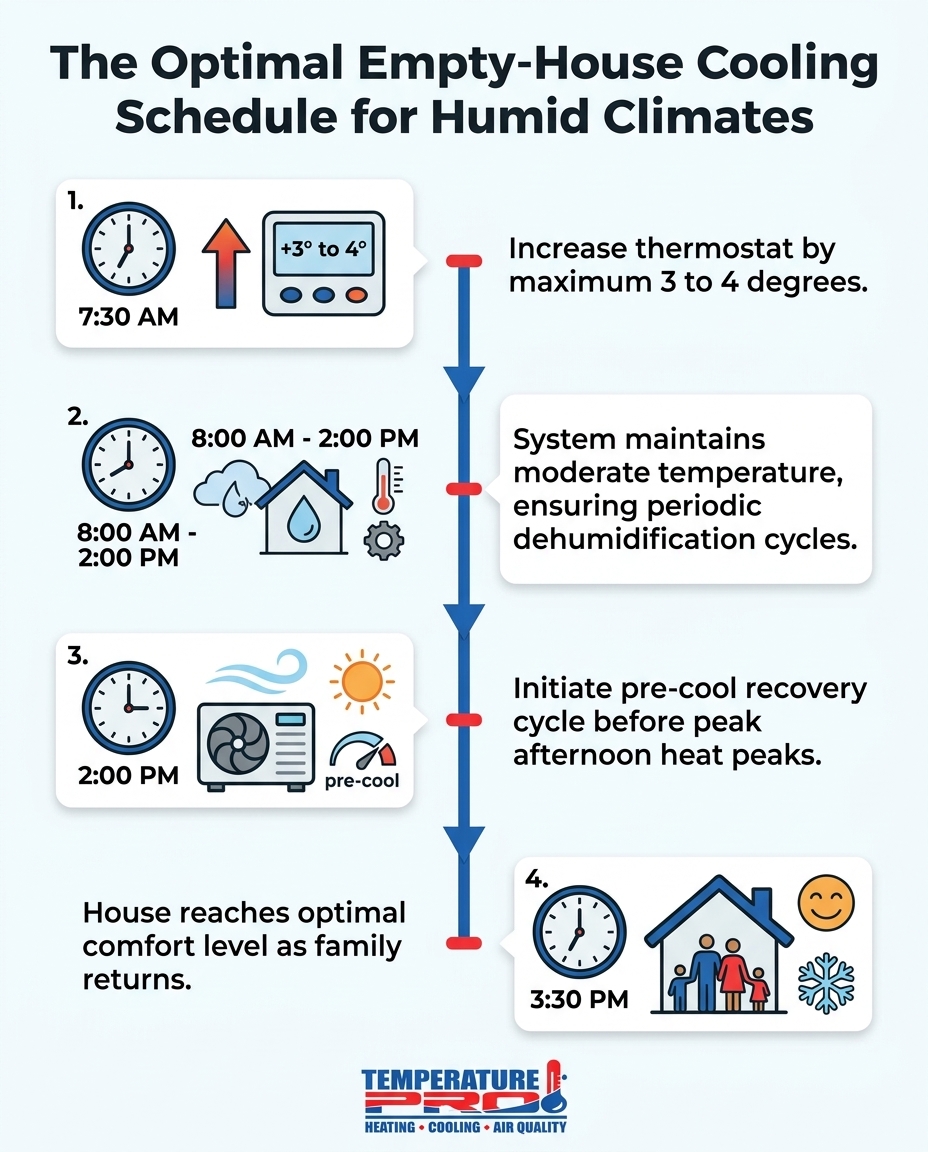
• 7:30 AM (Departure) — Thermostat Action: Increase temperature by 3 to 4 degrees. — System Goal: Allow the house to warm slightly while preventing humidity buildup.
• 8:00 AM - 1:59 PM — Thermostat Action: Maintain the setback temperature. — System Goal: System cycles periodically to filter air and extract latent moisture.
• 2:00 PM (Pre-Cool) — Thermostat Action: Drop temperature back to evening comfort setting. — System Goal: Begin a gradual recovery cycle before peak afternoon heat hits.
• 3:30 PM (Arrival) — Thermostat Action: Maintain evening comfort setting. — System Goal: House is fully stabilized, cool, and dry as the family returns.
By implementing this schedule during the August back-to-school transition, you protect your equipment from extreme stress while guaranteeing a comfortable environment the moment you walk through the front door.
The Optimal Empty-House Cooling Schedule for Humid Climates
Automating the Transition: Programmable vs. Smart Thermostat Setup
Enforcing a disciplined cooling schedule requires utilizing the technology on your wall effectively. While manual adjustments are possible, they are easily forgotten during the morning rush. Automating the transition ensures your home remains efficient without requiring daily oversight.
One Baton Rouge homeowner reached out to us this past spring for help making the best decision when buying a new cooling unit. After installing the system, we walked them step-by-step through their new thermostat setup so they would be fully prepared for this exact August back-to-school transition. Proper configuration during installation prevents the scheduling errors that lead to afternoon hot spots.
Steps to automate your comfort:
1. Choose the right schedule type: Basic programmable thermostats usually offer 5-2 day programming (weekdays vs. weekends) or 7-day programming. Smart thermostats offer dynamic scheduling and geofencing.
2. Set the departure baseline: Program the system to raise the temperature by a maximum of 3 to 4 degrees about 15 minutes before the last person leaves the house.
3. Lock in the recovery time: Program the return temperature to activate at 2:00 PM. Do not set it for the exact time you arrive home, or you will walk into a warm house.
4. Utilize geofencing (if applicable): If you have a smart thermostat, geofencing uses your smartphone's location to adjust the temperature automatically when you cross a certain distance threshold from your home. However, in late summer, ensure the geofence perimeter is wide enough to give the system at least an hour to recover before you pull into the driveway.
5. Disable extreme eco-modes: Many smart thermostats come with default "eco" settings that allow the house to reach 85 degrees while you are away. You must manually override these defaults to enforce the 3-degree rule.
What to Do If Your System Can't Keep Up By 3 PM
Sometimes, even when you follow the 3 to 4 degree maximum setback rule perfectly, you might return home to find the house is still uncomfortably warm. If your system is struggling to recover by 3 PM, it is critical to determine whether you are dealing with a scheduling issue or a mechanical failure.
An air conditioner that runs non-stop but fails to lower the temperature is sending a clear distress signal. If you notice these symptoms, you need to take immediate action to prevent a complete system breakdown.
Troubleshooting an afternoon cooling lag:
• Check the air filter: A clogged filter restricts airflow, causing the indoor coil to freeze and completely halting the cooling process. This is the most common culprit for a system that cannot keep up in the afternoon.
• Inspect the outdoor unit: Ensure the outdoor condenser is free of debris, tall grass, or leaves. If the unit cannot exhaust heat properly, it cannot cool your home.
• Feel the vent air: If the air blowing from your vents is lukewarm rather than crisp and cold, you may be dealing with low refrigerant levels, which requires professional diagnosis.
• Listen for odd noises: A humming or clicking sound from the outdoor unit often indicates a failing capacitor, which prevents the compressor from starting even when the thermostat calls for cooling.
If you have verified your schedule and changed your filter, but the house is still warm, it is time to consult an HVAC troubleshooter to diagnose the underlying mechanical issue.
Locking in Your Late-Summer Comfort Strategy
Managing your home's indoor climate during the August back-to-school season doesn't have to be a frustrating guessing game. By implementing a disciplined 3 to 4 degree maximum setback, you protect your equipment from extreme temperature swings, keep indoor humidity strictly controlled, and ensure your family returns to a comfortable environment every single afternoon.
Avoiding extreme setbacks is the smartest way to balance utility savings with reliable comfort. If your system is struggling to recover or you want to ensure it is prepared for the remaining heat of the season, schedule a proactive system check today. Taking action now ensures your home stays cool, dry, and comfortable long before the afternoon bus arrives.
Frequently Asked Questions
Is it cheaper to leave the AC on all day or turn it off when going to work?
In a humid climate, it is significantly better to leave the AC on a moderate setback rather than turning it off completely. Turning the system off allows extreme heat and humidity to build up inside the home. When you finally turn it back on, the system must run continuously during the hottest part of the day to overcome that massive deficit, which often costs more in energy and equipment wear than simply maintaining a steady, slightly elevated temperature.
How many degrees should I set back my thermostat in summer?
For homes in subtropical or high-humidity regions, you should set back your thermostat by a maximum of 3 to 4 degrees. While national guidelines often suggest 7 to 10 degrees, that advice is meant for dry climates. A smaller setback ensures your system cycles on frequently enough to remove moisture from the air, preventing your home from feeling like a sauna.
What is the best thermostat setting for an empty house in August?
The best setting is exactly 3 to 4 degrees higher than your preferred evening comfort level. For example, if you sleep comfortably at 72 degrees, set your away temperature to 75 or 76 degrees. This keeps the humidity in check and allows the system to easily recover the temperature before you return home in the late afternoon.
Why does my house feel so humid when I raise the thermostat during the day?
Your house feels humid because air conditioners only remove moisture from the air when they are actively running. When you raise the thermostat significantly, the system shuts off for long periods, allowing latent moisture to accumulate inside the home. To fix this, reduce the size of your setback so the system cycles on periodically to dehumidify the space.
How long does it take an AC to cool a house down by 3 degrees?
Under normal conditions, a properly sized air conditioning system takes about 45 minutes to an hour to lower the indoor temperature by 3 degrees. However, during peak afternoon heat, this process can take slightly longer due to solar heat gain. This is why it is critical to schedule your recovery cycle to begin around 2:00 PM, well before you actually arrive home.
Should I leave my AC fan on 'auto' or 'on' while I am at work?
You should always leave your AC fan set to "Auto" while you are at work. If you set it to "On," the fan will blow continuously, even when the outdoor compressor cycles off. In a humid climate, this constant airflow will evaporate the moisture sitting on your indoor coil and blow it right back into your living space, drastically increasing indoor humidity.
Thank you! Your submission has been received!
Oops! Something went wrong while submitting the form.
A failing defrost control board won't show symptoms in mild autumn weather, but it can turn your outdoor coil into an ice block this winter. See how our technicians catch silent failures early.
It seems logical to skip pre-season heating maintenance if you barely ran your system during a mild winter. However, long dormant periods in high humidity can damage internal components.
Sudden static shocks are a clear diagnostic sign that your indoor air is too dry. Understand the physics behind this fall shift and why whole-home humidification is the ultimate fix.