Managing High Humidity in Baton Rouge Pier-and-Beam Homes During August Storms
Managing High Humidity in Baton Rouge Pier-and-Beam Homes During August Storms
If your AC runs nonstop but your raised house still feels clammy, the problem might be beneath your feet. Unsealed crawlspace ductwork could be pulling ground moisture indoors.
The Clammy Reality of Late Summer in Raised Homes
Your air conditioner is running nonstop, but as the kids head back to school, the air inside your house still feels heavy, damp, and uncomfortably clammy. Managing high humidity in Baton Rouge pier-and-beam homes during August storms can feel like a losing battle when every afternoon downpour brings another wave of sticky air indoors. Many homeowners assume their air conditioning unit is failing or simply too old to keep up with the oppressive late-summer weather. You might find yourself constantly checking the thermostat, wondering why the temperature reads 72 degrees but the room feels like a swamp.
The truth often lies beneath your feet. In our years of serving the community, the TemperaturePro Baton Rouge team has found that in older Acadian and pier-and-beam homes, the primary culprit for indoor humidity spikes isn't usually a broken compressor or a failing evaporator coil. Instead, a pattern we see often is that the problem stems from unsealed ductwork pulling moisture directly from the saturated ground below your floorboards. When your ductwork acts like a vacuum over a wet crawlspace, treating the source of the humidity is far more effective than constantly lowering the thermostat and hoping for a different result.
How Heavy Rains Turn Your Crawlspace Into a Steam Room
To understand why your living room feels so damp, you have to look at the environmental chain reaction happening directly beneath your floorboards. August afternoon storms in southern Louisiana are notorious for dumping massive amounts of water in a very short window. Our technicians frequently see how this rapid, heavy rainfall instantly saturates the soil directly beneath and around your raised house.
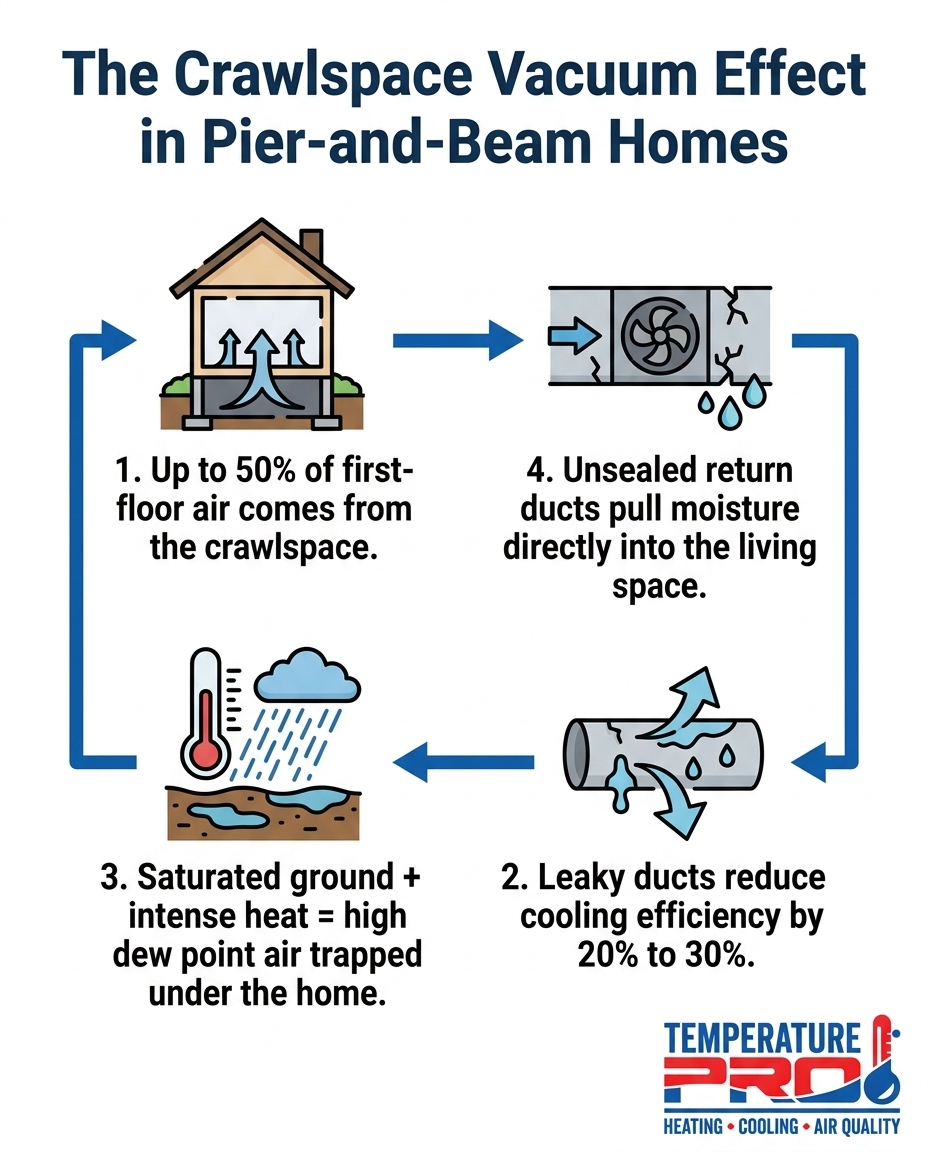
Once the rain stops, the intense late-summer heat returns, baking the saturated ground. This combination of peak summer heat and soaked earth creates a localized steam-room effect right in your crawlspace. According to data from the LSU AgCenter, raised floor homes in Louisiana face unique moisture challenges because this trapped, high-dew-point air stagnates under the house. Without proper mitigation, this dense, wet air simply sits there, waiting for a pathway to move upward into the drier environment of your living space.
The Environmental Chain Reaction:
• Rapid Soil Saturation: Sudden downpours overwhelm the ground's ability to drain, leaving standing water and soaked earth beneath the home.
• Heat-Driven Evaporation: As the sun comes back out, the ambient temperature rises, causing the ground moisture to evaporate into the confined crawlspace.
• Stagnation and High Dew Points: The air under the floorboards reaches near 100% relative humidity, creating a dense pocket of moisture that presses against the subfloor and any exposed mechanical systems.
Every time one of those predictable August afternoon storms rolls through, this cycle resets, constantly replenishing the supply of humid air waiting just inches below your feet.
The Vacuum Effect: How Ground Moisture Enters the Living Space
HVAC systems operate on fundamental pressure dynamics: they pull air in through return vents, condition it, and push it back out through supply vents. If your home has crawlspace ductwork systems, those metal or flex ducts are essentially the lungs of your house, breathing air in and out all day long. When those ducts are perfectly sealed, the air inside them remains completely separated from the damp air in the crawlspace.
However, when those ducts have leaks, the system acts like a massive vacuum cleaner positioned directly over the rain-soaked ground. As the blower motor engages, it creates negative pressure inside the return ducts. This negative pressure aggressively pulls that stagnant, high-dew-point air from the "steam room" below your house directly into your HVAC system. The Environmental Protection Agency (EPA) notes that up to 50% of the air on the first floor of a home can originate from the crawlspace. We've inspected countless crawlspaces where this vacuum effect actively bypasses the home's insulation and vapor barriers, injecting raw ground moisture straight into the living space.
The Role of Leaky Ductwork
Older crawlspace ductwork systems are particularly vulnerable to degradation. Over years of expanding and contracting in extreme southern heat and humidity, the materials holding your ducts together begin to fail. Degraded tape peels away, loose joints separate, and once-solid mastic sealant dries out and cracks. According to Energy.gov statistics, leaky ducts in unconditioned spaces can reduce cooling efficiency by 20 to 30 percent, forcing your system to work harder while simultaneously pumping wet air into your home.
• Properly Sealed Ducts — Airflow Source: 100% from inside the home — Impact on Indoor Humidity: Maintained at comfortable levels — Cooling Efficiency: Optimal performance
• Leaky Return Ducts — Airflow Source: Pulls from damp crawlspace — Impact on Indoor Humidity: Spikes dramatically after rain — Cooling Efficiency: Loses 20-30% efficiency
• Leaky Supply Ducts — Airflow Source: Pushes conditioned air outside — Impact on Indoor Humidity: Creates negative home pressure — Cooling Efficiency: Forces unit to run constantly
The Crawlspace Vacuum Effect in Pier-and-Beam Homes
Why Lowering the Thermostat Won't Solve the Problem
When the house feels sticky, the most common homeowner reaction is to walk over to the thermostat and drop the temperature by a few degrees. While this might provide a temporary blast of cold air, it fundamentally fails to address the root cause of the problem. Air conditioners are designed to cool the air and remove a specific, expected baseline of indoor humidity. They are not designed to combat a continuous, high-volume influx of ground moisture being actively pumped into the house.
Here is the frustrating paradox we often explain to our customers: lowering the thermostat forces your air conditioner to run longer. Because your blower motor is running for extended periods, the vacuum effect in your crawlspace is actually prolonged. You are actively pulling more moisture into the house the longer the system runs. This is a crucial distinction to make when evaluating your home's comfort. A genuine mechanical failure, such as a refrigerant leak, will result in warm air blowing from the vents. A ductwork integrity issue, on the other hand, usually results in cold air blowing from the vents, but the house still feels incredibly damp, especially after August afternoon storms. It's a pattern our team sees almost daily during late summer.
Signs Your Humidity is Duct-Driven:
• Cupping hardwood floors: Moisture rising from below causes the edges of floorboards to swell and curl upward.
• Musty odors after rain: A distinct, earthy smell that permeates the house specifically after a heavy downpour.
• Condensation on vents: Cold supply grilles dripping with water as high-humidity air hits the chilled metal.
• Clammy surfaces: Countertops and leather furniture feel slightly sticky to the touch despite the AC running.
If you are experiencing these symptoms, you need more than just a colder thermostat setting. For more strategies on managing Gulf Coast weather, you can review our humidity control tips for Gulf Coast homes, which highlight the importance of addressing the building envelope.
The Specific Vulnerabilities of Older Acadian Architecture
Baton Rouge older Acadian and pier-and-beam homes are architectural treasures, but they were designed for a different era of climate control. These traditional structures were built high off the ground specifically to promote maximum airflow beneath the floorboards, keeping the house cooler before the invention of modern central air conditioning. The crawlspace was meant to breathe.
However, retrofitting modern HVAC systems into these historic crawlspaces often leads to exposed, highly vulnerable duct runs. Unlike modern slab homes where ducts are routed through insulated attics or interior walls, raised homes often have their entire distribution system hanging in an unconditioned, hostile environment. The extreme moisture, occasional wildlife intrusion, and natural settling of the house put immense strain on the ductwork.
At TemperaturePro Baton Rouge, our deep local expertise in servicing older Acadian and pier-and-beam homes specific to southern Louisiana means your system is evaluated by professionals who understand how these unique crawlspaces interact with modern HVAC systems. Generic national advice often suggests full crawlspace encapsulation as the first step for any moisture problem. While encapsulation is a valid strategy, we find it is not always the most practical, immediate, or structurally appropriate first step for historic Louisiana homes that rely on subfloor ventilation. In our experience, emphasizing direct intervention on the ductwork itself is often the most immediate and effective way to stop the moisture transfer at its source.
Professional Duct Sealing: Treating the Source of the Humidity
If unsealed crawlspace ductwork systems are the vacuum pulling moisture into your home, then professional duct sealing is the definitive, targeted solution to shut that vacuum off. This is not a project for standard hardware store duct tape, which quickly degrades in high-humidity environments. Professional duct sealing is a comprehensive process that permanently fortifies your system against ground moisture intrusion.
During a professional sealing service, our technicians use specialized, long-lasting materials like fiberglass mesh and heavy-duty mastic sealant. This thick, paste-like material is painted over every joint, seam, and connection in the ductwork, hardening into an impenetrable, flexible shell. We also utilize specialized pressure testing equipment to measure the exact leakage rate of your system before and after the application, ensuring that the vacuum effect has been entirely neutralized.
The Benefits of a Sealed System:
• Neutralized Vacuum Effect: Ground moisture is physically blocked from entering the airflow, stopping the cycle of dampness.
• Improved Energy Efficiency: Conditioned air actually reaches your living space instead of leaking out under the house, lowering the workload on your system. Note that generic federal tax credits or local utility incentive programs may apply to qualifying energy-efficiency upgrades like duct sealing—we always advise readers to verify current programs with their utility or a tax professional.
• Reduced Compressor Strain: Because the AC no longer has to fight a continuous influx of wet air, the compressor cycles normally, extending the life of the equipment.
• Enhanced Indoor Air Quality: Sealing keeps out not just moisture, but dust, mold spores, and soil gases that originate in the crawlspace.
Once the ducts are properly sealed, your existing air conditioner can easily handle normal indoor humidity levels, allowing your home to finally feel cool, dry, and comfortable.
Protecting Your Home's Comfort Through the End of Summer
As we navigate the transition from late summer into early fall and the busy back-to-school season, the weather remains unpredictable. The frequent August afternoon storms will eventually give way to milder temperatures, but the underlying vulnerability of unsealed ductwork will remain a liability year-round. Having your ductwork and crawlspace inspected by our team before the end of the storm season is a crucial step in protecting your home's comfort and structural integrity.
Routine maintenance is the best way to identify degrading duct seals before they become major moisture liabilities. When a professional evaluates your system regularly, they can spot failing mastic, disconnected collars, or sagging flex ducts early on. This proactive care extends the overall lifespan of your HVAC equipment by preventing moisture-related corrosion on sensitive internal components and reducing the excessive wear and tear of constant, long-cycle operation.
Maintaining a sealed, optimized system is an ongoing commitment to your family's indoor air quality. By staying ahead of the weather and ensuring your equipment is prepared to handle the load, you can enjoy a consistently comfortable home. Enrolling in a routine HVAC maintenance plan ensures that these critical inspections happen on schedule, keeping your system running smoothly through every season.
Frequently Asked Questions About Raised Home Moisture Control
Why is my house so humid when the AC is running?
If your house feels humid while the AC is running, it usually means your system is pulling in more moisture than it can remove. In raised homes, our technicians frequently find this is caused by leaky crawlspace ductwork systems acting as a vacuum, drawing damp air from under the house directly into your living space. Lowering the thermostat only makes the system run longer, which can actually pull in even more moisture.
How do you stop moisture in a pier and beam foundation?
Stopping moisture transfer starts with sealing the pathways between the crawlspace and the home's interior. Professional duct sealing is the most immediate and effective step, as it stops the HVAC system from mechanically pulling damp air inside. Additional measures include ensuring proper grading around the home's exterior to divert rainwater and maintaining adequate ventilation under the floorboards.
Why is my pier and beam house so humid?
Pier and beam houses are highly susceptible to humidity because they sit directly over exposed earth. When the ground becomes saturated from heavy rains, the moisture evaporates upward. If your floor insulation is inadequate, your vapor barrier is compromised, or your HVAC ducts are leaking, that dense, humid air easily migrates upward into your conditioned living space.
Should you vent a crawl space in Louisiana?
Yes, traditional pier-and-beam homes in Louisiana generally require ventilation to prevent moisture from rotting the wooden subfloor and joists. However, the specific ventilation strategy depends heavily on the home's architecture and the presence of modern HVAC equipment. While some modern building science advocates for full encapsulation, we find that older historic homes often rely on cross-ventilation to breathe, making targeted duct sealing the safer first step for humidity control.
Can leaky ductwork cause high indoor humidity?
Absolutely. Leaky return ducts located in unconditioned spaces like crawlspaces or attics will pull outside moisture directly into your air handler. The system then distributes that wet air through your supply vents into every room of the house, completely overwhelming the air conditioner's ability to dehumidify the air.
How does heavy rain affect crawlspace ductwork?
Heavy rain rapidly saturates the soil beneath a home, creating a high-humidity microclimate in the crawlspace. If the ductwork running through that space has leaks, the negative pressure of the HVAC system will draw that freshly evaporated rainwater straight into the ducts. This turns your air conditioning system into a conduit for outdoor storm moisture.
Reclaim Your Comfort from Crawlspace Humidity
Understanding exactly how ground moisture enters your home through the ductwork is the first and most important step to achieving true indoor comfort. You don't have to spend another back-to-school season battling sticky floors and musty odors in your Baton Rouge older Acadian and pier-and-beam homes. By addressing the root cause of the problem rather than just treating the symptoms, you can permanently improve your home's climate.
Professional duct sealing in the crawlspace is the definitive solution to stop the vacuum effect and keep storm moisture where it belongs—outside. If you are tired of your AC running constantly without making a dent in the humidity, it is time to have your raised home's ductwork evaluated by the local professionals at TemperaturePro Baton Rouge. Reach out today to schedule comprehensive air conditioning services and reclaim your comfort from crawlspace humidity once and for all.
Thank you! Your submission has been received!
Oops! Something went wrong while submitting the form.
Prevent sudden heating breakdowns with these home maintenance tips and troubleshooting insights. Get clear answers on why pre-winter HVAC inspections matter.
Most homeowners think a late-week appointment is the most convenient choice for an HVAC tune-up. Discover why our dispatchers highly recommend booking on a Tuesday morning instead.
A furnace shutting down repeatedly during early fall tests is frustrating, but jumping the safety switch is a dangerous mistake. Understand the severe fire hazards of this DIY workaround.