Why Louisiana Humidity Makes AC and Humidity Control Tips for Gulf Coast Homes Essential
AC and humidity control tips for gulf coast homes are something every Louisiana homeowner needs — because in Baton Rouge, the air doesn't just feel hot, it feels heavy. Florida's average indoor relative humidity hovers around 74.5%, and conditions across the Gulf Coast are similarly punishing. The EPA recommends keeping indoor humidity between 30% and 50% — well below what most Gulf Coast homes see without active management.
Here's a quick overview of the most important steps you can take right now:
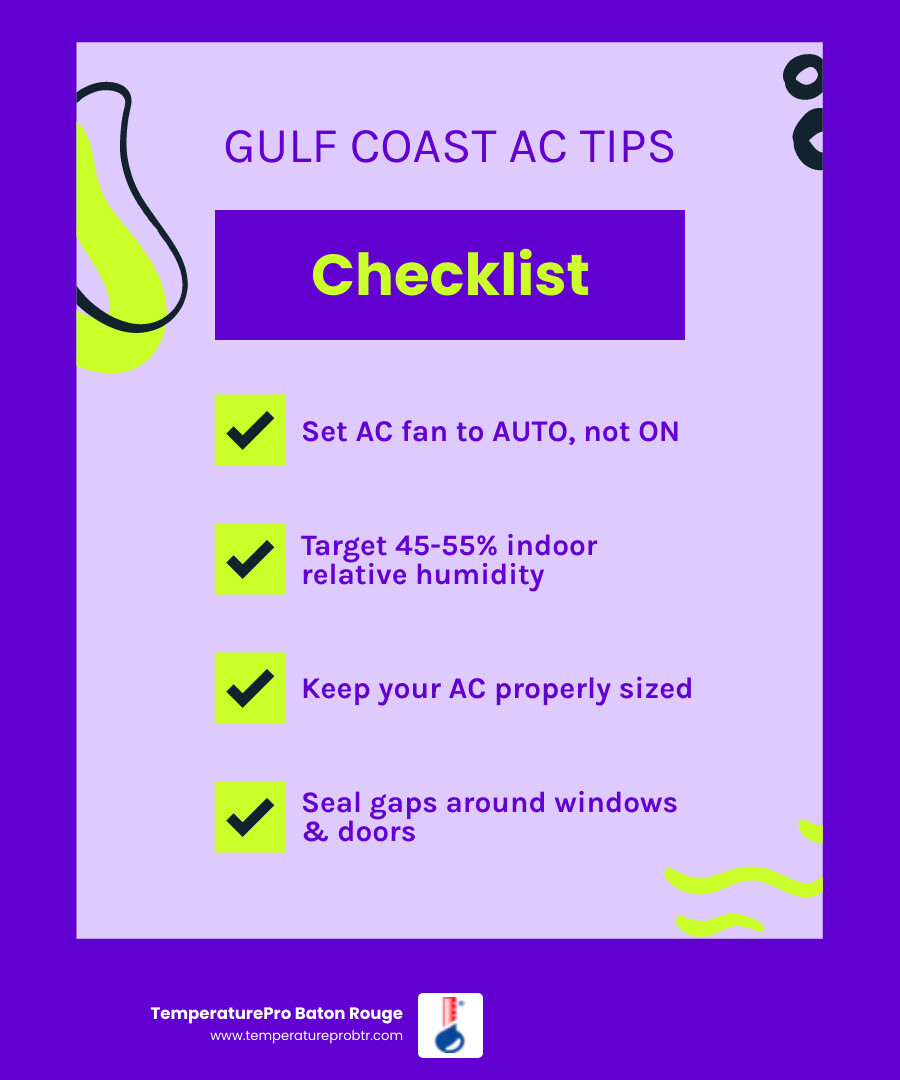
• Set your thermostat fan to AUTO, not ON, to allow moisture to drain off the evaporator coil
• Target 45-55% indoor relative humidity — use a digital hygrometer to monitor it
• Keep your AC properly sized — oversized units cool too fast and skip the dehumidification step
• Change air filters every 1-3 months — dirty filters reduce moisture removal efficiency
• Seal gaps around windows, doors, and ductwork to stop humid outdoor air from sneaking in
• Run exhaust fans in bathrooms for 20-30 minutes after showers and in kitchens while cooking
• Schedule annual HVAC maintenance — ideally before cooling season starts each spring
• Consider a whole-house dehumidifier if your AC can't keep up during shoulder seasons
The challenge here is real. A well-functioning AC can remove up to 30 gallons of water per day from your indoor air — but only when it's running correctly, sized properly, and maintained consistently. In Louisiana's climate, that's a tall order without the right strategy in place.
Why Does My Home Feel Sticky Even When the AC is Running?
It’s a common frustration for folks from Prairieville to Denham Springs: you’ve set the thermostat to a crisp 72 degrees, the air coming out of the vents is cold, yet you still feel like you’re wearing a damp sweater. This "sticky" feeling is usually caused by high indoor humidity, and it often points to a mismatch between your AC's cooling capacity and its dehumidification needs.
To understand why this happens, we have to look at the two types of cooling your AC performs: sensible cooling (lowering the actual air temperature) and latent cooling (removing moisture). In a humid climate like ours, your AC has to spend nearly half its energy just trying to wring the water out of the air.
One of the biggest culprits behind that clammy feeling is an oversized AC unit. It sounds counterintuitive — wouldn't a bigger unit be better? Not necessarily. A system that is too powerful for the square footage of your home will "short cycle." This means it blasts the house with cold air, hits the temperature setpoint in ten minutes, and shuts off. Because it didn't run long enough for the evaporator coils to get cold and stay cold, it never reached the "dew point" necessary to condense moisture. You end up with a home that is cold but damp.
If you are dealing with a system that seems to be struggling, you might be asking, Why is my AC running but not cooling? Often, the answer is that the air is technically cool, but the humidity is so high that your body's natural cooling mechanism (sweat) can't evaporate.
Furthermore, Solving Uneven Cooling Issues Baton Rouge Homes often involves balancing the airflow so that moisture isn't trapped in stagnant pockets of the house. When evaporator coils become saturated or airflow is restricted, the system loses its moisture removal capacity, leaving you in a sticky situation.
Essential ac and humidity control tips for gulf coast homes
Living in the Gulf Coast region in April 2026 means preparing for a long, humid season. To maintain a healthy and comfortable home, we recommend aiming for a relative humidity target of 45-55%. While the EPA suggests anything below 60% is acceptable to prevent mold, that 45-55% range is the "sweet spot" where the air feels light and your skin stays comfortable.
Monitoring this is easy and affordable. We suggest every homeowner in Central or Zachary pick up a digital hygrometer. It’s a small device that tells you exactly what your indoor humidity is. If you see that number creeping toward 65% or 70%, it’s time to take action.
One of the most effective ac and humidity control tips for gulf coast homes is to keep a close eye on your condensate system. Because your AC is pulling gallons of water out of the air daily, that water has to go somewhere. If your drain line is clogged, moisture can back up or, worse, increase the humidity level inside the unit itself. Solving AC Drainage Issues is a vital part of seasonal maintenance.
Here is a list of daily habits to help keep moisture at bay:
• Cover pots while boiling water: This prevents steam from adding to the indoor latent load.
• Cooler, shorter showers: Hot showers are basically personal steam rooms that tax your AC.
• Check your dryer vent: Ensure it is venting entirely outside and not leaking moist air into the laundry room.
• Indoor plants: While beautiful, having too many can actually increase humidity through transpiration.
As you prepare for the heat, don't forget to follow these Spring AC Tune-Up Tips to ensure your system is ready for the heavy lifting ahead.
Optimizing Your Thermostat for ac and humidity control tips for gulf coast homes
Your thermostat is the brain of your HVAC system, but if it’s not set correctly, it can actually make your home more humid. For the best balance of comfort and energy savings, we suggest a setpoint of 75-78 degrees when you are home.
The most critical setting, however, is the fan switch. Always set your fan to AUTO, never ON. When the fan is set to "ON," it runs continuously even when the cooling compressor is off. This blows air over the wet evaporator coils, re-evaporating all the water the system just worked so hard to collect and blowing it right back into your living room. By using "AUTO," the fan stops when the cooling stops, allowing the water to drip off the coils and out the drain line.
If you want to get serious about moisture, consider upgrading to a smart thermostat with a built-in humidity sensor. These devices can be programmed to "overcool" by a degree or two specifically to pull more moisture out of the air if the humidity rises above your target level.
Maintenance Strategies for ac and humidity control tips for gulf coast homes
Maintenance isn't just about preventing breakdowns; it's about preserving the system's ability to dehumidify. In our humid, salty Gulf air, components wear out faster than they do inland.
• Filter Selection: Use MERV 8 to 11 filters. They provide an excellent balance of air filtration without being so restrictive that they kill your airflow. If the airflow is too low, the coils can freeze; if it's too high, the air doesn't stay in contact with the cold coils long enough to lose its moisture.
• Combatting Corrosion: Salt air is a silent killer for HVAC units in the Gulf Coast. It eats away at the delicate aluminum fins on your outdoor condenser. Regular rinsing with a low-pressure garden hose can help, but professional coil cleaning is essential.
• Professional Programs: Enrolling in Baton Rouge AC Maintenance Programs ensures that a technician is checking your refrigerant charge and coil cleanliness twice a year. A system that is low on refrigerant will struggle to get the coils cold enough to dehumidify properly.
For more specific advice on the upcoming hot months, check out our Summer AC Maintenance Tips.
Advanced Solutions for Long-Term Moisture Management
Sometimes, even a perfectly maintained AC isn't enough for the Louisiana "shoulder seasons" — those weeks in late spring or early fall when it’s 75 degrees and 90% humidity outside. Because it’s not hot enough for the AC to run long cycles, the humidity builds up indoors.
This is where variable-speed compressors and multi-stage cooling come into play. Unlike traditional "single-stage" units that are either 100% on or 100% off, variable-speed systems can run at lower speeds for much longer periods. This allows for constant, gentle dehumidification without overcooling the house.
If you aren't ready to replace your entire HVAC system, a whole-house dehumidifier is the gold standard. These units are installed directly into your ductwork and work alongside your AC to pull moisture out of the air independently of the cooling cycle.
• Coverage — Portable Dehumidifier: Single room or small area — Whole-House Dehumidifier: Entire home via ductwork
• Drainage — Portable Dehumidifier: Manual bucket emptying — Whole-House Dehumidifier: Automatic drain line
• Noise — Portable Dehumidifier: Loud (in the living space) — Whole-House Dehumidifier: Quiet (located in attic/closet)
• Efficiency — Portable Dehumidifier: Lower (runs independently) — Whole-House Dehumidifier: Higher (integrated with HVAC)
• Control — Portable Dehumidifier: Basic dial or button — Whole-House Dehumidifier: Integrated with smart thermostat
If you notice your home feels "swampy" even when the temp is fine, these are the Signs Your AC Needs Repair in Louisiana Heat or perhaps a sign that you need a dedicated dehumidification solution.
Sealing and Ventilating Your Home Against the Gulf Air
You can have the best AC in the world, but if your home’s "envelope" is leaky, you are essentially trying to air condition the entire city of Gonzales. Every crack around a window or gap under a door is an invitation for humid Louisiana air to move in.
Air Sealing and InsulationSealing leaks can reduce humidity intrusion by up to 20%. Focus on:
• Weatherstripping: Replace worn-out seals on doors and windows.
• Duct Sealing: Leaky ducts in a hot, humid attic can suck in moisture and blow it into your bedrooms. This often leads to AC Airflow Troubles and Fixes for Prairieville Homes.
• Attic Insulation: Proper insulation keeps the heat of the attic from radiating into your living space, which reduces the load on your AC.
Controlled VentilationIn modern, tightly sealed homes, you need a way to get rid of the moisture we create inside (from breathing, cooking, and bathing).
• Exhaust Fans: Use your bathroom fans! Run them for at least 20 minutes after a shower to ensure the steam is fully evacuated.
• Kitchen Vents: Always turn on the range hood when boiling water or using the stovetop.
• ERVs: For the ultimate in high-tech ventilation, an Energy Recovery Ventilator (ERV) can swap out stale indoor air for fresh outdoor air while "pre-dehumidifying" the incoming air using the outgoing stream.
Frequently Asked Questions about Gulf Coast Humidity
Should I set my AC fan to 'ON' or 'AUTO' for better dehumidification?
You should almost always use the AUTO setting. As we mentioned earlier, the "ON" setting keeps the fan running even when the cooling cycle has stopped. This causes the water sitting on the evaporator coils to evaporate back into the air stream and return to your home. "AUTO" ensures the fan only runs when the coils are cold and actively removing moisture.
What is the ideal indoor humidity level for a Louisiana home?
For 2026 indoor air quality standards and general comfort, aim for 45% to 55%. Keeping it below 60% is essential for preventing mold and mildew growth, which can happen quickly in the humid environments of Walker or St. Gabriel.
Why do oversized AC systems fail at humidity control?
Oversized systems suffer from "short cycling." They are so powerful that they cool the air to the desired temperature very quickly and then shut off. Dehumidification requires long, steady run times. Without those long cycles, the air is cooled, but the moisture is never removed, leaving you feeling cold and clammy.
Conclusion
Managing the moisture in a Gulf Coast home is a year-round battle, but it’s one you can win with the right strategy. From simple habits like using your exhaust fans to advanced upgrades like variable-speed AC units and whole-house dehumidifiers, you have plenty of tools at your disposal to stay comfortable.
At TemperaturePro Baton Rouge, we are a family and veteran-owned company dedicated to keeping our neighbors comfortable. Whether you are in Baton Rouge, French Settlement, or St. Gabriel, we treat every customer like family. If your home feels sticky, or you're worried about your indoor air quality, we offer 24/7 support and professional humidity assessments to help you find the perfect balance.
Ready to take control of your home's climate? More info about air conditioning services is just a click away. Let us help you turn your home back into the oasis it’s meant to be!