The dirty condenser coil and ac performance connection is one of the most overlooked reasons why Baton Rouge homeowners suffer through warm rooms, sky-high energy bills, and AC systems that run nonstop without ever really catching up. When your outdoor unit is coated in dust, pollen, grass clippings, or cottonwood fuzz, your entire cooling system has to fight harder to do its job — and that fight costs you money every single day.
Here's the quick answer:
• A dirty condenser coil acts as an insulating barrier that traps heat in your outdoor unit
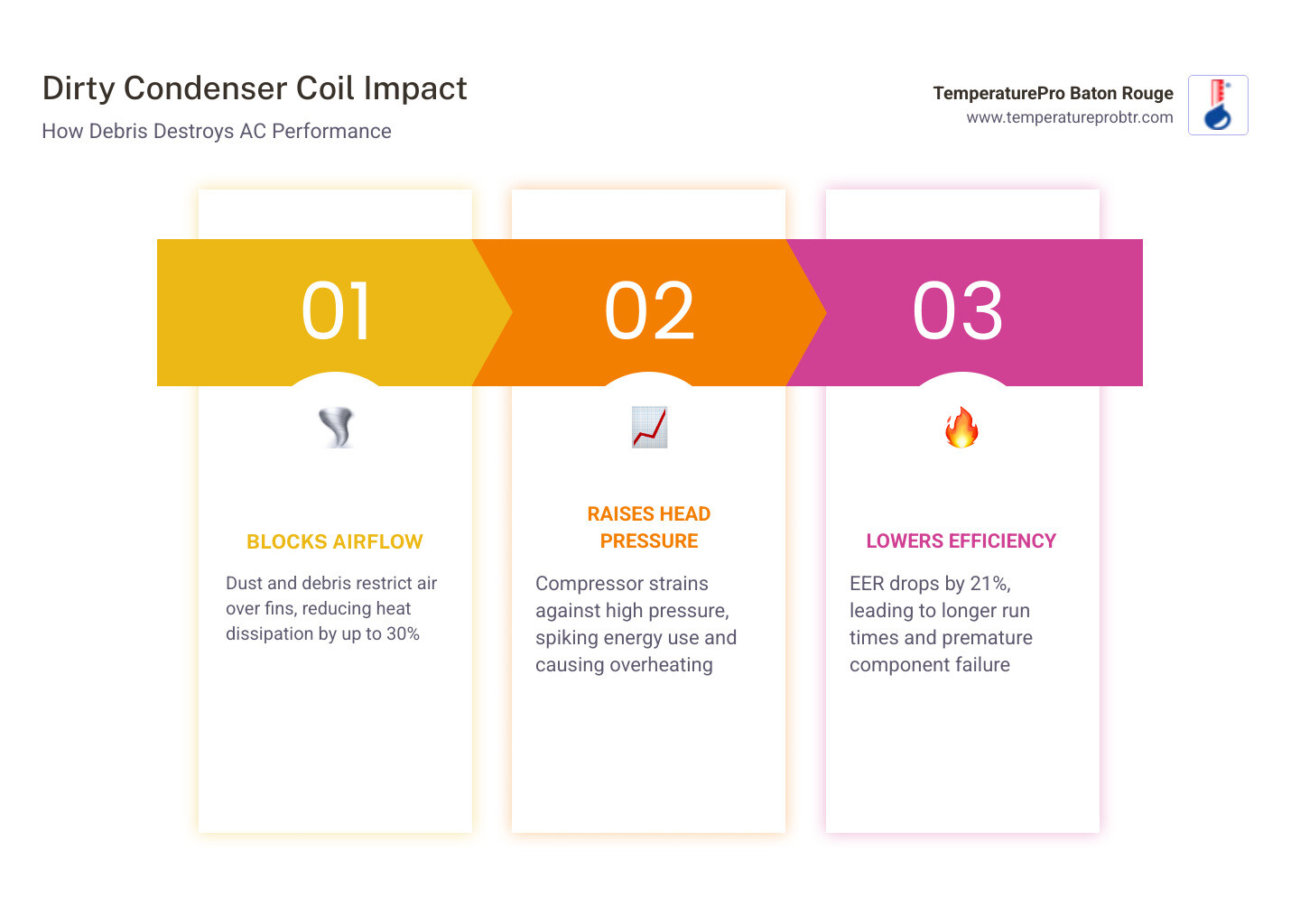
• Trapped heat forces your compressor to work harder, raising energy consumption by up to 30%
• Your AC runs longer cycles, cools less effectively, and wears out faster
• Cleaning the coil can improve your system's EER (energy efficiency ratio) by as much as 21%
• In Baton Rouge's hot, humid climate, coils can foul faster than in drier regions — making regular maintenance even more critical
Think of it this way: your AC pulls heat out of your home and dumps it outside through the condenser coil. When that coil is caked with debris, it's like trying to cool your house by pushing heat through a clogged window screen. The system strains. The bills climb. And eventually, something breaks.
In April 2026, with cooling season already ramping up across Louisiana, this is exactly the right time to understand what a dirty coil is doing to your system — and what you can do about it.
To understand why a little bit of dirt causes such a big problem, we first have to look at what the condenser coil actually does. While the evaporator coil inside your home is responsible for absorbing heat, the condenser coil located in your outdoor unit has the job of "rejecting" that heat into the outside air.
When we talk about the dirty condenser coil and ac performance connection, we are really talking about a breakdown in heat transfer. As refrigerant travels from inside your home to the outside unit, it carries a massive amount of thermal energy. The condenser coil, which is made of copper or aluminum tubes surrounded by thin metal fins, provides the surface area needed for that heat to escape.
However, when those fins are covered in a layer of grime, that dirt acts as a thermal insulator. Just like a winter coat keeps you warm by trapping body heat, a layer of dust on your coils keeps the refrigerant warm. This prevents the heat from leaving the system. If the heat can't escape, your air conditioner can't provide cool air back into your home. This is a primary reason why you might find yourself asking why is my AC running but not cooling.
From a technical standpoint, the impact of dirt on your coils is even more dramatic. When heat cannot be rejected efficiently, the temperature and pressure of the refrigerant inside the coil begin to rise. This is known as "high head pressure."
As head pressure increases, the compressor—the "heart" of your AC—has to work significantly harder to move the refrigerant. This increases the compression ratio, which lowers the system's volumetric efficiency. In simpler terms, the compressor moves less refrigerant while using more electricity.
This also affects the "subcooling" process. Proper subcooling ensures that the refrigerant is a pure liquid before it enters the expansion valve. When coils are dirty, subcooling can become erratic, leading to "liquid flash loss," which reduces the overall cooling capacity of the system. Ensuring your system is clean is the first step toward achieving AC service year-long system efficiency.
Efficiency loss and energy spikes
We’ve seen how much this thermodynamic strain affects your wallet. Research and real-world testing have shown that dirty coils can increase electricity costs by 16% or more. In extreme cases, the U.S. Department of Energy notes that a fouled coil can increase energy consumption by up to 30%.
Let’s look at the numbers from a tested 2-ton system:
• Before cleaning (Dirty): The system had an Energy Efficiency Ratio (EER) of 7.32.
• After cleaning (Clean): The EER jumped to 8.86—a 21% improvement in efficiency.
When your system is dirty, it draws more wattage to perform the same amount of cooling. In that same test, the system's wattage decreased from 2,644 to 2,367 after a simple cleaning. That is a 10.5% reduction in power draw just from removing dirt. Investing in maintenance is one of the best ways to reap the benefits of regular AC maintenance and keep your monthly utility bills manageable.
Recognizing Symptoms of a Fouled Outdoor Unit
How do you know if your outdoor unit is struggling? Sometimes the signs are obvious, like a visible layer of mud on the fins, but often the symptoms are internal.
If your condenser coil is dirty, you may notice:
• Warm air from vents: Even if the fan is blowing, the air doesn't feel crisp or cold.
• Constant running: The system never seems to reach the temperature set on the thermostat.
• High indoor humidity: Because the system is struggling with heat exchange, it can't effectively remove moisture from the air, leaving your home feeling "clammy."
• Ice buildup: Believe it or not, a dirty outdoor coil can cause the indoor evaporator coil to freeze up. This happens because the refrigerant cycle is disrupted, causing temperatures to drop below freezing in the wrong places.
Recognizing these signs your AC needs repair in Louisiana heat can save you from a total system breakdown in the middle of a July heatwave.
Short-cycling and unusual noises
When the dirty condenser coil and ac performance connection becomes severe, your system may begin "short-cycling." This is when the AC turns on and off frequently without ever completing a full cooling cycle. This happens because the internal components are overheating. Most modern units have safety switches that shut the system down if the compressor gets too hot.
You might also hear unusual noises. A stressed compressor often produces a loud buzzing or humming sound as it struggles against high head pressure. Rattling can also occur if debris like small sticks or heavy leaves have become lodged in the fan area. If you notice these issues, you should look into fixing an AC not cooling before the compressor suffers permanent damage.
Visual indicators of debris
In areas like Denham Springs, Walker, and Central, LA, our outdoor units face a variety of environmental "enemies."
1. Pollen: During the Louisiana spring, yellow pollen can coat coils, creating a sticky film that traps other dust.
2. Grass Clippings: If you mow your lawn and blow the clippings toward the AC unit, the fan will suck those clippings right into the delicate fins.
3. Cottonwood Fuzz: This white, fluffy debris acts like a thick blanket, completely choking off airflow.
4. Pet Hair: If you have dogs that spend time near the outdoor unit, their hair can quickly clog the coil.
Checking for these visual signs is a key part of our summer AC maintenance tips for keeping your home cool.
The Hidden Risks of Neglecting Coil Maintenance
Ignoring a dirty coil is a recipe for a very expensive repair bill. The compressor is the most expensive part of your AC system, and it relies on the refrigerant to stay cool. When the coil is dirty, the refrigerant returns to the compressor much hotter than it should be.
• BTU Capacity — Dirty Coil: 19,372 — Clean Coil: 20,992 — Improvement: +8.4%
• Wattage Draw — Dirty Coil: 2,644 — Clean Coil: 2,367 — Improvement: -10.5%
• EER (Efficiency) — Dirty Coil: 7.32 — Clean Coil: 8.86 — Improvement: +21%
When temperatures inside the compressor exceed 225°F, the oil that lubricates the moving parts begins to break down. This is called "carbonization." Once the oil turns into a sludge-like carbon, it can no longer protect the compressor, leading to mechanical failure. If your system is already showing signs of struggle, you need to know what to do when AC freezes up to prevent this kind of catastrophic damage.
Beyond immediate cooling issues, dirty coils significantly shorten the lifespan of your equipment. A well-maintained AC system in Louisiana should last 10 to 15 years. However, a system that is constantly straining against dirty coils may fail in as little as 7 or 8 years.
The increased pressure also puts a strain on the copper joints and valves, increasing the risk of refrigerant leaks. These leaks are not only bad for the environment but are also costly to fix, especially as older refrigerants become more expensive. For residents in Prairieville, following our AC maintenance Prairieville LA complete guide can help ensure your system hits that 15-year mark.
Impact on indoor air quality and comfort
While the condenser coil is outside, its performance directly impacts your indoor air quality. A system that runs constantly but doesn't cool effectively fails to regulate indoor humidity. High humidity is a breeding ground for mold and mildew.
Furthermore, if the system is struggling, it can't circulate air through your high-efficiency filters as often as it should, leading to an increase in indoor allergens like dust mites and pet dander. Maintaining your system according to our AC maintenance Central LA complete guide ensures that your home stays both cool and healthy.
Frequently Asked Questions about Condenser Coils
How often should I have my condenser coils cleaned in Louisiana?
In the Baton Rouge area, we recommend a professional inspection and cleaning at least once a year. Ideally, this should happen in the spring before the extreme heat hits. However, if you live in a high-pollen area or near a construction site in Zachary or Gonzales, you may need a quick rinse every 3 to 6 months. Following our spring AC tune-up tips is the best way to stay ahead of the grime.
Can I use a pressure washer to clean my AC coils?
Absolutely not. This is one of the most common mistakes homeowners make. The metal fins on your condenser coil are incredibly thin and delicate. A pressure washer will flatten these fins instantly, permanently blocking airflow and requiring a costly repair or even a full coil replacement.
We use low-pressure water and specialized, non-corrosive foaming cleaners to safely dissolve the "dirty truth" hiding in your coils. If you do attempt a DIY rinse, use a standard garden hose with a gentle spray and always turn off the power to the unit first.
Does cleaning the coils really lower my energy bills?
Yes! As the statistics show, cleaning a dirty coil can improve efficiency by 21% and reduce energy use by up to 15%. When your system runs shorter cycles and draws less amperage, you will see the difference on your monthly utility statement. It is one of the few home maintenance tasks that literally pays for itself over the course of a single summer.
Conclusion
The dirty condenser coil and ac performance connection is clear: a clean system is a cool, efficient, and long-lasting system. In Baton Rouge, where the humidity and heat are relentless, your air conditioner is your home's most important appliance. Don't let a layer of dust stand between you and a comfortable home.
At TemperaturePro Baton Rouge, we are a family and veteran-owned company that treats every customer like our own neighbors. Whether you are in St. Gabriel, French Settlement, or right here in Baton Rouge, we provide 24/7 support to keep your family comfortable. Our technicians don't just "splash some water" on your unit; we perform a deep, professional cleaning that restores your system's cooling power and protects your investment.
Don't wait for your compressor to fail or your energy bills to skyrocket. Schedule your Baton Rouge AC maintenance today and let us give your system the professional care it deserves.