What Is the $5,000 Rule for AC Replacement and How Do You Use It?
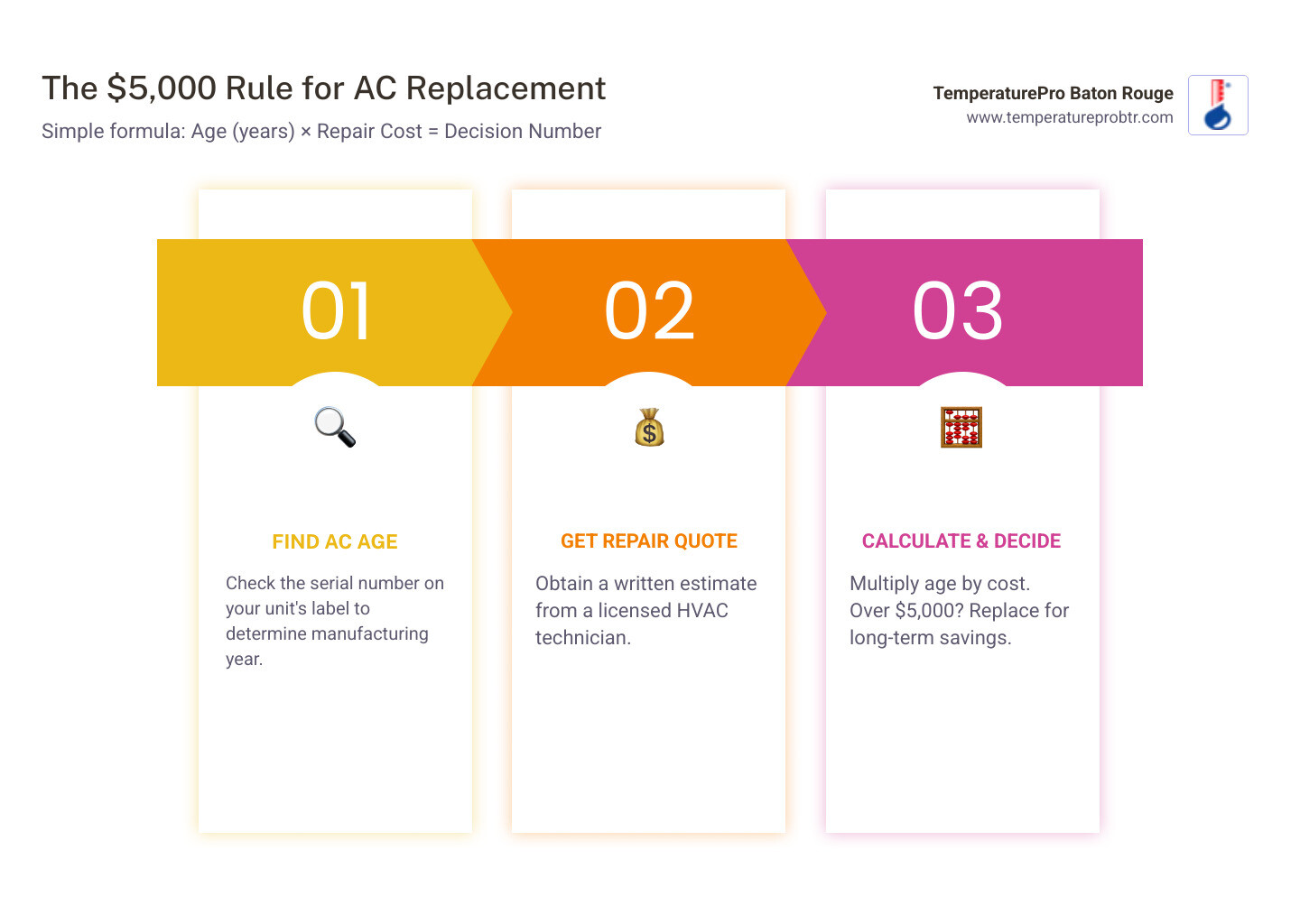
The $5,000 rule for AC replacement is a simple formula HVAC technicians use to help homeowners decide whether to repair or replace their air conditioning system: multiply your AC unit's age (in years) by the estimated repair cost, and if the result exceeds $5,000, replacement is generally the smarter financial move.
Quick answer at a glance:
• 5 years — Repair Estimate: $400 — Decision Number: $2,000 — Recommendation: Repair
• 10 years — Repair Estimate: $400 — Decision Number: $4,000 — Recommendation: Repair
• 10 years — Repair Estimate: $600 — Decision Number: $6,000 — Recommendation: Replace
• 12 years — Repair Estimate: $500 — Decision Number: $6,000 — Recommendation: Replace
• 15 years — Repair Estimate: $300 — Decision Number: $4,500 — Recommendation: Consider replacing (age alone is a red flag)
If you live in Baton Rouge, LA, where heat and humidity push AC systems harder than almost anywhere else in the country, this rule can save you from pouring money into a system that's already on its last legs. A breakdown in the middle of a Louisiana summer is not just uncomfortable — it can become a costly emergency if you make the wrong call under pressure.
The good news? The math is simple, and this guide will walk you through exactly how to apply it.
Understanding the 5000 Dollar Rule for AC Replacement
Deciding whether to keep patching up an old air conditioner or to invest in a brand-new one is a dilemma we see every day in the Baton Rouge area. It’s a classic case of "sunk cost." You don't want to waste the money you've already spent on the unit, but you also don't want to throw "good money after bad."
The $5,000 rule acts as a neutral, mathematical tie-breaker. It removes the emotion and the guesswork from the situation. Instead of wondering if your technician is just trying to sell you something, you can look at the numbers yourself. This rule is a threshold based on the reality that as a system ages, its value drops while its maintenance needs skyrocket.
When we talk about a cost-benefit analysis in the HVAC world, we aren't just looking at the single repair bill on your kitchen table today. We are looking at the probability of future repairs, the rising cost of energy, and the expected remaining life of the equipment. If you’re at a crossroads, understanding When Is It Time for AC Replacement can provide extra clarity alongside the math.
How to use the 5000 dollar rule for ac replacement
Applying the 5000 dollar rule for ac replacement is a straightforward process that anyone with a smartphone calculator can do in thirty seconds. There are only two numbers you need:
1. The Age of the System: How many years has this unit been cooling your home? (If you don't know, we'll explain how to find it later).
2. The Repair Quote: This is the total amount your HVAC professional quoted you for the current fix, including parts and labor.
You simply multiply those two numbers together. For example, if your unit is 12 years old and needs a repair that costs $500, your "Decision Number" is 6,000. Because 6,000 is greater than 5,000, the rule suggests that you are better off replacing the unit.
When the 5000 dollar rule for ac replacement suggests a new unit
The financial logic behind the $5,000 threshold is rooted in long-term value. When your Decision Number clears that 5,000 mark, it typically means the system is old enough that it has already lost most of its efficiency and reliability.
Investing a significant amount into a 10-year-old system is risky because another component—like the compressor or the fan motor—could fail just months later. In South Louisiana, where our units run almost year-round, a 10-year-old unit has "miles" on it that would make a 15-year-old unit in the North look brand new. By choosing replacement, you stop the cycle of emergency repairs and start fresh with a full manufacturer's warranty. If you're noticing other red flags like weird noises or uneven cooling, you should also check out these AC System Replacement Warning Signs.
Step-by-Step: How to Calculate Your Decision Number
We want you to feel confident in your choice. Before you commit to a major repair in Prairieville or Gonzales, take a moment to walk through these steps to ensure you're making the most financially sound decision for your family.
To get an accurate result, you need a professional inspection first. A quick "eyeball" test won't give you the specific repair figures needed for the calculation. Once you have that info, follow this path:
1. Find the age of your unit (in years): Look at the metal nameplate on your outdoor condenser. It usually lists the "Manufacture Date." If it only lists a serial number, you can often find the age by looking up the brand and serial number online, or we can look it up for you during a service call.
2. Obtain a written repair estimate: Ensure the estimate is comprehensive. It should include the cost of the parts, the labor, and any necessary refrigerant.
3. Multiply age by the estimate: This is the core of the 5000 dollar rule for ac replacement.
4. Compare the total to the 5,000 threshold:
— Under 5,000: Repairing is likely the more economical choice for now.
— Over 5,000: It’s time to start Choosing the Right AC Replacement to avoid wasting money.
While the math is simple, this is a guideline. If your unit is only 8 years old but has been repaired four times in the last two years, the "Decision Number" might be under 5,000, but common sense might still tell you to replace it. Reliability has its own value that math can't always capture.
Why System Age and Refrigerant Type Influence the Rule
One of the biggest factors that can "break" an older AC unit's budget is the type of refrigerant it uses. If your system was installed before 2010, there is a high chance it uses R-22 (often called Freon). The EPA phased out R-22 because it was harmful to the ozone layer.
Because R-22 is no longer being produced, the remaining supply is extremely limited and incredibly expensive. If your older unit has a leak, the cost to "recharge" the system can be astronomical. Often, a single refrigerant refill on an R-22 system can push your $5,000 rule calculation deep into the "Replace" category. Modern systems use R-410A or newer refrigerants that are more environmentally friendly and much more affordable to service.
Furthermore, the Department of Energy recently updated SEER2 standards. SEER (Seasonal Energy Efficiency Ratio) is like the "miles per gallon" for your air conditioner. Older systems typically operate at 8-10 SEER. Modern units are required to be much higher, often reaching 16-20 SEER or more. This jump in efficiency means that a new unit doesn't just stop the repairs; it actively lowers your monthly utility bills in Denham Springs or Zachary. If you are considering a transition to a more versatile system, keep an eye out for Heat Pump Replacement Signs as well.
Applying the Rule to the Louisiana Climate
Climate is the "X-factor" that makes the 5000 dollar rule for ac replacement even more critical for us here in Baton Rouge. In milder parts of the country, an air conditioner might only run for three or four months a year. In Louisiana, our cooling season can easily stretch from March through October—and sometimes we even need the AC on Christmas Day!
This constant strain means our units age in "dog years." A system that lasts 20 years in Maine might only last 12 to 15 years in St. Gabriel or French Settlement. The extreme humidity also forces the system to work harder to dehumidify the air, putting extra stress on the evaporator coils and the blower motor.
When the humidity is high, your AC isn't just a comfort machine; it's a home protection device. It prevents mold growth and protects your wood furniture and flooring. If your system is struggling and the $5,000 rule suggests replacement, delaying that decision could lead to more than just a hot house—it could lead to moisture issues in your home. For those looking for high-efficiency year-round comfort, knowing When to Get a New Heat Pump can be a game-changer in our humid climate.
Long-Term Benefits of Choosing Replacement Over Repair
While the upfront cost of a new system is higher than a repair, the long-term benefits often make it the cheaper option over a five-year window. Modern systems are designed to be quieter, more efficient, and better at controlling the "sticky" feeling of Louisiana humidity.
• Efficiency (SEER) — Older AC Systems (10+ Years): 8 - 10 SEER — Modern AC Replacements: 16 - 22+ SEER
• Refrigerant — Older AC Systems (10+ Years): R-22 (Phased out/Expensive) — Modern AC Replacements: R-410A or newer (Available)
• Warranty — Older AC Systems (10+ Years): Expired or limited — Modern AC Replacements: 10-year parts warranty (typical)
• Technology — Older AC Systems (10+ Years): Single-stage (On/Off) — Modern AC Replacements: Variable-speed (Precise cooling)
• Monthly Bills — Older AC Systems (10+ Years): Higher energy consumption — Modern AC Replacements: 20% - 40% lower cooling costs
• Air Quality — Older AC Systems (10+ Years): Basic filtration — Modern AC Replacements: Advanced humidity & allergen control
Beyond the monthly savings, there is the "peace of mind" factor. There is a certain stress that comes with owning a 15-year-old AC unit during a July heatwave. You find yourself listening for every weird click or hum, wondering if this is the day it finally dies. A new system eliminates that anxiety.
And don't forget, if your AC is failing, your heating system might not be far behind. Many homeowners choose to replace the entire HVAC system at once to save on labor and ensure the components are perfectly matched. If your furnace is also acting up, it might be the right When to Consider Furnace Replacement.
Frequently Asked Questions about AC Replacement
How do I find the age of my AC unit?
The easiest way is to check the "Date of Manufacture" on the outdoor unit's nameplate. If it’s faded or missing, find the serial number. The first few digits of the serial number often represent the week and year it was made (for example, a serial number starting with "1208" might mean it was made in the 12th week of 2008). If you're unsure, just give us a call, and we can decode it for you.
Is the 5,000 rule a hard requirement?
No, it’s a guideline. It is designed to give you a clear starting point. You should also consider your future plans. If you plan on moving in six months, you might choose the repair even if the rule suggests replacement. Conversely, if you have a family member with respiratory issues who needs the best possible air filtration, you might replace a unit even if the math says you could squeeze another year out of it.
Does this rule apply to heat pumps?
Yes! The logic remains the same. Since heat pumps work year-round for both heating and cooling in Baton Rouge, they actually accumulate wear and tear faster than a standard AC-only unit. The 5,000 rule is a great way to evaluate them as well.
Conclusion
At TemperaturePro Baton Rouge, we understand that an AC breakdown is one of the most stressful things a homeowner can deal with. We are a family and veteran-owned company, and we treat our neighbors in Central, Walker, and St. Gabriel like family. Our goal isn't just to sell you a new unit; it's to provide the most reliable, cost-effective solution for your specific home.
Whether the $5,000 rule points you toward a quick repair or a full system upgrade, we are here to help with 24/7 support and expert advice. We can perform a professional load calculation to ensure your new system is perfectly sized for your home—not too big, not too small, but just right for that Louisiana heat.
Ready to see where your system stands? More info about air conditioning services is just a click away, or you can call us today to schedule a professional evaluation. Let us help you keep your cool!