When to Repair vs Replace Your HVAC System: A Baton Rouge Homeowner's Guide
When to repair vs replace your HVAC system comes down to a few key factors: your system's age, the cost of repairs, how often it breaks down, and how much it's driving up your energy bills. Here's a quick breakdown to help you decide:
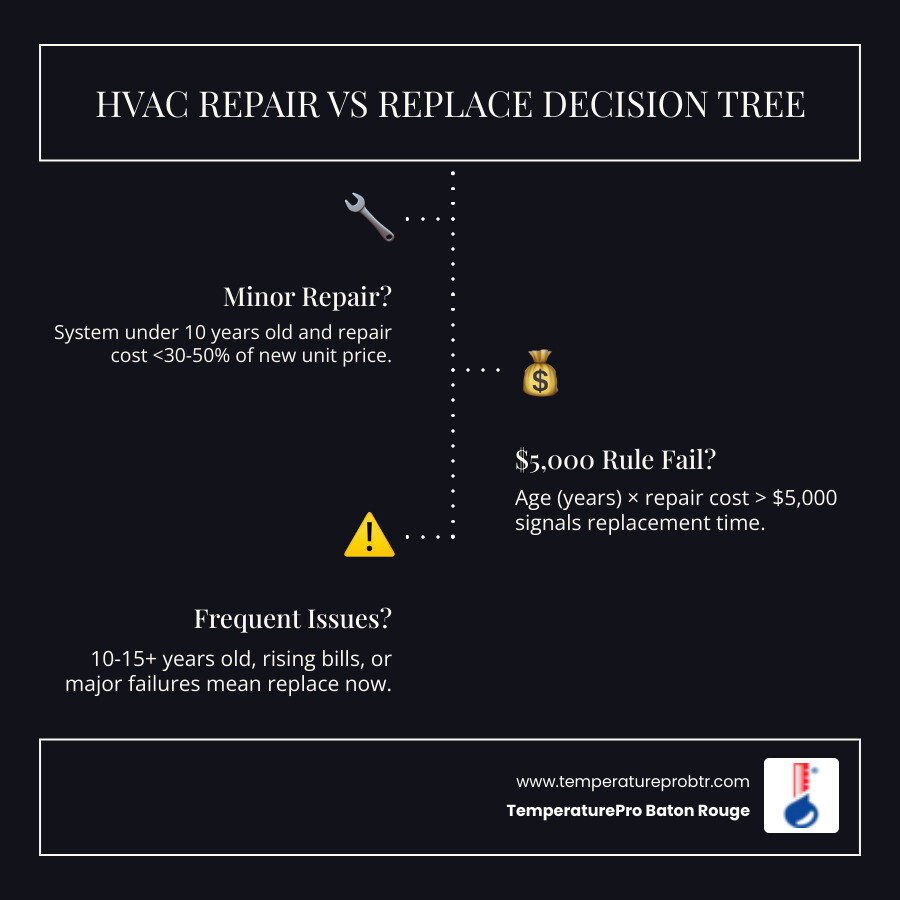
• Repair if your system is under 10 years old, the fix is minor, and repair costs are less than 30-50% of a new system's price
• Replace if your system is 10-15+ years old, repairs are frequent, energy bills keep climbing, or a major component like the compressor has failed
• Use the $5,000 Rule: Multiply your system's age by the repair cost — if the result exceeds $5,000, replacement is usually the smarter move
• Use the 50% Rule: If the repair cost is more than half the price of a new system, replace it
Few things cause more stress for Baton Rouge homeowners than an HVAC system that starts acting up. In Louisiana's intense heat and humidity, your heating and cooling system isn't a luxury — it's a lifeline. And when something goes wrong, you're stuck asking a tough question: is it worth fixing, or is it time to let go?
The answer isn't always obvious. A repair might seem like the cheaper choice in the moment, but an aging, inefficient system can quietly drain your wallet through rising energy bills and repeated service calls. On the other hand, a full replacement is a big investment, and it's not always necessary.
This guide walks you through the key signs, financial rules, and practical questions that help you make the right call — so you're not throwing money at a system that's already on its way out.
How Long Should My Heating and Cooling System Last in Baton Rouge?
In a perfect world, your HVAC system would last forever. In the real world—and especially in the humid, salt-tinged air of South Louisiana—mechanical systems have a finite lifespan. Generally, most HVAC systems are designed to last between 10 and 15 years. However, the specific component matters.
• Air Conditioners: In Baton Rouge, our AC units work overtime. Because they run nearly year-round to combat humidity, a typical central AC unit lasts about 10 to 12 years. If you’ve maintained it perfectly, you might stretch that to 15, but efficiency usually drops off sharply after a decade.
• Furnaces: Since we don’t lean on our heaters quite as hard as folks up north, a gas furnace can often last 15 to 20 years. However, safety becomes a major concern as they age.
• Heat Pumps: These systems pull double duty, heating in the winter and cooling in the summer. Because they are always "on the job," they typically have a lifespan of about 15 years.
Our local climate in areas like Prairieville and Denham Springs plays a huge role. High humidity causes components to corrode faster, and the sheer number of "cooling hours" we rack up each year means a system in Louisiana might reach its "retirement age" faster than one in a milder climate. If your unit is pushing the 10-year mark, it’s a good time to start reading up on When Is It Time for AC Replacement to avoid a mid-summer emergency. Similarly, if your heater is making strange noises every January, you should check out When to Consider Furnace Replacement.
When to Repair vs Replace Your HVAC System: The Financial Rules of Thumb
Deciding when to repair vs replace your hvac system often feels like a gamble. Do you spend a few hundred dollars now and hope the unit lasts another two years, or do you invest in a new system today? To take the guesswork out of it, professional technicians often use a few standard "rules of thumb."
1. The 50% Rule: This is the most straightforward financial guideline. If the cost of a single repair is more than 50% of what a brand-new system would cost, you should almost always replace it. It rarely makes sense to put that much money into an old machine that will likely break down again soon.
2. The 30% Rule: Some experts suggest being even more conservative. If a repair costs more than 30% of a new system and the unit is over 10 years old, the long-term value usually lies in replacement.
3. The "Three Strikes" Rule: Look at your repair history. Have you had three or more significant repairs in the last three years? If so, your system is likely experiencing a "cascade failure," where one part wearing out puts stress on others. At this point, you’re just "throwing good money after bad."
If you’re unsure where your current system stands, our team at TemperaturePro Baton Rouge can provide a full diagnostic through our HVAC Services to help you see the bigger picture.
Using the $5,000 Rule to Decide When to Repair vs Replace Your HVAC System
One of the most popular tools in the industry is the $5,000 Rule. It’s a simple math equation that helps homeowners in places like Gonzales and Zachary see the financial reality of their situation.
The Formula: Age of the System (in years) x Cost of the Repair = Result
• If the result is less than $5,000, it generally makes sense to repair the unit.
• If the result is more than $5,000, you should strongly consider replacement.
For example, if you have a 12-year-old AC unit that needs a $500 repair, the math looks like this: 12 x 500 = 6,000. Since 6,000 is greater than 5,000, the rule suggests that replacing the unit is the better long-term investment. Why? Because a 12-year-old unit is already near the end of its life, and that $500 is likely just the first of many upcoming expenses. If you're dealing with a heat pump specifically, you can find more tailored advice on When to Get a New Heat Pump.
Evaluating Efficiency Standards When to Repair vs Replace Your HVAC System
Sometimes, the decision isn't about whether the system can run, but whether it should. Older systems are notoriously inefficient. HVAC technology has leaped forward in the last decade, meaning a new system uses significantly less power to achieve the same level of comfort.
• SEER2 Ratings: The Seasonal Energy Efficiency Ratio (SEER2) measures how much cooling a system puts out for every watt of electricity it uses. Many older systems in Baton Rouge homes are rated at SEER 8 or 10. Modern standard units start at SEER 14 or 15, and high-efficiency models can go well above 20. Switching from a SEER 9 to a SEER 14 unit can reduce your energy consumption by more than 35%.
• AFUE: For furnaces, the Annual Fuel Utilization Efficiency (AFUE) tells you how much fuel is converted to heat versus how much is wasted. Older furnaces might be 80% efficient, while new ENERGY STAR models can reach 95% or higher.
• Utility Bill Spikes: If your energy bills have been creeping up year after year despite your usage staying the same, your system is likely working harder and longer to do the same job. This "hidden cost" of keeping an old HVAC system can often justify the monthly payment on a new, efficient one.
What Are the Warning Signs That My AC Is Failing?
While math rules are helpful, your system will often "tell" you when it’s reaching the end of the line. Recognizing these AC System Replacement Warning Signs early can save you from a total system collapse during a July heatwave.
• The R-22 Refrigerant Issue: If your AC was built before 2010, it likely uses R-22 refrigerant (often called Freon). This refrigerant has been phased out by the EPA because it’s harmful to the ozone layer. It is no longer being produced, which means repairs involving refrigerant leaks have become incredibly expensive and difficult. If your R-22 system has a leak, replacement is almost always the only logical path.
• Uneven Temperatures: Do you have one bedroom that feels like a sauna while the living room is a walk-in freezer? This often means your system can no longer handle the static pressure required to push air through your home effectively.
• Strange Noises and Smells: Squealing, grinding, or banging noises are signs of mechanical failure. Musty smells could indicate mold in the ductwork or a failing drainage system, while burning smells are an immediate electrical red flag.
• Safety Hazards: This is the most critical factor. For furnaces, a cracked heat exchanger can leak carbon monoxide into your home—a colorless, odorless, and potentially lethal gas. If a technician finds a safety issue like this, repair is often impossible or unsafe; immediate replacement is required.
For a deeper dive into what to watch for, check out these Key Signs Your HVAC Needs Urgent Repair or Replacement.
Frequently Asked Questions About HVAC Decisions
Navigating heating and cooling can be confusing. Here is a quick comparison to help you weigh your options:
• Upfront Cost — Repairing Your Current System: Lower — Replacing with a New System: Higher
• Monthly Bills — Repairing Your Current System: Stay high or increase — Replacing with a New System: Decrease by 20% to 40%
• Reliability — Repairing Your Current System: Uncertain; potential for more breaks — Replacing with a New System: High; includes new warranty
• Comfort — Repairing Your Current System: Uneven temps; higher humidity — Replacing with a New System: Precise control; better air quality
• Technology — Repairing Your Current System: Outdated; manual controls — Replacing with a New System: Smart stats; variable-speed motors
• Environment — Repairing Your Current System: Uses older, harsher refrigerants — Replacing with a New System: Eco-friendly; lower carbon footprint
Beyond the unit itself, don't forget the "veins" of your home—the ductwork. The average home's ductwork leaks about 30% of its air before it ever reaches your rooms. If you're investing in a new system, it's the perfect time to ensure your ducts are sealed and efficient. You can learn more about these indicators in our guides on Heat Pump Replacement Signs and Furnace Replacement Top Indicators.
Should I replace my HVAC if I am selling my home soon?
This is a common question in the Baton Rouge real estate market. If your system is functioning well and is under 10 years old, a repair is usually sufficient. However, if your system is 15 years old and nearing the end of its life, a savvy home inspector will flag it. Replacing an ancient unit can actually increase your home's value and make it much more attractive to buyers who don't want to inherit a major expense the moment they move in.
What are the safety risks of repairing an old furnace?
The biggest risk is carbon monoxide (CO) poisoning. As furnaces age, the metal heat exchanger can develop small cracks due to years of expanding and contracting. While a technician can sometimes patch minor issues, a compromised heat exchanger is a major safety hazard. Additionally, older electrical components can become fire risks. If a system is deemed unsafe, we will always recommend replacement to protect your family.
How much can a new system save on monthly energy bills?
According to ENERGY STAR, replacing a 10-year-old AC with a new certified unit can save you up to 20% on your cooling costs. In some cases, homeowners who switch from very old, inefficient systems to modern variable-speed technology see their energy bills drop by as much as 40%. Given that HVAC equipment accounts for about 50% of a typical home's energy use, those savings add up fast.
Conclusion
At the end of the day, deciding when to repair vs replace your hvac system is about balancing your immediate budget with your long-term comfort and safety. While a repair might get you through the week, a new system offers the peace of mind that comes with a manufacturer’s warranty, lower utility bills, and a home that stays perfectly cool even when the Louisiana sun is at its fiercest.
At TemperaturePro Baton Rouge, we understand that every home and every budget is different. As a family and veteran-owned company, we treat our customers in Baton Rouge, Central, and St. Gabriel like our own neighbors. We aren't here to sell you something you don't need; we're here to provide honest, 24/7 support and expert advice so you can make the best choice for your family.
Whether you need a quick fix to get your AC running tonight or you want a professional inspection to see if it's finally time for an upgrade, we're here to help.
More info about HVAC services