5 min read
Fall HVAC Troubleshooting: Why Your Heater Smells Like Burning Dust on Startup
Is that burning dust smell normal? Read our home maintenance tips and troubleshooting to see why heating startup odors happen and when to call a professional.


When Your AC Can't Keep Up With the Heat: What's Really Going OnWhen your AC can't keep up with the heat, it's usually caused by one or more of the following:Design limits - Most AC systems can only cool your home 15-20°F below the outdoor
When your AC can't keep up with the heat, it's usually caused by one or more of the following:
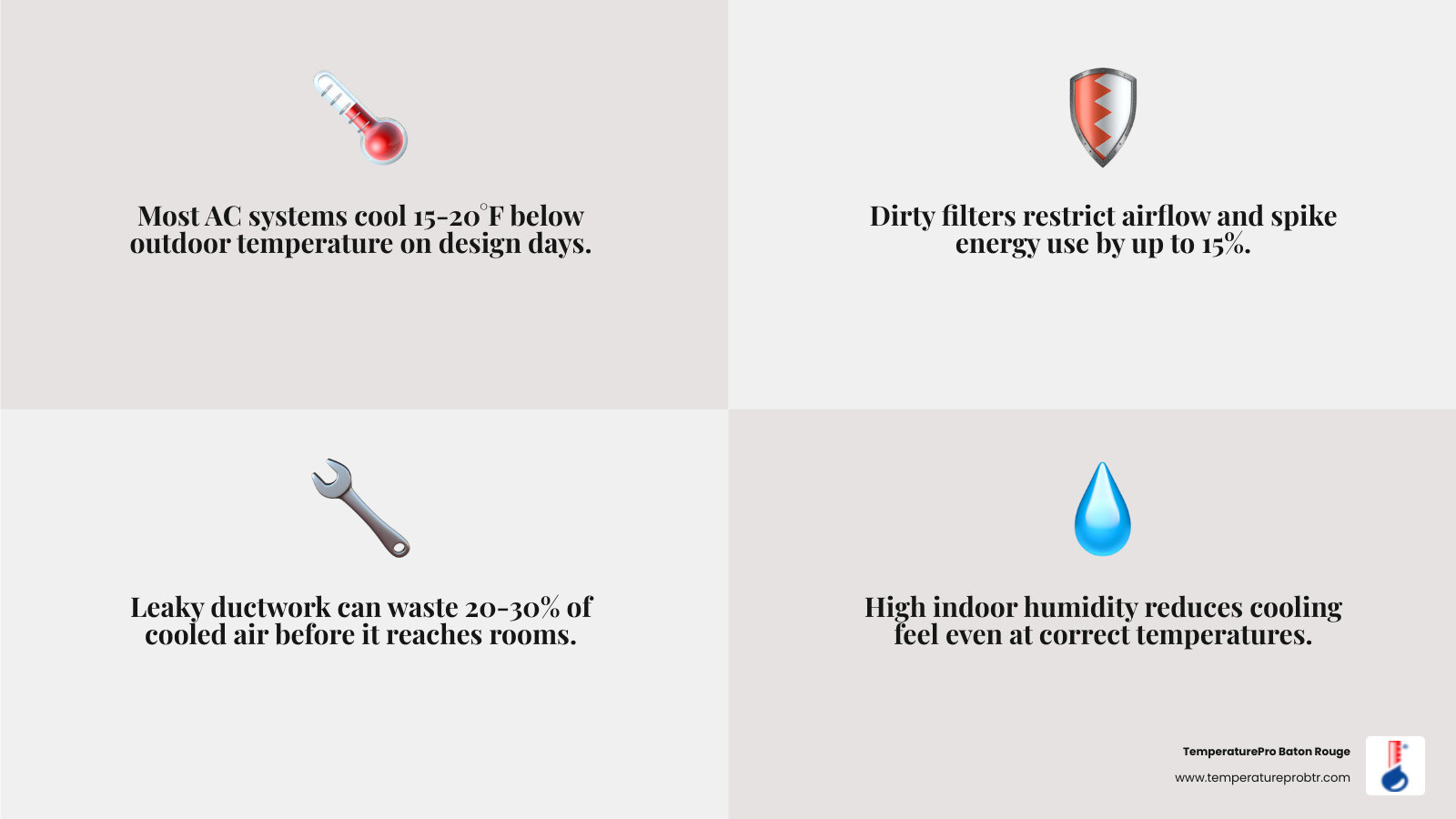
• Design limits - Most AC systems can only cool your home 15-20°F below the outdoor temperature
• Dirty air filters - Clogged filters restrict airflow and can spike energy use by up to 15%
• Refrigerant leaks - Low refrigerant means less cooling power, often shown by ice on coils or hissing sounds
• Leaky ductwork - Gaps in ducts can bleed out 20-30% of cooled air before it reaches your living spaces
• Undersized or aging system - A unit past its 10-15 year lifespan or too small for your home simply cannot keep pace on brutal summer days
• Dirty condenser coils - A clogged outdoor unit can't release heat effectively
• High indoor humidity - Excess moisture makes your home feel hotter even when the temperature reads right
Baton Rouge summers are no joke. When outdoor temperatures climb into the upper 90s or past 100°F, even a well-functioning air conditioner can struggle to hit your thermostat's target. That's not always a sign something is broken — but it can be. Knowing the difference between a system working at its limits and one that genuinely needs attention can save you from unnecessary discomfort, high energy bills, or a costly breakdown at the worst possible time.
This guide walks you through why your AC loses ground on the hottest days, what you can check yourself, and when it's time to call in a professional.
It is a common sight in Louisiana: the thermostat is set to 71°F, but the indoor display stubbornly reads 78°F while the outdoor sun blazes at 100°F. Before you panic and assume your system is broken, it is important to understand "design temperatures." Most residential air conditioning systems are engineered to handle average summer highs—usually in the low 90s for our region.
The "20-degree rule" is a fundamental principle of HVAC physics. Under ideal conditions, a properly functioning AC is designed to create a 20-degree differential between the outdoor air and your indoor sanctuary. If it is 100°F in Baton Rouge, your AC is doing its job perfectly if it keeps your living room at 80°F.
We use a "Manual J" load calculation to determine the exact size of the system a home needs. This calculation considers your square footage, insulation quality, and window orientation. However, even a perfectly sized unit has a maximum cooling capacity. When we experience record-breaking heatwaves that exceed local design temperatures, your system may run indefinitely without reaching your setpoint. If you are noticing that some parts of your home are significantly warmer than others during these peaks, you might be dealing with Solving Uneven Cooling in Your Home.
• 90°F — Expected Indoor Temp (Max Cooling): 70°F - 72°F
• 95°F — Expected Indoor Temp (Max Cooling): 75°F - 77°F
• 100°F — Expected Indoor Temp (Max Cooling): 80°F - 82°F
• 105°F — Expected Indoor Temp (Max Cooling): 85°F+
While physics explains some performance drops, mechanical issues are often to blame when your home feels like a sauna. Airflow is the lifeblood of your HVAC system. When airflow is restricted, the heat exchange process fails. This can lead to frozen evaporator coils (yes, your AC can freeze even in 100-degree weather!) or a struggling compressor that eventually overheats and shuts down.
Common mechanical barriers include:
• Condenser Debris: Your outdoor unit needs to "breathe" to release the heat it gathered from inside. If it’s buried in grass clippings, leaves, or dirt, the heat stays trapped in the system.
• Refrigerant Leaks: Refrigerant is not "fuel"—it doesn't get used up. If levels are low, you have a leak. This reduces the system's ability to absorb heat, often resulting in lukewarm air coming from the vents.
If you suspect your system is blowing air but not actually dropping the temperature, check out our guide on Fixing an AC Not Cooling or learn more about AC Airflow Problems and Solutions.
The simplest reason when your ac cant keep up with the heat is often hiding right behind your return vent. A dirty air filter acts like a wall, forcing your blower motor to work twice as hard to pull air through. This doesn't just make you warmer; it can increase your energy consumption by up to 15%.
We recommend using filters with a MERV rating between 8 and 11 for residential homes in Baton Rouge. While higher MERV ratings catch smaller particles, they can sometimes be too restrictive for older systems during a heatwave. During the peak cooling months of May through August, you should check your filter every 30 days. For more localized advice, see our Best AC Maintenance Tips Gonzales LA.
Your attic is likely the hottest place in your house, often reaching 140°F or more. If your ductwork has even minor leaks, it is sucking in that scorching attic air or blowing your expensive cold air into the rafters. Statistics show that leaky ducts can result in a 30% loss in efficiency. This means nearly a third of the money you spend on cooling is being wasted.
In older Baton Rouge homes, shifting foundations or aging tape can cause ducts to disconnect. This creates "hot spots" in specific rooms. If you are struggling with a bedroom that won't stay cool, you may be facing Solving Uneven Cooling Issues Baton Rouge Homes.
Before calling for emergency service, there are several steps you can take to alleviate the strain on your system. First, check your thermostat settings. Ensure it is set to "Cool" and the fan is set to "Auto" rather than "On" to help manage humidity. If you need more immediate ideas, browse our AC Not Cooling Troubleshooting Tips for Baton Rouge.
You can help your AC by reducing the "heat load" it has to fight.
• Ceiling Fans: Ensure they are spinning counter-clockwise to push a breeze downward. This doesn't lower the temperature, but the wind-chill effect makes you feel 4–6 degrees cooler.
• Window Treatments: Close blinds and curtains, especially on west-facing windows, to block solar heat gain.
• Appliance Timing: Avoid using the oven, dryer, or dishwasher during the hottest part of the day (2 PM to 7 PM).
• Weather-Stripping: Check for air leaks around doors and windows. If you can feel heat coming in, your cold air is going out.
DIY fixes have their limits. If you notice any of the following, it is time to turn the system off to prevent permanent damage and call us:
• Hissing or Bubbling: This usually indicates a refrigerant leak.
• Ice on the Unit: If you see ice on the copper lines or the indoor coil, your system has a serious airflow or refrigerant issue.
• Short Cycling: If the AC turns on and off every few minutes, the compressor may be overheating.
• Burning Smells: This could indicate an electrical failure or a motor burning out.
For those in the middle of a meltdown, we offer 24/7 Emergency Repair Services in Baton Rouge.
Sometimes, the reason when your ac cant keep up with the heat is simply that the system has reached the end of its road. Most AC units last between 10 and 15 years. As they age, they lose efficiency. An old SEER 10 unit from 15 years ago uses significantly more power to produce less cooling than a modern SEER 18+ system.
If your repair bills are stacking up or your energy costs have skyrocketed despite regular maintenance, it might be more cost-effective to upgrade. Modern systems are better at dehumidification and can handle the extreme Louisiana humidity much more effectively. Learn the AC System Replacement Warning Signs and find out When Is It Time for AC Replacement.
The best way to ensure your AC doesn't fail when it hits 100 degrees is to catch small problems in the spring. A well-maintained system performs up to 25% more efficiently and lasts 40% longer. During a professional tune-up, we clean the coils, check refrigerant levels, and tighten electrical connections that could otherwise fail under the stress of a heatwave.
Check out our Spring AC Tune-Up Tips to prepare for next year, and remind yourself of the Benefits of Regular AC Maintenance to keep your utility bills in check.
In areas like Prairieville, we often see specific airflow issues related to home construction styles and duct layouts. Whether it's a failing blower motor or ducts that need professional sealing, localized solutions are key to restoring comfort. We specialize in AC Airflow Troubles and Fixes for Prairieville Homes, ensuring every room in your house stays at the temperature you desire.
Yes, it can be normal. When the outdoor temperature is near or above the system's design limit, the AC will run continuously to try and maintain the setpoint. However, if it runs all day and the temperature inside continues to rise, there is likely an underlying maintenance issue or a lack of capacity.
This is due to the 20-degree differential limit. If the air coming out of your vents is 15-20 degrees cooler than the air going into the return, your system is technically performing as designed. To get below 75°F on a 100°F day, you would need superior insulation, high-performance windows, and a system sized specifically for extreme peaks.
Humidity adds "latent heat" to the air. Your AC has to work to remove moisture before it can effectively lower the temperature. If your indoor humidity is above 50%, the air will feel "sticky" and warm, even if the thermometer says 72°F. A struggling AC often fails to dehumidify properly, making the heat feel much worse.
When your ac cant keep up with the heat, you don't have to suffer through a sweltering house. Whether your system is reaching its natural physical limits or is in need of a professional repair, the team at TemperaturePro Baton Rouge is here to help.
As a family and veteran-owned company, we take pride in serving our neighbors in Baton Rouge, Prairieville, Gonzales, and beyond. We treat every customer like family, providing honest assessments and 24/7 support to ensure you never have to spend a night in the heat. From simple tune-ups to full system replacements, we have the expertise to keep your home cool all summer long.
Ready to get your home back to a comfortable temperature? Contact us today for expert Air Conditioning Services and experience the difference of a team that truly cares about your comfort.
Go With Experience