Understanding how humidity affects your AC performance is the single most important thing Baton Rouge homeowners can do to stay comfortable and keep energy bills under control during Louisiana's brutal summers. Here's a quick breakdown:
How humidity impacts your AC — at a glance:
• Forces longer run times — The AC must remove moisture from the air before it can effectively lower the temperature, so it runs harder and longer.
• Reduces cooling power — In high humidity, the temperature drop across your AC coil can fall from a normal 18–22°F down to 10°F or less.
• Makes rooms feel hotter — When indoor relative humidity rises above 50–60%, your home can feel several degrees warmer than what the thermostat actually reads.
• Increases wear on components — Longer cycles put extra strain on the compressor and coils, shortening your system's lifespan.
• Signals a possible sizing problem — Oversized units cool the air too quickly and shut off before removing enough moisture, leaving your home cold but clammy.
Most people think cooling comfort is all about temperature. Set the thermostat to 72°F and you're done, right? Not exactly — especially if you live in Baton Rouge, LA.
Baton Rouge sits in a subtropical climate where summer humidity regularly climbs well above 80% outdoors. That heavy, wet air doesn't just make you uncomfortable outside. It follows you inside, and it makes your air conditioner work twice as hard just to keep up.
The tricky part? Your thermostat only reads temperature. It has no idea how muggy the air actually feels. So your system can hit its target temperature and shut off while the room still feels like a damp towel. That gap between what the thermostat shows and what your body actually feels is exactly where humidity does its damage — to your comfort, your energy bills, and your equipment.
To understand why your air conditioner struggles in May 2026, we have to look at the science of "psychrometrics"—the study of air, water vapor, and temperature. We often talk about air conditioning as if it only blows "cold," but it is actually a massive heat-and-moisture-removal machine.
When we talk about how humidity affects your AC performance, we are looking at the total load placed on the system. In a dry climate, the AC has one job: lower the air temperature. In Baton Rouge, Prairieville, and Denham Springs, the AC has two jobs: lower the temperature and wring out gallons of water from the air. If your system is already showing Signs Your AC Needs Repair in Louisiana Heat, high humidity will likely push it over the edge.
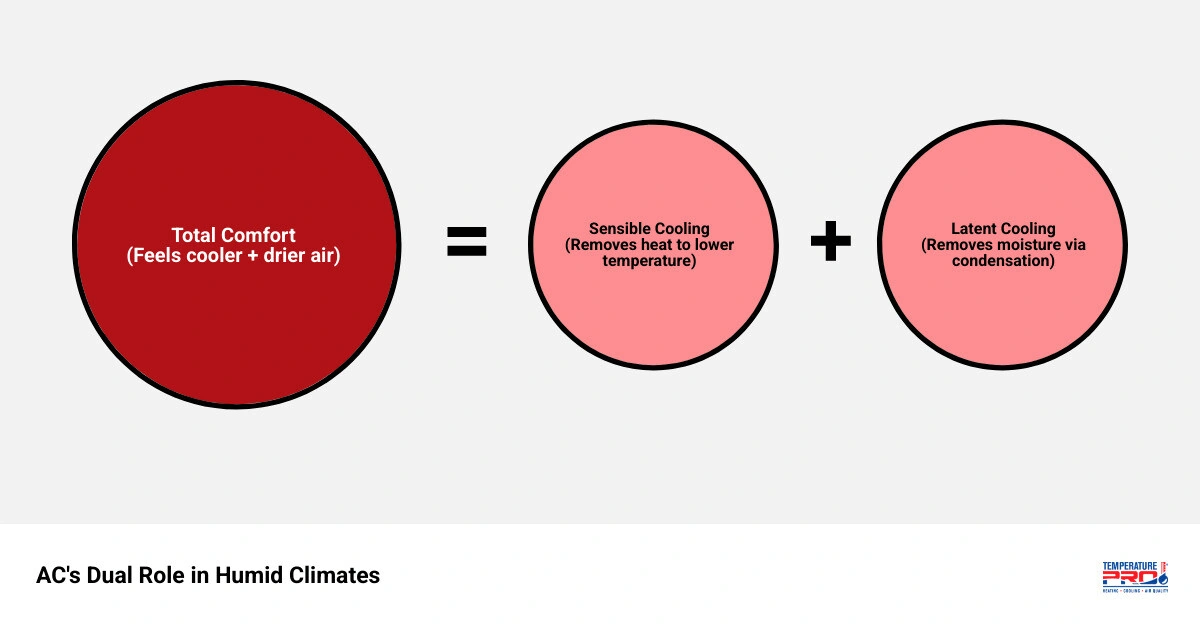
Sensible vs. Latent Cooling Loads
In the HVAC world, we split cooling into two categories:
1. Sensible Heat: This is the heat you can "sense" with a thermometer. It’s the actual temperature of the air.
2. Latent Heat: This is the energy hidden in water vapor. It doesn't change the temperature, but it changes the state of the air from "crisp" to "soupy."
When humidity is high, your AC has to spend a huge chunk of its capacity removing latent heat (moisture) before it can even begin to lower the sensible heat (temperature). It’s like trying to dry off with a towel while standing in the rain—the system is so busy managing the water that it loses its ability to cool the air effectively.
The Role of the Evaporator Coil and Dew Point
The "magic" happens at the evaporator coil. As warm, humid air from your Central or Zachary home passes over this cold coil, the moisture in the air hits its dew point. This is the temperature at which water vapor turns back into liquid water.
Think of a cold soda can "sweating" on a porch in Gonzales. That condensation is exactly what happens inside your AC. The water collects on the coil, drips into a drain pan, and flows out of your house through a condensate line. However, if the humidity is too high, a thick layer of water can actually coat the coil tubes, acting as an insulator. This makes it harder for the refrigerant inside the coil to absorb heat from your air, causing the system to run longer and longer without reaching the target temperature.
Why High Humidity Makes Your Baton Rouge Home Feel Warmer
Have you ever walked into a room where the thermostat says 72°F, but you still feel sticky and gross? You aren't imagining it. High indoor humidity creates a "heat index" effect inside your own living room.
When the air is saturated with moisture, your body’s natural cooling mechanism—sweat evaporation—slows down. If your sweat can't evaporate, your body can't shed heat. This is why a home with 70% humidity feels significantly warmer than a home at 45% humidity, even if the temperature is identical. Beyond just feeling "gross," high humidity can lead to Signs Your AC Needs Repair in Louisiana Heat like mold growth and musty odors that ruin your indoor air quality. Knowing How to Extend the Life of Your AC in Louisiana starts with controlling this moisture.
The Heat Index and Sweat Evaporation
The "apparent temperature" is what you actually feel. For optimal comfort and health, we recommend keeping your indoor relative humidity (RH) between 30% and 50%. Once you cross the 60% threshold, your home becomes a breeding ground for dust mites and mold. More importantly, the "feel" of the room shifts. At 50% RH, 75°F feels like 75°F. At 70% RH, that same 75°F can feel like 80°F.
If your AC is being overwhelmed by Louisiana's subtropical moisture, it will leave a trail of clues. Watch for these common indicators:
• Fogged Windows: Condensation on the inside of your windows in the morning.
• Sticky Surfaces: Wood furniture or floors that feel slightly tacky or "damp" to the touch.
• Never-Ending Cycles: The AC runs for hours without stopping, but the air never feels "crisp."
• Musty Odors: That "old basement" smell lingering in your carpets or upholstery.
• 30% - 50% — Perceived Comfort: Ideal, crisp, comfortable — AC Strain: Normal/Efficient — Mold Risk: Low
• 55% - 60% — Perceived Comfort: Slightly heavy, "clammy" — AC Strain: Moderate — Mold Risk: Moderate
• Above 65% — Perceived Comfort: Hot, sticky, suffocating — AC Strain: Extreme/High Wear — Mold Risk: High
The Impact on Efficiency, Energy Bills, and Equipment Lifespan
When we talk about how humidity affects your AC performance, we aren't just talking about your comfort—we’re talking about your wallet. Because a humid home forces the AC to run "long-cycles" to remove moisture, your electricity meter is spinning much faster than it needs to.
In places like Baton Rouge and St. Gabriel, the extra workload caused by latent heat can slash your system's efficiency. Instead of the standard 18–22°F temperature drop (the difference between the air going into the intake and the air coming out of the vents), a moisture-overloaded system might only manage a 10°F drop. This is because all the cooling energy is being used to turn vapor into water rather than lowering the air temperature.
The How Louisiana Heat and Humidity Affect AC Lifespan is a major concern for local homeowners. In drier states, an AC might last 15 to 20 years. In the humid Gulf South, that lifespan often drops to 10 or 12 years. The constant "tug-of-war" between moisture and cooling means your system rarely gets a break, leading to premature mechanical failure.
Long-term Wear and Compressor Strain
The compressor is the "heart" of your AC, and humidity is its greatest enemy. Long-cycling means the compressor stays hot for longer periods, which breaks down the lubrication and wears out the internal seals. This is why the Average Lifespan of an AC System in the South is shorter than in other regions. Regular maintenance isn't just a suggestion here; it’s a survival tactic for your equipment.
Sizing and Modern Solutions for Better Dehumidification
One of the biggest mistakes we see in the Baton Rouge area is the "bigger is better" mentality. Many homeowners think that if their house is humid, they need a "stronger" (larger) AC unit. In reality, an oversized unit is the worst thing for humidity.
The Danger of Oversized AC Units
If an AC unit is too large for the square footage of your home, it will perform what we call "short-cycling." It blasts the house with cold air, hits the thermostat target in 10 minutes, and shuts off.
The problem? It takes about 15 to 20 minutes of continuous running for the evaporator coil to get cold enough to start pulling significant moisture out of the air. An oversized unit cools the air so fast it never has a chance to dehumidify. This creates the "Cave Effect"—your house is 68°F, but it’s so damp and clammy you feel like you're living in a limestone cavern. Proper sizing using a Manual J load calculation is essential to ensure your system runs long enough to actually dry the air.
Advanced HVAC Technology for Moisture Control
Luckily, modern technology has given us better tools to fight the Louisiana mugginess:
• Variable-Speed Blowers: These fans can slow down to move air across the cooling coil more slowly, which increases "dwell time" and pulls way more water out of the air.
• Whole-House Dehumidifiers: These integrate directly into your ductwork to remove moisture independently of the AC cooling cycle.
• Smart Thermostats: Many modern units can monitor humidity and tell the AC to keep running at a lower speed specifically to dehumidify, even if the temperature goal is met.
• The "Auto" Fan Setting: Always keep your fan on "Auto." If you set it to "On," the fan keeps blowing after the cooling cycle stops. This blows air over the wet evaporator coil, evaporating all that water right back into your home before it can drain away!
Frequently Asked Questions About Humidity and AC
What is the ideal indoor humidity level for May 2026?
The "Goldilocks zone" for indoor air is between 30% and 50% relative humidity. This range is perfect for preventing mold growth, protecting wood furniture from warping, and ensuring your AC operates at peak efficiency. If you find your home is consistently above 55%, it’s time to look into supplemental dehumidification.
Can an air conditioner work as a dehumidifier?
Yes, but with limits. Every AC is naturally a dehumidifier because of the condensation process on the evaporator coil. However, its primary "trigger" is temperature. If the temperature is fine but the humidity is high, a standard single-stage AC won't turn on to fix the moisture issue. That’s where a whole-house dehumidifier becomes a game-changer.
Why does my house feel sticky even when the AC is on?
This is usually caused by a high "latent load." Common culprits include:
• Duct Leaks: Pulling in humid air from your attic or crawlspace.
• Oversized Units: Short-cycling before moisture removal is complete.
• Infiltration: Gaps around doors and windows letting in that heavy Louisiana air.
• Internal Sources: Cooking, long showers, or even lots of indoor plants can add to the moisture load.
Conclusion: Achieving the Perfect Balance of Comfort
Managing how humidity affects your AC performance is about more than just comfort—it’s about protecting your home and your health. In Baton Rouge, Prairieville, and the surrounding communities, the humidity isn't just a weather report; it’s a constant challenge for your HVAC system.
At TemperaturePro Baton Rouge, we are a family and veteran-owned company that understands exactly what Louisiana summers demand from an air conditioner. We don't just look at the thermostat; we look at the whole picture, from system sizing to indoor air quality. Whether you need a precision tune-up to clear your condensate lines or a high-efficiency variable-speed upgrade to finally kill that "sticky" feeling, we treat every customer like family.
Don't let the humidity win this summer. Schedule your humidity-smart AC service today and experience the difference of a truly comfortable, dry home.