How Long Does an AC Last in Louisiana? Here's What Baton Rouge Homeowners Need to Know
The average lifespan of an AC system in the south is significantly shorter than most homeowners expect. If you want the quick answer:
• Central Split AC — National Average: 15-20 years — Southern States (LA, TX, FL): 10-15 years — Coastal Areas: 8-12 years
• Heat Pump — National Average: 10-16 years — Southern States (LA, TX, FL): 8-12 years — Coastal Areas: 8-11 years
• Ductless Mini-Split — National Average: 12-20 years — Southern States (LA, TX, FL): 10-16 years — Coastal Areas: 10-14 years
• Package Unit — National Average: 12-15 years — Southern States (LA, TX, FL): 8-12 years — Coastal Areas: 7-11 years
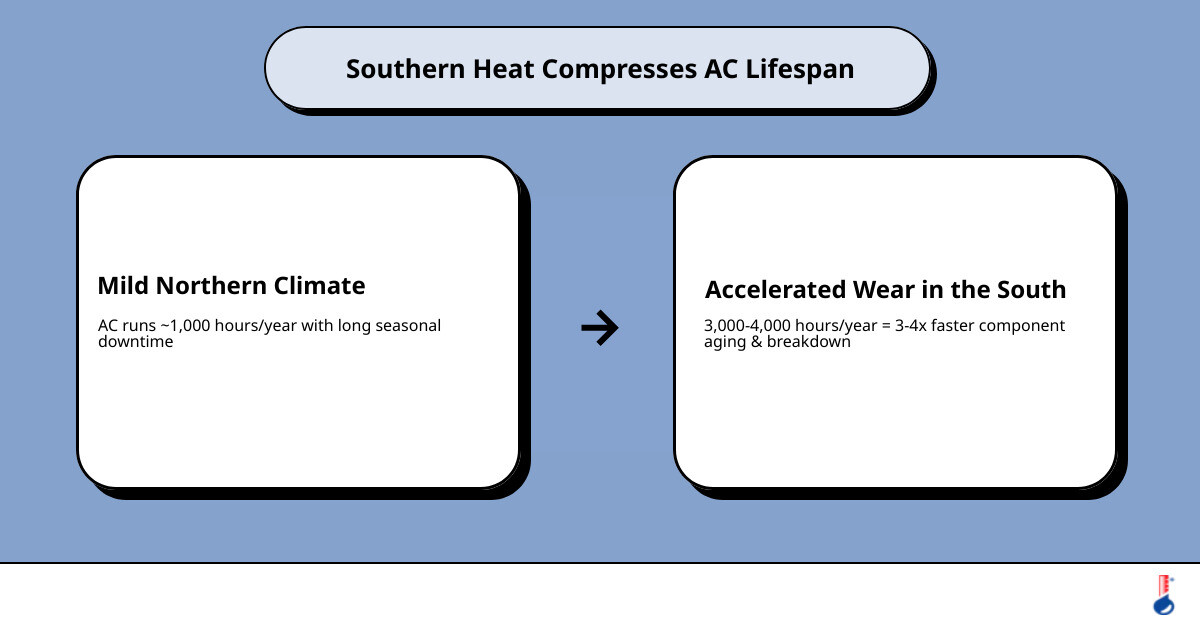
In Baton Rouge, LA, your air conditioner faces some of the harshest operating conditions in the country. The combination of extreme summer heat, suffocating humidity, and a cooling season that stretches nearly year-round puts enormous strain on every component in your system. While an AC in a mild northern climate might run 1,000 hours per year, systems here in Louisiana routinely log 3,000 to 4,000 hours annually — that's the equivalent of running a northern system for three or four years, packed into just one.
The result? A system that wears out faster, breaks down more often, and costs more to run as it ages. Knowing where your AC stands in its lifespan can help you make smarter decisions before a breakdown catches you off guard in the middle of a Louisiana summer.
Understanding the Average Lifespan of an AC System in the South
When we talk about the average lifespan of an AC system in the south, we aren't just looking at a calendar. We are looking at "mechanical miles." Just like a truck that drives 50,000 miles a year will wear out faster than one that stays in the garage, a Baton Rouge AC unit accumulates wear and tear at an accelerated rate.
In most parts of the country, an air conditioner is a seasonal appliance. It gets a nice long break during the fall and winter. Down here in the South, our "winter" might consist of three weeks of actual cold, scattered between days where the humidity spikes and we find ourselves reaching for the thermostat again. Because our systems rarely get a true period of dormancy, the components—especially the compressor and the fan motors—are under near-constant thermal stress.
For homeowners in places like Prairieville or Central, a well-maintained system typically hits its "retirement age" between 10 and 15 years. While it’s possible to stretch a unit to 20 years, it’s often not the most cost-effective choice. As systems age in our climate, they lose efficiency, meaning you pay more every month for less cooling power. If you’re starting to see the red flags, it’s worth checking out these AC system replacement warning signs to see if your unit is waving the white flag.
Why the average lifespan of an ac system in the south is shorter than the national average
It really comes down to the math of usage. The national average for AC lifespan is often cited as 15 to 20 years, but that data includes homes in Maine, Oregon, and Michigan where the AC might only run for three months out of the year.
In Louisiana, we experience roughly 2,800 to 3,200 cooling degree days annually. Compare that to the national average of 1,000 to 1,500, and you can see why our equipment is tired! This constant "thermal cycling"—the system turning on and off to battle the heat—causes the metal components to expand and contract repeatedly. Over a decade, this leads to microscopic cracks in coils and weakened electrical connections.
Furthermore, we don't just have heat; we have "soup." Our high humidity means the AC has to work twice as hard. It isn't just lowering the temperature; it’s pulling gallons of water out of the air every single day. This moisture, combined with the heat, creates a perfect environment for corrosion. If you're wondering when is it time for AC replacement, the answer usually arrives when the cost of keeping an inefficient, aging system running exceeds the monthly savings of a new, high-efficiency model.
How system type affects the average lifespan of an ac system in the south
Not all cooling systems are built the same, and their lifespan in the South varies based on how they handle our unique environment:
• Central Split-Systems: These are the workhorses of Baton Rouge homes. With the condenser outside and the evaporator coil inside, they usually last 10-15 years. The outdoor unit bears the brunt of the weather, while the indoor unit deals with the humidity.
• Heat Pumps: In the South, heat pumps are incredibly popular because they handle both cooling and our mild heating needs. However, because they run year-round (cooling in summer, heating in winter), they often have a slightly shorter lifespan of 8-12 years due to the lack of any "off-season."
• Ductless Mini-Splits: These systems are gaining ground in areas like Zachary and Denham Springs for additions or older homes. Because they use inverter technology to run at variable speeds rather than just "all on" or "all off," they can sometimes last a bit longer, reaching 10-16 years if the filters are kept meticulously clean.
• Gas Furnaces: While the AC side of your system might give out at year 12, a gas furnace in the South can easily last 20-25 years. Why? Because we barely use them! They spend most of their lives waiting for that one week in January where it actually freezes.
When the time comes to retire your old unit, choosing the right AC replacement involves looking at SEER2 ratings and ensuring the system is sized correctly for our specific Louisiana humidity levels.
Environmental Stressors Unique to Louisiana and the Gulf Coast
Living in the South, particularly in the Gulf Coast region, means our homes are subject to environmental factors that "northern" AC units never have to worry about. It’s not just the heat; it’s the chemistry of the air.
Salt Air and Sulfur Exposure
You don't have to live right on the beach in Grand Isle to feel the effects of salt air. In the South, salt particles can be carried by the wind for many miles inland. For homes in the southern parts of our service area, like French Settlement or St. Gabriel, salt-air corrosion is a real threat. Salt settles on the outdoor condenser coils and, when combined with our morning dew, creates a corrosive brine that eats away at the aluminum fins. This "pitting" reduces the unit's ability to release heat, forcing the compressor to work harder and die younger.
We also have to contend with high sulfur content in some areas and the general "chemical" stress of a humid, industrial, and agricultural landscape. If you notice your system is struggling to keep up, it might be more than just a dirty filter; it could be physical degradation of the coils. We often help neighbors with fixing an AC not cooling only to find that environmental corrosion has finally taken its toll.
Impact of humidity on the average lifespan of an ac system in the south
Humidity is the silent killer of Southern HVAC systems. In Baton Rouge, the humidity doesn't just make your hair frizz; it puts a "latent heat load" on your AC. Your system has to spend a massive amount of energy just turning water vapor into liquid condensate before it can even begin to lower the air temperature.
This constant moisture means the internal components of your AC are almost always wet. This leads to several issues:
1. Rust: Metal components, even those treated for moisture, will eventually succumb to rust in a 90% humidity environment.
2. Mold and Biological Growth: The dark, damp interior of an evaporator coil is a playground for mold. If not cleaned, this growth blocks airflow and insulates the coils, making the system run longer and hotter.
3. Drainage Stress: Our systems produce an incredible amount of water. If the drain lines aren't maintained, they clog quickly. This can lead to water backing up into the system, which is a common reason for what to do when AC freezes up. A frozen system isn't just an inconvenience; the ice can physically warp the coils and slug the compressor with liquid refrigerant, which is a "death sentence" for the motor.
Essential Maintenance for Maximizing System Longevity
If you want to beat the odds and keep your AC running past that 15-year mark, you cannot treat it like a "set it and forget it" appliance. In the South, maintenance is the difference between a system that lasts 10 years and one that lasts 17.
Here is your Southern AC Survival Checklist:
• Change Filters Monthly: Don't believe the "90-day" labels on those fancy pleated filters. In a Louisiana summer, your AC is moving so much air that a filter can become clogged with dust, pollen, and pet dander in just 30 days. A clogged filter is like trying to breathe through a straw while running a marathon—it will eventually cause the heart (the compressor) to fail.
• Keep the Outdoor Unit Clear: We love our lush Louisiana landscapes, but keep your bushes, vines, and grass at least two feet away from the condenser. It needs to "breathe" to release the heat it pulled from your house.
• Hose Down the Coils: Gently (and we mean gently) rinsing your outdoor coils with a garden hose once a month can wash away salt, dirt, and pollen that trap heat.
• Monitor the Drain Line: A little bit of vinegar down the condensate drain line can help prevent the "sludge" that leads to backups.
We’ve seen the benefits of regular AC maintenance. It’s the cheapest insurance policy you can buy for your home’s comfort.
While DIY steps are great, a professional eyes-on inspection twice a year is non-negotiable in the South. During a professional tune-up, we look at things a homeowner can't see:
• Refrigerant Levels: A system that is even slightly low on refrigerant will run longer and hotter, significantly shortening the compressor’s life.
• Electrical Connections: Heat causes wires to expand and contract, which can loosen terminals. Tightening these prevents "pitting" and electrical fires.
• Capacitor Testing: The capacitor is like the "battery" that starts your AC. In the South, these are the most common parts to fail due to heat. Replacing a weakening capacitor during a tune-up prevents it from dying on a Sunday afternoon and potentially taking the motor with it.
• Surge Protection: Between our frequent thunderstorms and the occasional grid instability, power surges are a major cause of electronic board failure in modern AC units. We highly recommend whole-home surge protection to shield your HVAC investment.
When to Repair vs. Replace: The 50% Rule
Eventually, every homeowner faces the "Repair vs. Replace" dilemma. You’re staring at a repair bill, and you have to decide: do I put more money into this old girl, or is it time for something new?
In the industry, we often use the 50% Rule. If the cost of the repair is more than 50% of the value of the system, it’s time to replace it. However, in the South, we also use a "Multiplication Rule" (sometimes called the $5,000 rule):Multiply the age of the system by the cost of the repair. If the result is more than $5,000, you are likely better off replacing the unit.
For example:
• A 12-year-old system needs a $500 repair. (12 x 500 = 6,000). Replace.
• A 5-year-old system needs a $500 repair. (5 x 500 = 2,500). Repair.
The R-22 Factor and SEER2 Standards
If your system was manufactured before 2010, it likely uses R-22 refrigerant (Freon). The EPA has phased this out, making it incredibly expensive and difficult to find. If an R-22 system has a leak, the cost of the refrigerant alone often makes a repair a bad investment.
Additionally, as of 2023, the Department of Energy has implemented new SEER2 efficiency standards. Modern systems are significantly more efficient than those built just a decade ago. Replacing a 12-year-old unit with a new SEER2-compliant system can often slash your cooling bills by 20% to 40%, which helps the new system pay for itself over time.
Signs Your Southern AC is Nearing End-of-Life
• The "Vicious Cycle": The system turns on and off constantly (short-cycling) or runs all day without ever reaching the set temperature.
• Humidity Issues: You feel "clammy" inside even when the air is cool. This means the system is no longer effectively removing moisture.
• Noises and Smells: Grinding, squealing, or a "burning" electrical smell are signs that motors or bearings are on their last legs.
• The Utility Bill Spike: If your bill is 30% higher than it was last July, but your habits haven't changed, your AC is likely losing its efficiency due to age.
Frequently Asked Questions about Southern AC Longevity
Can an air conditioner last 20 years in Louisiana?
It is possible, but it’s the exception, not the rule. To reach 20 years in Baton Rouge, a system needs to be high-quality, perfectly sized, and meticulously maintained twice a year since day one. Even then, a 20-year-old system is a "dinosaur" in terms of efficiency. You might be keeping it alive, but you’re likely paying for a new system anyway through your high monthly utility bills.
Does salt air affect homes far from the coast?
Yes! Wind-blown salt can travel far inland during storms and high-wind days. While it’s not as intense as it is for a house on the beach, it still contributes to "coil pitting" over time. This is why we recommend that all Southern homeowners—even those in Denham Springs or Walker—rinse their outdoor units occasionally.
How often should I change my filters in the South?
During the peak of summer (June through September), we recommend checking your filter every 30 days. If you have pets, live near a dusty road, or have high pollen counts in your yard, you will likely need to change it monthly. During the "shoulder seasons" (spring and fall), you can often go 60 to 90 days, but always let the "light test" be your guide: if you hold the filter up to a light and can't see through it, it’s done.
Conclusion
The average lifespan of an AC system in the south is a testament to the hard work these machines do to keep us comfortable. In the "Louisiana Oven," a system that gives you 12 to 15 years of loyal service has done its job well. By staying on top of maintenance and listening for those early warning signs, you can ensure you aren't left sweating when the humidity hits triple digits.
At TemperaturePro Baton Rouge, we are a family and veteran-owned company that understands exactly what our local climate does to your HVAC system. We treat every customer like family, providing honest evaluations and reliable 24/7 support for all your cooling needs. Whether you are in Baton Rouge, Gonzales, or Zachary, we are here to help you maximize the life of your current system or help you find the perfect high-efficiency replacement when the time comes.
Don't wait for a total system failure to start planning. Schedule your professional AC evaluation today and let us help you keep your cool, no matter how high the Louisiana heat climbs.