5 min read
Common Homeowner Questions Answered: Why Your Heater Smells Like Burning Dust
Why does your heater smell like burning dust in fall? See how to spot normal burn-off versus a real hazard in these common homeowner questions answered.


Why Knowing How to Clean Your AC Condenser Unit Safely Can Save You Money in Baton RougeIf you want to know how to clean your AC condenser unit safely, here is a quick overview before we dive into the details:Turn off all power at the therm
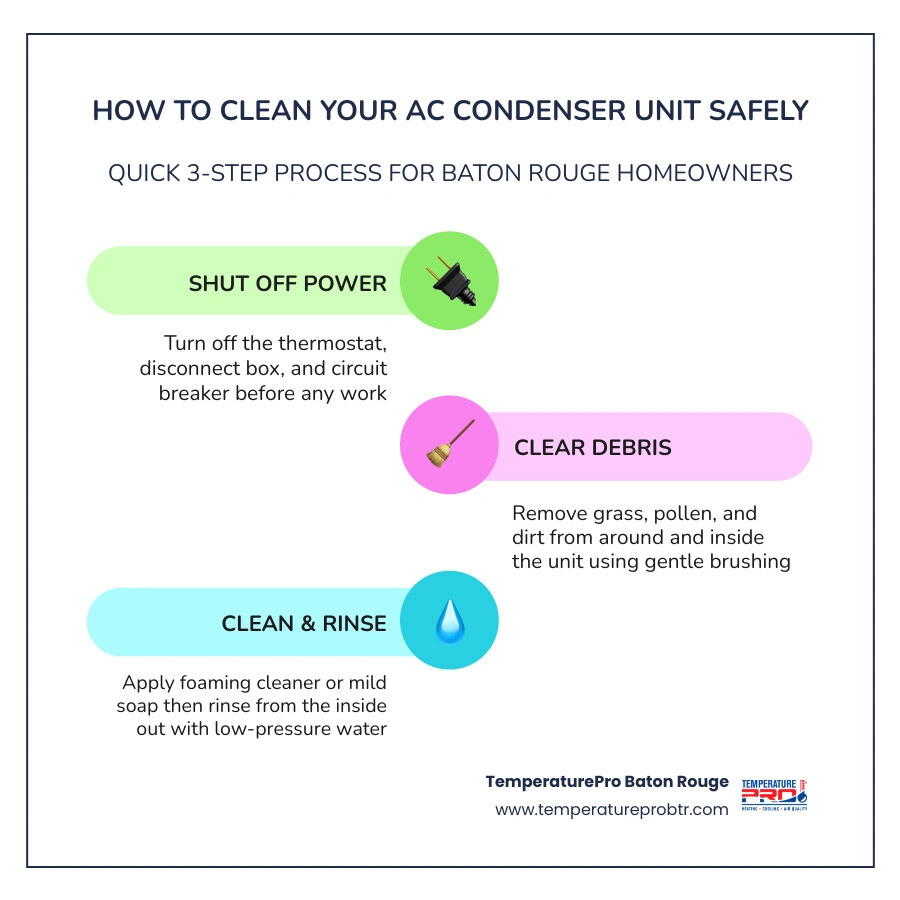
If you want to know how to clean your AC condenser unit safely, here is a quick overview before we dive into the details:
1. Turn off all power at the thermostat, disconnect box, and circuit breaker
2. Clear debris from around and inside the unit
3. Remove outer panels with a screwdriver
4. Brush or vacuum loose dirt from the fins using gentle, vertical strokes
5. Apply a foaming coil cleaner or mild soap and water
6. Rinse from the inside out using a standard garden hose on low pressure
7. Straighten any bent fins with a fin comb
8. Reassemble and restore power only after the unit is fully dry
Baton Rouge summers are no joke. From May through September, your outdoor AC condenser runs hard almost every single day — pulling heat out of your home and releasing it into the Louisiana heat. Over time, dirt, pollen, grass clippings, and debris build up on the condenser coils and block airflow. When that happens, your system works harder, your energy bills climb, and your equipment wears out faster.
According to the U.S. Department of Energy, dirty condenser coils can increase energy consumption by anywhere from 5 to 25 percent. That is a significant hit to your wallet — especially during a Baton Rouge summer when your AC barely gets a break.
The good news is that basic condenser cleaning is something most homeowners can handle safely with the right steps and the right precautions. This guide walks you through exactly what to do.
As we move into May 2026, the humidity in South Louisiana is already beginning to climb. Your outdoor AC unit is the workhorse of your home comfort system. It contains the condenser coils—a network of copper tubing surrounded by thin aluminum fins. These fins are designed to maximize surface area to release heat. When they are coated in a layer of "Louisiana gumbo" (a mix of dust, pollen, and humidity), that heat transfer is stifled.
Regular maintenance is the most effective way to protect your investment. A clean system doesn't just feel better; it operates at peak efficiency, which directly translates to lower utility bills. Furthermore, keeping the coils clean prevents the compressor from overheating. Since the compressor is often the most expensive part to replace, a little bit of cleaning goes a long way toward avoiding a major financial headache. For a deeper look at total system care, check out our AC Maintenance Guide.
How do you know it's time to learn how to clean your ac condenser unit safely? Keep an eye out for these red flags:
• Visible Buildup: If you see "matted" debris, grass clippings from the lawnmower, or a gray film on the fins, your unit is struggling for air.
• Warm Air from Vents: If the indoor air isn't as crisp as it used to be, the outdoor unit might be failing to release heat effectively.
• Longer Cycles: If your AC seems to be running constantly without reaching the set temperature, airflow restriction is a likely culprit.
• Spiking Energy Bills: A sudden increase in your monthly cooling costs often indicates the system is working overtime to compensate for dirty coils.
For residents in the capital area, our Best AC Maintenance Guide Baton Rouge LA provides more local insights on identifying these issues.
By taking the time to clean your condenser, you are essentially giving your air conditioner a fresh start. A clean system can reduce cooling costs by 5 to 15 percent. More importantly, it reduces the mechanical wear and tear on the motor and compressor. In our humid climate, a well-maintained unit can last 15 to 20 years, whereas a neglected one might fail in as little as 8 to 10 years. Learn more about How to Extend the Life of Your AC in Louisiana to make sure you get the most out of your system.
Before you start, you need to gather the right supplies. You don't need a degree in mechanical engineering, but you do need to be prepared.
What You’ll Need:
• A standard garden hose (NEVER a pressure washer).
• A soft-bristle brush or a shop vacuum with a brush attachment.
• A screwdriver or nut driver (to remove the protective cage).
• Work gloves and safety glasses (fins are sharp!).
• A fin comb (to straighten bent fins).
• Foaming coil cleaner (optional but recommended).
Safety is our top priority at TemperaturePro Baton Rouge. If you are ever uncomfortable with the electrical or mechanical aspects of your unit, residents in Zachary can reach out for a professional AC tune-up.
The most critical safety step is disconnecting the power. Water and electricity do not mix.
1. Thermostat: Turn the system to "Off" at the thermostat inside.
2. Disconnect Box: Look for a metal box mounted on the wall near your outdoor unit. Open it and pull the "pull-out" switch or flip the breaker to the "Off" position.
3. Circuit Breaker: For an extra layer of safety, flip the dedicated AC breaker in your home's main electrical panel.
Wait a few minutes to ensure any remaining electrical charge in the capacitors has dissipated before you begin working.
Not all cleaners are created equal. In fact, using the wrong chemical can eat through your aluminum fins and ruin your unit.
• Commercial Foaming Cleaner — Pros: Specifically designed to lift dirt from deep within the fins; often self-rinsing. — Cons: Must ensure it is "non-acidic" to prevent corrosion.
• Mild Detergent & Water — Pros: Safe, cheap, and effective for light dust and dirt. — Cons: May not cut through heavy grease or matted pollen.
• Vinegar/Bleach — Pros: DO NOT USE. — Cons: Highly corrosive to aluminum and copper; can void your warranty.
Using biodegradable solutions is always best for your lawn and the local Louisiana environment.
Now that you're prepped, let's get to work. If you follow these steps, you can significantly boost your system's performance. For those in Prairieville, our AC Maintenance Guide offers additional tips tailored to your neighborhood.
Start by giving your unit some "breathing room." In Baton Rouge, our lush vegetation grows fast.
• Clear the Area: Trim back bushes, weeds, and grass so there is at least a 2-foot clearance around the entire unit. This ensures proper airflow.
• Remove the Top: Most units have a fan mounted at the top. Use your screwdriver to remove the screws holding the fan grill or the entire top panel.
• Be Careful with Wires: When you lift the top, be mindful of the wires connected to the fan motor. You don't need to disconnect them; usually, you can just set the top aside gently.
• Debris Removal: Use your hands (with gloves!) or a shop vacuum to remove leaves, twigs, and dead insects from the bottom of the unit.
For residents in Denham Springs, keeping this area clear is the first step in our local maintenance guide.
Once the big stuff is out of the way, it's time for the deep clean.
1. Dry Brush: Use your soft brush to gently whisk away loose dirt from the outside of the fins. Always brush in the direction of the fins (usually vertical) to avoid bending them.
2. Apply Cleaner: Spray your foaming coil cleaner onto the coils. Let it sit for about 5 to 10 minutes (follow the label instructions). You'll see it start to foam up as it pulls dirt out of the crevices.
3. The Inside-Out Rinse: This is the most important "pro tip." Take your garden hose and spray from the inside of the unit outward. This pushes the dirt out the way it came in, rather than jamming it deeper into the fins.
4. Straighten Fins: Inspect the unit for any bent aluminum fins. Use a fin comb to gently straighten them. This restores the airflow paths.
5. Reassemble: Put the top back on and secure the screws.
6. The Wait: Let the unit dry completely—usually 30 to 60 minutes in our Louisiana sun—before restoring power.
Residents in St. Gabriel can find more specific tune-up tips here.
Even with the best intentions, a few common mistakes can lead to expensive repairs:
• Using a Pressure Washer: This is the #1 mistake. The high-pressure stream will flatten your aluminum fins like a deck of cards, permanently restricting airflow.
• Skipping the Power Off: Never attempt to clean the unit while the fan is spinning. It’s dangerous for you and bad for the motor.
• Harsh Chemicals: As mentioned, avoid acidic cleaners. They can cause pinhole leaks in the copper tubing, leading to refrigerant loss.
• Spraying Electrical Components: While the outdoor unit is designed to handle rain, you should avoid directly blasting the electrical disconnect box or the internal control board with a high-pressure stream.
For those in French Settlement, avoiding these pitfalls is a key part of our maintenance guide.
While knowing how to clean your ac condenser unit safely is a great skill, some things require a pro. At TemperaturePro Baton Rouge, we recommend a professional AC maintenance visit at least once a year.
Call us if you notice:
• Refrigerant Leaks: If you see oily residue on the coils or ice forming on the lines, you likely have a leak.
• Strange Noises: Grinding, squealing, or heavy rattling usually indicates a failing fan motor or compressor.
• Electrical Issues: If your breaker keeps tripping or you see charred wires, stop immediately and call a professional.
• Heavy Fin Damage: If more than 20% of your fins are crushed or bent, a professional might need to use specialized tools to restore airflow.
For most Baton Rouge homes, a thorough cleaning once a year in early spring is perfect. However, if you have lots of cottonwood trees or if your mower discharges grass toward the unit, you might want to give it a quick "hose-only" rinse every few months during the summer.
Absolutely not. We cannot stress this enough—a pressure washer will damage the delicate aluminum fins. A standard garden hose with a spray nozzle on a "shower" or "gentle" setting is all you need.
Yes! By improving the heat transfer efficiency, your system doesn't have to run as long to cool your home. This can save you anywhere from 5 to 15 percent on your monthly cooling costs.
Taking the time to learn how to clean your ac condenser unit safely is one of the best things you can do for your home's comfort and your wallet. In the heat of a Louisiana summer, a clean AC isn't just a luxury—it's a necessity.
While DIY cleaning is a fantastic way to maintain your system between visits, nothing replaces a professional tune-up. Our team at TemperaturePro Baton Rouge is family and veteran-owned, and we treat every customer like family. Whether you are in Gonzales, Zachary, or Denham Springs, we are here to ensure your system is running at peak performance. For our neighbors in Gonzales, be sure to check out our local maintenance services guide.
Don't wait for the next heatwave! Schedule your professional AC maintenance with TemperaturePro Baton Rouge today and breathe easy all summer long.
Go With Experience