Why Louisiana's Subtropical Climate Is One of the Hardest Environments for HVAC Systems in the U.S.
How Louisiana climate affects your HVAC system comes down to a few punishing realities: relentless heat, suffocating humidity, coastal corrosion, and erratic cold snaps that keep your equipment working harder — and wearing out faster — than almost anywhere else in the country.
Here's a quick look at the key ways Louisiana's climate stresses your system:
• Extreme cooling demand — Louisiana logs 2,800–3,200 cooling degree days per year, compared to the national average of roughly 1,000–1,500
• High humidity year-round — Relative humidity routinely exceeds 70% during the core cooling season, pushing into 80%+ in coastal parishes
• Shortened equipment lifespan — Central AC systems last 10–15 years in Louisiana vs. 15–20 years nationally; heat pumps average just 8–12 years here
• Latent heat overload — A disproportionate share of your cooling load is moisture removal, not just temperature reduction
• Coastal corrosion — Salt-laden air attacks aluminum fins and copper connections on outdoor units
• Winter humidity traps — Even mild 40°F days feel colder and force your system to work harder due to moisture in the air
• Storm and flood risk — Hurricane-force winds and flooding can damage or destroy outdoor equipment entirely
If you live in the Baton Rouge area, your HVAC system faces all of these stressors — sometimes all in the same week. Understanding what's happening to your equipment is the first step toward protecting it.
Louisiana sits squarely in ASHRAE Climate Zone 2A, officially classified as "Hot-Humid." That label doesn't fully capture what it feels like to run an HVAC system here through a long summer stretch or a sudden late-January cold snap. Your system isn't just cooling air — it's constantly fighting moisture, heat, and corrosion on multiple fronts, season after season.
The result? Equipment that ages faster, bills that run higher, and indoor comfort problems that baffle homeowners who don't realize the climate itself is the culprit.
Defining the Louisiana Climate: Zone 2A and the Latent Heat Challenge
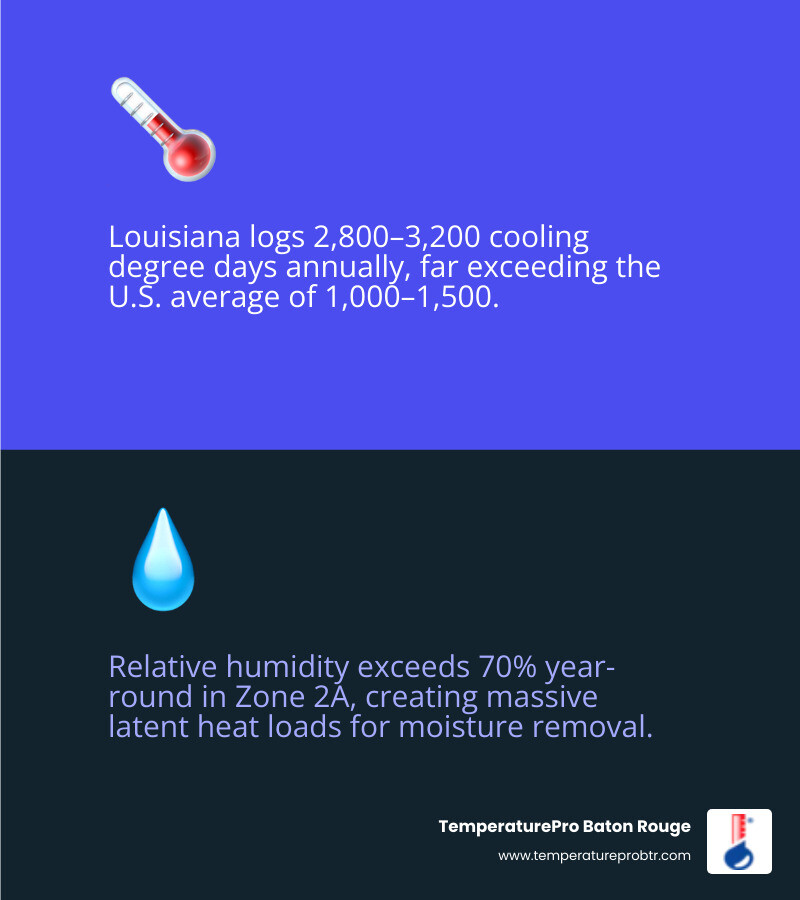
When we talk about how louisiana climate affects your hvac system, we have to start with the technical classification: ASHRAE Climate Zone 2A. This "Hot-Humid" designation means we deal with high temperatures and even higher moisture levels. In places like Baton Rouge, Prairieville, and Gonzales, we see between 2,800 and 3,200 cooling degree days annually. To put that in perspective, many northern states only see about 1,000. Our systems are essentially running a marathon while others are taking a brisk walk.
The real "secret" enemy in Louisiana is latent heat. Most people think of heat as just the number on the thermometer (sensible heat). However, latent heat is the energy held in the moisture of the air. In Zone 2A, a massive portion of the work your air conditioner does is simply removing water from the air so you don't feel "clammy" indoors. If the relative humidity in your home stays above 60%, mold growth accelerates, and the air feels heavy, even if the temperature is set to 70°F.
More info about HVAC services
How Louisiana climate affects your hvac system sizing and selection
In our part of the country, "bigger is better" is a dangerous myth when it comes to air conditioning. If a system is oversized for a home in Zachary or Denham Springs, it will engage in "short cycling." This means it turns on, cools the air temperature very quickly, and shuts off before it has a chance to pull the moisture out of the air.
To get it right, we use Manual J load calculations. This isn't just a guess based on square footage; it accounts for your home’s insulation, window types, and local climate data. We look specifically at the Sensible Heat Ratio (SHR). In Louisiana, we aim for an SHR of 0.65 to 0.75. This ensures the system is designed to handle that heavy latent moisture load. Additionally, as of 2026, all new split systems in the South must meet a minimum of 15 SEER2 efficiency standards to help manage the high energy demands of our long cooling seasons.
The sheer volume of work required to keep a home comfortable in St. Gabriel or Walker takes a toll on the machinery. While a compressor in the Midwest might last two decades, the "Gulf Coast Grind" usually cuts that short.
• Central Split AC — National Average Lifespan: 15–20 Years — Louisiana Adjusted Lifespan: 10–15 Years
• Air-Source Heat Pump — National Average Lifespan: 10–15 Years — Louisiana Adjusted Lifespan: 8–12 Years
• Evaporator Coils — National Average Lifespan: 12–15 Years — Louisiana Adjusted Lifespan: 7–10 Years
• Gas Furnace — National Average Lifespan: 20+ Years — Louisiana Adjusted Lifespan: 15–18 Years
The constant 70% to 80% humidity means your evaporator coils are perpetually wet. This creates a breeding ground for biological growth and accelerates the wear on the metal. Thermal cycling stress—the expansion and contraction of parts as they heat up and cool down—happens much more frequently here because our "shoulder seasons" (spring and fall) are so short.
If you've ever turned on your AC in Central or French Settlement and smelled something like a locker room, you’ve experienced Dirty Sock Syndrome. This is caused by mold and bacteria buildup on the evaporator coils, often occurring when the system transitions between heating and cooling modes during our unpredictable winters.
Other common climate-induced problems include:
• Frozen Coils: High humidity can lead to excessive condensation that freezes if airflow is even slightly restricted.
• Poor Dehumidification: When the air feels "thick" despite the AC running, the system isn't managing the latent load effectively.
• Sky-High Energy Bills: As components struggle against the heat and humidity, they draw more power to achieve the same cooling effect.
[LIST] Signs your system is struggling with the climate:
• Indoor humidity levels consistently above 55%.
• Musty odors coming from vents.
• The outdoor unit runs constantly without reaching the thermostat setting.
• Frequent "tripping" of breakers during heat waves.
Coastal Corrosion and the Shortened Lifespan of Gulf Coast Units
Even if you aren't directly on the beach, the salt-laden air from the Gulf of Mexico travels inland, affecting homes throughout the Baton Rouge metro area. This salt air is a catalyst for galvanic corrosion, which happens when different types of metal (like copper tubes and aluminum fins) interact in a moist, salty environment.
Over time, the delicate aluminum fins on your outdoor condenser will "pitting" and eventually crumble. This destroys the unit's ability to release heat, forcing the compressor to work harder until it eventually fails. In our coastal-adjacent parishes, we highly recommend protective coatings for coils and cabinets to act as a barrier against this chemical attack.
Furthermore, we have to account for extreme weather. ASCE 7 wind speed requirements in Louisiana often mandate that outdoor units be anchored to withstand winds between 130 and 150 mph. Without proper hurricane hardening and secure mounting, a summer storm can shift your unit, breaking refrigerant lines and causing expensive leaks.
Managing the "Damp Cold": Why Winter Humidity Matters
Louisiana winters are famous for being "mild," but any local in Prairieville will tell you that a 40-degree day here feels colder than a 20-degree day in the mountains. This is because our air is moisture-heavy. Water vapor is a great conductor of heat, so it pulls the warmth right off your body—and right out of your home.
This "damp cold" puts a unique strain on heat pumps. In drier climates, a heat pump is incredibly efficient. In Louisiana, the high humidity can cause frost to build up on the outdoor coils very quickly when temperatures dip. This forces the system into "defrost mode" more often, which temporarily uses auxiliary electric heat (the "heat strips"). Because auxiliary heat is much less efficient than the heat pump itself, your energy bills can spike unexpectedly during January cold snaps.
More info about HVAC services
Essential Strategies for Protecting Your System in 2026
Living in Zone 2A doesn't mean you're doomed to high bills and early system failure. It just means you have to be proactive. In 2026, the gold standard for home comfort in Louisiana is the installation of a whole-home dehumidifier. These systems work alongside your AC to pull moisture out of the air independently of the cooling cycle. This allows you to keep your home at a comfortable 45% to 55% humidity level even on days when it’s not hot enough for the AC to run full-blast.
Other essential upgrades include:
• UV Germicidal Lights: Installed over the evaporator coil, these kill mold spores and bacteria before they can cause Dirty Sock Syndrome.
• High-Efficiency Filtration: Capturing dust and allergens is vital when our homes are sealed tight against the summer heat.
• Flood Elevation: If you are in a Special Flood Hazard Area (SFHA), your outdoor unit should be elevated above the Base Flood Elevation (BFE). This protects sensitive electrical components from the flash flooding common in our region.
How Louisiana climate affects your hvac system maintenance needs
Maintenance in Louisiana isn't a luxury; it's a survival tactic for your equipment. Because our systems run so many hours per year, we recommend bi-annual inspections—once in the spring before the heat hits, and once in the fall before the first cold snap.
During these visits, we focus on:
• Coil Cleaning: Removing the "blanket" of dust and salt that prevents heat transfer.
• Drain Line Clearing: High humidity produces gallons of condensation; if those lines clog, you end up with water damage in your attic or closet.
• Professional Calibration: Ensuring the thermostat and sensors are reading correctly to prevent unnecessary cycling.
• Surge Protection: Protecting your investment from the power surges common during our frequent thunderstorms and hurricane season.
Frequently Asked Questions about Louisiana HVAC Care
Why do HVAC systems in Louisiana have shorter lifespans than the national average?
The primary reason is run-time accumulation. Because our cooling season lasts from March through October (and sometimes into November), a Louisiana AC unit might run for 3,000 hours a year, while a unit in a cooler state might only run for 800. Combined with humidity-driven corrosion and the thermal stress of high-heat days, the components simply wear out faster. An adjusted range of 10–15 years is the realistic expectation for our area.
What is the ideal indoor humidity level for a Baton Rouge home?
We recommend maintaining an indoor humidity level between 45% and 55% year-round. Keeping it in this "sweet spot" prevents mold and mildew growth, makes the air feel cooler (allowing you to set your thermostat a few degrees higher), and protects your home’s wood flooring and furniture from warping.
Are heat pumps effective for Louisiana’s erratic winter cold snaps?
Absolutely. Modern heat pumps are incredibly efficient down to about 25°F. Since our winter design temperature is roughly 28°F, a heat pump is actually the ideal choice for Zone 2A. They provide excellent comfort for the 90% of winter days that are mild and damp, while having backup heat available for those rare nights when the temperature truly plunges.
Conclusion: Building Climate Resilience in Your Home
The "Gulf Coast Grind" is real, but it doesn't have to break your budget or your peace of mind. By understanding how louisiana climate affects your hvac system, you can make smarter choices about sizing, maintenance, and air quality. Whether it's protecting your outdoor unit from salt air in St. Gabriel or managing the damp cold in Zachary, the right strategy can add years to your system's life.
At TemperaturePro Baton Rouge, we are family and veteran-owned, and we know exactly what it takes to keep a home comfortable in this subtropical environment. We treat every customer like family, providing the 24/7 reliability you need when the Louisiana heat becomes too much to handle. From Prairieville to Denham Springs and everywhere in between, we're here to ensure your system is ready for whatever the 2026 weather brings.
Schedule your 2026 climate-readiness inspection with TemperaturePro Baton Rouge