Is It Time? How to Know When Should You Replace Your AC in a Hot Climate
When should you replace your ac in a hot climate, the answer comes down to a few clear signals most homeowners in Baton Rouge and across the South will recognize:
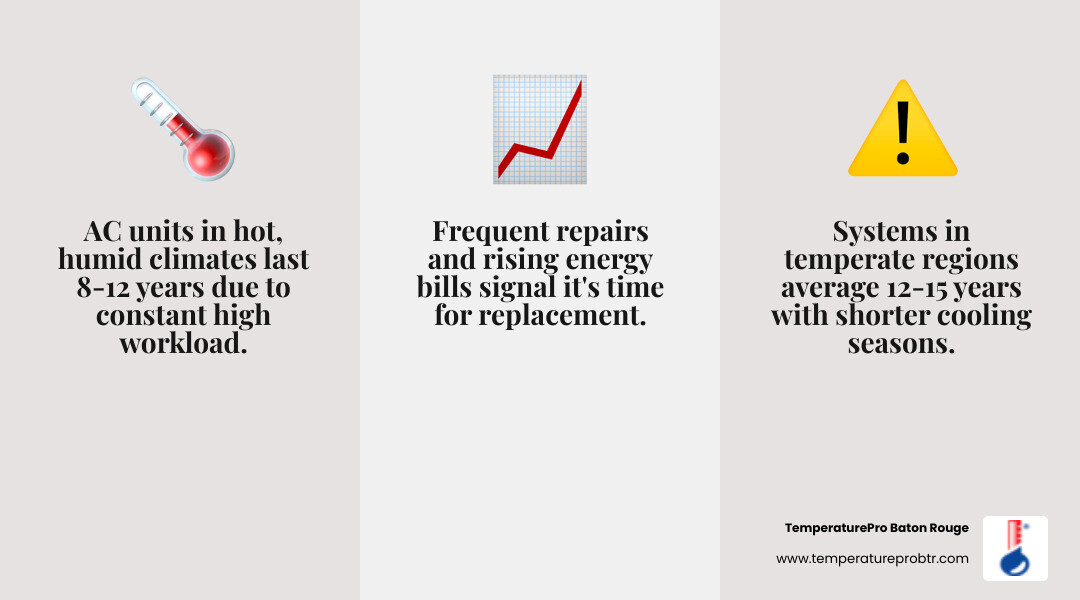
• Age: AC units in hot, humid climates like Louisiana typically last just 8-12 years — significantly less than the 12-15 year national average
• Repair costs: If a repair bill exceeds 50% of what a new system would cost, replacement is usually the smarter move
• Rising energy bills: A steady climb in cooling costs often means your system is losing efficiency fast
• Poor performance: If your home can't stay below 78-80°F on a hot day, your system is struggling
• R-22 refrigerant: If your unit still uses this phased-out refrigerant, replacement is strongly recommended
• Frequent breakdowns: Multiple repairs in a single season are a strong sign the system is near the end of its life
Here in Baton Rouge, your air conditioner isn't a seasonal appliance — it's running hard for most of the year. The combination of intense heat, heavy humidity, and long cooling seasons puts Southern AC systems under stress that homeowners in cooler parts of the country simply don't deal with. That extra workload shortens your system's lifespan, quietly chips away at its efficiency, and can leave you facing a full breakdown on the hottest day of the summer.
The good news is that knowing the warning signs early gives you options. You can plan ahead, avoid an emergency replacement, and make a smart financial decision — instead of a desperate one.
Understanding Lifespan: When Should You Replace Your AC in a Hot Climate?
If you have lived in Louisiana for even one summer, you know that our air conditioners don't just "work"—they battle. In more temperate regions of the U.S., an AC unit might last 15 to 20 years because it only runs for three or four months out of the year. Down here, our cooling season can easily stretch from March through October, and sometimes we’re even flipping the cooling on during a humid Christmas afternoon.
Because of this relentless demand, the average lifespan of an AC unit in a hot climate is significantly shorter. While the national average hovers around 15 years, systems in high-heat, high-humidity zones like Louisiana often see their performance drop off sharply between the 8 and 12-year marks. If you are looking at AC replacement Central LA or AC replacement Prairieville LA, you are likely noticing that your decade-old system just doesn't have the "oomph" it used to.
Regional Lifespan Expectations
Why does the South eat AC units for breakfast? It’s a combination of three factors:
1. Year-Round Usage: In places like Baton Rouge and Prairieville, our systems run for 7 to 8 months a year, often for 10 to 14 hours a day during the peak of July and August. This is the equivalent of driving a car 30,000 miles a year versus the standard 10,000.
2. Humidity Stress: Humidity doesn't just make you feel sticky; it makes your AC work twice as hard. The system has to remove moisture from the air before it can effectively lower the temperature. This constant dehumidification process puts extra strain on the evaporator coil and the compressor.
3. System Degradation: Heat is the enemy of mechanical parts. Constant operation in 90°F+ temperatures causes electrical components to wear out faster and lubricants to break down. For those living near the coast or in areas with high moisture, salt air or heavy humidity can also lead to corrosion of the delicate metal fins and coils.
Red Flags: Signs Your System is Struggling with Southern Humidity
Sometimes your AC doesn't just quit; it sends out "SOS" signals for months before the final breakdown. One of the most common AC system replacement warning signs is a sudden inability to manage indoor humidity. If your home feels "muggy" even when the air is blowing, your system is likely failing to pull enough moisture out of the air.
You might also notice your system "short-cycling," which is when it turns on and off frequently without ever reaching the desired temperature. This is incredibly hard on the motor and is often a precursor to a total system failure. If you ever find yourself wondering what to do when AC freezes up, it’s often a sign of restricted airflow or a refrigerant leak—both of which are serious red flags for an aging unit.
If you aren't sure if it's time to pull the trigger on a new unit, keep an eye (and ear) out for these performance indicators:
• Weak Ventilation: If the air coming out of your vents feels like a gentle breeze rather than a strong gust, your blower motor or ductwork may be failing.
• Warm Air: This is the most obvious sign. If the air coming from the vents isn't icy cold, your compressor might be on its last legs. There are specific signs your AC compressor needs replacement, such as loud clicking or rattling noises when the unit starts up.
• Unusual Noises: Grinding, squealing, or banging sounds are never a good sign. They usually indicate a loose part or a motor bearing that has given up the ghost.
• Dust Buildup: If you find yourself dusting your furniture every two days, your old AC might not be filtering the air effectively anymore, or there could be leaks in your ductwork pulling in attic dust.
The Decision Matrix: Repairing vs. Replacing Your Cooling System
• Typical Cost — Repairing Your Old AC: Lower upfront, but frequent — Replacing with a New System: Higher upfront, but long-term savings
• Efficiency — Repairing Your Old AC: Decreases every year — Replacing with a New System: 20-40% higher than old units
• Reliability — Repairing Your Old AC: High risk of summer breakdowns — Replacing with a New System: Peace of mind with warranty
• Refrigerant — Repairing Your Old AC: Uses expensive, phased-out R-22 — Replacing with a New System: Uses modern, eco-friendly R-410A or R-454B
• Home Value — Repairing Your Old AC: No impact — Replacing with a New System: Increases resale value significantly
Deciding between a repair and a replacement is often the hardest part for homeowners in Gonzales or Denham Springs. To make it easier, we often suggest using the 50% Rule: If the cost of a single repair is more than 50% of the value of a new system, it’s time to replace.
Another popular method is the $5,000 Rule. You multiply the age of the unit by the cost of the repair. For example, if your 10-year-old unit needs a $600 repair, that equals $6,000. Since $6,000 is over the $5,000 threshold, replacement is generally the more economical long-term choice. Knowing when is it time for AC replacement helps you avoid "throwing good money after bad" on a system that is destined to fail again in six months.
Financial Rules of Thumb
We often see homeowners fall into the trap of "death by a thousand cuts." You spend a few hundred dollars on a capacitor in May, another few hundred on a fan motor in July, and by September, you've spent a significant portion of what a down payment on a new, high-efficiency system would have been.
If you are looking at Air Conditioning Replacement Walker LA, consider the refrigerant your current system uses. If your unit was manufactured before 2010, it likely uses R-22 (often called Freon). This refrigerant has been phased out by the EPA because it is harmful to the ozone layer. Because it is no longer being produced, the cost to "top off" a system with R-22 has skyrocketed. A simple leak repair on an R-22 system can now cost nearly as much as a new unit, making replacement the only logical choice.
Maximizing Efficiency and Comfort with a Modern Upgrade
When you finally decide to upgrade, the benefits go far beyond just "having cold air." Modern AC systems are lightyears ahead of the units built just a decade ago. One of the biggest shifts is the move to SEER2 ratings (Seasonal Energy Efficiency Ratio). Upgrading from an old 10 SEER unit to a modern 17 or 20 SEER2 system can slash your monthly cooling bills by 20% to 40%. In a climate where the AC runs 14 hours a day, those savings add up fast—often paying for the system itself in just a few years.
When choosing the right AC replacement, you also gain access to variable-speed motors. Unlike older "single-stage" units that are either 100% on or 100% off, variable-speed systems can run at lower speeds to maintain a perfectly consistent temperature and—more importantly—provide superior humidity control. This means no more "hot spots" in the house and a much more comfortable environment for your family.
Strategic Timing: When Should You Replace Your AC in a Hot Climate to Save Most?
The worst time to replace your AC is in the middle of a July heatwave. Not only is it a miserable experience to wait for an installation while your house is 90 degrees, but it’s also the busiest time for HVAC companies.
The smartest homeowners plan their replacements during the "shoulder seasons"—March and April or October and November. During these months, the demand for emergency repairs is lower, which often means better scheduling availability and sometimes even manufacturer rebates or special financing offers.
To keep your current system limping along until you’re ready, or to protect your new investment, follow a best AC maintenance guide Walker LA. Simple things like changing your filters every 30 to 60 days can extend the life of your unit by 3 to 5 years. For our neighbors in Zachary, following best AC maintenance tips Zachary LA like keeping the outdoor unit clear of debris and grass clippings can prevent the compressor from overheating during those triple-digit August afternoons.
Conclusion
At TemperaturePro Baton Rouge, we understand that your air conditioner is the heart of your home’s comfort. As a family and veteran-owned company, we treat every installation and repair like we’re working on our own home. Whether you are in St. Gabriel, French Settlement, or right here in Baton Rouge, we are committed to providing honest, reliable advice on whether a repair or a full replacement is the best path forward for your family.
Replacing your AC is a big decision, but it’s also an opportunity to improve your indoor air quality, lower your utility bills, and increase your home’s value. Don't wait for a total system failure to leave you sweating in the dark.
Benefits of a modern AC replacement include:
• Significantly lower monthly energy bills (20-40% savings)
• Enhanced humidity control for a "crisp" indoor feel
• Quieter operation with advanced motor technology
• Peace of mind with long-term manufacturer warranties
• Improved indoor air quality and reduced dust
If your system is over 10 years old and struggling to keep up, contact our experts for professional air conditioning services today. We offer 24/7 support and are always ready to help you navigate the "final countdown" of your current AC unit.
How long does an AC unit typically last in Louisiana?
Due to the extreme heat and humidity, most units in Louisiana last between 8 and 12 years. While some may last longer with meticulous maintenance, their efficiency usually drops significantly after the decade mark.
What is the 50% rule for AC replacement?
The 50% rule suggests that if a repair cost exceeds 50% of the price of a brand-new system, you are better off replacing the unit. This prevents you from investing heavily in an aging system that is likely to break down again soon.
Why should I replace a system that uses R-22 refrigerant?
R-22 refrigerant has been phased out globally. Because it is no longer produced, the cost to repair leaks and refill these systems is extremely high. Additionally, R-22 systems are far less energy-efficient than modern units using R-410A or newer alternatives.