5 min read
Fall HVAC Troubleshooting: Why Your Heater Smells Like Burning Dust on Startup
Is that burning dust smell normal? Read our home maintenance tips and troubleshooting to see why heating startup odors happen and when to call a professional.


How Does a Heat Pump Work — And Why Baton Rouge Homeowners Are Making the SwitchHow does a heat pump work is one of the most common questions homeowners ask when shopping for a smarter, more efficient way to heat and cool their homes. And i
How does a heat pump work is one of the most common questions homeowners ask when shopping for a smarter, more efficient way to heat and cool their homes. And it's a great question — because once you understand the basics, it's easy to see why heat pumps have become one of the most popular HVAC upgrades across the country.
Here's the short answer:
A heat pump moves heat from one place to another instead of generating it. In summer, it pulls heat out of your home and releases it outside. In winter, it does the reverse — extracting heat from outdoor air and bringing it inside. It runs on electricity and uses a refrigerant to carry that heat through the system.
The basic steps:
1. Refrigerant absorbs heat from the air (indoors or outdoors, depending on the season)
2. The compressor pressurizes the refrigerant, raising its temperature
3. The condenser coil releases that heat where it's needed
4. The expansion valve drops the pressure, cooling the refrigerant back down
5. The cycle repeats continuously to maintain your desired temperature
This process is remarkably efficient. A typical heat pump delivers around 3 to 4 units of heating or cooling energy for every 1 unit of electricity it consumes — making it 3 to 5 times more efficient than a traditional gas boiler or electric furnace.
For homeowners in Baton Rouge, LA, where summers are brutal and winters are mild, a heat pump can handle year-round comfort from a single system. Whether your current setup is struggling to keep up or you're simply looking for a lower-energy alternative, understanding how a heat pump works is the first step toward making a confident decision.
To understand how does a heat pump work, we first have to look at what it doesn’t do. Unlike a traditional furnace, a heat pump does not create heat. A furnace burns fossil fuels like natural gas or uses electric resistance (think of a giant toaster) to generate warmth from scratch. This process is limited by the laws of physics; you can never get more energy out than you put in.
A heat pump, however, is a master of "heat transfer." It uses a small amount of electric power to operate a compressor and fans that move existing thermal energy from one place to another. Even when it feels chilly outside in Zachary, LA, there is still a significant amount of heat energy present in the air. The heat pump simply gathers that "free" heat and pumps it into your living room.
Because it moves heat rather than creating it, a heat pump is incredibly clean and efficient. You aren't burning fuel inside your home, which means no combustion gases or carbon monoxide concerns. For many of our neighbors seeking Heat Pump Service in Baton Rouge, LA, the primary draw is this elegant, all-electric approach to home comfort.
If you have an air conditioner, you actually already own half of a heat pump system! A standard AC unit is designed to move heat in one direction: from inside your house to the great outdoors.
The "magic" component that separates a heat pump from a standard AC is the reversing valve. This valve allows the system to switch the direction of the refrigerant flow.
• In Cooling Mode: It works exactly like an air conditioner, absorbing indoor heat and dumping it outside.
• In Heating Mode: The reversing valve flips, and the system begins absorbing heat from the outdoor air to release it inside.
This dual-function capability makes the heat pump a year-round workhorse, eliminating the need for a separate furnace and air conditioner taking up space in your utility closet.
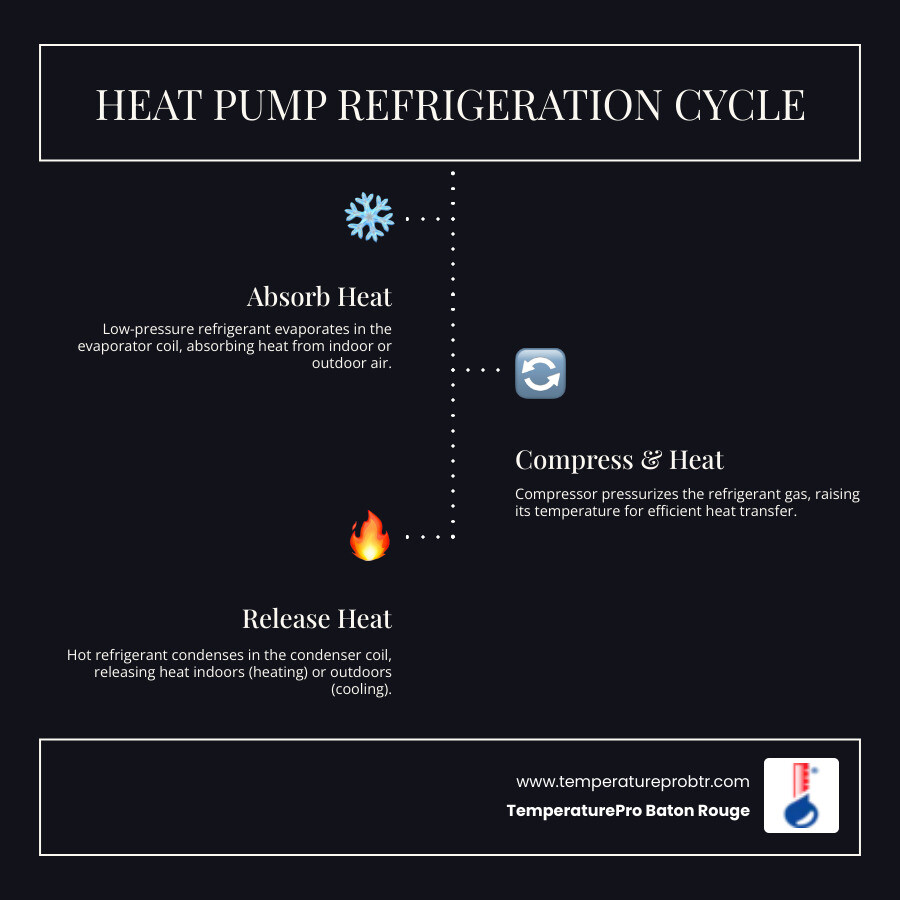
To really grasp the science, we have to look at the refrigeration cycle. This cycle relies on the physical property that when you change a fluid's pressure, you change its temperature. By manipulating a special fluid called refrigerant, the system can become much colder than the outdoor air (to absorb heat) or much hotter than the indoor air (to release it).
Inside that metal cabinet in your yard and the air handler in your attic, four main components are working in perfect harmony:
1. The Evaporator Coil: This is where the magic starts. Cold, low-pressure liquid refrigerant flows through these coils. As air blows over the coils, the refrigerant absorbs heat and "boils" into a low-pressure gas. This is a phase change, which allows the fluid to soak up a massive amount of "latent heat."
2. The Compressor: This is the heart of the system. It takes that low-pressure gas and squeezes it tightly. Just like a bike pump gets hot when you use it, the refrigerant becomes a very hot, high-pressure gas after leaving the compressor.
3. The Condenser Coil: The hot gas travels to the condenser. As air passes over these coils, the refrigerant releases its heat to the surroundings and condenses back into a high-pressure liquid.
4. The Expansion Valve: Before the cycle starts over, the liquid passes through a tiny opening. This sudden drop in pressure causes the temperature to plummet, turning the refrigerant back into a chilly liquid ready to absorb more heat.
If you are looking for Heat Pump Service in Prairieville, LA or Gonzales, LA, our team can inspect these specific components to ensure the pressures are exactly where they need to be for maximum efficiency.
A common myth is that heat pumps stop working when the temperature drops. While older models struggled, modern technology has changed the game. Even at 0°F, there is thermal energy in the air. To extract it, the heat pump simply makes the refrigerant colder than the outside air. Because heat naturally moves toward cold, the refrigerant "soaks up" the heat from the freezing wind.
In the rare event of a deep freeze in Walker, LA, most systems are equipped with supplemental heat (often electric heat strips) to provide a boost if the outdoor unit can't keep up. However, "cold-climate" heat pumps are now rated to provide efficient warmth even when temperatures dip well below zero.
When we talk about heat pump efficiency, we often use a term called the Coefficient of Performance (COP).
• Electric Furnace — Typical Efficiency (COP): 1.0 (100%) — Energy Source: Electricity
• High-Efficiency Gas Boiler — Typical Efficiency (COP): 0.95 (95%) — Energy Source: Natural Gas
• Air-Source Heat Pump — Typical Efficiency (COP): 3.0 – 4.5 (300% - 450%) — Energy Source: Electricity
• Geothermal Heat Pump — Typical Efficiency (COP): 4.0 – 7.0 (400% - 700%) — Energy Source: Electricity / Earth
As you can see, a heat pump is the only system that can be more than 100% efficient. This is because it isn't converting energy into heat; it’s just moving it. For every $1 of electricity you spend, you might get $4 worth of heat.
In our humid Louisiana climate, efficiency is also measured by SEER2 (for cooling) and HSPF2 (for heating). High-efficiency units can significantly lower your carbon footprint and monthly utility bills. If you're wondering about the best ratings for our area, Heat Pump Service in Denham Springs, LA can help you calculate your potential savings.
Not every home is built the same, which is why there are several ways to install a heat pump system.
• Air-Source Heat Pumps: The most common type. They look like a standard AC unit and swap heat with the outside air.
• Ground-Source (Geothermal): These systems use underground pipe loops to tap into the stable 55-degree temperature of the earth. While they have a higher upfront requirement for installation, they are the "gold standard" for efficiency and can last up to 50 years.
• Ductless Mini-Split: Perfect for homes in Gonzales, LA or Prairieville, LA that don't have existing ductwork. These systems use a small outdoor unit connected to one or more indoor "heads" mounted on the wall.
If your home already has a network of ducts, a central air-source heat pump is usually the easiest swap. It uses your existing vents to distribute air. However, ductwork can lose up to 35% of its energy through leaks or poor insulation.
Ductless mini-splits offer:
• Zoning Control: You can turn off the air in the guest room while keeping the master bedroom perfectly chilled.
• Installation Flexibility: No need to tear up ceilings or walls to add bulky ducts.
• Whisper-Quiet Operation: Most indoor units are quieter than a library.
Actually, they use much less electricity than traditional electric heating. While a heat pump runs on electricity, its annual consumption typically falls between 6,176 and 10,244 kWh, depending on your home's size and insulation. Because it's so much more efficient than an electric furnace, most homeowners see their total energy usage drop significantly after making the switch.
With regular professional maintenance, you can expect a high-quality heat pump to last about 15 years. Because they work year-round (both summer and winter), they do experience more "mileage" than a system that only runs half the year. That's why we recommend bi-annual check-ups, especially for our customers needing Heat Pump Service in St. Gabriel, LA. Keeping the coils clean and the refrigerant levels precise is the key to longevity.
Absolutely. In cooling mode, a heat pump is literally an air conditioner. It is designed to handle the sweltering Louisiana summers. In fact, many modern heat pumps feature variable-speed compressors that are even better at dehumidification than standard ACs. They can run at lower speeds for longer periods, pulling more moisture out of the air so you feel cooler at higher temperatures.
Understanding how does a heat pump work reveals a technology that is both simple in principle and sophisticated in performance. By moving heat instead of creating it, these systems offer a pathway to lower bills, a smaller carbon footprint, and a more comfortable home.
At TemperaturePro Baton Rouge, we aren't just HVAC experts; we are a family and veteran-owned company dedicated to serving our community. We treat every customer like family, providing 24/7 support for those unexpected middle-of-the-night issues. Whether you are in St. Gabriel, LA, Central, LA, or Walker, LA, we have the local expertise to design a system that fits your home’s specific needs.
Ready to see the difference an efficient system can make? Upgrade your home comfort with TemperaturePro heat pumps today and let us help you stay cool in the summer and cozy in the winter.
Go With Experience