Why Knowing How to Tell If Your AC Compressor Is Failing Could Save You Thousands
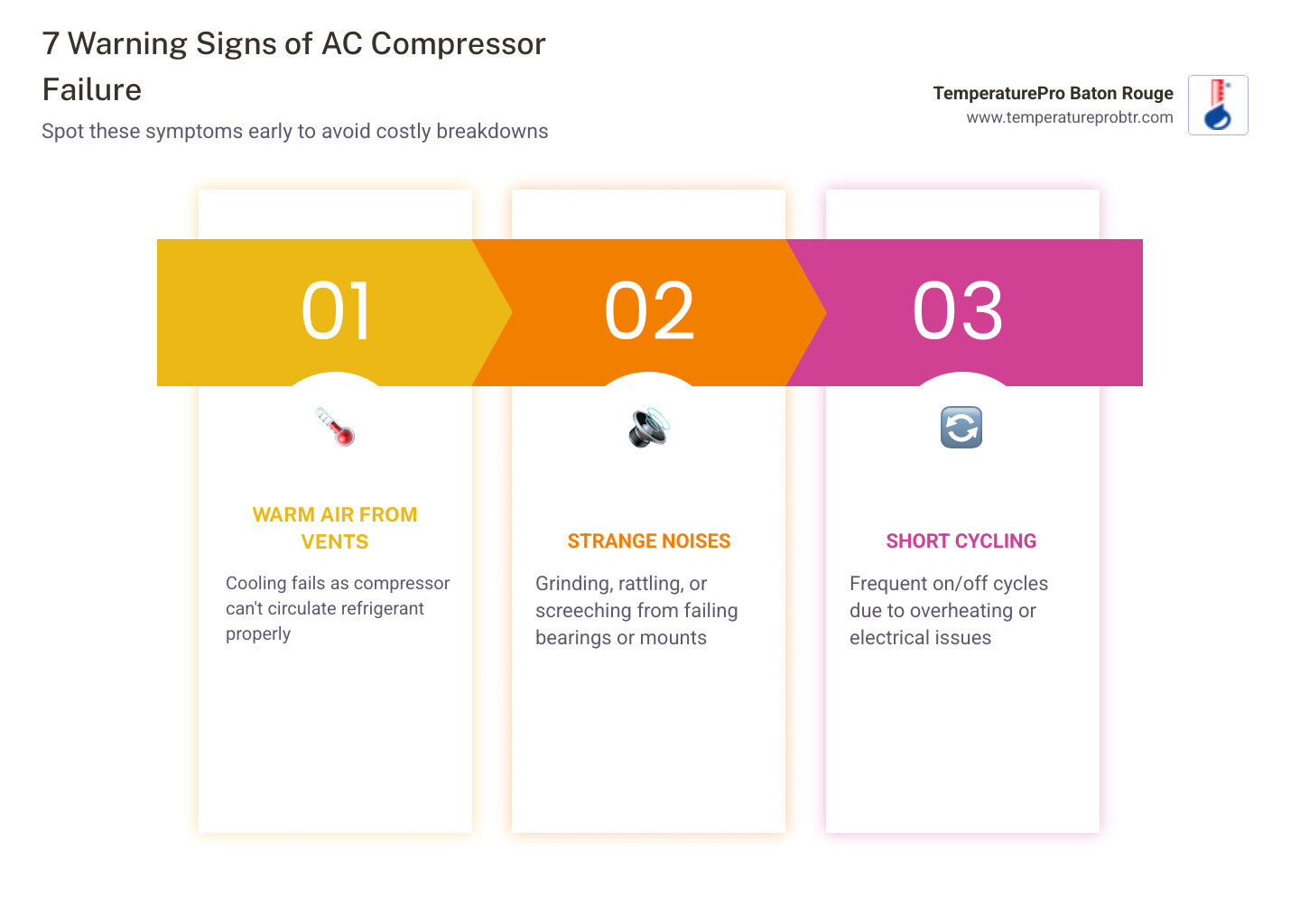
How to tell if your ac compressor is failing comes down to a handful of clear warning signs most homeowners can spot before things get worse:
• Warm or hot air blowing from vents despite the thermostat being set to cool
• Strange noises from the outdoor unit — grinding, rattling, clicking, or screeching
• Circuit breaker tripping repeatedly when the AC tries to run
• Hard starting — the unit struggles, hesitates, or causes lights to flicker when it kicks on
• Short cycling — the system turns on and off more frequently than normal
• Noticeably higher energy bills without a change in usage
• Visible refrigerant leaks or oil stains around the outdoor unit
Here in Baton Rouge, LA, summer heat is no joke — and your AC compressor is the one part that keeps the whole cooling system alive. Think of it as the heart of your air conditioner. When it starts to fail, your entire system suffers, and so does your comfort. The bad news is that a failing compressor rarely announces itself all at once. It tends to send small, easy-to-miss signals long before it quits completely. Catching those signals early is the difference between a manageable repair and a full system replacement on the hottest day of the year.
What exactly does an AC compressor do for my Baton Rouge home?
To understand how to tell if your ac compressor is failing, we first need to look at what this heavy-duty component actually does. Located inside your outdoor unit, the compressor is essentially a high-powered pump. If the thermostat is the "brain" of your AC, the compressor is the "heart."
Its primary job is to circulate refrigerant through the system. It takes low-pressure, cool gas from your indoor evaporator coils and squeezes it into a high-pressure, hot gas. This pressure increase is vital because it allows the refrigerant to release the heat it gathered from inside your home into the outdoor air.
Without a functioning compressor, the heat exchange process stops. The refrigerant can’t move, the humidity stays trapped in your house, and the air coming out of your vents will stay stubbornly warm. Because this part works so hard—especially during a humid July afternoon in Prairieville or Gonzales—it is often the most expensive component to replace. It also plays a massive role in your home’s energy efficiency. A struggling compressor has to run longer and work harder to achieve the same cooling effect, which is why AC Compressor Failure Signs often show up first on your monthly utility bill.
How to tell if your ac compressor is failing: Common warning signs
Detecting a problem early can be the difference between a simple part replacement and needing a whole new unit. Use the table below to see how a healthy system compares to one that is struggling.
• Vent Temperature — Normal Operation: Consistently cold (approx. 15-20°F below intake) — Potential Failure Sign: Lukewarm or room-temperature air
• System Sounds — Normal Operation: A steady, low-level hum — Potential Failure Sign: Grinding, clattering, or loud clicking
• Startup — Normal Operation: Smooth engagement with a brief hum — Potential Failure Sign: Shaking, stuttering, or lights dimming
• Cycle Length — Normal Operation: 15-20 minutes per cycle — Potential Failure Sign: Turning on/off every few minutes
• Electrical — Normal Operation: Runs without affecting breakers — Potential Failure Sign: Frequently trips the circuit breaker
If you notice these symptoms, it’s time to pay closer attention. One of the most common ways how to tell if your ac compressor is failing is by monitoring your thermostat. If the indoor temperature keeps climbing even though the AC is "running," the compressor likely isn't pressurizing the refrigerant correctly.
You might also notice "hard starting." This happens when the compressor's internal motor struggles to turn over. It draws a massive amount of electricity to get moving, which is why you might see your living room lights flicker for a split second when the AC kicks on. Over time, this electrical strain leads to tripped breakers—a safety mechanism designed to prevent an electrical fire when a motor is drawing too much current.
Recognizing how to tell if your ac compressor is failing through unusual noises
Your ears are often your best diagnostic tool. While no air conditioner is silent, a failing compressor makes very specific "cries for help."
• Grinding or Screeching: This usually points to mechanical wear, such as failing bearings or a motor that is beginning to seize.
• Rattling or Clapping: This could mean the compressor mounts have come loose, or internal hardware has broken off and is bouncing around inside the sealed canister.
• Clicking: A repetitive clicking noise often signals an issue with the electrical relay or the start capacitor. It’s the sound of the system trying—and failing—to engage the compressor.
If you hear these sounds in your Zachary or Denham Springs home, don't ignore them. Continuing to run a noisy unit can cause "shrapnel" from internal damage to spread through your refrigerant lines, ruining the entire system. Check out these Signs Your AC Compressor Needs Replacement for more details on what those sounds might mean for your unit's lifespan.
How to tell if your ac compressor is failing when your home won't stay cool
When a compressor begins to lose its "pumping power," the first thing you’ll notice is a lack of comfort. You might feel like the air coming from the vents is "cool-ish" but not cold. This happens because the compressor isn't creating enough pressure to facilitate the heat exchange process.
In the high humidity of South Louisiana, a failing compressor also fails at dehumidification. If your home feels "sticky" or damp even when the AC is on, the compressor isn't running long enough or effectively enough to pull moisture out of the air. You may also see ice forming on the indoor evaporator coils—ironically, when the compressor fails to move refrigerant properly, the coils can drop below freezing, causing condensation to turn into a block of ice.
Why is my air conditioner compressor struggling in the Louisiana heat?
In places like Baton Rouge and St. Gabriel, our HVAC systems work harder than almost anywhere else in the country. Statistics show that most AC compressors last between 10 and 15 years, but several factors can cut that life short:
1. Dirty Condenser Coils: If the outdoor unit is caked in dust, mud, or grass clippings, it can't release heat. The compressor has to work twice as hard to compensate, leading to overheating.
2. Low Refrigerant Levels: If there is a leak in your lines, the compressor has to pump faster and harder to move what little refrigerant is left. This also leads to a lack of lubrication, as the oil that protects the compressor travels with the refrigerant.
3. Electrical Issues: Power surges or failing capacitors can damage the sensitive motor windings inside the compressor.
4. Lack of Maintenance: Up to 80 percent of compressor failures that happen before the 10-year mark are preventable with regular tune-ups.
What should I do if I suspect my compressor is going bad?
If you think you've spotted the signs of how to tell if your ac compressor is failing, don't panic. There are a few steps you can take safely before calling in the pros:
• Check the Air Filter: A clogged filter restricts airflow, putting immense strain on the compressor. Replace it if it's dirty.
• Clear the Area: Ensure there are at least two feet of clear space around your outdoor unit. Remove weeds, bushes, or debris that might be blocking airflow.
• Check the Breaker: If the unit won't turn on, check your electrical panel. If the breaker is tripped, reset it once. If it trips again immediately, stop. Do not keep resetting it, as this indicates a serious electrical fault.
• Listen and Observe: Note exactly what sounds you hear and when they happen. Does the outdoor fan spin even if the compressor doesn't hum? This info is gold for your technician.
While DIY checks are great, the compressor is a high-voltage component involving pressurized chemicals. Professional diagnosis often involves using a multimeter to check for "shorts to ground" or using specialized gauges to check refrigerant pressures. These aren't DIY tasks!
Is it better to replace the compressor or the whole unit?
This is the "million-dollar question" for many homeowners in Walker and Central. Since the compressor is the most expensive part of the system, you have to weigh the investment carefully.
• Age of the System: If your unit is over 10 years old, replacing just the compressor is often like putting a brand-new engine in a car with 300,000 miles. Other parts are likely to fail soon.
• Warranty Status: Many compressors come with a 5-to-10-year manufacturer warranty. If you are still covered, replacing just the part is usually the way to go.
• Refrigerant Type: If your older unit uses R-22 (Freon), which is being phased out, it is almost always better to upgrade to a new, high-efficiency system using modern refrigerants.
• Energy Savings: A new, high-SEER unit can lower your energy bills by 20% to 40% compared to an aging, failing system.
Frequently Asked Questions about AC Compressor Failure
Is it safe to run my AC if the compressor is failing?
It is generally not recommended. If the compressor is making loud noises or tripping breakers, continuing to run it can cause a "burnout." This releases acid into your refrigerant lines, which can ruin the remaining parts of your HVAC system and make a future replacement much more expensive.
How long do AC compressors typically last in Baton Rouge?
With our high heat and humidity, most compressors last 10 to 12 years. However, with regular professional maintenance—like cleaning the coils and checking the electrical connections—some can last 15 years or more.
Can a bad compressor cause my electricity bill to increase?
Absolutely. A failing compressor is inefficient. It will draw more "amps" (electrical current) to do its job and will likely run for much longer cycles to try and cool your home. It's common to see a 10% to 30% jump in cooling costs when a compressor starts to go bad.
Conclusion
Your AC compressor works tirelessly to keep your family comfortable against the Louisiana humidity. Knowing how to tell if your ac compressor is failing allows you to take action before you're stuck in a 90-degree house waiting for an emergency repair. Whether it's a strange rattling sound in Zachary or a tripped breaker in French Settlement, these signs are your system's way of asking for help.
At TemperaturePro Baton Rouge, we are a family and veteran-owned company dedicated to keeping our neighbors cool. We treat every customer like family, providing honest assessments and 24/7 support for those "it-always-happens-on-a-Sunday" breakdowns. If you've noticed any of the warning signs mentioned today, don't wait for total failure. Contact us for a professional inspection and let us help you decide the best path forward for your home's comfort.
More info about air conditioning services