5 min read
Home Maintenance Tips and Troubleshooting for Your Fall HVAC Switchover
Smelling burning dust when the heat kicks on? Decide with confidence using vital home maintenance tips and troubleshooting steps for fall HVAC switchovers.


Why Is My AC Running But Not Cooling? (Quick Answer for Baton Rouge Homeowners)If you're wondering why is my ac running but not cooling, you're not alone — and in Baton Rouge's brutal summer heat, it's more than just uncomfortable. Your sys
If you're wondering why is my ac running but not cooling, you're not alone — and in Baton Rouge's brutal summer heat, it's more than just uncomfortable. Your system is humming, air is moving through the vents, but the house stays warm and sticky. The good news: most causes are diagnosable, and some you can fix yourself right now.
The most common reasons your AC is running but not cooling:
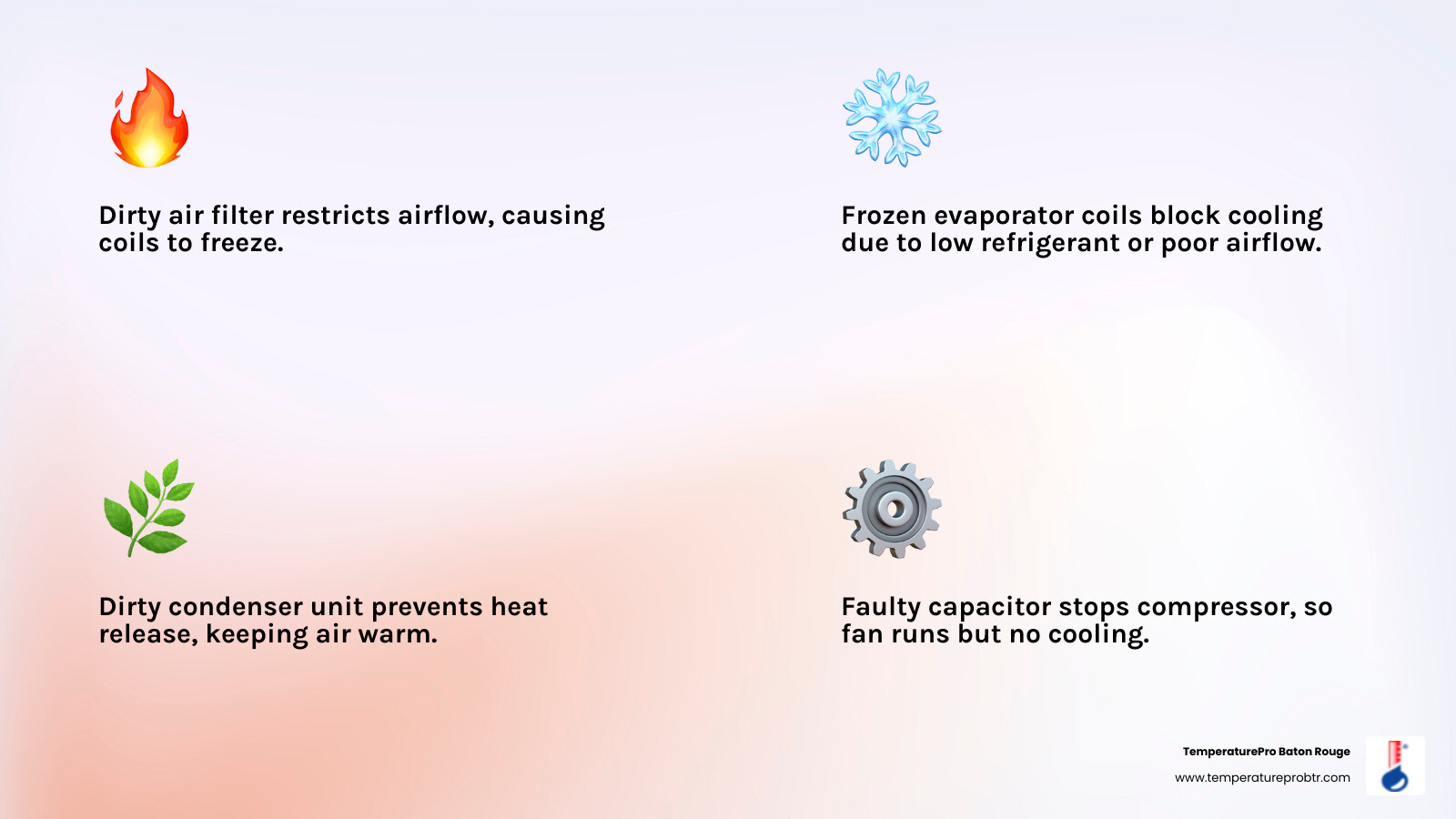
1. Dirty or clogged air filter - restricts airflow and can freeze the system
2. Incorrect thermostat settings - fan set to "On" instead of "Auto," or wrong mode
3. Frozen evaporator coils - caused by poor airflow or low refrigerant
4. Low refrigerant / refrigerant leak - prevents proper heat absorption
5. Dirty outdoor condenser unit - can't release heat efficiently
6. Faulty capacitor or fan motor - outdoor unit runs but compressor doesn't engage
7. Blocked or leaky ductwork - cool air escapes before reaching your rooms
8. Undersized or aging system - can't keep up with Baton Rouge's peak heat demand
Some of these are quick DIY fixes. Others need a licensed HVAC technician — especially anything involving refrigerant or electrical components.
Before you assume the worst, there are several "low-hanging fruit" items we recommend checking. Sometimes, the solution is as simple as a flick of a switch or a fresh set of batteries.
It sounds basic, but you’d be surprised how often a thermostat accidentally gets bumped into "Heat" mode or "Fan Only" mode. First, verify that your thermostat is set to "Cool" and that the temperature setting is at least five degrees below the current room temperature.
A major culprit for why a house feels warm while the AC is "running" is the fan setting. If your fan is set to "On," the blower motor runs 24/7, even when the outdoor compressor isn't cooling the air. This circulates unconditioned, humid air throughout your home. Switch it to "Auto" so the fan only blows when the cooling cycle is active. If your display is blank or fading, try replacing the batteries; a weak signal can prevent the system from engaging the cooling stage properly. For more detailed steps, check out our guide on Fixing an AC Not Cooling.
If the indoor blower is moving air but the outdoor unit isn't making any noise, you might have a tripped breaker. Go to your electrical panel and look for the switch labeled "AC" or "Condenser." If it’s in the middle position, flip it all the way to "Off" and then back to "On."
Be careful, though—if the AC Keeps Tripping the Circuit Breaker repeatedly, do not keep resetting it. This indicates a serious electrical fault or a failing compressor that needs professional attention. If you want to try a system reset, turn the AC off at the thermostat, wait about five to ten minutes to allow pressures to equalize, and then turn it back on.
In our experience serving Baton Rouge and Prairieville, airflow is the number one reason for cooling failures. Think of your AC like a pair of lungs; if it can't breathe, it can't work.
A heavily clogged air filter acts like a wall. It forces your blower motor to work twice as hard while delivering half the air. Over time, this lack of airflow causes the temperature around the evaporator coil to drop too low, leading to a frozen system. We recommend replacing your filters every 1 to 3 months. If you have pets or high dust levels in your home, once a month is the gold standard during a Louisiana summer. You can find more specific AC Airflow Problems and Solutions on our blog.
Check your return grilles (the large vents where air is sucked in) and your supply registers (where the cold air comes out). Are they blocked by curtains, couches, or bookshelves? Even closing vents in "unused" rooms can backfire by increasing pressure in the ductwork and reducing efficiency. For residents in the surrounding areas, we've compiled AC Airflow Troubles and Fixes for Prairieville Homes to help navigate these common local issues.
If your AC is running and the air coming out is cold, but the house won't cool down, your ducts might be the problem. The Department of Energy estimates that typical homes lose 20% to 30% of conditioned air through leaks in the ductwork. If your ducts are in a hot attic in Denham Springs or Walker, that cool air is escaping into the rafters instead of cooling your living room. This is a common cause when Solving Uneven Cooling in Your Home becomes a priority.
If you notice ice forming on the copper lines leading to your outdoor unit, or if you see frost on the indoor cabinet, your evaporator coil has frozen. When this happens, the ice actually acts as an insulator, preventing the refrigerant from absorbing heat from your home.
If you see ice, turn the AC off immediately and switch the fan to "On" to help it thaw. Do not try to scrape the ice off, as you could puncture the delicate coils. Once it's thawed, check your filter. If the filter was clean and it freezes again, you likely have a refrigerant issue. Our guide on What to Do When AC Freezes Up provides a step-by-step recovery plan.
Refrigerant is the "blood" of your AC system. It doesn't get "used up" like gasoline; it stays in a sealed loop. If your levels are low, it means you have a leak.
Common signs of a refrigerant leak include:
• Hissing or bubbling noises near the indoor or outdoor unit.
• Gurgling sounds that suggest air or moisture has entered the lines. Learn What a Gurgling AC Sound Means for Your Baton Rouge Home to catch this early.
• Ice buildup on the refrigerant lines even on a 90-degree day.
Handling refrigerant requires specialized tools and EPA Section 608 certification. It is illegal and dangerous for a homeowner to attempt to "top off" their own Freon. If you suspect a leak, read more about How to Handle AC Refrigerant Issues and then call in the pros. Understanding What Gurgling AC Sound Means can save your compressor from permanent damage.
The outdoor unit (the condenser) is responsible for releasing the heat collected from inside your home. If it’s dirty or crowded, that heat has nowhere to go, and your AC will run non-stop without lowering the temperature.
Your outdoor unit needs at least two feet of clear space on all sides to "breathe" properly. Overgrown bushes, tall grass, or stacked firewood can choke the unit. Additionally, the metal fins on the sides of the unit can get clogged with dirt, pollen, and grass clippings.
You can gently clean these fins with a garden hose (never a pressure washer!), spraying from the inside out to dislodge debris. For more localized advice, see our AC Not Cooling Troubleshooting Tips for Baton Rouge. While you're out there, check the drain line; a clog can cause the system to shut down to prevent water damage. We have tips for Solving AC Drainage Issues if you notice water pooling where it shouldn't.
Sometimes the outdoor fan is spinning, but the compressor—the heart of the system—isn't actually running. This is often due to a failed capacitor. Capacitors are like large batteries that give the motor the "kick" it needs to start. In the extreme heat of South Louisiana, these components wear out faster than in cooler climates.
If you hear a Why AC is Making a Loud Banging Noise or a clicking sound coming from the unit, it could be a failing contactor or a compressor struggling to start. If the compressor has failed entirely, you'll notice the air coming from the vents is exactly the same temperature as the air in the room. Check the Signs Your AC Compressor Needs Replacement to see if your system is at a crossroads. We also recommend Troubleshooting AC Sounds and Odors if you smell something burning or hear screeching.
Sometimes, the reason why is my ac running but not cooling isn't a "broken" part, but a limitation of the equipment itself.
• Runtime — Undersized Unit: Runs constantly without reaching set temp — Oversized Unit: Turns on and off frequently (Short-cycling)
• Humidity — Undersized Unit: Generally low (because it runs so much) — Oversized Unit: Very high (doesn't run long enough to dehumidify)
• Comfort — Undersized Unit: House is warm during peak afternoon — Oversized Unit: House feels "clammy" or has cold/hot spots
• Energy Bills — Undersized Unit: Extremely high due to constant operation — Oversized Unit: High due to frequent, high-draw startups
If you've recently added onto your home in Central or Zachary, your old AC might now be undersized. Conversely, an oversized unit won't run long enough to remove the thick Louisiana humidity, leaving you feeling sticky even if the air is "cool." For help with these balance issues, see Solving Uneven Cooling Issues Baton Rouge Homes.
Most central air conditioners have a lifespan of 10 to 15 years. As they age, the mechanical parts become less efficient. If your system is over a decade old and struggles every time the temperature hits 90 degrees, it might simply be reaching the end of its useful life. An aging system will naturally lose its ability to maintain a 15–20 degree temperature differential between the indoor and outdoor air.
Yes. If the system is running but not cooling, you are wasting electricity and putting unnecessary strain on the compressor. If the issue is a frozen coil, running the AC will only make the ice block thicker. Turn it off, set the fan to "On," and call a technician to prevent a minor part failure from turning into a total compressor burnout.
In a typical home with decent insulation, you should notice a temperature drop within 15 to 30 minutes. However, an AC is designed to maintain temperature rather than drop it rapidly. If it’s 95 degrees outside and your house has warmed up to 80, it may take several hours to get back down to 72. Most systems are designed to keep a home about 20 degrees cooler than the outdoor temperature.
This usually points to a heat exchange failure. Either the indoor evaporator coil is frozen/dirty (can't absorb heat), or the outdoor condenser is dirty/broken (can't release heat). It could also be a calibration issue with your thermostat. If your system keeps shutting down before it gets cool, see Why Your AC Keeps Tripping the Breaker Baton Rouge.
Dealing with an AC that runs but doesn't cool is a major headache, especially in our local climate. Whether you’re in Baton Rouge, Gonzales, or St. Gabriel, you deserve a home that feels like an oasis. While DIY checks like changing your filter and clearing your outdoor unit are great first steps, complex mechanical and refrigerant issues require an expert touch.
At TemperaturePro Baton Rouge, we are a family and veteran-owned company dedicated to keeping our neighbors comfortable. We treat every customer like family and offer 24/7 support for those middle-of-the-night cooling emergencies. If your house is still warm after trying these tips, don't suffer through the heat.
My AC Isn't Cooling My House in Baton Rouge - Who Offers 24/7 Emergency Repair Services is a question we answer every day with fast, reliable action.
Schedule your expert air conditioning service today and let us get your home back to the perfect temperature!
Go With Experience