Navigating HOA Restrictions When Relocating Your Outdoor AC Unit in St. George
Navigating HOA Restrictions When Relocating Your Outdoor AC Unit in St. George
Moving a noisy AC condenser away from your backyard patio requires more than just calling a contractor. Learn how to meet strict St. George HOA setback and decibel limits before starting work.
The Hidden Complexities of Moving Your AC Condenser Away From the Patio
Your air conditioning system is running nonstop to fight the late August heat, but the roaring compressor is completely ruining your backyard patio, making you realize that navigating HOA restrictions when relocating your outdoor AC unit in St. George is the only way you will ever enjoy your outdoor space again. It is incredibly frustrating to invest in a beautiful outdoor living area only to have every conversation drowned out by the mechanical hum of a condenser unit sitting just a few feet away. For many homeowners, the immediate reaction is to call a contractor and request that the unit be moved to the side of the house as soon as possible. However, scheduling physical relocation work before verifying your local subdivision rules is a common and costly mistake.
Before you commit to a major project like air conditioning relocation and installation, it is critical to understand how this process fits into broader HVAC services and local compliance regulations. In newer St. George subdivisions, homeowners associations maintain strict architectural guidelines that govern exactly where mechanical equipment can be placed. Simply shifting the unit around the corner is rarely a straightforward task. It requires mapping out property lines, analyzing sound requirements, and ensuring the new location does not violate community standards.
The reality of relocation: Comprehensive planning protects homeowners from forced rollbacks. Moving a condenser involves extending refrigerant lines, rerouting high-voltage electrical wiring, and pouring or setting a new level pad. If you complete this work without prior HOA approval, the architectural review board can issue costly fines and legally compel you to move the unit back to its original footprint at your own expense.
• The unit can be moved anywhere out of sight. — The HOA Compliance Reality: The unit must sit within strictly defined property setbacks, even if hidden.
• A privacy fence solves all compliance issues. — The HOA Compliance Reality: Fences address visual rules, but sound ordinances still apply at the property line.
• Approval takes a quick phone call. — The HOA Compliance Reality: Formal submission of plot plans and equipment specifications is usually required.
Understanding Noise Ordinances vs. Visual Compliance
A typical pattern we see is homeowners assuming that if the air conditioner cannot be seen from the street, the relocation will automatically be approved. While visual screening—such as installing privacy fences, lattice enclosures, or dense landscaping—is often a mandatory part of the HOA requirement, it is usually only half of the equation. Auditory compliance is often much stricter and far more difficult to navigate than visual compliance.
Most residential noise ordinances cap continuous mechanical noise at specific decibel levels at the boundary of your property. HOA decibel limits at property line boundaries generally hover around 55 to 60 decibels. To put that into perspective, a standard conversation is about 60 decibels, while an older, single-stage AC compressor can easily produce 70 to 80 decibels of noise. If you move your unit to a narrow side yard, the sound waves will bounce off your brick exterior and your neighbor's wall, amplifying the noise and potentially violating the ordinance.
How Mechanical Wear Increases Decibel Output
It is also crucial to recognize how mechanical issues can artificially inflate noise levels, complicating your compliance efforts. As compressors age, bearings wear down, fan blades become unbalanced, and internal components begin to rattle. If your system is struggling, you might be wondering why your AC is making a loud banging noise—and that excess mechanical racket can easily push your unit over the acceptable decibel limit, even if the manufacturer's original rating was compliant.
• Vibrating panels: Loose screws on the cabinet exterior create a high-frequency rattle that travels easily across property lines.
• Failing fan motors: A grinding motor produces a harsh, continuous drone that neighbors will quickly notice.
• Compressor hard starts: A loud jolt or bang every time the system turns on can trigger nuisance complaints, even if the running volume is low.
A compliant relocation must account for the unit's maximum decibel output in its current condition, not just the factory rating it had when it was brand new.
Measuring Clearances on Narrow Property Lots
One of the most rigid hurdles in the relocation process is the property setback requirement. A setback is a defined distance from your property line—front, side, and rear—where permanent structures and mechanical equipment cannot be placed. HOAs enforce these setbacks to ensure emergency access, maintain drainage easements, and prevent neighborhoods from feeling overly crowded.
In newer St. George subdivisions, developers have maximized buildable square footage, resulting in homes with incredibly limited side-yard space. Finding adequate clearance on these narrow lots is a significant challenge. If your HOA requires a five-foot setback from the side property line, and your side yard is only seven feet wide, a standard condenser unit (which is often three feet wide) physically cannot fit in that space without violating the rule.
Factoring in Manufacturer Airflow Requirements
The math becomes even more complicated when you overlap HOA setback rules with the minimum airflow clearances required by the HVAC manufacturer. Condensers require specific breathing room to function efficiently. They must pull in vast amounts of ambient air across the condenser coils to release the heat removed from your home.
• Wall clearance: Most manufacturers require a minimum of 12 to 24 inches of clearance between the unit and the exterior wall of the house.
• Shrubbery and fencing: There must typically be 24 to 36 inches of clearance on the remaining sides to allow for proper airflow and technician service access.
• Overhead clearance: The unit needs 48 to 60 inches of unobstructed vertical space to exhaust hot air upward without it recirculating back into the system.
Jamming a unit too close to a fence just to satisfy an HOA setback requirement can cause the system to suffocate. This leads to overheating, skyrocketing energy bills, and eventual compressor failure. Identifying a viable relocation zone requires plotting both the HOA setback lines and the manufacturer's airflow zones on a standard property plot plan to find the "safe zone" where both criteria are met.
Why the End of Summer is the True Test for Condenser Noise
With the intense, prolonged heat typical of the Baton Rouge and St. George area, air conditioning is not an intermittent luxury—it is a constant necessity. Because systems run almost continuously during the hottest months, noise compliance becomes a 24/7 issue rather than an occasional nuisance. Evaluating your system's sound footprint during mild spring weather will give you a false sense of security.
The true test for condenser noise occurs in late August. During this peak seasonal heat, your air conditioner operates at maximum capacity. Single-stage units run continuously for hours, while variable-speed units ramp up to their highest fan speeds to keep up with the extreme cooling demand. This prolonged operation at maximum output significantly increases the overall sound footprint of the equipment.
Homeowners across the St. George and greater Baton Rouge service areas often discover that measuring baseline noise during this peak cooling demand is the most accurate way to prevent unexpected HOA complaints later. If you relocate a unit based on how it sounds in April, you may find yourself facing noise violations from neighbors by August. Thoroughly evaluating the current unit's performance under heavy load is a mandatory step before finalizing any new location.
Preparing Your Architectural Review Board (ARB) Submission
Once you have identified a location that meets both airflow requirements and setback rules, the next step is securing official approval. Skipping the formal Architectural Review Board (ARB) submission is a guaranteed way to invite scrutiny. Walking the board through a well-documented plan shows that you respect the community guidelines and have done your due diligence.
Our firsthand local expertise in navigating specific St. George HOA regulations and narrow lot lines helps streamline the approval process, ensuring that your submission answers the board's questions before they even have to ask them. Here is how to prepare a comprehensive ARB submission:
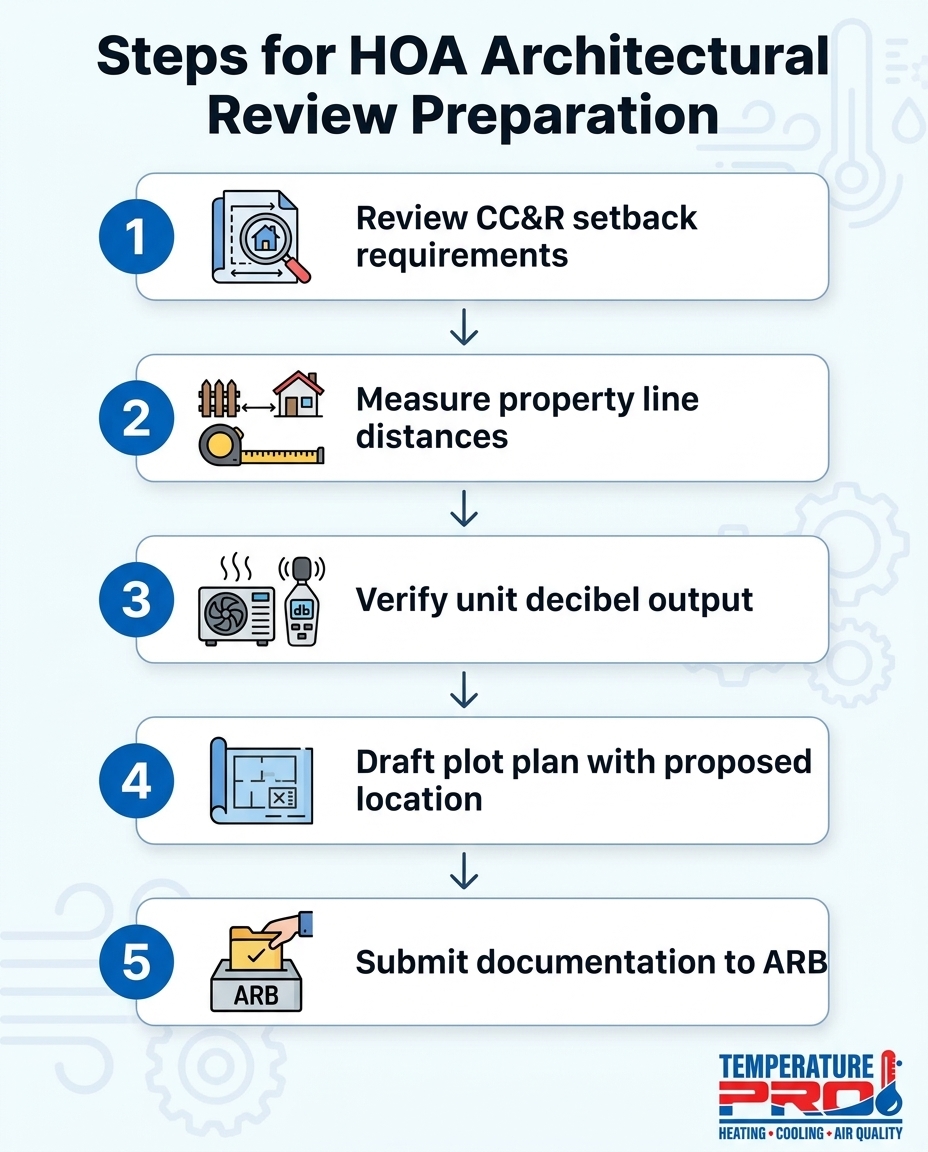
1. Obtain your official plot plan: Locate the property survey you received at closing. This document shows your exact property lines, easements, and current footprint.
2. Mark the proposed location clearly: Draw the new location of the AC unit on the plot plan to scale. Clearly label the distance from the unit to the side and rear property lines to prove it respects the setback.
3. Provide equipment specifications: Submit the manufacturer's cut sheet for your condenser. Highlight the unit's dimensions and its official decibel rating to prove it falls under the HOA decibel limits at property line boundaries.
4. Detail the visual screening: Include photos or architectural drawings of the fencing or landscaping you plan to install to hide the unit from street view, ensuring it matches community aesthetics.
5. Include a professional assessment: Attach a brief statement or plan from a licensed HVAC professional confirming that the new location meets all manufacturer airflow and safety clearances.
Having a professional assessment to back up your submission adds significant weight to your request. Depending on your specific HOA, the review process can take anywhere from two to four weeks, so factor this timeline into your project planning before the weather shifts.
Steps for HOA Architectural Review Preparation
Common Roadblocks in the Relocation Planning Phase: Navigating HOA Restrictions When Relocating Your Outdoor AC Unit in St. George
Even with careful preparation, the planning phase can present several unexpected hurdles. Highlighting these potential pitfalls is vital when homeowners attempt to rush the process. Skipping upfront measurements and assuming approval is a recipe for project delays.
Ordering materials prematurely: One of the biggest risks is ordering line set extensions, electrical conduit, or pouring a concrete pad before securing official HOA approval. If the ARB rejects your proposed location, any materials purchased or preliminary work completed becomes a sunk cost. Always wait for written approval before authorizing a contractor to begin staging materials.
Relying on verbal permission: It is a common misconception that if your next-door neighbor says they don't mind the noise, you are clear to proceed. Verbal permission from neighbors carries zero weight with an architectural review board. If that neighbor moves, or if the HOA conducts a random compliance audit, you will be held accountable to the written bylaws of newer St. George subdivisions, regardless of any informal agreements.
Pre-existing landscaping interference: Often, the only mathematically compliant relocation spot on a narrow lot happens to be right where a mature oak tree or an extensive root system is located. You cannot simply place a condenser on uneven roots, and cutting major roots can kill the tree—which might be another HOA violation. For more insights on the technical side of this process, reviewing common HVAC and installation questions can help you avoid these compounding complications.
Taking the Next Step Toward a Quieter Outdoor Space
A clear understanding of setback rules, airflow requirements, and noise ordinances is the absolute key to a successful relocation project. Thorough planning upfront prevents massive headaches, costly fines, and strained relationships with your homeowners association. Moving a condenser is a highly technical process, and ensuring the new location is legally compliant is just as important as ensuring the electrical and refrigerant lines are properly installed.
As you prepare for the intense heat of late August, don't let a poorly placed, roaring condenser keep you from enjoying your patio. If you are serious about navigating HOA restrictions when relocating your outdoor AC unit in St. George, the smartest move is to consult with a local expert who understands both the mechanical requirements and the local neighborhood regulations. Reach out to a professional today to map out a fully compliant, efficient relocation plan for your home.
Frequently Asked Questions
Can an HOA stop me from moving my AC unit?
Yes, an HOA has the legal authority to stop or reject an AC relocation if it violates the community's Covenants, Conditions, and Restrictions (CC&Rs). Most associations require formal approval through an Architectural Review Board before any exterior modifications are made. If you move the unit without permission, they can fine you and legally compel you to return it to its original location.
How close to the property line can an air conditioner be?
This distance is governed by your specific HOA setback rules and local municipal codes, but it typically ranges from 3 to 5 feet from the side or rear property lines. You must check your neighborhood's specific bylaws, as newer subdivisions with narrower lots may have specialized zoning rules. Additionally, the unit must still maintain proper airflow clearance from fences and walls.
What is the acceptable decibel level for an AC unit in a neighborhood?
Most residential noise ordinances and HOA guidelines cap continuous mechanical noise at roughly 55 to 60 decibels measured at the property line. While modern, high-efficiency units often run quietly enough to meet this standard, older or poorly maintained units can easily exceed it. It is important to measure the sound output during peak operation to ensure compliance.
How do I measure AC decibels for my HOA?
To get an accurate reading for your HOA, you should measure the sound level at the exact boundary of your property line, not right next to the unit. You can use a dedicated digital decibel meter or a highly rated smartphone app to capture the baseline noise. For the best results, take the measurement during the hottest part of the day when the unit is running at its maximum fan speed.
What are standard AC setback requirements for narrow lots?
On narrow lots, standard AC setbacks usually demand at least 3 feet of clearance from the property boundary to ensure drainage and emergency access. However, because the unit itself also requires about 2 feet of clearance from your home's exterior wall for airflow, finding a compliant spot can be incredibly tight. Homeowners often have to work closely with their HVAC contractor to find a location that satisfies both the HOA and the manufacturer.
Do I need a permit as well as HOA approval to relocate my condenser?
Yes, in most municipalities, relocating an AC condenser requires a mechanical and electrical permit from the city or parish, in addition to your HOA's architectural approval. Moving the unit involves extending high-voltage electrical lines and refrigerant piping, which must be inspected for safety and code compliance. Your licensed HVAC contractor will typically handle pulling the necessary municipal permits on your behalf.
Thank you! Your submission has been received!
Oops! Something went wrong while submitting the form.
Prevent sudden heating breakdowns with these home maintenance tips and troubleshooting insights. Get clear answers on why pre-winter HVAC inspections matter.
Most homeowners think a late-week appointment is the most convenient choice for an HVAC tune-up. Discover why our dispatchers highly recommend booking on a Tuesday morning instead.
A furnace shutting down repeatedly during early fall tests is frustrating, but jumping the safety switch is a dangerous mistake. Understand the severe fire hazards of this DIY workaround.