Upgrading to a Variable-Speed Compressor vs. Adding a Whole-Home Dehumidifier for Sticky August Days
Upgrading to a Variable-Speed Compressor vs. Adding a Whole-Home Dehumidifier for Sticky August Days
Dropping the thermostat won't cure a cold, clammy house in late summer. See how replacing your AC compressor compares to adding a dedicated dehumidifier to finally solve high indoor humidity.
The Myth of the Thermostat: Why Lowering the Temperature Doesn't Cure a Clammy House
At TemperaturePro Baton Rouge, a pattern we see often is homeowners constantly sweating inside their own houses, where the debate ultimately comes down to Upgrading to a Variable-Speed Compressor vs. Adding a Whole-Home Dehumidifier for sticky August days. A common misconception among homeowners is that dropping the thermostat down to 68 degrees will magically dry out the indoor air. In reality, standard air conditioners are triggered purely by temperature, not by the amount of moisture trapped in your living space. If you find yourself shivering in a sweater while your skin still feels damp, your cooling system is failing at its secondary job: dehumidification. Resolving this uncomfortable late-summer dynamic requires a fundamental shift in how your home handles heavy moisture loads, which means choosing between replacing your outdoor technology or adding a dedicated moisture-removal appliance.
Understanding the 'Cold and Clammy' Phenomenon in Southern Louisiana
To fix a house that feels like a swamp, our technicians always start by explaining the difference between the two types of heat your HVAC system battles every day: sensible heat and latent heat. Sensible heat is the temperature you can actually read on a thermometer. When the sun beats down on your roof and raises the indoor temperature from 72 to 78 degrees, that is an increase in sensible heat. Latent heat, on the other hand, is the thermal energy trapped inside water vapor. It is the heavy, oppressive feeling in the air that makes 75 degrees in Arizona feel completely different from 75 degrees in Baton Rouge.
During the late-summer back-to-school transition, we notice that home occupancy patterns usually shift. Families leave the house empty for longer stretches during the day, often setting the thermostat a few degrees higher to save energy. Because the sensible heat load drops (fewer people, higher thermostat setting), standard air conditioners run for much shorter cycles. However, the latent heat load—the sheer volume of moisture infiltrating your home from the humid outdoors—remains incredibly high. If you want to dive deeper into how these regional factors impact your daily comfort, exploring humidity control tips for Gulf Coast homes can provide a solid baseline.
In southern Louisiana, where extreme late-summer humidity routinely exceeds 75%, peak latent heat loads simply overwhelm standard cooling equipment. The system reads that the sensible temperature has been reached, shuts off, and leaves gallons of airborne water vapor lingering in your living room.
Sensible vs. Latent Heat Extraction
The mechanical disconnect: Standard, builder-grade air conditioners are incredibly efficient at dropping the sensible temperature quickly. They blast a massive volume of frigid air into the room, satisfying the wall thermostat in ten or fifteen minutes.
However, extracting latent heat takes time. Moisture removal only happens when warm, humid indoor air blows across the freezing cold evaporator coils inside your air handler. The longer the air flows over those cold coils, the more water condenses, drips into the drain pan, and exits your home. When standard ACs cool the air too rapidly, they shut down before this condensation process can pull enough moisture out of the environment. The resulting indoor environment is a frustrating paradox: a freezing 70 degrees, but a suffocating 65% relative humidity.
The Short-Cycling Trap of Single-Stage Compressors
The root of the problem: The vast majority of aging residential cooling systems we service rely on single-stage compressors. A single-stage compressor is a binary machine. It only has two modes: 100% ON or 100% OFF. Whenever the thermostat calls for cooling, the compressor roars to life at maximum capacity, pushing as much refrigerant through the lines as physically possible.
The cause of short-cycling: Because a single-stage unit operates at full blast, it often cools the ambient air faster than it can dehumidify it. This leads to a phenomenon known as short-cycling. The system turns on, blasts cold air, satisfies the thermostat quickly, and abruptly shuts down. Ten minutes later, the heavy, sticky August late-summer air makes the house feel uncomfortable again, prompting the homeowner to lower the temperature further. The system kicks back on, runs for another brief sprint, and shuts off again.
The solution and the toll it takes: This constant starting and stopping inflicts severe wear and tear on aging equipment. The most mechanically stressful moment for any HVAC system is the initial startup. Forcing an older single-stage unit to hard-start dozens of times a day during peak heat drastically reduces the lifespan of capacitors, contactors, and the compressor itself. Our team at TemperaturePro Baton Rouge recently responded to a homeowner who experienced this breaking point firsthand during a summer move-in. Their aging single-stage AC stopped working entirely on the very day they moved into their new house, completely overwhelmed by the peak seasonal demand. Fortunately, our emergency technicians arrived quickly to diagnose the failure and get the house cooled down, but this sudden breakdown perfectly illustrates the intense strain that short-cycling places on older equipment.
If you are currently relying on an older single-stage unit, maintaining a routine HVAC maintenance plan is a critical baseline to prevent these sudden failures while you weigh your long-term upgrade options.
How Variable-Speed Compressors Solve the Humidity Equation
If your current air conditioner is aging out and requires a full replacement, our team highly recommends upgrading to a variable-speed compressor as the most comprehensive way to eliminate indoor humidity. Unlike single-stage units that only blast at 100% capacity, variable-speed technology acts more like the gas pedal in your car. It can ramp up to full power during the hottest part of the afternoon, but more importantly, it can throttle down to operate at capacities as low as 25% to 30%.
By running continuously at a very low speed, a variable-speed compressor fundamentally changes how your home is conditioned.
1. Continuous Air Circulation: The system gently and quietly circulates air throughout the house all day long, eliminating hot spots and humid dead zones.
2. Maximum Moisture Extraction: Because the system runs for 45 minutes to an hour at a low capacity, indoor air is constantly flowing over the cold evaporator coils. This extended contact time acts like a giant sponge, wringing massive amounts of latent heat (moisture) out of the air.
3. Prevention of Overcooling: The low-speed operation precisely matches the cooling load of the house. It maintains a steady temperature without plunging the house into a freezing, clammy state.
The Mechanics of Long Run Cycles
Our extensive Baton Rouge installation experience reveals exactly why these longer run cycles are critical for Gulf Coast comfort. When a variable-speed system operates in a low stage, the evaporator coil stays consistently cold, and the blower motor moves air at a reduced velocity. This slower air movement allows the water vapor more time to condense into liquid on the coil fins.
Instead of turning on and off, the system simply adjusts its output to match the precise heat and humidity load of the home. The energy efficiency benefits are also substantial; avoiding the massive power draw of constant start-and-stop cycles significantly reduces the electrical strain on your home, making variable-speed technology the premier choice for a complete system overhaul.
Adding a Whole-Home Dehumidifier to Your Existing System
What if your current single-stage air conditioner is relatively new, under five years old, and in perfect working condition? Ripping out a perfectly good system to upgrade to variable-speed technology doesn't make mechanical or logical sense. In this scenario, we frequently recommend supplementing your existing setup by adding a whole-home dehumidifier.
Active vs. Passive Extraction: While an air conditioner removes moisture passively as a byproduct of cooling the air, a dedicated whole-home dehumidifier is built for active moisture extraction. These heavy-duty appliances integrate directly into your existing HVAC ductwork, working alongside your central air system or operating completely independently when cooling isn't needed.
Massive Capacity: A standard whole-home dehumidifier is capable of removing 70 to 130+ pints of moisture per day from your indoor air. Because it operates independently of the AC's cooling cycle, it can aggressively dry out the house even on mild, sticky August late-summer days when the sensible temperature isn't high enough to trigger the air conditioner.
Elevated Comfort at Higher Temperatures: When you remove the heavy latent heat from the air, the sensible temperature feels drastically different. Homeowners with dedicated whole-home dehumidification frequently find they can set their thermostats to 74 or 75 degrees and feel significantly more comfortable than they did at 68 degrees with high humidity. This targeted approach allows your newer single-stage AC to handle the temperature while the dehumidifier completely manages the moisture.
Side-by-Side Comparison: Which Upgrade Fits Your Home?
Both solutions effectively eliminate the cold and clammy feeling, but choosing the right path depends entirely on the lifespan and condition of your current cooling equipment. Here is a clear breakdown of how the two upgrades compare mechanically based on what we see in the field.
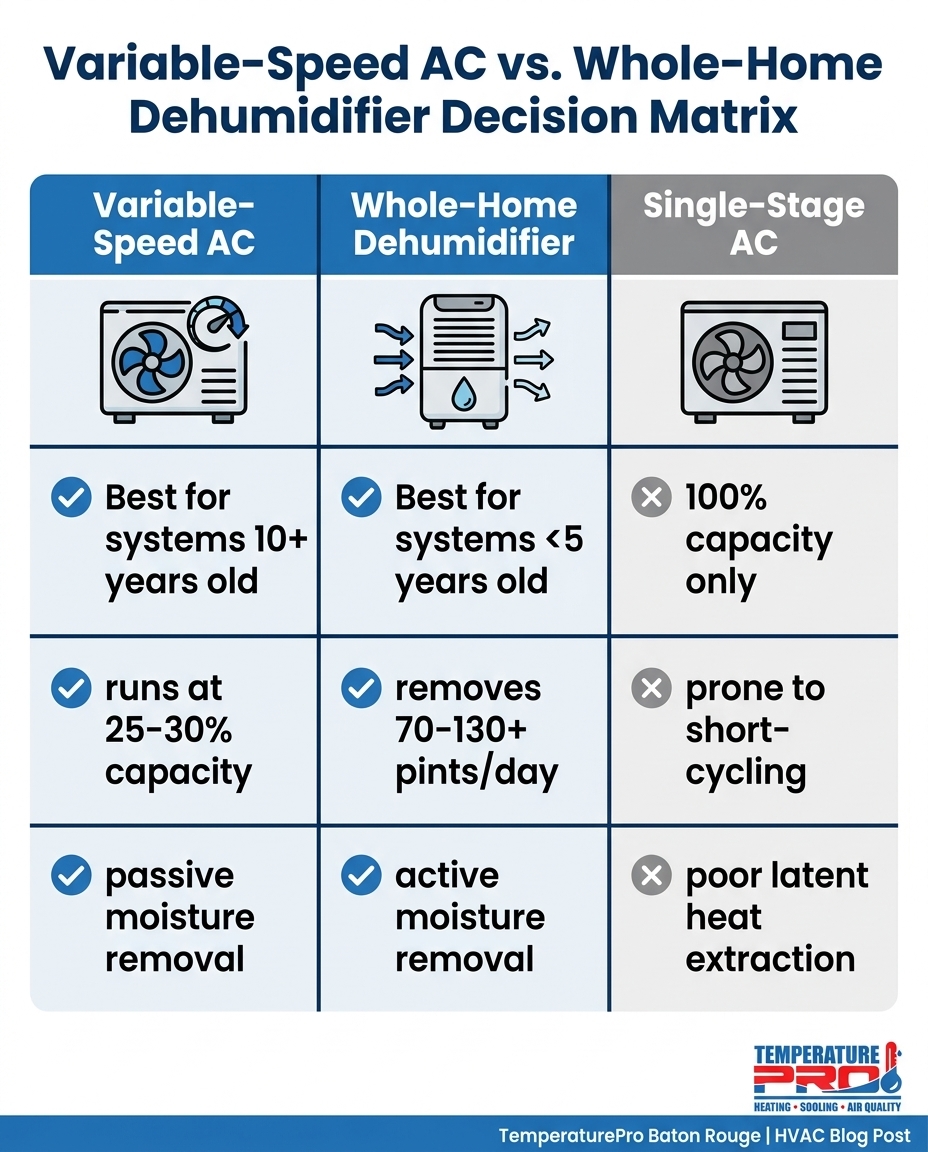
• Moisture Removal Method — Variable-Speed AC Upgrade: Passive (byproduct of long, slow, low-capacity cooling cycles). — Whole-Home Dehumidifier Add-on: Active (dedicated moisture extraction independent of the cooling cycle).
• Installation Scenario — Variable-Speed AC Upgrade: Full system overhaul (replacing the outdoor compressor and indoor coil). — Whole-Home Dehumidifier Add-on: Ductwork add-on (integrated into existing return/supply plenums).
• Ideal Candidate — Variable-Speed AC Upgrade: Homes with aging systems (10+ years old) nearing the end of their lifespan. — Whole-Home Dehumidifier Add-on: Homes with newer single-stage systems (under 5 years old) in good condition.
• Primary Benefit — Variable-Speed AC Upgrade: Eliminates short-cycling, maximizes energy efficiency, provides precise temperature control. — Whole-Home Dehumidifier Add-on: Allows independent humidity control without overcooling, massive daily moisture removal capacity.
• Baton Rouge Climate Fit — Variable-Speed AC Upgrade: Excellent for managing both peak sensible heat and heavy latent loads simultaneously. — Whole-Home Dehumidifier Add-on: Perfect for mild, deeply humid days when the AC doesn't run long enough to dry the air.
Variable-Speed AC vs. Whole-Home Dehumidifier Decision Matrix
Factoring in Equipment Age, Efficiency, and Incentives
When our team evaluates major mechanical upgrades to combat sticky August late-summer conditions, equipment age is the ultimate deciding factor. If your system is over a decade old, pouring resources into a ductwork add-on might be a temporary bandage on a failing system. Upgrading to a high-efficiency variable-speed heat pump or air conditioner impacts your long-term energy consumption drastically. These modern units meet stringent new efficiency standards, utilizing advanced scroll compressors and smart communicating thermostats to optimize every watt of electricity used.
Rebates and Incentives: Because variable-speed systems operate with such high efficiency, they frequently qualify for various generic incentives. Federal tax credits or local utility rebates may apply to qualifying high-efficiency installations. We always advise homeowners to verify current programs with their tax professional or local utility provider, as these incentives can help offset the initial investment of a full system replacement.
Protecting Your Property: Beyond personal comfort, investing in either a variable-speed system or a dedicated dehumidifier protects the physical structure of your home. Excess moisture is the primary catalyst for mold growth inside ductwork, drywall damage, and the warping of expensive hardwood floors. By bringing your indoor relative humidity down to the recommended 45% to 50% range, you are actively preserving your home's interior.
Understanding the logistics of these upgrades is critical, which is why exploring flexible HVAC financing options can help you frame out the best path forward for your specific mechanical needs.
Frequently Asked Questions About High-Humidity Cooling Solutions
Does a variable speed AC dehumidify better than a single stage?
Yes, a variable-speed AC dehumidifies significantly better than a single-stage unit. Because a variable-speed compressor can operate at lower capacities (like 25% or 30%), it runs for much longer cycles. This extended run time allows indoor air to continuously pass over the cold evaporator coils, extracting far more moisture from the air than a single-stage unit that blasts on and off in short bursts.
Can I add a dehumidifier to my existing HVAC system?
Yes, a whole-home dehumidifier can be integrated directly into your existing HVAC ductwork. It is typically plumbed into the return or supply plenums, allowing it to pull air from the house, strip out the heavy moisture, and distribute the dry air back through your vents. This is a solution we frequently install for homes in Baton Rouge with newer single-stage air conditioners that are struggling with high humidity.
Why does my house feel damp with the AC on?
Your house feels damp because your air conditioner is satisfying the sensible temperature on the thermostat before it has time to remove the latent heat (moisture) from the air. This usually happens when a single-stage AC is oversized or when the outdoor temperature drops but the humidity remains high, causing the system to short-cycle and leave water vapor trapped indoors.
Is a whole house dehumidifier worth it?
A whole-house dehumidifier is absolutely worth the investment if your current AC is under five years old but fails to keep your home dry. It operates independently of your cooling cycle, removing up to 130 pints of moisture per day. By lowering the indoor humidity, you can actually set your thermostat at a higher, more energy-efficient temperature while feeling significantly cooler and more comfortable.
How does back-to-school season affect my home's cooling load?
During the back-to-school season, homes are often empty during the hottest parts of the day, leading homeowners to raise the thermostat. This reduces the sensible cooling load, meaning the AC runs less frequently. However, the latent heat load (outdoor humidity) remains severe. With the AC running shorter cycles, it fails to dehumidify the air, resulting in a cold, clammy, and uncomfortable environment when the family returns home.
Reclaim Your Indoor Comfort Before Summer Ends
Living with a cold and clammy house is a mechanical failure, not a permanent fact of life in southern Louisiana. Whether your sticky August late-summer discomfort stems from an aging single-stage unit that needs to be replaced, or a newer system that simply needs dedicated moisture-removal support, there is a distinct engineering solution for your home. You do not have to settle for shivering while you sweat.
The first step toward resolving this issue is having our experts at TemperaturePro Baton Rouge perform a professional assessment of your current system's latent cooling capacity. A thorough evaluation will determine whether your equipment is short-cycling due to age and sizing, or if your ductwork is the perfect candidate for an active dehumidification add-on. Take control of your home's environment today by scheduling a consultation for indoor air quality and dehumidification services to ensure your living space remains perfectly dry and comfortable year-round.
Thank you! Your submission has been received!
Oops! Something went wrong while submitting the form.
Prevent sudden heating breakdowns with these home maintenance tips and troubleshooting insights. Get clear answers on why pre-winter HVAC inspections matter.
Most homeowners think a late-week appointment is the most convenient choice for an HVAC tune-up. Discover why our dispatchers highly recommend booking on a Tuesday morning instead.
A furnace shutting down repeatedly during early fall tests is frustrating, but jumping the safety switch is a dangerous mistake. Understand the severe fire hazards of this DIY workaround.