The Mechanical Toll of Running Your AC with a Dirty Filter Since May
The Mechanical Toll of Running Your AC with a Dirty Filter Since May
Ignoring your air filter triggers a mechanical chain reaction that destroys blower motors. See how summer heat and static pressure turn a minor chore into a major breakdown.
Why Late Summer Brings a Wave of Blower Motor Failures: The Mechanical Toll of Running Your AC with a Dirty Filter Since May
Your air conditioner is running nonstop, but the air coming from your vents feels incredibly weak, and the house simply will not cool down. The mechanical toll of running your AC with a dirty filter since May often goes unnoticed until the system completely shuts down in the middle of a heatwave. Most homeowners view changing the air filter as a minor housekeeping chore, similar to dusting the blinds or sweeping the floor. In reality, your air filter is a critical mechanical component that regulates the entire breathing process of your HVAC system. When that filter is ignored, the resulting damage is severe, expensive, and entirely preventable.
If you are experiencing sudden system issues, learn more about our Air Conditioning services, or explore our HVAC Maintenance Plan to ensure your equipment stays protected year-round.
As we reach the August late-summer peak heat and the back-to-school transition begins, our technicians at TemperaturePro Baton Rouge see a massive, predictable spike in catastrophic blower motor failures. These breakdowns rarely happen because the motor was defective from the factory. Instead, they are the direct result of a mechanical chain reaction that started months earlier. A filter installed in the spring gradually fills with dust, pet dander, pollen, and microscopic airborne debris. As this barrier thickens, it suffocates the cooling system, forcing internal components to work twice as hard just to move a normal amount of air. Understanding the physics of this airflow restriction is the first step in protecting your system from an untimely late-summer breakdown.
Understanding the Physics of Static Pressure in Your HVAC System
The core problem: To understand why a dirty filter destroys blower motors, you first have to understand static pressure. In the residential HVAC systems our team services every day, static pressure is simply the measurement of resistance to airflow within your ductwork and equipment. Your cooling system is precisely engineered to push and pull air against a very specific, limited amount of resistance. When the system operates within its designed static pressure parameters, the air flows smoothly, the motor stays cool, and your home stays comfortable.
The mechanical cause: When the filter media becomes saturated with debris, it creates a physical wall that the air cannot easily pass through. This causes a severe spike in static pressure. Think of it like trying to breathe deeply through a tiny cocktail straw while running a marathon. The harder you try to pull air in, the more resistance you feel. In your HVAC system, high static pressure means the blower motor is fighting a losing battle against a blocked intake. The motor bears the absolute brunt of this increased resistance, straining its internal windings and electrical components just to keep the air moving.
• Clean Filter (New) — Static Pressure Level: Normal (0.5 in. w.c. or lower) — Blower Motor Impact: Operates smoothly, stays cool — Cooling Performance: Optimal airflow and temperature drop
• Slightly Dirty (30 Days) — Static Pressure Level: Slightly Elevated — Blower Motor Impact: Minor RPM increase, slight strain — Cooling Performance: Unnoticeable drop in efficiency
• Heavily Clogged (90+ Days) — Static Pressure Level: Dangerously High (0.8+ in. w.c.) — Blower Motor Impact: Overheating, excessive amp draw — Cooling Performance: Weak airflow, warm air from vents
The Role of the Blower Motor in Overcoming Resistance
Your blower motor is responsible for pulling warm return air from your home, drawing it through the filter, pushing it over the freezing cold evaporator coil, and then distributing it back through the supply ducts. Residential blower motors are incredibly strong, but they have strict design limits regarding static pressure thresholds. When high static pressure forces the motor to exceed these design limits, the electrical components begin to degrade. The motor is literally pulling a vacuum against a clogged filter, fighting a physical blockage that it was never designed to overcome.
The 90-Day Accumulation: Why May's Filter is Destroyed by August
One of the most damaging misconceptions in home maintenance is the myth of the "90-day filter." Many homeowners buy a pleated filter from the hardware store, read "lasts up to 3 months" on the packaging, and mark their calendar. However, filter lifespan is not based on days on a calendar; it is based entirely on system run-hours and the volume of air passing through the media. A filter installed in a mild climate where the AC runs for two hours a day might easily last three months. In the deep South, that same filter is subjected to a completely different workload.
In our years of servicing homes across Baton Rouge, we've seen firsthand how the near-continuous high temperatures and extreme humidity from May through August require maximum AC duty cycles. Your system might run for 12, 14, or even 16 hours a day during peak summer heat to keep up with the thermal load and remove heavy moisture from the air. This relentless operation drastically accelerates the accumulation of dust, dander, and airborne particulates. If you want to know how to extend the life of your AC in Louisiana, the first rule we tell our customers is to throw away the 90-day timeline.
The mathematical reality is staggering. If your system runs 12 hours a day, a filter installed in May has endured over 1,000 hours of continuous operation by the time August arrives. That means 1,000 hours of pulling millions of cubic feet of air, along with all the suspended particles in your home, through a single piece of fabric. By late summer, that "90-day" filter has reached its maximum holding capacity. It is no longer filtering the air; it is acting as a solid barrier, choking the life out of your cooling system and setting the stage for a catastrophic mechanical failure.
How Modern ECM Blower Motors Overwork to Compensate
To fully grasp the damage caused by a clogged filter, you have to look at the technology inside your air handler. Older, standard AC motors (called PSC motors) operated at a single speed. If a filter got clogged, a PSC motor would simply move less air. In the modern HVAC systems our team installs today, however, units are equipped with Electronically Commutated Motors (ECMs). These variable-speed motors are incredibly efficient and "smart," but that very intelligence becomes their downfall when high static pressure is introduced.
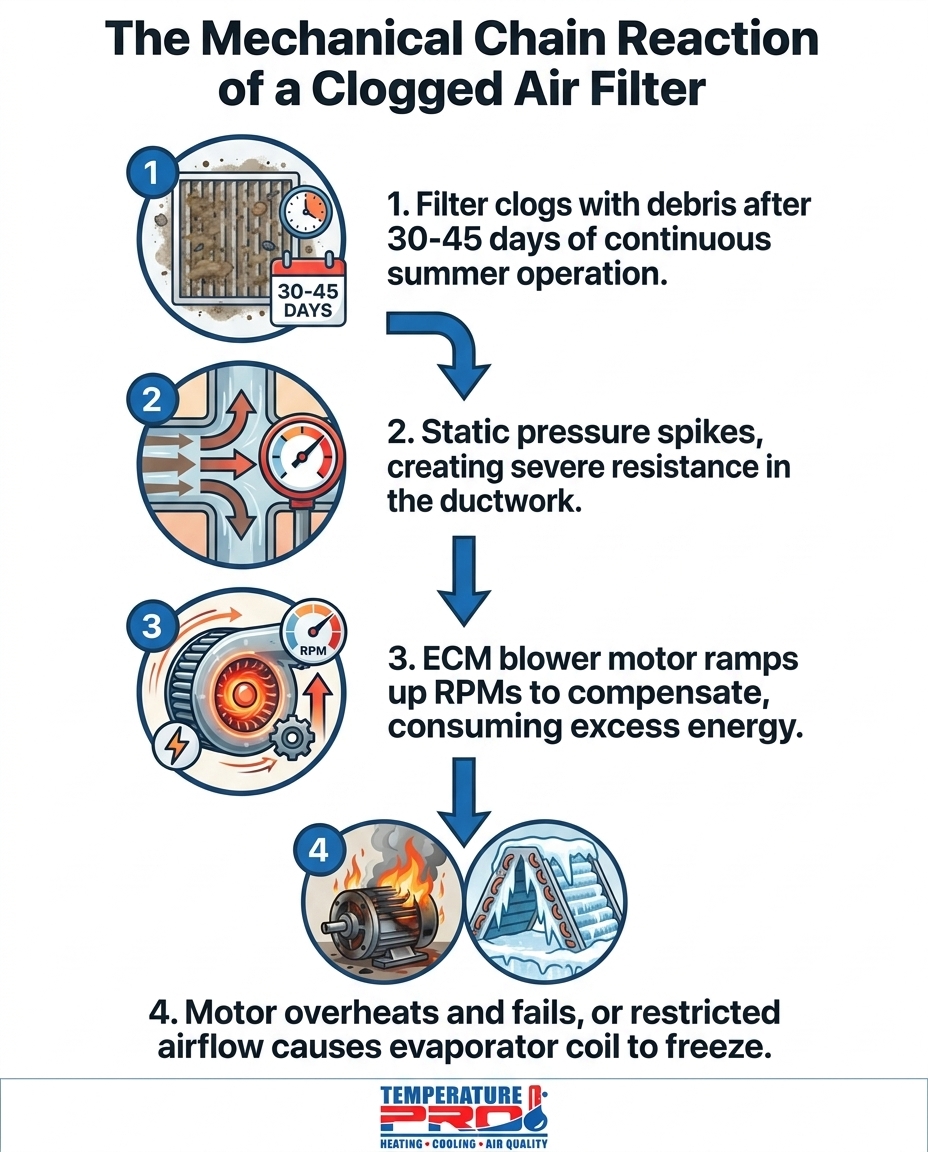
ECMs are programmed to maintain a specific volume of airflow (measured in cubic feet per minute, or CFM) regardless of the conditions. When they detect resistance from a dirty filter, they automatically ramp up their speed to compensate. Here is the step-by-step mechanical toll this creates:
1. Initial Restriction Detection: The ECM senses that the targeted volume of air is not moving through the ductwork due to the blockage at the return filter.
2. Aggressive RPM Ramp-Up: To overcome the high static pressure, the motor's internal computer commands it to spin faster, increasing its revolutions per minute (RPMs) significantly above normal operating levels.
3. Exponential Energy Consumption: As the motor spins faster to fight the physical blockage, its electrical amp draw spikes. The system begins consuming exponentially more electricity just to force air through the clogged media.
4. Thermal Overload and Burnout: The continuous high-speed operation generates massive amounts of excess heat within the motor housing. Because the airflow is restricted, the motor isn't receiving the cool air it needs to regulate its own temperature, eventually leading to a complete thermal breakdown.
The Hidden Cost of Increased RPMs
The electrical strain of this compensation process is massive. Not only are you paying significantly higher utility bills for a system that is struggling to cool your home, but the internal components of the motor are physically degrading. The bearings dry out from the excessive heat, and the electrical windings lose their insulation. By the time the motor finally stops spinning, the thermal damage is irreversible, requiring a complete, expensive replacement.
The Mechanical Chain Reaction of a Clogged Air Filter
The Domino Effect: Secondary Failures Caused by Restricted Airflow
The hidden danger: The blower motor is not the only component that suffers when a filter is neglected. The restriction of airflow creates a severe domino effect throughout the entire HVAC system. Your air conditioner cools your home by absorbing indoor heat through the indoor evaporator coil. The refrigerant inside this coil relies on a steady stream of warm return air blowing across it to vaporize properly. When a clogged filter chokes off that warm airflow, the temperature of the refrigerant drops rapidly below freezing.
The freezing chain reaction: As the coil drops below 32 degrees Fahrenheit, the natural humidity in your home's air condenses on the cold metal and immediately freezes. This creates a thin layer of frost that quickly grows into a solid block of ice. Once the coil is encased in ice, airflow is restricted even further, accelerating the freezing process. If the system continues to run in this state, the liquid refrigerant cannot absorb heat and vaporize. Instead, it flows backward through the copper lines directly into the outdoor compressor—a dangerous condition known as liquid slugging.
The ultimate consequence: Compressors are designed to pump vapor, not liquid. When liquid refrigerant hits the compressor valves, it can destroy the heart of your outdoor unit in a matter of minutes. Our technicians recently responded to a local homeowner who experienced this exact panic during the August late-summer peak heat. They called us for an emergency repair on a Friday afternoon because their upstairs cooling system had completely shut down right before they were expecting company. Our technician arrived right away, diagnosed the severe airflow restriction, thawed the system, and got the upstairs cool in time for their guests. Often, these sudden Friday afternoon breakdowns are the final domino falling after weeks of restricted airflow. By ensuring proper Indoor Air Quality and maintaining clean filters, you prevent a cheap piece of pleated fabric from causing the two most expensive repairs in an HVAC system: the blower motor and the compressor.
Diagnosing the Damage: Symptoms of Severe Mechanical Strain
Your HVAC system will usually try to warn you before a catastrophic failure occurs. Catching these symptoms early can mean the difference between a simple service call and a major component replacement. If your system has been running on the same filter since May, we highly recommend that you actively monitor how the equipment sounds and feels.
Here are the most common signs our team sees when a system is suffering from severe mechanical strain:
• Audible warning signs: Listen to your indoor air handler. A strained ECM blower motor will often produce a high-pitched whining noise, a loud hum, or you may hear it aggressively ramping up and down like a jet engine trying to take off.
• Weak airflow from vents: Hold your hand over the supply registers. If the system is running constantly but you only feel a weak trickle of air, high static pressure has choked the system.
• Hot and cold spots: Because the air lacks the velocity to reach the furthest rooms in your house, you will notice significant temperature imbalances between different areas of your home.
• Short cycling: The system may turn on, run for five minutes, and suddenly shut off before the house reaches the target temperature. This happens when the internal safety limits trip because the motor is dangerously overheating.
When a Simple Filter Swap Isn't Enough
If your system has been running with a clogged filter for months in Baton Rouge, simply pulling out the dirty filter and sliding in a clean one might not reverse the mechanical damage already done. If the motor's internal windings have suffered thermal degradation, or if the coil is already frozen solid, the system will continue to malfunction even with a fresh filter. If you notice these severe symptoms, turn the system off immediately at the thermostat to prevent further damage. Continuing to force the system to run will only guarantee a more expensive repair.
If your system shuts down, it is critical to get an accurate diagnosis from a professional rather than guessing at the problem. Our team recently provided a second opinion for a Baton Rouge homeowner after they received a costly estimate for a full system replacement from a different contractor. Upon inspection, our technician found that the severe system strain had actually caused a disengaged fuse and issues with a tampered circuit board. Because the actual problem was properly diagnosed using a reliable HVAC Troubleshooter approach, we had the AC system up and running within 30 minutes. Accurate diagnostics prevent you from paying for a new motor when the issue might be an electrical safety trip caused by the initial strain.
Professional Remediation: Correcting the Chain Reaction
Once a system has been severely strained by high static pressure, a professional technician must step in to reset the baseline performance. You cannot simply cross your fingers and hope the motor recovers. At TemperaturePro Baton Rouge, being a veteran-owned company means our team relies on disciplined, preventative standard operating procedures (SOPs) rather than guesswork. Our straight-shooting professionals will perform a comprehensive diagnostic to ensure every component is safe to operate.
The professional remediation process begins with measuring the static pressure using specialized manometers. This tells our technicians exactly how much resistance the ductwork and motor are currently facing. Next, they will test the electrical draw of the blower motor. By measuring the amperage, the technician can determine if the motor is pulling excess electricity, which indicates permanent thermal damage to the internal windings. If the amp draw is dangerously high even with a clean filter, the motor is compromised and will eventually fail.
Finally, the technician must inspect the evaporator coil. When a filter becomes heavily clogged, the immense suction can actually pull dirt and debris around the edges of the filter frame—a phenomenon known as dirt bypass. This debris embeds itself directly into the wet evaporator coil, creating a permanent airflow restriction that cannot be fixed by changing the filter. The technician will chemically clean the coil, verify the refrigerant charge, and ensure that the entire system is restored to factory specifications, protecting you from unexpected breakdowns for the rest of the cooling season.
Frequently Asked Questions
Can a dirty filter cause the blower motor to fail? Yes, a dirty filter is one of the leading causes of blower motor failure. When the filter is clogged, it severely restricts airflow, forcing the motor to work much harder to pull air through the system. This continuous strain causes the motor to overheat, eventually burning out its electrical components.
How long does it take for a dirty filter to damage an AC? Damage can begin occurring in just a few weeks during peak summer heat. While mild weather might allow a filter to last months, running your AC constantly in high temperatures forces massive amounts of air and debris through the filter rapidly. Once the filter is fully blocked, severe strain on the motor and compressor begins immediately.
What happens if I don't change my AC filter for 3 months? If you don't change your filter for three months during heavy summer use, the system will experience high static pressure and reduced airflow. This leads to poor cooling performance, significantly higher energy bills, frozen evaporator coils, and an incredibly high risk of permanent damage to the blower motor.
Why is my AC blowing weak air even though it's running? Weak airflow is the classic symptom of an airflow restriction, most commonly caused by a severely clogged air filter. The blower motor is spinning, but it simply cannot pull enough air through the blocked filter media to push a strong breeze out of your supply vents.
Does a clogged filter increase static pressure? Absolutely. A clogged filter acts as a physical wall in your ductwork, creating immense resistance. This resistance causes static pressure to spike well beyond the system's safe design limits, which forces variable-speed motors to ramp up dangerously high to compensate.
How can I tell if my blower motor is overheating? An overheating blower motor will often emit a loud humming or whining noise, and you may notice the system short cycling (turning off prematurely). In severe cases, the system will shut down entirely, and the metal cabinet of the indoor air handler may feel unusually warm to the touch.
Protecting Your System from the Mechanical Toll of Running Your AC with a Dirty Filter Since May
Don't let a neglected maintenance task turn into a catastrophic late-summer breakdown. Understanding the mechanical toll of running your AC with a dirty filter since May empowers you to take control of your system's health. By maintaining proper airflow, you protect your equipment from severe static pressure and ensure reliable comfort. Contact us today to schedule a comprehensive diagnostic, or ask about our HVAC Maintenance Plan to keep your system running efficiently all year long.
Thank you! Your submission has been received!
Oops! Something went wrong while submitting the form.
Prevent sudden heating breakdowns with these home maintenance tips and troubleshooting insights. Get clear answers on why pre-winter HVAC inspections matter.
Most homeowners think a late-week appointment is the most convenient choice for an HVAC tune-up. Discover why our dispatchers highly recommend booking on a Tuesday morning instead.
A furnace shutting down repeatedly during early fall tests is frustrating, but jumping the safety switch is a dangerous mistake. Understand the severe fire hazards of this DIY workaround.