Is Your AC Struggling? Know the Low Refrigerant Signs in Your AC System
The low refrigerant signs in your AC system are something every Baton Rouge, LA homeowner should recognize before a small problem turns into a costly repair. When your AC can't keep up with Louisiana's brutal summer heat, low refrigerant is one of the most common — and most overlooked — causes.
Here are the key signs your AC may be low on refrigerant:
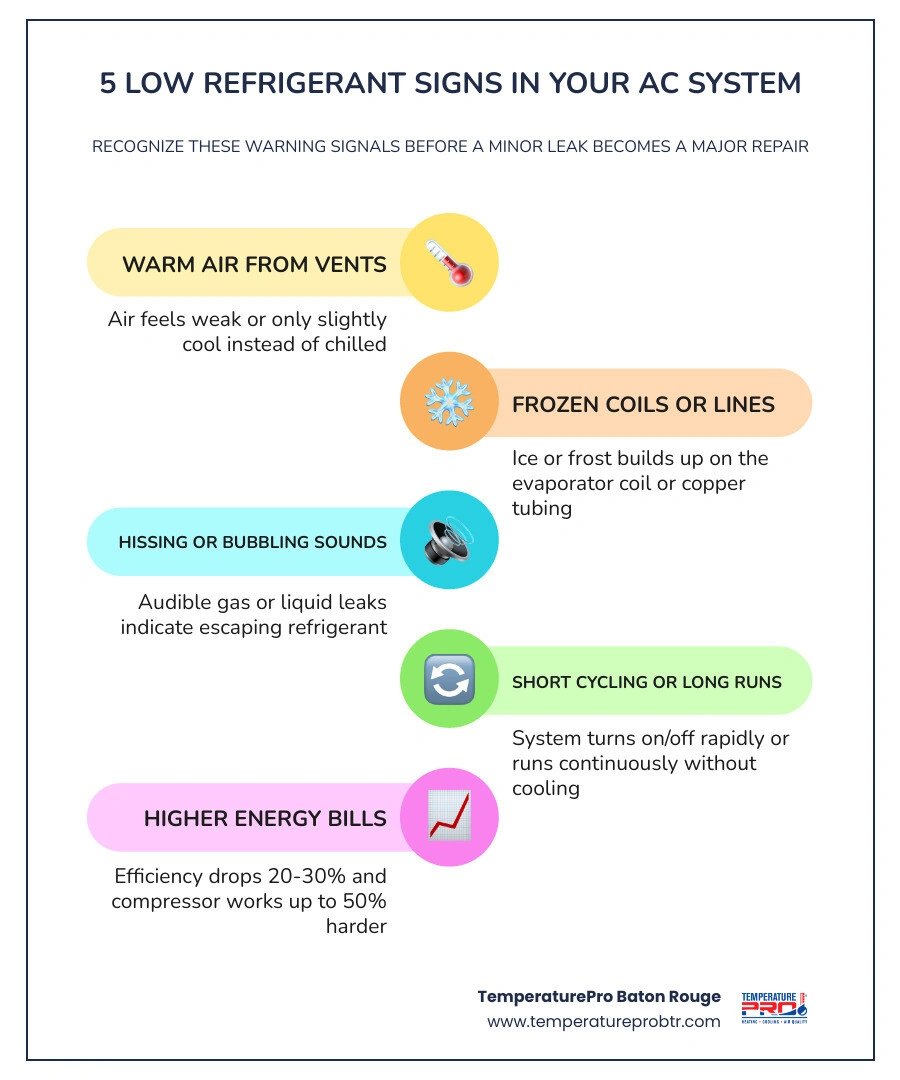
• Warm or weakly cooled air blowing from your vents
• Ice or frost buildup on refrigerant lines or the evaporator coil
• Hissing or bubbling sounds coming from the unit
• Short cycling or unusually long run times
• Unexplained spikes in your energy bills
Unlike engine oil, refrigerant doesn't get consumed during normal operation. If your system is low, that almost always means there's a leak somewhere in the closed-loop system — and it won't fix itself.
The good news? Catching these warning signs early can save your compressor, your comfort, and your wallet. AC systems with low refrigerant can lose 20–30% of their cooling efficiency, and the compressor can end up working up to 50% harder than it should — dramatically raising the risk of a full system failure.
Below, we'll walk through each warning sign in detail so you know exactly what to look for.
Glossary for low refrigerant signs in your ac system:
• dirty condenser coil and ac performance connection
• when your ac cant keep up with the heat
• why is my ac running but not cooling
What Is Refrigerant and Why Is It Essential?
To understand why low refrigerant is such a big deal, it helps to know what refrigerant actually does. Many people believe an air conditioner creates cold air by drawing in outdoor air and cooling it down. In reality, your air conditioner works by removing heat from inside your home and dumping it outside.
Refrigerant is the specialized chemical compound that makes this heat transfer possible. It acts like a train on a circular track, constantly circulating between your indoor and outdoor units. It undergoes continuous phase changes, shifting from a low-pressure gas to a high-pressure liquid and back again.
Here is how the cooling cycle works:
1. Heat Absorption: The cold, low-pressure liquid refrigerant flows through the indoor evaporator coil. As warm indoor air blows over this coil, the refrigerant absorbs the heat from the air. This rapid heat absorption causes the refrigerant to warm up and evaporate into a gas.
2. Compression: The refrigerant gas travels outdoor to the compressor, which squeezes the gas, raising its pressure and temperature.
3. Heat Release: The hot, high-pressure gas enters the outdoor condenser coil. A large fan blows outdoor air over this coil, releasing the captured indoor heat into the outside atmosphere. This cooling causes the refrigerant to condense back into a liquid.
4. Expansion: The liquid refrigerant passes through an expansion valve, which drops its pressure and temperature, sending it back indoors to repeat the cycle.
If your system experiences a leak and loses its charge, the pressure balance is thrown completely out of whack. Without enough refrigerant, the system cannot absorb heat efficiently. This chemical imbalance is the root cause behind Why Is My AC Blowing Warm Air and why your home remains sticky and warm even when the system runs nonstop.
5 Critical Low Refrigerant Signs in Your AC System

When your system is low on its chemical charge, it will drop hints—and eventually scream for help. Recognizing these low refrigerant signs in your AC system early can prevent total system breakdowns.
Before we dive into the specific signs, it is helpful to note that some low refrigerant symptoms can mimic other common HVAC issues, such as a clogged air filter. Below is a quick-reference table to help you distinguish between the two:
• Airflow Strength — Low Refrigerant Level: Normal strength, but air is warm/lukewarm — Dirty Air Filter: Very weak airflow from all supply vents
• Ice on Coils/Lines — Low Refrigerant Level: Yes, often accompanied by hissing or bubbling noises — Dirty Air Filter: Yes, due to restricted airflow suffocating the coil
• Noises — Low Refrigerant Level: Hissing or bubbling sounds along the refrigerant lines — Dirty Air Filter: Whistling, flapping, or humming near the return grille
• Thermostat Behavior — Low Refrigerant Level: AC runs constantly but temperature never reaches the set point — Dirty Air Filter: AC may short cycle or run longer, but air is still cool
Warm Air Vents: Clear Low Refrigerant Signs in Your AC System
One of the most immediate signs of low refrigerant is that the air coming out of your supply vents simply isn’t cold. You might stand directly under a vent in your living room and feel a steady breeze, but it feels more like a fan than a high-performance air conditioner.
When refrigerant levels drop, the remaining liquid evaporates much earlier in the evaporator coil than designed. As a result, only a tiny portion of the coil actually gets cold. The air blowing across the rest of the warm coil remains uncooled, leading to lukewarm or warm air entering your home. If you notice this happening in your home, you can read our guide on Fixing an AC Not Cooling to understand the troubleshooting steps.
Frozen Coils: Physical Low Refrigerant Signs in Your AC System
It sounds counterintuitive: how can an air conditioner that is low on cooling power freeze itself into a block of ice?
It all comes down to physics and pressure. When the refrigerant charge drops, the pressure inside the evaporator coil plummets. According to thermodynamic laws, a drop in pressure causes a corresponding drop in temperature. The temperature of the evaporator coil drops below freezing (32°F).
As the warm, humid indoor air from your Baton Rouge home blows over this super-frozen coil, the moisture in the air instantly condenses and freezes onto the metal. Over time, a thick layer of ice wraps around the coil and can even travel down the copper refrigerant lines all the way to your outdoor unit.
If you notice ice forming on your indoor or outdoor components, turn off your system immediately at the thermostat to let it thaw, and check out our article on What to Do When AC Freezes Up before calling in the professionals.
Hissing or Bubbling Noises
Your air conditioner should run with a steady, predictable hum. If you start hearing unusual noises coming from your indoor or outdoor units, it is time to investigate.
Because refrigerant is highly pressurized, a leak in the copper tubing or joints will make distinct sounds:
• Hissing: This typically indicates that the refrigerant is escaping as a high-pressure gas. Hissing is common when the leak is located in the vapor lines or near the compressor.
• Bubbling: If the leak is located in a section of the line where the refrigerant is still in its liquid state, you may hear a bubbling or gurgling noise, similar to drinking through a straw when the glass is nearly empty.
If you hear these sounds, do not ignore them. A gas or liquid leak means chemical refrigerant is actively escaping into your home's air or the outdoor environment.
Short Cycling and Constant Running
An air conditioner is designed to run in balanced cycles, usually lasting 15 to 20 minutes, until your home reaches the desired temperature. However, low refrigerant forces your system into extreme operating patterns.
• Constant Running: Because the system cannot absorb heat efficiently, it will run continuously without ever reaching the temperature set on your thermostat. You might set the thermostat to 72°F, but the indoor temperature stubbornly hangs at 78°F while the system runs all day.
• Short Cycling: In some modern systems, low refrigerant levels trigger low-pressure safety switches. To protect the compressor from running dry and overheating, the system will abruptly shut down, only to turn back on a few minutes later when the pressure stabilizes slightly. This constant on-and-off cycle is known as short cycling.
Both patterns place immense strain on your equipment. If your unit is struggling to keep up with the humid Louisiana climate, read more about When Your AC Can't Keep Up with the Heat.
Spiking Utility Bills
Have you noticed your electricity bills climbing higher and higher, even though your household habits haven't changed? A sudden, unexplained jump in power consumption is a classic sign of low refrigerant.
When your system loses its charge, it loses its cooling efficiency. To compensate for the lack of heat-absorbing power, the AC must run significantly longer to cool your home. Since the compressor and fan motors are running hours longer than normal, your energy usage skyrockets. In fact, a system running low on refrigerant can easily consume 20% to 30% more energy, turning your monthly utility bill into an unwelcome surprise.
Why Low Refrigerant Means a Leak, Not Normal Usage
One of the most important facts every homeowner should know is that refrigerant is never "used up" or consumed by your air conditioner.
An AC system is a completely closed, sealed loop. The refrigerant simply cycles back and forth, changing states to move heat. If your system is low on refrigerant, it is not because your AC "burned through it" during a hot July stretch in Prairieville or Central, LA. It means you have a leak.
Refrigerant leaks can develop for several reasons:
• Formicary Corrosion: This is a common issue in humid Southern climates. Volatile organic compounds (VOCs) found in household products (like cleaning sprays, paints, and cosmetics) react with the copper tubing in your indoor evaporator coil. Over time, this chemical reaction creates microscopic pinhole leaks in the copper.
• Vibration Damage: As your AC runs, the natural vibrations of the compressor and fans can cause copper lines to rub against other components or metal brackets, eventually wearing a hole through the line.
• Loose Joints and Degraded Seals: The fittings, valves, and rubber seals connecting different parts of your system can loosen or dry out over time, allowing refrigerant to seep out.
• Age-Related Wear: Systems that are 10 to 15 years old are significantly more prone to leaks due to general metal fatigue and component wear. If you want to keep your system in top shape and prevent these leaks, check out our comprehensive AC Maintenance Guide Denham Springs LA.
Simply "topping off" or adding more refrigerant without finding and repairing the source of the leak is a temporary, expensive band-aid. It is also harmful to the environment and, in many cases, illegal under EPA regulations. The leak must be found, sealed, and the system properly recharged to manufacturer specifications.
The Risks of Ignoring Low Refrigerant Levels
Ignoring the warning signs of low refrigerant can transform a simple repair into an absolute HVAC disaster.
The refrigerant does more than just cool your home; it also acts as a coolant for the compressor itself. The compressor is the "heart" of your air conditioning system, and it is by far one of the most expensive components to replace.
When refrigerant levels are low:
1. Overheating: The compressor does not receive the cool return gas it needs to keep its operating temperature down. It begins to run incredibly hot.
2. Excessive Friction: Refrigerant carries lubricating oil throughout the system. When refrigerant levels drop, the oil cannot circulate properly, leaving the compressor's moving parts dry and prone to severe friction.
3. Mechanical Failure: The combination of extreme heat and lack of lubrication will eventually cause the compressor to lock up, burn out, or fail entirely.
If your compressor fails, you are often faced with a difficult decision: pay for an incredibly expensive compressor replacement or replace the entire outdoor unit. To help you spot the warning signs before it is too late, read our guides on AC Compressor Failure Signs, Signs Your AC Compressor Needs Replacement, and How to Tell If Your AC Compressor Is Failing.
Frequently Asked Questions About AC Refrigerant
Navigating air conditioning repairs can feel overwhelming. Here are answers to some of the most common questions homeowners ask our team.
Can I top off my AC refrigerant myself?
Absolutely not. Attempting to recharge your home’s air conditioner yourself is highly dangerous, illegal without proper certification, and can easily ruin your system.
Under Section 608 of the Clean Air Act, the Environmental Protection Agency (EPA) strictly prohibits uncertified individuals from purchasing or handling residential refrigerants. These chemicals are highly pressurized greenhouse gases that can cause severe chemical burns, blindness, or environmental damage if handled incorrectly.
Furthermore, DIY recharge kits sold at auto parts stores are designed for vehicles, not home HVAC systems. Using the wrong type of refrigerant or overcharging your system can instantly destroy your compressor. A professional HVAC technician uses specialized manifold gauges, digital scales, and vacuum pumps to charge your system to the exact ounce.
How do professionals diagnose a refrigerant leak?
When a licensed technician from TemperaturePro Baton Rouge visits your home, they use advanced diagnostic tools to pinpoint the exact location of the leak:
• Electronic Leak Detection: Technicians use highly sensitive electronic "sniffers" that can detect the chemical signature of escaping refrigerant gas, even in microscopic amounts.
• Nitrogen Pressure Testing: The remaining refrigerant is safely evacuated, and the system is pressurized with dry nitrogen gas. By monitoring pressure gauges over time, we can confirm if a leak exists and listen for the escape of gas.
• Ultraviolet (UV) Dye Testing: A safe, fluorescent dye is injected into the refrigerant lines. As the system runs, the dye escapes through the leak. Using a UV light and specialized glasses, the technician can easily spot the glowing dye at the leak site.
For more troubleshooting insights tailored to our local area, read our guide on AC Not Cooling Troubleshooting Tips for Baton Rouge.
How often should I have my AC system inspected to prevent leaks?
We highly recommend scheduling a professional AC inspection and tune-up at least once a year, ideally in the spring before the intense summer heat sets in.
During an annual maintenance visit, a technician will check your system's operating pressures, inspect copper lines for signs of wear or vibration damage, clean the coils, and ensure all electrical connections are secure. Catching a tiny pinhole leak or a rubbing line during a routine spring tune-up can save you from a major breakdown in the middle of a July heatwave.
To learn more about how routine visits protect your equipment and lower your bills, explore the Benefits of Regular AC Maintenance.
Conclusion
Recognizing the low refrigerant signs in your AC system is the first step toward protecting your home’s comfort and your budget. Whether you have noticed lukewarm air blowing from your vents, a mysterious hissing sound, or ice forming on your outdoor copper lines, ignoring these symptoms will only lead to more severe damage and higher energy bills.
At TemperaturePro Baton Rouge, we are proud to be a family and veteran-owned HVAC company serving our neighbors across Baton Rouge, Prairieville, Gonzales, Denham Springs, Walker, Central, Zachary, St. Gabriel, and French Settlement, LA. We treat every customer like family, providing honest diagnostics, transparent communication, and fast, reliable service.
If you suspect your system is running low on refrigerant, don't wait for your compressor to fail. Contact us today to schedule a professional diagnostic check and experience the reliable comfort of our expert air conditioning services!