Is It Safe to Run My AC Continuously During an August Heatwave in Louisiana?
Is It Safe to Run My AC Continuously During an August Heatwave in Louisiana?
When extreme heat hits, it's tempting to turn off your air conditioner to give the motor a break. Here is why interrupting long cooling cycles actually causes more wear and tear on your system.
Should You Give Your AC a Break in Extreme Heat?
Are you wondering, is it safe to run my AC continuously during an August heatwave in Louisiana, as you listen to your outdoor unit hum for the fourth straight hour? You are not alone. A typical pattern we see is homeowners nervously watching their thermostat, worrying that their air conditioner is going to burn its motor out from sheer exhaustion. The psychological urge to walk over to the wall and switch the system off to "give the machine a rest" is incredibly strong when the heat index climbs and the equipment never seems to cycle off.
Here is the reality of living in Baton Rouge: late-summer weather puts an immense, unrelenting load on your home's cooling equipment. Your system is fighting a two-front war against both soaring temperatures and suffocating moisture. However, modern HVAC systems are explicitly designed for this exact type of endurance. Manually interrupting the cooling cycle to force a rest period is usually a mistake that causes more harm than good.
If you need trusted air conditioning services to keep your home comfortable, our team can help ensure your system is prepared for the hardest months of the year.
The Short Answer: Yes, Continuous Operation is Safe
Yes, it is safe to run your AC continuously during a heatwave. In high-humidity climates like Louisiana, long cooling cycles are actually necessary to properly remove moisture from the air and keep your home comfortable.
When an August heatwave settles over the Gulf Coast, your air conditioner is doing exactly what it was engineered to do under a peak load. Steady, continuous cooling is the normal operating state for a system fighting extreme outdoor temperatures. The equipment is built to run for hours on end without taking damage, provided it has clean filters and adequate airflow.
It is important to distinguish between a system running long cycles by design and a system that is struggling due to neglect. A healthy unit will blow noticeably cold air and keep the indoor humidity low, even if it runs all afternoon. A neglected unit will run constantly but fail to lower the temperature, blowing lukewarm air while the house feels sticky. Enrolling in a proactive AC maintenance plan ensures that your system handles these continuous cycles efficiently without unnecessary wear and tear on the internal components.
The Physics of Cooling: Latent Heat and Dehumidification
To understand why your system needs to run for so long, you have to look at the mechanical reality of how air conditioning actually works. Your system does not just pump cold air into the room; it extracts heat and moisture from the air already inside your house. If you want to explore more ways to improve your home's atmosphere, looking into indoor air quality solutions can make a massive difference.
In Louisiana, cooling is divided into two distinct challenges:
1. Sensible Heat: This is the raw temperature you see on your thermometer. It is the physical heat energy in the air that makes you feel hot.
2. Latent Heat: This is the humidity, or the water vapor suspended in the air. Water holds a massive amount of heat energy, and it makes the air feel heavy, sticky, and far hotter than the actual temperature reading.
During an August heatwave, latent heat accounts for a massive portion of the cooling load. Your air conditioner must physically dry the air before it can effectively drop the temperature. If you shut the system off to "rest" it, the indoor humidity spikes rapidly. This creates a damp environment that feels incredibly uncomfortable and serves as a prime breeding ground for mold.
Why Moisture Removal Takes Time
Dehumidification is a slow, steady process. Here is how it happens:
• Sustained airflow is required: Warm, wet indoor air is blown across the freezing-cold evaporator coil inside your house.
• Condensation takes time: The water vapor in the air condenses into liquid water on the cold metal fins of the coil—just like water droplets forming on the outside of a cold glass of iced tea.
• Short cycles fail at this task: If the system only runs for ten minutes and then shuts off, the coil never gets cold enough, for long enough, to extract a meaningful amount of water. The house will quickly develop a "clammy" feeling.
Continuous air movement over the evaporator coil is the only reliable way to maintain the ideal 30% to 50% indoor humidity level during peak summer weather.
The Danger of 'Resting' Your AC: The Short-Cycling Trap
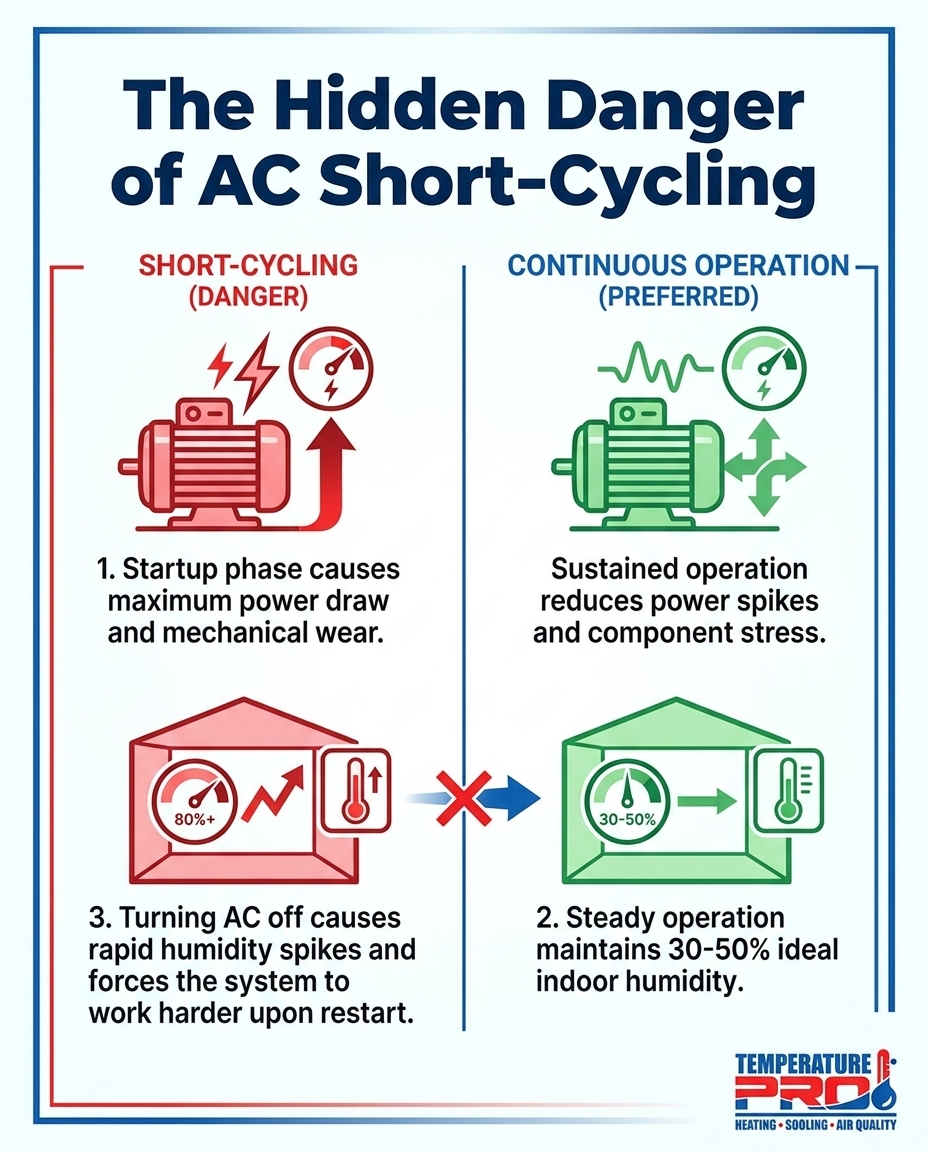
The biggest myth in home cooling is that turning the AC off saves wear and tear on the machine. In reality, the exact opposite is true. Air conditioners experience the vast majority of their mechanical stress during the startup phase, not while they are running.
When a compressor kicks on, it requires a massive surge of electricity to overcome inertia and get the heavy internal motors spinning from a dead stop. This surge is called "inrush current." It generates a spike of heat and puts significant torque on the mechanical parts. Once the motor is spinning at its operating speed, momentum takes over. The electrical draw drops significantly, and the system settles into a low-stress, steady rhythm.
Manually turning your thermostat off and on forces the system to endure unnecessary, damaging startups. Furthermore, when you leave the system off for an hour in the middle of a Baton Rouge afternoon, heat and humidity flood back into the home. When you finally turn the system back on, it has to work twice as hard to overcome that accumulated heat load. Finding ways of reducing cooling costs without sacrificing comfort is always a better strategy than manually interrupting the machine's natural cycles.
• Initial Startup — Electrical Draw: Massive surge (Inrush current) — Mechanical Stress: High torque and friction — Impact on Humidity: None (system just starting)
• Steady Operation — Electrical Draw: Low, consistent power use — Mechanical Stress: Minimal (momentum assists) — Impact on Humidity: Actively removing moisture
• Frequent On/Off (Short-Cycling) — Electrical Draw: Repeated high surges — Mechanical Stress: Severe wear on compressor — Impact on Humidity: Fails to dry the air properly
The Hidden Danger of AC Short-Cycling
Normal Continuous Running vs. A Failing System
While continuous operation is normal during an August heatwave, it is crucial to know the difference between a healthy system that is working hard and a broken system that is crying out for help. A system that runs constantly but fails to condition the air is burning electricity without providing any benefit.
Signs of a healthy, hard-working system:
• Cold air at the vents: The air blowing out of your registers feels crisp and noticeably cold to the touch.
• Low humidity: The air inside the home feels dry and comfortable, even if the temperature is a degree or two higher than your normal setting.
• Steady progress: The thermostat is either maintaining the set temperature or very slowly approaching it against the extreme outdoor heat.
• Normal sounds: The outdoor unit produces a steady, even hum without rattles or grinding noises.
Signs of an unhealthy, failing system:
• Lukewarm air: The vents are blowing room-temperature or warm air, meaning the system is not actually cooling or dehumidifying.
• Ice buildup: You see white frost or solid ice forming on the copper refrigerant lines outside or on the indoor coil.
• Strange noises: The compressor is buzzing loudly, clicking repeatedly, or making harsh metal-on-metal sounds.
• Rising indoor temps: The house is getting progressively hotter throughout the day despite the system running nonstop.
When to Call for Emergency Repair
If you notice the warning signs of a failing system, prompt action is required. Letting a truly broken system run continuously can destroy the compressor. One local homeowner experienced a total loss of cooling capacity on a Friday afternoon, right before expected company arrived. Because they recognized the system was blowing warm air instead of just working hard, they reached out for emergency repair immediately. A technician arrived promptly to fix the unit, ensuring the upstairs was cool and comfortable in time for the weekend. Rapid professional response is essential when a system shows signs of refrigerant leaks or electrical failure.
Mission Readiness: Surviving the Summer Stress
Working with a veteran-owned company means applying a standard of "mission readiness" to your home's mechanical systems. Just like military equipment must be prepared for extreme stress in the field, your air conditioner must be prepared for the brutal reality of a Baton Rouge summer. When your system is mission-ready, it can handle continuous operation without failing.
You can support your system's endurance by following a few critical operational protocols:
• Keep air filters clean: A dirty filter chokes off the airflow to the evaporator coil. This forces the blower motor to work harder and can cause the coil to freeze solid. Check your filter every 30 days during peak summer usage.
• Clear the outdoor perimeter: The condenser unit outside needs to breathe to release the heat it absorbed from your house. Keep tall grass, bushes, and debris at least two feet away from the metal fins.
• Leave your vents open: Closing too many vents in unused rooms disrupts the engineered pressure balance of your ductwork. This increases static pressure and strains the blower motor. Keep at least 80% of your vents fully open.
• Seek honest expertise: If the system acts up, do not panic. Another local customer reached out for a second opinion after receiving a massive replacement estimate from a different company. During a thorough inspection, a technician found a foreign substance on a circuit board, cleaned it, and re-engaged a fuse. The system was back up and running within 30 minutes. Honest, expert assessment is always better than a rushed replacement.
Frequently Asked Questions About Summer AC Operation
Homeowners naturally have a lot of questions when the weather pushes their equipment to the limit. If you are looking for more comprehensive answers regarding your system's behavior, reviewing our HVAC FAQs can provide excellent guidance. Here are the most common questions we hear during extreme heat events.
Is it bad to leave your AC on all day during a heatwave?
No, it is not bad for the system to run all day. Air conditioners are built for continuous operation under heavy loads. Turning the system off and on repeatedly actually causes more mechanical wear on the compressor than leaving it running steadily.
How long should an AC run in 95-degree heat?
In 95-degree heat with high humidity, it is entirely normal for an AC to run for 45 minutes to an hour per cycle, or even continuously during the hottest part of the afternoon. As long as the air coming from the vents is cold and the indoor humidity is low, the system is operating correctly.
Should I give my AC a break or turn it off completely?
You should not turn the AC off completely to give it a break. Shutting the system down allows heat and heavy moisture to flood back into the home. When you turn it back on, the system has to work twice as hard to remove that accumulated humidity, stressing the components further.
Can an AC compressor overheat from running constantly?
A healthy compressor is cooled by the cold refrigerant returning to it from inside the house, so it will not overheat just from running continuously. However, if the system is low on refrigerant, has a clogged air filter, or has dirty outdoor coils, it can overheat and trigger an automatic safety shutdown.
Why does my AC run constantly but the house isn't cooling?
If the AC runs constantly but the temperature inside continues to rise, the system is failing to remove heat. This is usually caused by a refrigerant leak, a frozen evaporator coil, a severely clogged air filter, or a failing compressor. This requires immediate professional diagnosis.
Does continuous AC operation use more electricity than turning it on and off?
Continuous operation does use steady electricity, but turning the system off and letting the house get hot requires a massive amount of energy to cool it back down later. Maintaining a steady temperature is generally more energy-efficient and vastly improves your indoor comfort and humidity control.
Keep Your Home Cool and Your Mind at Ease
The next time you hear your outdoor unit running continuously during an August heatwave, you can rest easy knowing that the machine is doing exactly what it was built to do. Fighting back against Louisiana humidity requires long, steady cooling cycles. As long as your system is blowing cold air and keeping the moisture levels down, there is no need to manually interrupt the cycle.
Remember that regular, proactive care is the best way to prevent actual breakdowns when the weather gets extreme. If you want to ensure your equipment is fully prepared to handle the stress of continuous summer operation, reach out to our team today to schedule a comprehensive inspection or join our maintenance program.
Thank you! Your submission has been received!
Oops! Something went wrong while submitting the form.
It seems logical to skip pre-season heating maintenance if you barely ran your system during a mild winter. However, long dormant periods in high humidity can damage internal components.
Sudden static shocks are a clear diagnostic sign that your indoor air is too dry. Understand the physics behind this fall shift and why whole-home humidification is the ultimate fix.
Flipped homes look great but often hide starved HVAC returns behind new drywall. Discover how objective static pressure testing reveals these hidden bottlenecks before winter heating season begins.