Repairing a 10-Year-Old R-410A System vs. Upgrading to Next-Gen Refrigerant Standards
Repairing a 10-Year-Old R-410A System vs. Upgrading to Next-Gen Refrigerant Standards
When your older AC fails during peak July heat, you face a tough choice. See why patching an aging R-410A unit might cost more long-term than a modern upgrade.
The Breaking Point: When Your Aging AC Fails in Mid-Summer
In our years of keeping Baton Rouge homes cool, our team at TemperaturePro frequently encounters a common misconception: that a struggling air conditioner usually just needs a quick refrigerant top-off to survive the rest of the season. However, repairing a 10-Year-Old R-410A system vs. upgrading to next-gen refrigerant standards requires a much deeper look at your equipment's true condition and the rapidly shifting regulations in the HVAC industry. When a major compressor or evaporator coil failure strikes during July peak summer heat in Baton Rouge, the situation quickly shifts from a minor inconvenience to an urgent comfort crisis.
In these high-stress moments, we see homeowners faced with a significant decision: do you authorize a major, expensive stopgap repair to keep your aging unit limping along, or do you invest in a modern system equipped with next-generation refrigerants? Making this choice requires looking beyond the immediate fix. You have to consider the long-term reliability of your equipment, the availability of legacy replacement parts, and the industry-wide phase-down of older refrigerants. For expert guidance on weighing these options, explore our HVAC services to ensure you make the most informed decision for your home.
The Reality of Subtropical Climates on a Decade-Old System
When researching the expected lifespan of a central air conditioning unit, you will often find national averages suggesting a system should last 15 to 20 years. However, our technicians can confidently tell you that those averages factor in mild climates where units sit idle for months at a time. The reality of living in a subtropical climate drastically alters how long your equipment can reliably function before requiring a professional air conditioning replacement.
National Averages vs. Southern Heat Realities
In our Baton Rouge service area, the intense, prolonged heat and high humidity require AC systems to run nearly year-round. Instead of operating for a few hundred hours a summer, we typically see systems logging over 2,000 cooling hours annually. This continuous operation accelerates wear and tear on every moving part, degrading the system's overall efficiency much faster than a comparable unit in a northern state.
1. Increased cycle times: High humidity forces your system to run longer cycles just to pull moisture out of the air before it can effectively lower the temperature.
2. Thermal stress: Operating continuously during peak afternoon heat prevents the compressor from fully cooling down between cycles.
3. Accelerated component degradation: Capacitors, contactors, and fan motors endure significantly more electrical and mechanical stress over a ten-year period.
The Compounding Toll on Aging Compressors
By the time our technicians inspect a 10-year-old R-410A system, the mechanical fatigue on the compressor is usually substantial. The internal valves and bearings have endured thousands of hours of high-pressure operation. When you combine this accumulated wear with the extreme demands of peak summer, the risk of a catastrophic mid-summer breakdown skyrockets. A unit that has been battling intense southern humidity for a decade is simply not the same machine it was when it was installed, making major repairs increasingly risky.
Understanding the EPA AIM Act and the R-410A Phase-Down
Beyond the mechanical wear and tear our team diagnoses on specific units, external regulatory changes are drastically altering the landscape of HVAC repairs. The Environmental Protection Agency (EPA) has implemented the American Innovation and Manufacturing (AIM) Act, which mandates a nationwide phase-down of hydrofluorocarbons (HFCs). This legislation directly impacts the refrigerant running through your current system.
Why R-410A is Becoming Scarce
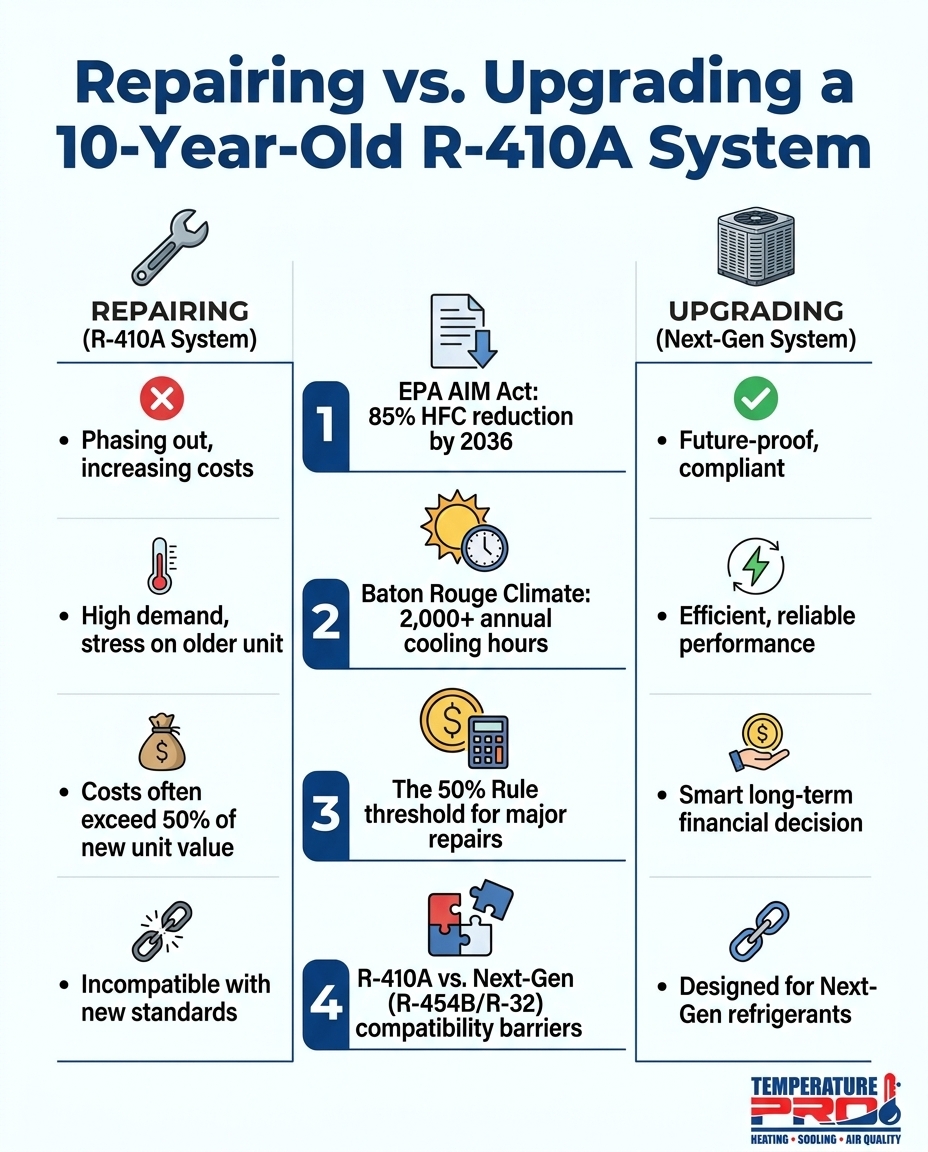
The AIM Act requires an 85% reduction in HFC production and consumption by the year 2036. R-410A, the standard refrigerant used in almost all residential AC units installed over the last decade, is a primary target of this phase-down. Because production is being aggressively scaled back, the supply of R-410A is dwindling.
• Supply and demand economics: As the available stockpile of R-410A shrinks, the cost to acquire it naturally rises.
• Costly leak repairs: If your 10-year-old R-410A system develops a leak, recharging the system will become progressively more expensive each passing year.
• Long-term viability: Relying on a phased-out refrigerant means you are investing money into a system that the industry is actively leaving behind.
The Shift to Low-GWP Alternatives
To comply with these new environmental regulations, the HVAC industry is transitioning to next-generation refrigerants, primarily R-454B and R-32. These alternatives are classified as having a significantly lower Global Warming Potential (GWP). Not only do they meet the stringent new EPA standards, but they are also designed to operate more efficiently, transferring heat more effectively than legacy refrigerants. We always explain this industry shift to our clients, as understanding it is critical when deciding whether to pour money into an obsolete system.
Evaluating the Repair Option: The 50% Rule and Leak Risks
When our technicians arrive at a sudden breakdown, we find it helps to provide homeowners with an objective, non-salesy framework to evaluate their options. One common field scenario we see involves a homeowner whose system was assessed for a minor issue, and our technician found a failing part that was still under warranty, returning later to install it and resolve the problem. In that specific situation, a repair makes perfect sense. However, if your system is out of warranty and requires a major component replacement, the math changes entirely.
Applying the Age-vs-Reliability Matrix
A highly effective way we help clients make this decision is by applying the "50% Rule." This guideline suggests that if the cost of repairing your aging unit exceeds 50% of the cost of a new system, upgrading is the smarter financial move. When applying this rule to a system that has endured July peak summer heat in Baton Rouge for a decade, you must also factor in the diminishing returns of patching a leak. Fixing a leak in your evaporator coil today does not reset the clock on your aging compressor, which could fail next month. For a deeper dive into this framework, you can read more about deciding whether to repair or replace your AC in Louisiana.
The Retrofit Myth
The problem: Many homeowners we speak with assume they can simply fix the broken part on their current unit and refill it with the new, cheaper, next-gen refrigerants once R-410A becomes too scarce. The cause: This misconception stems from older transitions (like the shift from R-22 to R-410A), where "drop-in" replacement refrigerants were sometimes marketed. The solution: You cannot retrofit an R-410A system to use R-454B or R-32. The new A2L refrigerants operate at different pressures, require different synthetic oils, and have updated safety standards (including specific sensors and mitigation boards) built directly into the new equipment. Attempting a retrofit is a severe safety hazard and technically impossible, meaning an R-410A system is permanently tethered to an obsolete, dwindling refrigerant supply.
The Long-Term Benefits of Upgrading to Next-Gen Standards
When we recommend choosing to replace your aging system now, rather than waiting for a complete and total failure, it is because modern systems offer significant advantages that extend far beyond simply restoring cold air to your home. Today's equipment represents a massive leap forward in both technology and efficiency.
Enhanced Cooling Performance for Extreme Heat
Today's air conditioners are rated under the new SEER2 testing standards, meaning they are rigorously evaluated to perform efficiently under high-stress conditions. A modern system designed for next-gen refrigerants utilizes variable-speed or two-stage compressor technology. Instead of blasting at 100% capacity and shutting off, these units can run at lower speeds for longer periods. This is highly effective for extreme southern humidity, as longer run times at lower speeds pull significantly more moisture out of the air, resulting in superior indoor air quality and comfort.
Furthermore, upgrading restores your peace of mind. You eliminate the constant anxiety of wondering if your 10-year-old R-410A system will survive the next heatwave. It is also worth noting that generic energy rebates, federal tax credits, or local utility incentive programs may apply to qualifying high-efficiency installations. While you should always consult your utility provider or a tax professional for current availability, these incentives can help offset the initial investment. To explore how to make this upgrade fit your budget comfortably, review our HVAC financing options.
Side-by-Side Comparison: Repair vs. Upgrade
To simplify this complex decision, we find it helps to view the pros, cons, and long-term impacts of both options side by side. During July peak summer heat in Baton Rouge, having a clear breakdown of what you are actually paying for is crucial.
• Immediate Outcome — Major Repair (10-Year-Old System): Short-term relief; the immediate symptom is fixed. — Upgrade (Next-Gen System): Long-term reliability; the entire system is brand new.
• Refrigerant Supply — Major Repair (10-Year-Old System): Tethered to R-410A, which is facing an 85% phase-down. — Upgrade (Next-Gen System): Uses R-454B or R-32, the new industry standard.
• Warranty Protection — Major Repair (10-Year-Old System): Usually only covers the specific part replaced, if at all. — Upgrade (Next-Gen System): Comprehensive 10-year parts warranty on the whole system.
• Efficiency (SEER2) — Major Repair (10-Year-Old System): Degraded efficiency from a decade of wear and tear. — Upgrade (Next-Gen System): High SEER2 ratings, significantly lowering monthly energy use.
• Future Breakdowns — Major Repair (10-Year-Old System): High probability of other aging components failing soon. — Upgrade (Next-Gen System): Minimal risk; protected by a routine AC maintenance plan.
The bottom line: A major repair on an obsolete system is a recurring expense, while an upgrade is a one-time investment in your home's future comfort and energy efficiency.
Repairing vs. Upgrading a 10-Year-Old R-410A System
Making the Right Choice Under Pressure with Honest Guidance
Facing a major HVAC failure is incredibly stressful, especially when it happens at the worst possible time. Our team recently helped a local homeowner who experienced a total system failure on a Friday afternoon just hours before expected guests arrived. While our prompt emergency service successfully restored cooling to their upstairs in time, situations like this highlight how quickly panic can set in. When you are sweating in your own living room, it is easy to make a rushed decision or fall victim to high-pressure sales tactics.
As a veteran-owned HVAC company, our crew at TemperaturePro Baton Rouge provides honest, no-pressure cost-benefit analyses to help you make the best long-term financial decision. We believe in transparency and integrity. Our technicians will thoroughly diagnose your 10-year-old R-410A system, clearly explain its true condition, and present you with all viable options. We do not push replacements unless the math and the mechanical reality prove it is genuinely the best path forward for your home and your budget.
Frequently Asked Questions About R-410A and System Upgrades
Is it worth fixing a 10 year old AC?
The short answer we give our clients is that it depends heavily on the cost of the repair and the overall condition of the unit. If the repair is minor, such as replacing a capacitor or a contactor, fixing it is usually worthwhile. However, if the system requires a major component like a compressor or an evaporator coil, investing heavily in a 10-year-old unit is generally not recommended. Applying the 50% rule helps clarify this: if the repair exceeds half the value of a replacement, upgrading is the better long-term choice.
Can I still get R-410A for my AC?
Yes, R-410A is still available for servicing existing air conditioning systems. However, because the EPA AIM Act mandates a massive reduction in its production, the supply is steadily shrinking. As the available stockpile decreases over the coming years, the cost to acquire R-410A for leak repairs will continue to rise, making maintenance on legacy systems increasingly expensive.
What replaces R-410A refrigerant?
The HVAC industry is shifting to next-generation A2L refrigerants, primarily R-454B and R-32. These modern refrigerants have a significantly lower Global Warming Potential (GWP) and meet the stringent new environmental regulations set by the EPA. They are also designed to be highly efficient, allowing modern air conditioning systems to provide better cooling performance while using less energy.
Can I put new refrigerant in an old AC?
No, you cannot put next-generation refrigerants into a system designed for R-410A. The new A2L refrigerants operate at different pressures and require specific synthetic oils that are incompatible with older compressors. Furthermore, because A2L refrigerants have different flammability ratings, new systems are built with specialized safety sensors and mitigation boards that legacy systems completely lack.
What happens when R-410A is completely phased out?
When R-410A production is fully phased down, existing systems will have to rely strictly on reclaimed or stockpiled refrigerant for repairs. This will make recharging an older system with a leak exceptionally difficult and costly. Eventually, maintaining an R-410A system will become financially impractical, forcing homeowners to upgrade to units that utilize the new industry-standard refrigerants.
How does southern humidity affect the lifespan of an AC unit?
Southern humidity forces an air conditioner to work significantly harder and run for much longer cycles compared to units in drier, milder climates. Because the system must remove heavy moisture from the air before it can effectively drop the indoor temperature, components endure massive mechanical fatigue. This continuous operation often reduces the reliable lifespan of a system, making the 10-year mark a critical threshold for major breakdowns.
Secure Your Home's Long-Term Comfort Today
Waiting for a total system failure during peak heat is a risk we often see lead to rushed decisions and uncomfortable days. If you are debating whether repairing a 10-Year-Old R-410A system vs. upgrading to next-gen refrigerant standards is right for you, don't wait until the compressor completely gives out. Schedule an objective, honest diagnostic with our TemperaturePro Baton Rouge team today to get a clear framework for your home's future comfort and performance.
Thank you! Your submission has been received!
Oops! Something went wrong while submitting the form.
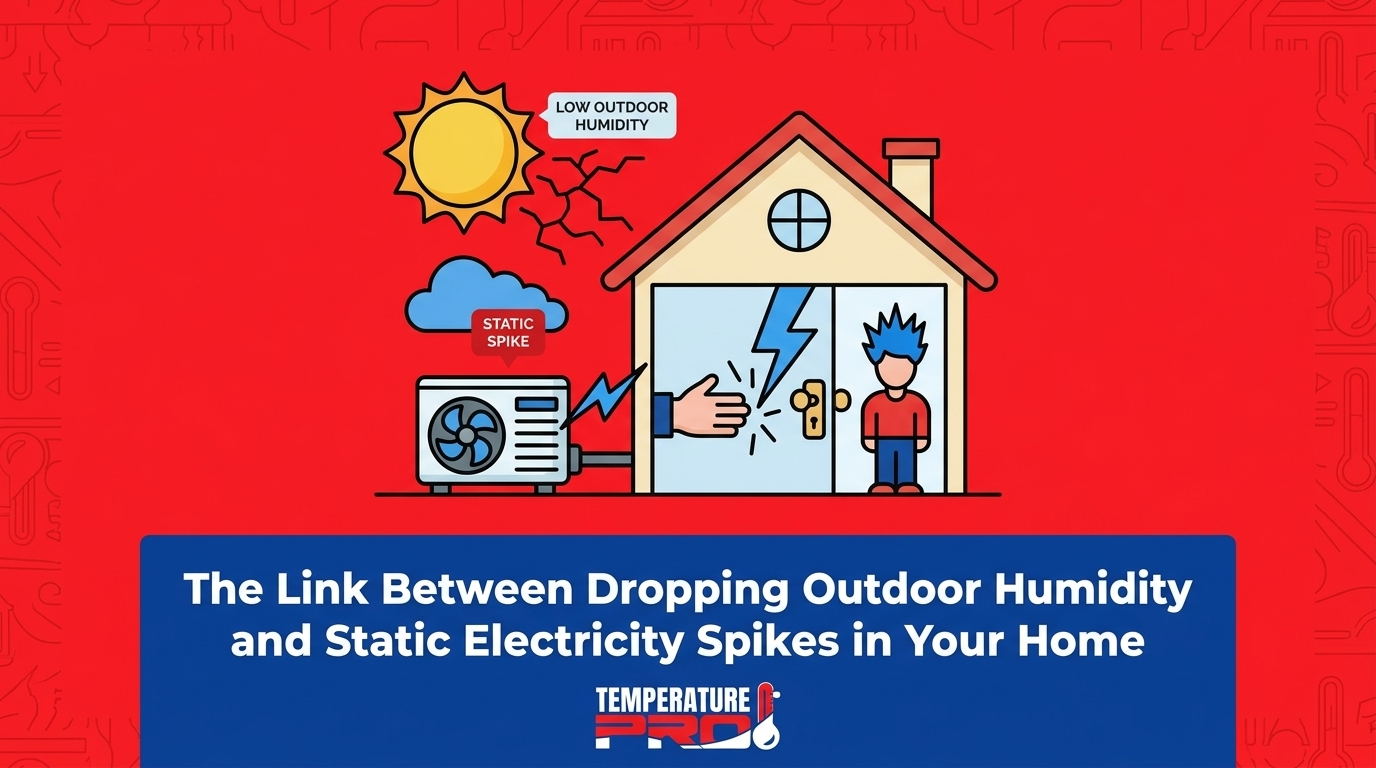
Sudden static shocks are a clear diagnostic sign that your indoor air is too dry. Understand the physics behind this fall shift and why whole-home humidification is the ultimate fix.
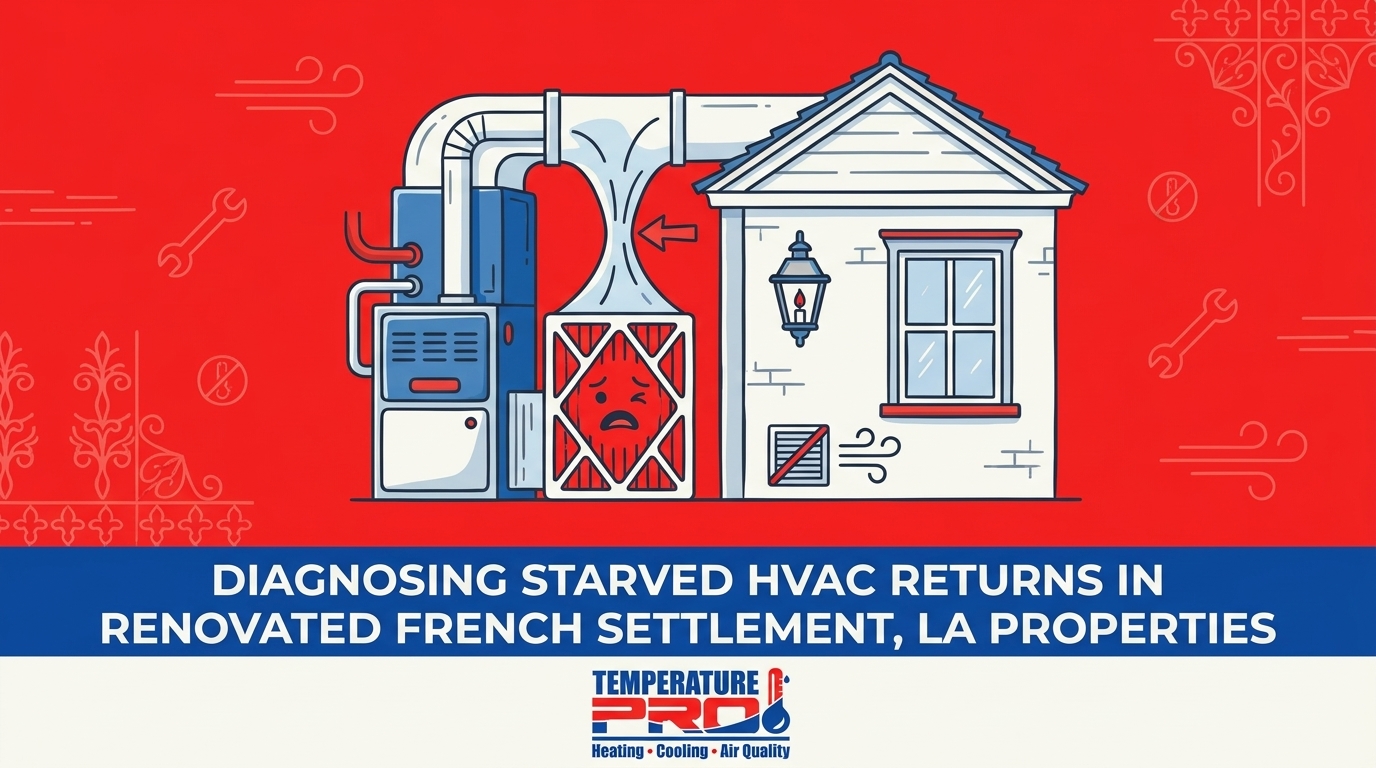
Flipped homes look great but often hide starved HVAC returns behind new drywall. Discover how objective static pressure testing reveals these hidden bottlenecks before winter heating season begins.
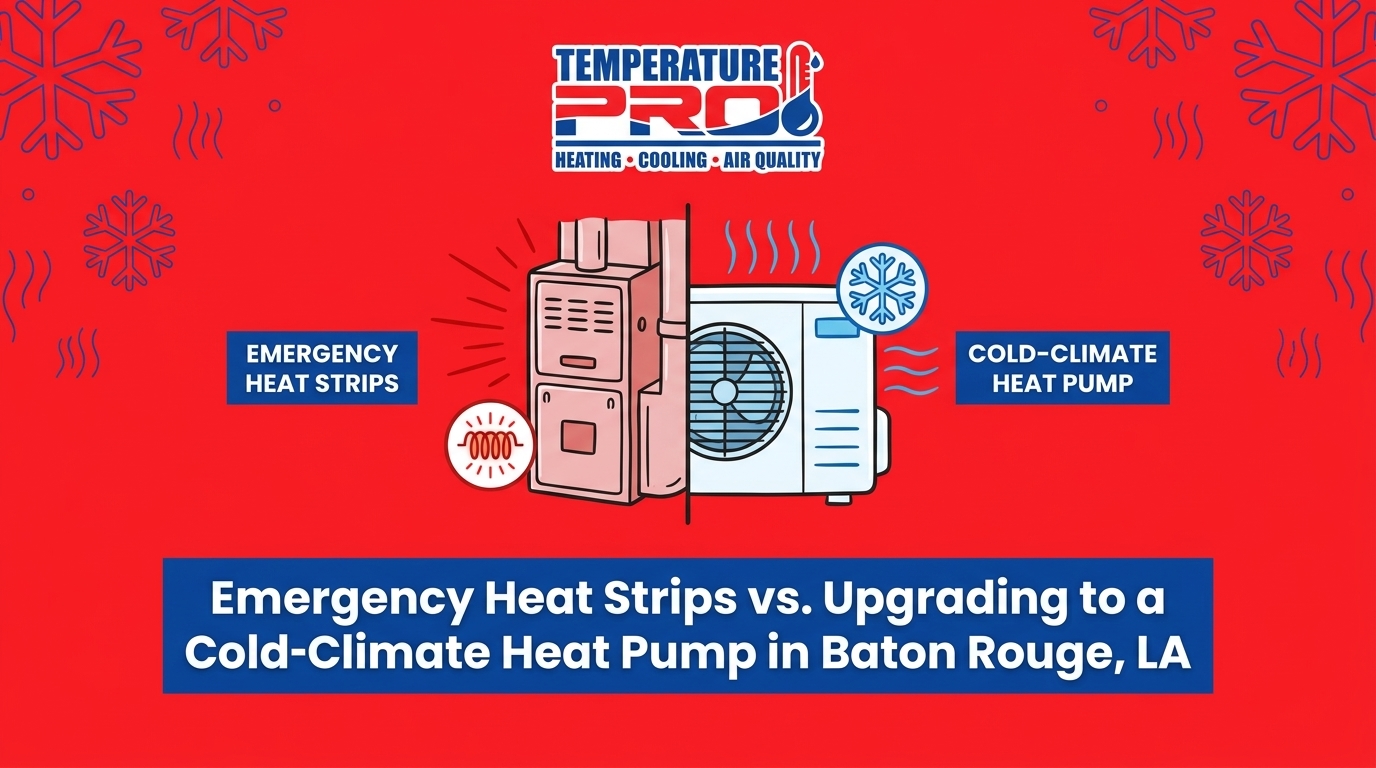
Tired of massive energy spikes during sudden winter freezes? See how modern inverter-driven heat pumps maintain efficiency without relying on energy-hogging resistive strips.