5 min read
Why Is My Heat Pump Emitting a Burning Smell During Its First Fall Cycle?
That alarming odor on the first chilly morning is usually just summer dust burning off your heat strips. Find out how long it should last before you need to worry.


Why Finding the Best AC Filter for Louisiana Homes Is Harder Than It LooksIf you're looking for the best AC filter for Louisiana homes, here's a quick answer:Top Picks by Household Need:Household TypeRecommended MERVFilter TypeStandard home
If you're looking for the best AC filter for Louisiana homes, here's a quick answer:
Top Picks by Household Need:
• Standard home, no allergies — Recommended MERV: MERV 8 — Filter Type: Pleated disposable
• Pets, mild allergies — Recommended MERV: MERV 11 — Filter Type: Pleated disposable
• Asthma, mold concerns, smokers — Recommended MERV: MERV 13 — Filter Type: Pleated, system-compatible only
• Window AC units — Recommended MERV: MERV 11-14 — Filter Type: Unit-specific replacement filter
Quick rule of thumb: Most Louisiana homeowners do best with a MERV 11 pleated disposable filter, changed every 30-60 days during peak cooling season.
Louisiana's climate is tough on HVAC systems and even tougher on the air you breathe inside your home. Between the long, sweltering summers, near-constant humidity, heavy oak and grass pollen seasons, and persistent mold risk, your AC filter is working overtime compared to homes in drier states. The wrong filter either lets harmful particles through or chokes your system's airflow, and neither is good.
Choosing the right filter isn't just about better air quality. It's also about protecting your HVAC equipment from strain, keeping energy bills in check, and making sure your system can actually handle the filter you install.
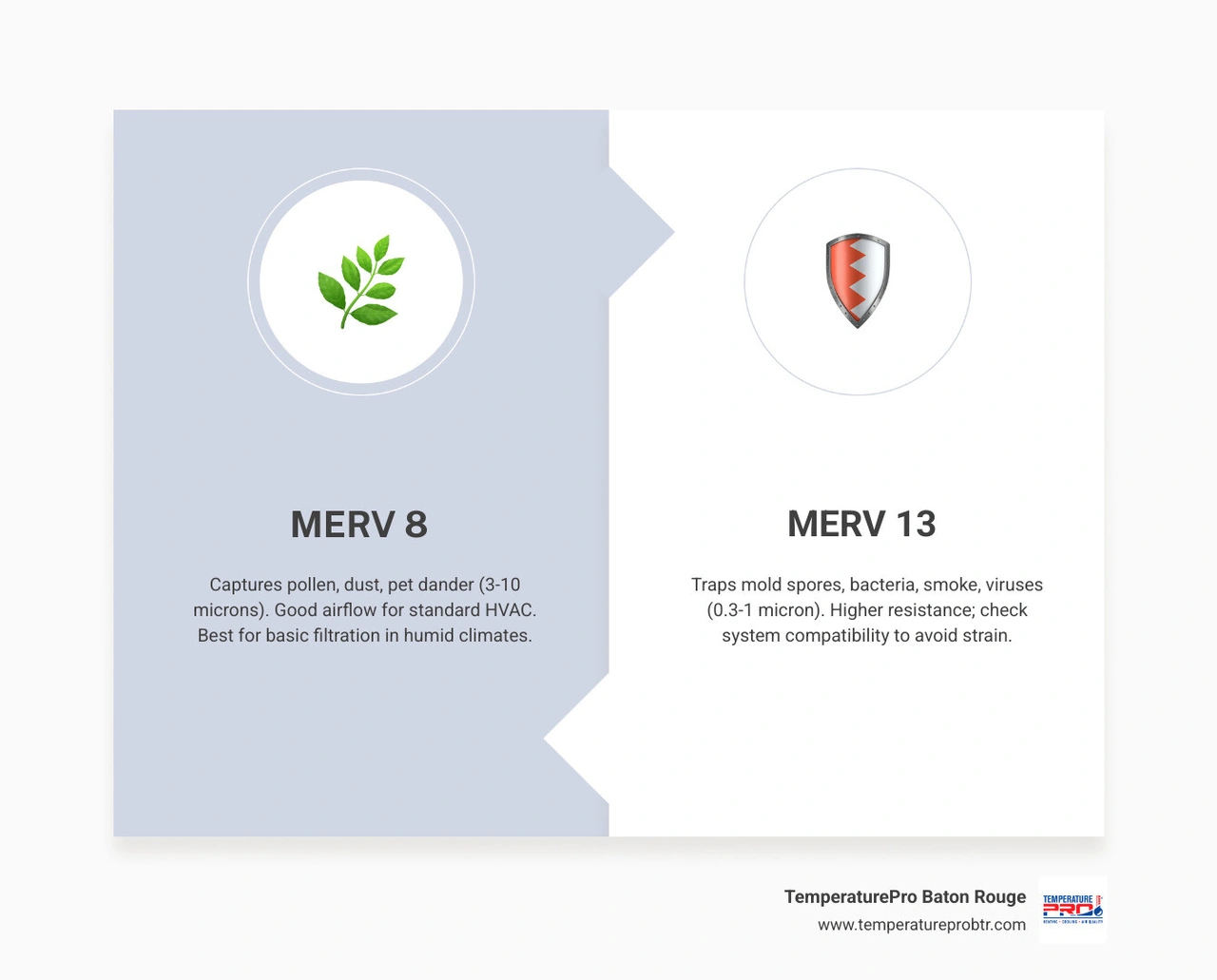
The biggest factor in choosing the right filter is the MERV rating. MERV stands for Minimum Efficiency Reporting Value. It is the standard scale used to measure how effectively an HVAC filter captures airborne particles. The scale was developed through ASHRAE testing, and for homes, the most relevant range is usually MERV 8 through MERV 13.
A higher MERV rating means a filter can trap smaller particles, but that does not automatically make it the best choice. In air conditioning, filtration and airflow have to stay in balance. A filter that is too loose will not clean the air very well. A filter that is too restrictive can reduce airflow, raise static pressure, and make your AC work harder than it should.
For most homes in Baton Rouge, Prairieville, Gonzales, Denham Springs, Walker, Central, Zachary, St. Gabriel, and French Settlement, the sweet spot is usually somewhere between MERV 8 and MERV 11, with MERV 13 reserved for homes with special air quality needs and systems that can support it.
Louisiana is not a mild climate, and your filter knows it.
Our region deals with:
• High humidity for much of the year
• Mold and mildew risk
• Heavy seasonal pollen from trees and grasses
• Dust mites that thrive in humid conditions
• Long cooling seasons that keep systems running for months at a time
• Pet dander and fine dust that build up fast indoors
That mix means homeowners here often need a better filtration strategy than the bare-minimum filter sold at a big box store. A basic flat fiberglass filter may stop large lint particles, but it does very little for finer allergens that make Louisiana indoor air feel stuffy, dusty, or sneeze-inducing.
Humidity also changes the equation. When your system runs hard for long stretches, a filter can load up faster. Add pets, kids, open doors, yard traffic, and pollen season, and even a decent filter can become clogged sooner than expected.
MERV ratings range from 1 to 20, though typical residential filters usually fall below the top end of that scale. In plain English:
• Lower MERV = captures larger particles, less resistance
• Higher MERV = captures smaller particles, more resistance
Particle size matters because common Louisiana irritants are not all the same size.
• MERV 8 filters are effective for roughly 3 to 10 micron particles, including pollen, dust, dust mites, mold spores, and lint
• MERV 11 filters are effective down to about 1 to 3 microns, adding better capture of pet dander, finer debris, and some bacteria and fungi
• MERV 13 filters can capture particles in the 0.3 to 1 micron range, including smoke and much finer airborne contaminants
That sounds great, but here is the catch: if your system is not designed for a denser filter, a high MERV rating can create airflow problems. In the real world, that can contribute to:
• Weak airflow from vents
• Longer run times
• Higher wear on the blower
• Reduced cooling performance
• Frozen evaporator coils in severe cases
So when we talk about the best AC filter for Louisiana homes, we are really talking about the best combination of filtration, fit, and airflow for your specific system.
Here is the practical comparison most homeowners want.
• MERV 8 — Best For: Standard homes — Captures Well: Pollen, dust, dust mites, mold spores, lint — Less Effective For: Fine dander, smoke, very small particles — Airflow Resistance: Low
• MERV 11 — Best For: Homes with pets or mild allergies — Captures Well: Everything in MERV 8 plus finer dust, pet dander, hair, some bacteria and fungi — Less Effective For: Very fine smoke and ultrafine particles — Airflow Resistance: Moderate
• MERV 13 — Best For: Asthma, mold concerns, smoke, stronger allergy needs — Captures Well: Very fine particles, smoke, smog, bacteria, some virus-carrying particles — Less Effective For: Can be too restrictive for some systems — Airflow Resistance: Higher
For a standard central HVAC system in Louisiana, we usually recommend starting with one of these:
• MERV 8 pleated disposable filter for homes without major allergy concerns
• MERV 11 pleated disposable filter for most households that want better air quality without pushing system limits
If we had to choose one “most likely to work well” option for the average home, it would be MERV 11 in a quality pleated disposable filter. It tends to be the sweet spot for balancing airflow and particle capture, especially in homes with:
• One or more pets
• Family members with mild allergies
• Lots of summer AC use
• Frequent dust buildup indoors
A 1-inch pleated MERV 11 filter is often a better choice than a cheap flat filter, but it still has to match your system's design. Older systems or undersized return ducts may do better with MERV 8 unless a technician confirms otherwise.
MERV 13 can be a smart choice in the right home, especially when indoor air quality is a serious concern. It is often worth considering if your household includes:
• Allergy sufferers with strong seasonal symptoms
• Asthma or other respiratory conditions
• A smoker in the home
• Increased sensitivity to outdoor smoke or smog
• Greater concern about mold spores and finer airborne particles
• Someone who is immunocompromised
MERV 13 filters capture particles down to 0.3 to 1 microns, which makes them far better at handling fine particulate matter than MERV 8 or MERV 11. That is especially useful during bad pollen periods or when outside air quality drops.
That said, MERV 13 should usually be used only when:
• The HVAC manual allows it
• The blower and return side can handle the added resistance
• The filter fits properly
• The system has been checked for airflow and static pressure issues
• A thicker media filter cabinet is available, if needed
In many homes, a 4-inch or 5-inch media filter can deliver strong filtration with less airflow penalty than a 1-inch high-MERV filter. Same idea, less drama.
Usually, MERV 14 is too much for a standard residential central AC system unless that system was specifically designed for it.
A MERV 14 filter can capture extremely fine particles, and some products advertise strong performance against smoke, bacteria, and virus-sized particles. But that level of filtration comes with more resistance. In a typical home system with a 1-inch filter slot, MERV 14 may reduce airflow enough to cause comfort and equipment issues.
Potential problems include:
• Low airflow at the registers
• Excessive blower strain
• Reduced cooling efficiency
• Ice on the evaporator coil
• Shortened equipment life over time
If a homeowner needs that level of filtration, we are more likely to recommend a professionally matched media cabinet or a dedicated indoor air quality upgrade rather than just stuffing the densest filter possible into the return grille and hoping for the best.
Not all filters with the same MERV rating are built the same way. Material, design, and thickness all affect how well a filter works in humid Louisiana conditions.
For most homes in our area, pleated disposable filters are the better choice.
Why? Because the pleats create more surface area. More surface area means the filter can catch more particles without clogging quite as fast. That matters in Louisiana, where filters are fighting pollen, dust, mold spores, pet dander, and heavy runtime all at once.
Pleated disposable filters usually offer:
• Better particle capture
• Better protection for the HVAC equipment
• Better performance in homes with pets or allergies
• More options in useful MERV ratings like 8, 11, and 13
Fiberglass filters, by comparison, are typically very basic. They may allow more airflow, but they also allow more debris to pass through. They are better at protecting the blower from large debris than improving indoor air quality.
Washable filters sound convenient, but in practice they are often less reliable for whole-home HVAC use. If they are not cleaned thoroughly and dried completely, they can become a problem in humid conditions. In Louisiana, a filter that is still damp should not go back into the return.
Filter thickness matters more than many homeowners realize.
A standard 1-inch filter is common and can work well, but thicker filters usually have more media surface area. That helps them hold more debris while maintaining better airflow over time.
Benefits of thicker filters include:
• Longer service life
• Better airflow compared to a dense 1-inch filter
• Higher filtration potential with less restriction
• Better support for MERV 11 to MERV 13 applications
A 4-inch or 5-inch media filter cabinet can often handle high-performance filtration much better than a standard 1-inch slot. That is one reason homeowners who want better indoor air quality may benefit from a system upgrade rather than simply choosing the highest number on the shelf.
Fit matters too. Even a great filter performs poorly if air can slip around the edges. Bypass air means dirty air avoids the filter altogether. Make sure the nominal size on the package matches the actual size your system needs, and do not force a filter that is too tight or use one that sits loose in the rack.
If you have pets, allergies, asthma, or mold concerns, your filter needs go beyond "good enough."
Here is a simple guide:
• Pets and mild allergies: MERV 11 pleated disposable
• Asthma or stronger allergies: MERV 11 or MERV 13, depending on system compatibility
• Mold concerns in humid areas: MERV 11 as a strong baseline, MERV 13 if the system supports it
• No special concerns: MERV 8 pleated disposable is often fine
Pet homes especially benefit from upgrading above MERV 8. Pet hair is large, but pet dander is much finer and stays airborne longer. MERV 11 usually offers a meaningful improvement without the airflow penalty that can come with jumping straight to MERV 13.
For mold concerns, a filter helps capture spores moving through the air, but it does not solve a moisture problem by itself. Humidity control, proper drainage, clean coils, and ventilation all matter too.
In Louisiana, filters usually need to be changed more often than the “set it and forget it” crowd hopes.
A practical rule for most homes is every 30 to 90 days, depending on the filter type, MERV rating, and household conditions. During long cooling stretches, heavy pollen season, or periods of constant AC use, the interval often shortens.
For more ways to reduce indoor air problems in muggy weather, see how to improve indoor air quality in humid climates.
Use this as a general starting point:
• Single occupant, no pets, low dust: every 60 to 90 days for a 1-inch pleated filter
• Average family home: every 30 to 60 days for a 1-inch pleated filter
• Pets in the home: every 30 to 45 days
• Allergies or asthma: check monthly, replace about every 30 to 60 days depending on loading
• Heavy AC use during peak summer: inspect monthly
• 4-inch media filters: often longer lasting, but still inspect regularly and follow system guidance
Window AC filters and room-unit replacement filters often need attention around every 90 days or sooner if the unit runs heavily or the filter looks dirty.
Do not rely on the calendar alone. Your house and your AC will usually give you clues.
Watch for:
• Visible dust buildup on the filter
• Weak airflow from supply vents
• More dust collecting around the home
• Musty odors
• Longer cooling cycles
• Dirt buildup at the return grille
• Worsening allergy symptoms indoors
If a dirty filter is left in place too long, your system has to fight for air. That can increase wear and reduce comfort. This is one reason regular tune-ups matter so much. Our guide on the benefits of regular AC maintenance explains how routine care helps protect both air quality and equipment life.
A good filter is important, but it is not the only tool for improving indoor air quality.
High-MERV filters work by trapping particles as air moves through the HVAC system. Air scrubbers and whole-home air purification add another layer by actively treating the air moving through the system.
In homes with persistent odor issues, allergy symptoms, or elevated mold concern, a filtration-only approach may not be enough. Louisiana humidity can make indoor air quality more complicated, especially if there are multiple contributors like moisture, poor ventilation, pets, and long AC runtimes.
Air scrubbers and advanced purifiers can complement filtration rather than replace it. Some systems are designed to continuously treat circulated air throughout the home. As a point of reference, some air-scrubber style products are rated to clean the air in a 450 square foot room about 15 times per day in high-humidity, high-pollen conditions.
If you want to explore that option, visit advanced purifier solutions and our indoor air quality services page.
Before upgrading from MERV 8 to MERV 11 or MERV 13, check a few basics:
• Read the owner manual for filter guidance
• Check the current filter size and thickness
• Look at whether the system uses a 1-inch slot or a media cabinet
• Note whether airflow already seems weak
• Inspect for dirt around the coil or return grille
• Have static pressure and airflow checked by a technician if you are unsure
A professional inspection is especially important if you have an older system, comfort problems, or a history of frozen coils. TemperaturePro Baton Rouge can evaluate whether your system can safely support a higher-efficiency filter or whether another indoor air quality upgrade makes more sense. You can learn more on our Baton Rouge indoor air quality page.
Window AC units are a different animal.
They often use unit-specific filters, and some replacement options may advertise MERV 11 to MERV 14 performance. That can be useful in a bedroom, home office, or small living area, especially for allergy control. Some premium room-unit filters are rated to capture pollen, dust, pet dander, smoke, and other fine particles, with replacement around every 3 months.
But the same airflow warning still applies. A filter that is too restrictive for the unit can hurt performance. Since window units also deal directly with condensate moisture, keeping the filter clean is critical in humid Louisiana conditions.
For better whole-home comfort, filtration should also work alongside ventilation and humidity management. Our article on ventilation services explains why that bigger picture matters.
For many homeowners, MERV 11 is the better starting point. It captures pollen, mold spores, pet dander, and other common allergy triggers more effectively than MERV 8 while still being manageable for many residential systems.
MERV 13 is better at capturing even finer particles and may be worth it for severe allergies, asthma, smoke sensitivity, or more serious IAQ concerns. But it only makes sense if the system can handle it without choking airflow.
So for Louisiana allergies:
• MERV 11 is usually the best balance
• MERV 13 is the upgrade option when health needs are higher and the HVAC system is compatible
Yes, it can if the system is not designed for it.
The filter itself does not “damage” the unit in a direct way, but restricted airflow can create conditions that lead to problems, including:
• Frozen evaporator coils
• Blower strain
• Reduced cooling
• Longer run times
• Higher wear on components
That is why we do not recommend jumping to MERV 13 or MERV 14 blindly. Filter upgrades should match the blower, ductwork, and filter cabinet.
Most homeowners should start with a pleated disposable filter, not fiberglass.
From there:
• Start with MERV 8 if you have a standard system and no major air quality concerns
• Upgrade to MERV 11 if you have pets, mild allergies, or want better everyday filtration
• Consider MERV 13 only after confirming system compatibility
Also make sure the filter is the correct size, fits snugly, and gets changed on schedule. The right filter on time beats the wrong filter left in place for six months every single time.
Choosing the best AC filter for Louisiana homes is really about finding the best fit for your house, your health needs, and your HVAC system. In our climate, that usually means skipping flimsy fiberglass filters, using a quality pleated disposable filter, and staying realistic about how much resistance your system can handle.
For most homes, MERV 11 is the best all-around choice. MERV 8 still works well as a basic option, and MERV 13 can be excellent for certain households when the system is designed for it. Just remember: better filtration only helps when airflow stays healthy too.
At TemperaturePro Baton Rouge, we are proud to be a family-owned and veteran-owned team serving homeowners across Baton Rouge and nearby communities with fast, reliable comfort and indoor air quality support. If you want help choosing the right filter, checking airflow, or building a better long-term maintenance plan, we are here for you.
For more helpful reading, check out our AC maintenance guide for Baton Rouge, learn how Louisiana heat and humidity affect AC lifespan, see how to extend the life of your AC in Louisiana, or get more info about our maintenance plan.
Go With Experience