Can I Delay My Fall Furnace Tune-Up if We Barely Used the Heater Last Year?
Can I Delay My Fall Furnace Tune-Up if We Barely Used the Heater Last Year?
It seems logical to skip pre-season heating maintenance if you barely ran your system during a mild winter. However, long dormant periods in high humidity can damage internal components.
Is It Safe to Skip Pre-Season Heating Maintenance After a Mild Winter?
At TemperaturePro Baton Rouge, we hear this question every autumn: can I delay my fall furnace tune-up if we barely used the heater last year? It is a logical question to ask. When a mechanical system does not run very often, it feels like it should not need much attention. You might look at your heating unit, remember how mild last winter was, and think you can easily skip a year of maintenance to save a little time and effort. However, measuring a furnace's health purely by how many hours it ran completely misses the biggest threat to its internal components: the long off-season.
The short answer is: No, you should not delay your fall furnace tune-up even if the heater saw minimal use. In our experience serving humid climates like Baton Rouge, a furnace sitting dormant through the summer suffers from oxidized flame sensors, sticking gas valves, and spider webs clogging burner orifices, making a pre-season safety check essential.
Many homeowners assume that a furnace only experiences wear and tear when the blower motor is spinning and the burners are firing. This misconception leads people to treat their heating system like a car—assuming that if you do not put miles on it, you do not need an oil change. But an HVAC system operates in a dynamic indoor environment. Our professional heating services are fundamentally about safety and hazard prevention, not just cleaning away winter soot. Leaving a complex gas appliance unchecked after months of dormancy is a risk that simply is not worth taking.
The Hidden Toll of a Long, Humid Summer on Dormant Heating Equipment
Our technicians consistently see that sitting idle is often more damaging to a furnace than running consistently, and you have to look at the environment surrounding the unit to understand why. Baton Rouge experiences a long, humid summer. For eight or nine months out of the year, your heating system sits completely dormant while the air conditioning side of your HVAC system works overtime.
The problem with high humidity: When relative humidity consistently stays above 60%, it accelerates the oxidation of exposed metals. Your furnace is full of sensitive metallic components, electrical contacts, and sensors. Even though your AC is removing moisture from the indoor air, the physical cabinet housing your furnace still experiences temperature fluctuations and ambient moisture. This creates a uniquely corrosive environment for idle indoor heating equipment compared to drier climates.
The impact of stagnant air: During the cooling season, air flows through the ductwork, but the specific combustion chambers, burner tubes, and gas valves of your furnace remain completely stagnant. This lack of airflow allows airborne moisture and household dust to settle heavily on critical components.
To put this into perspective, compare the two types of wear your system experiences:
• Mechanical Wear — Cause: Running the heater during a mild winter — Impact on the Furnace: Minor friction on moving parts, slight soot buildup on burners, standard filter loading.
• Environmental Wear — Cause: Sitting dormant through an 8-month humid summer — Impact on the Furnace: Chemical oxidation (rust) on sensors, lubricants drying out or settling, pest intrusion in dark spaces.
The short mechanical wear of a mild winter is predictable and easy to manage. The prolonged chemical and environmental wear of a long off-season is silent, hidden, and far more likely to cause an unexpected breakdown when you finally turn the thermostat to "heat."
Three Major Furnace Failures Caused by Sitting Idle
When our TemperaturePro technicians open a furnace cabinet in early fall, we are not looking for damage caused by last January's cold snap. We are hunting for the specific component degradations that occurred over the summer. Here are the three most common failures our team sees caused by sitting idle:
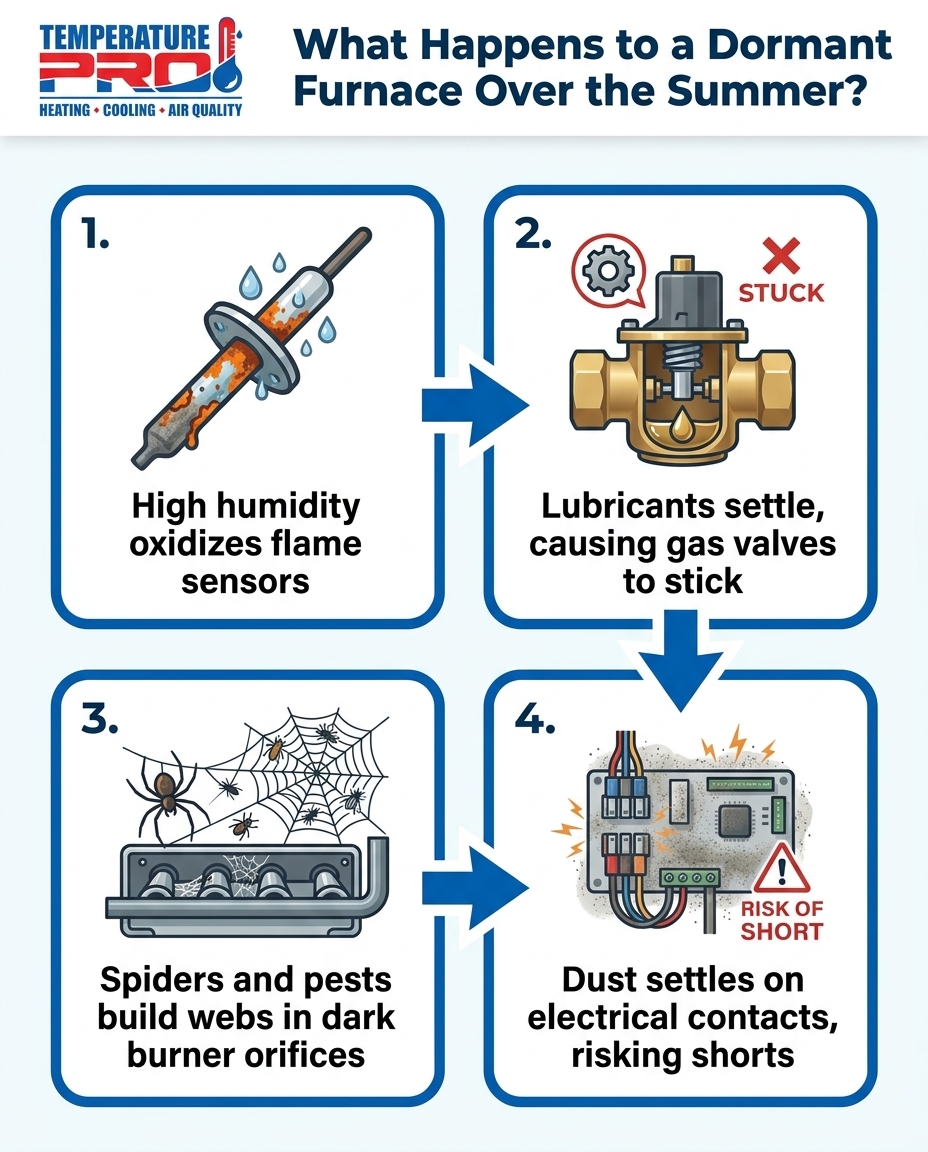
1. Oxidized Flame Sensors: The flame sensor is a vital safety device. It is a thin metal rod that sits directly in the path of the burner flame. Its job is to confirm that a fire is actually burning when the gas valve opens. Over a humid summer, moisture in the air causes a microscopic layer of rust and oxidation to form on this metal rod. When fall arrives and you turn on the heat, that invisible layer of rust acts as an insulator. It prevents the sensor from detecting the flame, causing the system to immediately shut down the gas supply for safety. Your furnace will turn on, run for a few seconds, and then turn right back off.
2. Sticking Gas Valves: Gas valves are mechanical gates that open and close to supply fuel to the burners. They rely on internal lubricants to move smoothly. After months of total inactivity, these lubricants can settle, dry out, or become gummy. A mechanical valve can easily seize up after 8 months of sitting still. If a gas valve sticks closed, you get no heat. If it sticks open, you face severe safety and ignition risks.
3. Pest Intrusion: Spiders and insects constantly seek shelter in dark, undisturbed spaces. The cylindrical metal tubes of your furnace's burner orifices provide the perfect summer home. Spiders frequently spin thick webs inside these tubes. When the heating season begins, those webs act as physical blockages. They can restrict gas flow entirely, or worse, cause the flames to roll backward out of the front of the furnace—a dangerous condition known as flame rollout.
Why Dust and Humidity Threaten Electrical Contacts
Beyond the mechanical and combustion components, your furnace relies on a complex network of electrical relays, control boards, and limit switches. During the long off-season, airborne particulates settle thickly on these dormant electrical contacts.
When you combine a heavy layer of household dust with high summer humidity, the dust absorbs the moisture and becomes slightly conductive—or conversely, acts as a stubborn insulator. This buildup can cause electrical shorts, blown fuses, or ignition failures the very first time the system is powered on in the fall. This is a major reason why we check the heat exchanger before you actually need it, ensuring that all surrounding electrical and safety systems are clean, dry, and communicating correctly.
What Happens to a Dormant Furnace Over the Summer?
Why Fall Maintenance is a Strict Safety Inspection, Not Just a Cleaning
It is time to shift how you view your annual heating appointment. Many homeowners think of it as an "efficiency tune-up" or a simple dusting. In reality, we treat it as a critical safety hazard prevention protocol. Modern gas furnaces are powerful appliances that burn combustible fuel inside your home, and they are equipped with complex safety switches designed to protect you.
Testing the safety limits: A proper fall inspection verifies that every single safety switch is fully operational. Our technicians test the high-limit switch (which shuts the system down if it overheats) and the pressure switches (which ensure exhaust gases are venting safely outdoors). If these switches degraded or became stuck during the summer dormancy, your system could operate in an unsafe condition, risking carbon monoxide leaks or fire hazards.
The value of disciplined protocols: Working with our veteran-owned team at TemperaturePro Baton Rouge means you are getting a rigorous, disciplined safety inspection where our technicians follow strict protocols to catch minor off-season wear before it becomes a hazard. There is no guesswork—just a systematic verification of every component. Even premium, highly reliable systems like Daikin furnaces require this baseline safety verification after sitting dormant to ensure they operate precisely as engineered.
Catching hidden problems early: Catching a sticking valve or failing limit switch in September prevents a catastrophic failure during the first real cold snap of the year. In one case last winter, a local homeowner reached out to us when their heater suddenly stopped working on a freezing night. Because the system had skipped its pre-season check, a hidden wiring error had gone completely unnoticed. When our technician arrived to diagnose and repair the heater, they found and fixed the wiring fault—which not only restored the heat safely but also ended up improving the AC fan's performance for the following summer. Preventative checks catch these interconnected issues before they leave you in the cold.
Frequently Asked Questions About Fall Furnace Maintenance
Do I really need a furnace tune up every year?
Yes, annual tune-ups are required by most manufacturers to maintain warranty coverage. Beyond warranty requirements, yearly inspections verify that critical safety mechanisms haven't degraded during the humid off-season. Having our professionals look at the system every fall ensures it operates safely and efficiently all winter long.
What happens if I skip furnace maintenance?
Skipping maintenance increases the risk of unexpected breakdowns, carbon monoxide exposure, and higher energy bills. Minor issues like a dirty flame sensor or a small spider web can cause the entire system to lock out when you need it most. Over time, neglected maintenance also shortens the overall lifespan of the equipment.
How often should a gas furnace be serviced?
A gas furnace should be serviced once a year, ideally in the early fall before the heating season begins. This timing allows our technicians to clean away summer dust, check for oxidized parts, and ensure the system is safe to operate before the first cold snap hits.
Can a furnace sit for a year without being used?
While it can physically sit idle, doing so allows dust, pests, and moisture to accumulate inside the sensitive mechanical and electrical components. A furnace should never be turned on after a year of dormancy without a professional safety inspection. The risk of sticking valves and clogged burners is simply too high after prolonged inactivity.
Will skipping a tune-up save me money if I barely ran the heat?
No, the cost of replacing a seized blower motor or repairing a compromised gas valve far exceeds the cost of routine preventative maintenance. Preventative care catches small, inexpensive problems before they turn into major emergency repairs, saving you money and stress in the long run.
Secure Your Heating System Before the First Cold Snap
A logical, climate-based approach to maintenance is the best way to prevent unexpected winter emergencies. Even if last winter was mild and your system barely ran, the long, humid summer has undoubtedly taken a toll on the dormant components inside your furnace cabinet.
Do not wait until the temperature drops and your system locks out due to a rusted sensor or a sticking valve. Schedule your pre-season safety inspection with TemperaturePro Baton Rouge now, before the cold weather arrives and technician schedules fill up. By taking action early, you ensure your heating system is safe, clean, and ready to perform flawlessly the moment you need it.
Thank you! Your submission has been received!
Oops! Something went wrong while submitting the form.
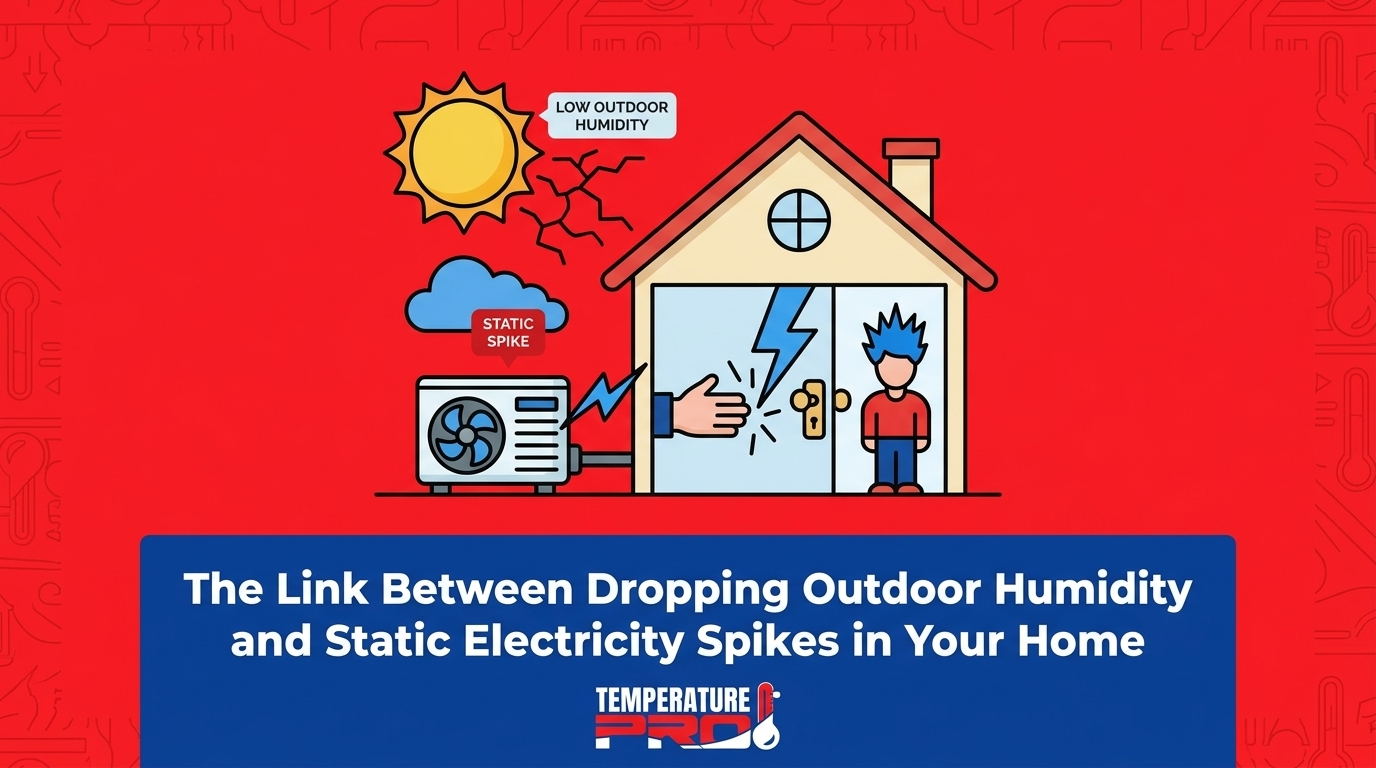
Sudden static shocks are a clear diagnostic sign that your indoor air is too dry. Understand the physics behind this fall shift and why whole-home humidification is the ultimate fix.
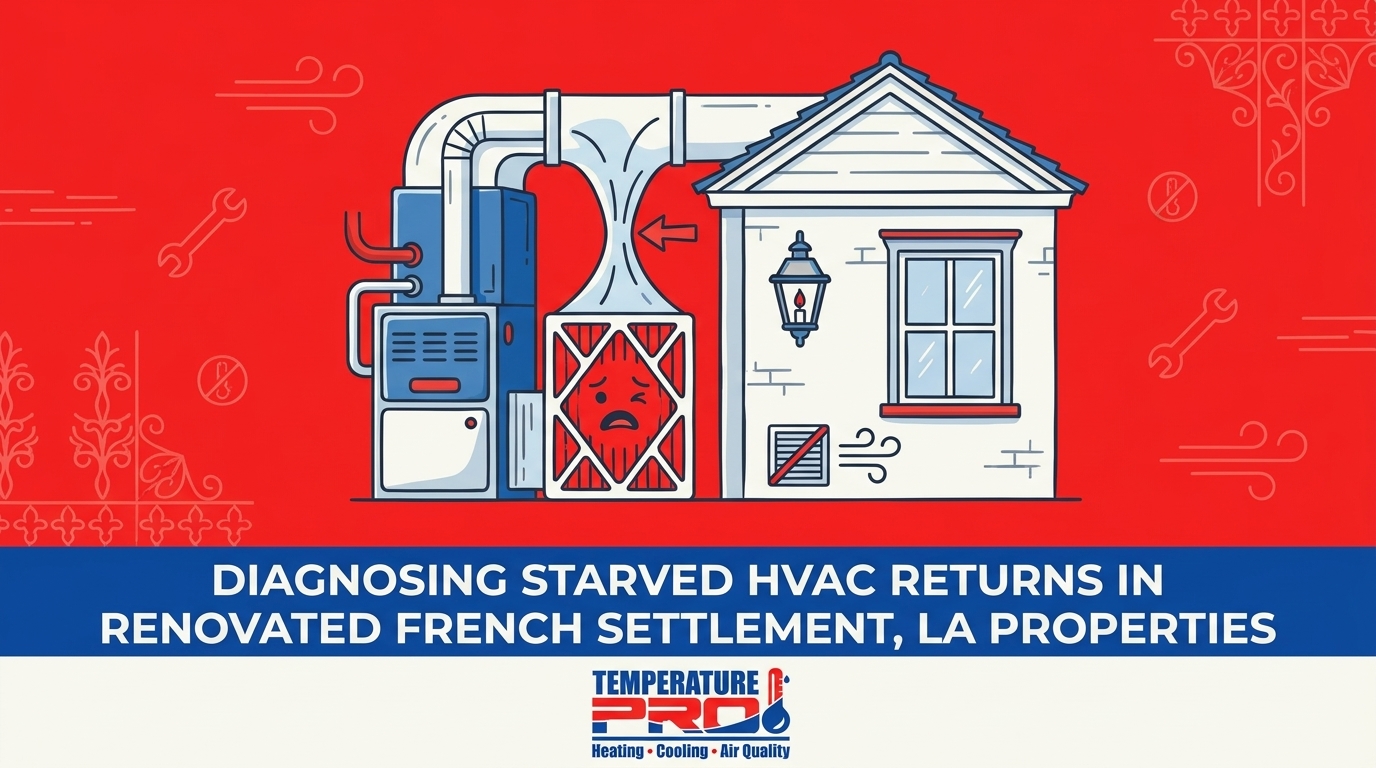
Flipped homes look great but often hide starved HVAC returns behind new drywall. Discover how objective static pressure testing reveals these hidden bottlenecks before winter heating season begins.
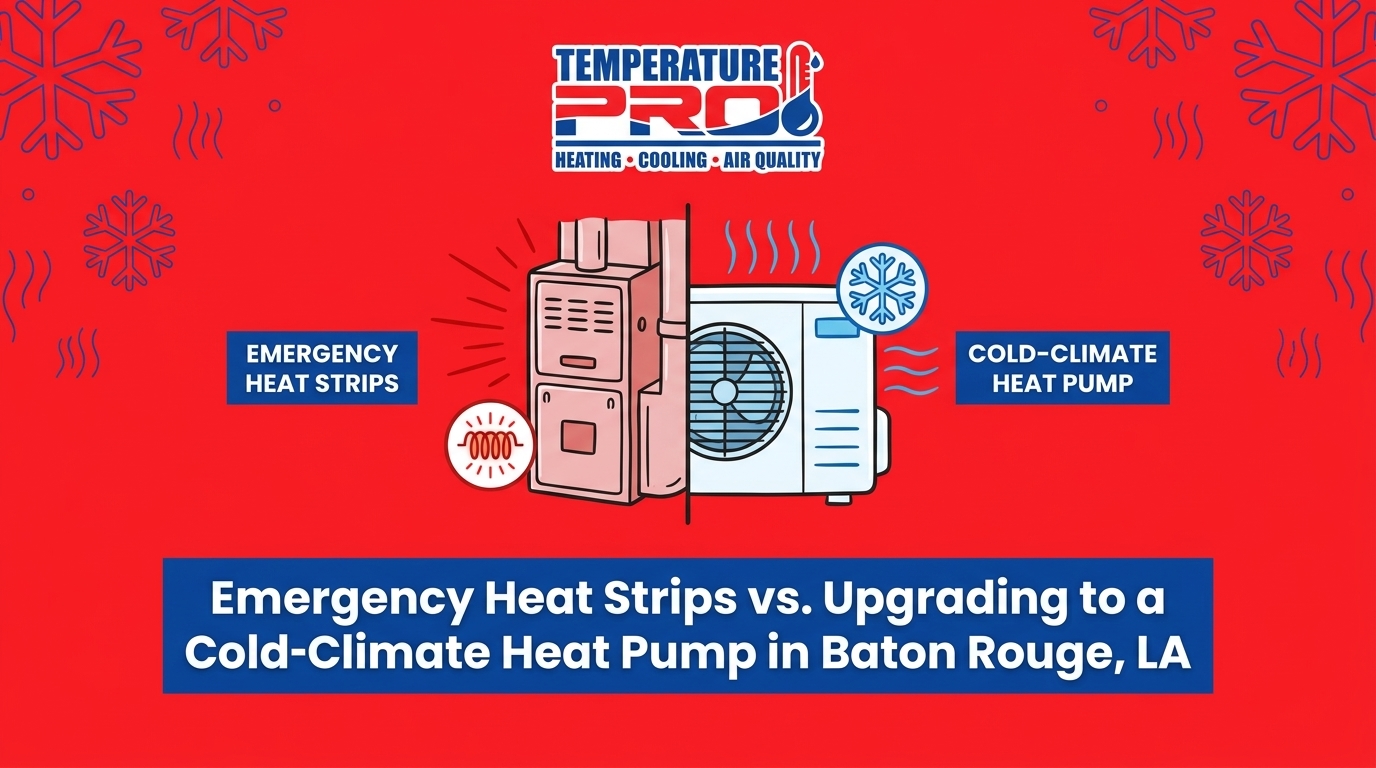
Tired of massive energy spikes during sudden winter freezes? See how modern inverter-driven heat pumps maintain efficiency without relying on energy-hogging resistive strips.