5 min read
Fall HVAC Troubleshooting: Why Your Heater Smells Like Burning Dust on Startup
Is that burning dust smell normal? Read our home maintenance tips and troubleshooting to see why heating startup odors happen and when to call a professional.


Months of summer humidity can cause microscopic rust and stress cracks inside a dormant furnace. A proactive September safety check identifies these hidden risks before you turn the heater on.
As the intense summer heat begins to fade and we approach the September pre-heating transition, the topic of pre-fall HVAC inspections—why we check the heat exchanger before you actually need it—should be at the top of every homeowner's to-do list. September in Louisiana is a deceptive month; the calendar says fall, but your air conditioner is likely still running daily. However, beneath the surface of your dormant furnace, a hidden threat may have been slowly developing for months. Gas furnaces that sit unused through long, humid summers are highly susceptible to microscopic damage, specifically within the heat exchanger.
Most homeowners naturally assume that if a piece of equipment hasn't been turned on, it hasn't experienced any wear and tear. Unfortunately, the opposite is true for heating systems in southern climates. The long period of inactivity is precisely when environmental damage takes hold. This is the exact moment when you face a critical decision: turn on the heater during the first unpredictable cold snap and hope for the best, or schedule a comprehensive safety check beforehand. By investing in professional heating services and securing an HVAC maintenance plan, you ensure that licensed technicians can identify and resolve these silent, invisible threats before your family relies on the system for warmth.
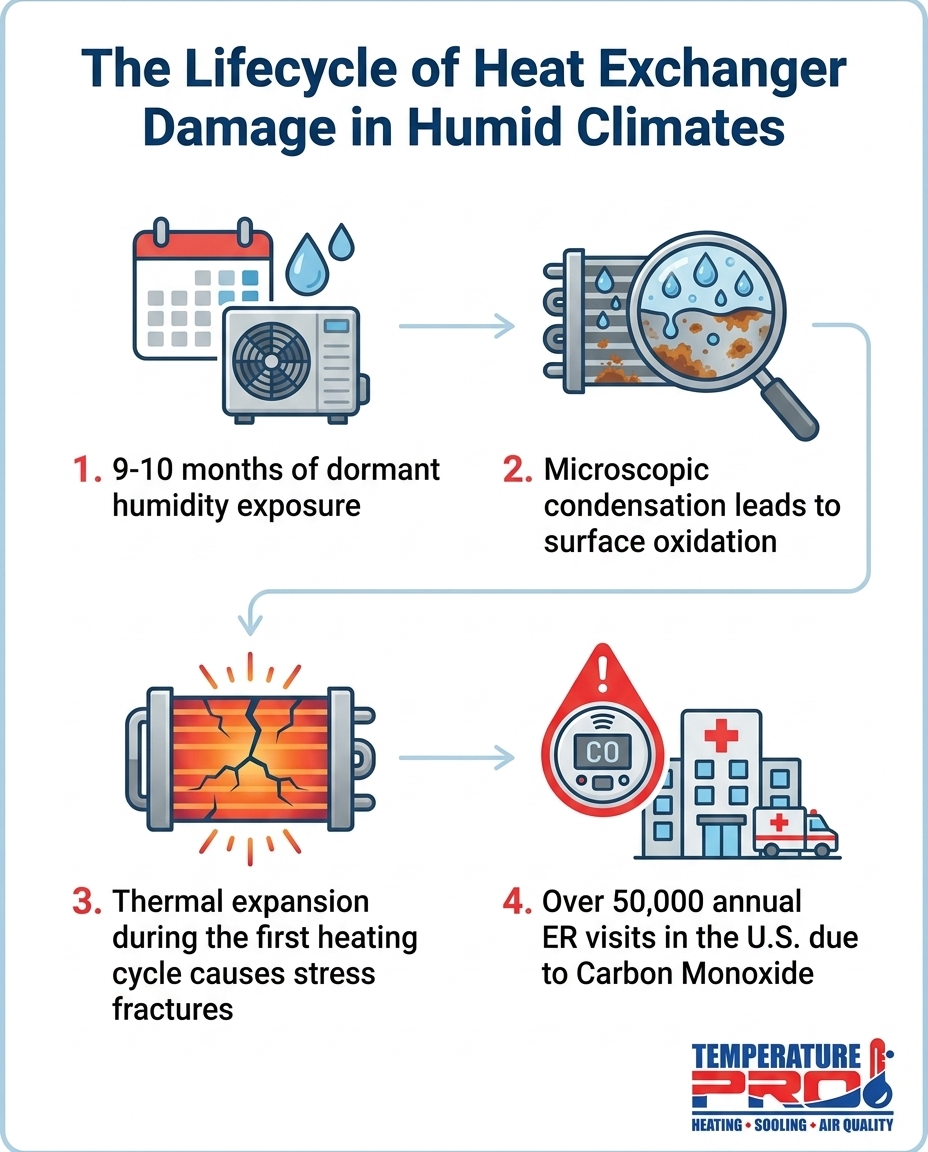
It sounds entirely counterintuitive, but not using your furnace in a humid climate is often worse for its internal metal components than running it heavily in a freezing, dry climate. We call this the humidity paradox. In the Baton Rouge area, furnaces typically sit completely dormant for 9 to 10 months out of the year. During this extended off-season, they are subjected to environmental factors that accelerate degradation.
With summer humidity levels regularly exceeding 80% across the region, the air inside your attic, garage, or utility closet is thick with moisture. As your air conditioner runs, the ductwork and the furnace cabinet experience temperature fluctuations. This causes condensation to form directly on the internal metal components of the dormant furnace, including the heat exchanger. Because the furnace never fires up to burn off this moisture, the metal sits damp for months on end, creating the perfect breeding ground for oxidation and surface rust.
To understand why this is so detrimental, it helps to compare how furnaces age in different environments.
• Usage Cycle — Northern Climates: 6+ months of daily, heavy operation. — Baton Rouge Area: 2-3 months of sporadic, light operation.
• Moisture Exposure — Northern Climates: Dry winter air prevents internal condensation. — Baton Rouge Area: 9-10 months of high humidity and resting moisture.
• Primary Wear Mechanism — Northern Climates: Mechanical fatigue from constant firing and blowing. — Baton Rouge Area: Oxidation and rust from sitting dormant in damp air.
• Heat Exchanger Status — Northern Climates: Stays dry due to frequent combustion heat. — Baton Rouge Area: Develops surface rust that weakens structural integrity.
This resting period is when the foundation for serious winter hazards is laid. The rust that forms during the humid summer months eats away at the metal, thinning the walls of the heat exchanger and preparing it to fail the moment it is finally called into action.
To understand why a pre-season check is absolutely necessary, you must understand the tremendous physical stress your furnace undergoes during a heating cycle. The heat exchanger is arguably the most critical component of your gas furnace. Its job is twofold: it must safely contain the highly toxic combustion gases created by burning fuel, while simultaneously transferring the heat from those gases to the clean air blowing through your home's ventilation system. The two air streams—the toxic exhaust and your breathing air—must never mix.
The problem: When the furnace fires up, the heat exchanger rapidly heats up to hundreds of degrees. Metal naturally expands when heated and contracts when it cools down. This constant expansion and contraction is known as thermal stress. In a brand-new, healthy furnace, the metal is flexible and strong enough to handle this cycle endlessly.
The cause: However, when you introduce the Baton Rouge area's summer humidity into the equation, the metal's integrity changes. The surface rust that formed during those 9 to 10 months of dormancy has weakened specific spots on the heat exchanger. Rust is brittle; it does not expand and contract smoothly like healthy steel or aluminized metal.
The solution: Because this degradation happens on a microscopic level inside a sealed combustion chamber, it is impossible for a homeowner to evaluate it safely. Inspecting this physical breakdown requires licensed professionals utilizing specialized tools. Never attempt to disassemble your furnace to look for rust, as disturbing these components can inadvertently cause a leak.
• Oxidation weakens the structural integrity: The damp summer air converts strong metal into brittle iron oxide.
• Maximum stress during the first cycle: The very first time you turn on your heater in the late fall, the sudden thermal expansion pulls at these rusted, brittle areas.
• Microscopic fissures develop: The weakened metal cannot stretch, causing it to tear on a microscopic level.
• Expansion into dangerous cracks: With each subsequent heating cycle, that tiny fissure expands, eventually becoming a full-blown crack that breaches the seal between the combustion chamber and your home's air supply.
The transition from a tiny, hairline fracture to a life-threatening emergency can happen rapidly, and it is entirely invisible to the naked eye. When a heat exchanger cracks, it compromises the only barrier standing between the fire burning inside your furnace and the air circulating through your living room, bedrooms, and hallways.
The primary byproduct of burning natural gas or propane is carbon monoxide (CO). Carbon monoxide is a highly toxic, odorless, colorless, and tasteless gas. Because human senses cannot detect it, it is often referred to as the "silent killer." According to data from the Centers for Disease Control and Prevention (CDC), carbon monoxide poisoning is responsible for over 50,000 emergency room visits annually in the United States. A significant portion of these incidents trace back to poorly maintained or compromised residential heating systems.
Under normal, safe conditions, the heat exchanger contains these toxic gases and routes them safely out of your home through the exhaust flue. But when a crack develops—even one as thin as a human hair—the physics of the system change. The blower motor that pushes warm air into your home creates positive pressure around the outside of the heat exchanger. This pressure can alter the draft of the flames, causing the toxic exhaust gases to be pushed out of the crack and mixed directly into the clean air stream. Within minutes, the ventilation system distributes carbon monoxide to every room in the house.
Because these leaks are completely silent and invisible, waiting for a symptom to appear is a dangerous gamble. By the time carbon monoxide detectors sound an alarm, the gas is already present in the home. Proactive detection during the September pre-heating transition is the only reliable defense against this severe safety hazard.
A common misconception among homeowners is that they can simply shine a flashlight into the furnace cabinet to see if the heat exchanger is intact. This is a dangerous oversimplification. The heat exchanger is a complex, serpentine series of metal tubes and clamshells. The vast majority of its surface area is completely hidden from view, tucked deep inside the furnace framework.
This is where the proactive safety focus of a professional inspection becomes invaluable. Licensed technicians do not rely on a simple visual once-over. They employ advanced diagnostic techniques designed to find microscopic cracks before they become a dangerous carbon monoxide hazard.
• High-Resolution Inspection Cameras: Technicians use flexible, lighted endoscope cameras to navigate the tight curves and hidden chambers of the heat exchanger. These cameras feed high-definition video to a monitor, allowing the technician to spot hairline fractures, rust scaling, and soot buildup that a flashlight could never illuminate.
• Combustion Analysis Testing: This is a sophisticated chemical test performed while the furnace is running. A technician inserts a probe into the exhaust flue to measure the exact composition of the gases leaving the system. If the oxygen, carbon dioxide, and carbon monoxide levels fall outside of strict safety parameters, it is a definitive scientific indicator that the combustion process is compromised—often pointing directly to a cracked heat exchanger.
• Airflow and Draft Measurement: Professionals test the draft pressure to ensure that exhaust gases are being properly pulled up the chimney or flue, rather than spilling back into the furnace cabinet.
The value of this deep diagnostic work cannot be overstated. A recent service call for a multi-unit system tune-up demonstrated the value of this approach perfectly. While cleaning the coils, the technician utilized advanced diagnostics to identify and explain potential future issues to the homeowner long before they could cause a sudden breakdown. By catching these warning signs early, the homeowner was able to address the health of the system proactively. This exact methodology is applied when scrutinizing a heat exchanger in the fall—finding the microscopic rust before it becomes a macroscopic emergency.
While carbon monoxide is the most severe and immediate threat posed by a cracked heat exchanger, it is not the only concern. The mechanical integrity of your furnace is deeply intertwined with the overall health and comfort of your household. When the barrier between combustion and circulation is broken, a variety of exhaust byproducts can be introduced into your living space.
Beyond CO, a compromised furnace can leak nitrogen dioxide, sulfur dioxide, and unburned fuel odors into the air stream. Even in small, non-lethal amounts, these combustion byproducts can cause significant respiratory irritation. Homeowners may experience unexplained headaches, persistent coughing, watery eyes, or fatigue that magically disappears when they leave the house. These symptoms are often mistakenly attributed to winter allergies or the common cold, when in reality, the furnace is quietly contaminating the air.
This issue is compounded by the way we live during the colder months. When the temperature drops in the Baton Rouge area, windows are sealed shut, doors are kept closed, and homes are buttoned up tight to conserve energy. This lack of natural ventilation means that any contaminants leaking from the furnace are trapped inside, recirculating through the ductwork again and again.
Your heating system should be the foundation of a healthy indoor environment, not a source of pollution. Ensuring that your heat exchanger is completely sealed is a critical first step in protecting your home's indoor air quality. A healthy furnace burns fuel cleanly, vents exhaust completely, and delivers nothing but pure, warm air to your living spaces.
Understanding the risks of a compromised heat exchanger naturally leads to the question of timing. When is the best time to have this critical component checked? The answer lies in the seasonal transition. September is the optimal window for a pre-fall inspection because the heavy cooling season is winding down, but the intense heating season hasn't fully started.
Waiting until November or December to turn on your heater for the first time is a recipe for stress. If the furnace fails to ignite, or worse, if it ignites but poses a safety hazard, you will find yourself dealing with an emergency during the busiest time of the year for HVAC technicians. The first major cold snap always triggers a flood of service calls from homeowners whose dormant systems failed upon startup.
By scheduling your inspection in September, you gain a massive advantage. You ensure your system is safe, clean, and ready to perform weeks before emergency services are required. Consider a situation where a homeowner called during the fall because their heater wasn't working properly. A technician arrived promptly, identified a specific wiring error, and had the system running again in no time. Because this was caught early in the season, the homeowner avoided the discomfort of freezing temperatures and the stress of an emergency breakdown.
Neglecting seasonal transitions has cascading consequences. A rusted heat exchanger forces the system to work harder, run less efficiently, and ultimately fail sooner. Understanding the risks of skipping HVAC maintenance is crucial for protecting your investment. Don't let the lingering late-summer heat lull you into a false sense of security. The September pre-heating transition is your best opportunity to verify that your furnace is safe, efficient, and ready to keep your family warm without compromising their health.
Why is a cracked heat exchanger dangerous?
A cracked heat exchanger is dangerous because it allows toxic combustion gases, including carbon monoxide, to leak into your home's breathing air. Normally, the heat exchanger acts as a sealed barrier between the fire and the air blowing through your vents. When that barrier breaks, odorless and invisible gases can quickly circulate through the house, posing a severe, life-threatening risk to anyone inside.
How often should a heat exchanger be inspected?
A heat exchanger should be inspected at least once a year, ideally in the early fall before the heating season begins. Because metal fatigue and rust can develop over the summer months while the system sits dormant, an annual check ensures that any microscopic cracks are caught before the furnace is put under the heavy stress of winter operation.
What causes a heat exchanger to crack even if it's rarely used?
Even with rare use, a heat exchanger can crack due to the combination of high summer humidity and thermal stress. During long, humid summers, condensation forms on the dormant metal, leading to rust and oxidation that weakens the structure. When the furnace is finally turned on, the rapid heating and expansion of the metal causes those weakened, rusted areas to fracture.
Can a cracked heat exchanger be repaired or welded?
No, a cracked heat exchanger cannot be safely repaired with welding or sealants. Because of the extreme temperature fluctuations and the critical safety requirement of containing carbon monoxide, a compromised heat exchanger must be entirely replaced by a licensed professional, or the entire furnace must be replaced if the unit is older.
What are the silent signs of a carbon monoxide leak from a furnace?
Silent signs of a carbon monoxide leak include unexplained physical symptoms like frequent headaches, dizziness, nausea, and fatigue that improve when you leave the house. You might also notice excessive condensation on your windows, a yellow or wavering burner flame instead of a crisp blue one, or soot gathering around the furnace cabinet.
Does high humidity really affect a furnace that is turned off?
Yes, high humidity heavily affects a furnace even when it is completely turned off. The moisture in the air causes condensation to build up on the internal metal components, and because the furnace isn't running to generate heat and dry itself out, that moisture sits for months, leading to severe rust and corrosion.
Go With Experience