5 min read
Can I Hose Off My Outdoor AC Unit to Make It Run Cooler?
When your AC struggles in the late-summer heat, spraying it with a garden hose seems like a logical quick fix. Find out why this actually bakes mud and minerals onto your coils.


Before assuming your warm AC needs a refrigerant recharge, our technicians investigate the blower motor and ductwork. Measuring CFM airflow prevents costly misdiagnoses.
Your air conditioner is running nonstop, but the house still feels uncomfortably warm. When you are dealing with a struggling system, understanding how our technicians verify proper airflow over the coil before recommending a refrigerant charge is the key to getting a lasting repair instead of a temporary patch. In our years serving Baton Rouge homeowners, we've found it is incredibly common for people to assume that warm air coming from the vents immediately means the system needs a "Freon recharge." However, the actual culprit our team typically sees is heavily restricted airflow.
During the intense, August late-summer heat, your air conditioning system is under immense strain. Constant operation as families transition back to school means that every component is working overtime. When a system struggles to keep up, restricted airflow over the evaporator coil produces symptoms that perfectly mimic low refrigerant. If a technician does not investigate the airflow first, they might misdiagnose the problem entirely.
Our professional diagnostic methodology at TemperaturePro Baton Rouge requires verifying that the right volume of air is moving through your system before we ever attach our gauges. This strict adherence to proper testing is a cornerstone of our air conditioning services. By ruling out airflow bottlenecks first, we protect your equipment from the severe damage that comes from improper charging.
To understand why airflow is so critical to diagnosing an air conditioner, you have to look at the basic science of how your system cools your home. The evaporator coil and blower motor assembly work together to remove heat from your indoor air. The coil does not actually create cold air; instead, it absorbs heat from the warm air passing over it.
The Heat Transfer Process
When the blower motor pushes warm indoor air across the cold evaporator coil, the refrigerant inside the coil absorbs that heat and carries it outside. If airflow is heavily restricted—whether by a loaded filter, a failing motor, or blocked ducts—insufficient heat reaches the coil. Without that heat, the temperature of the coil begins to drop drastically.
In the world of HVAC physics, temperature and pressure are directly linked. When the evaporator coil's temperature drops due to a lack of warm air passing over it, the internal refrigerant pressure drops right along with it. To a less-experienced technician looking only at pressure gauges, this artificially low pressure looks exactly like a system that is low on refrigerant. This creates a "false positive" for a leak.
This situation is especially dangerous in our local climate. With Baton Rouge frequently experiencing 70%+ relative humidity in late summer, the air is packed with moisture. A pattern we see often at TemperaturePro is when that highly humid air hits a freezing-cold evaporator coil suffering from low airflow, the condensation quickly freezes. Within hours, the coil can turn into a solid block of ice, further choking off the air and causing system efficiency to plummet by up to 15% while putting massive strain on the compressor.
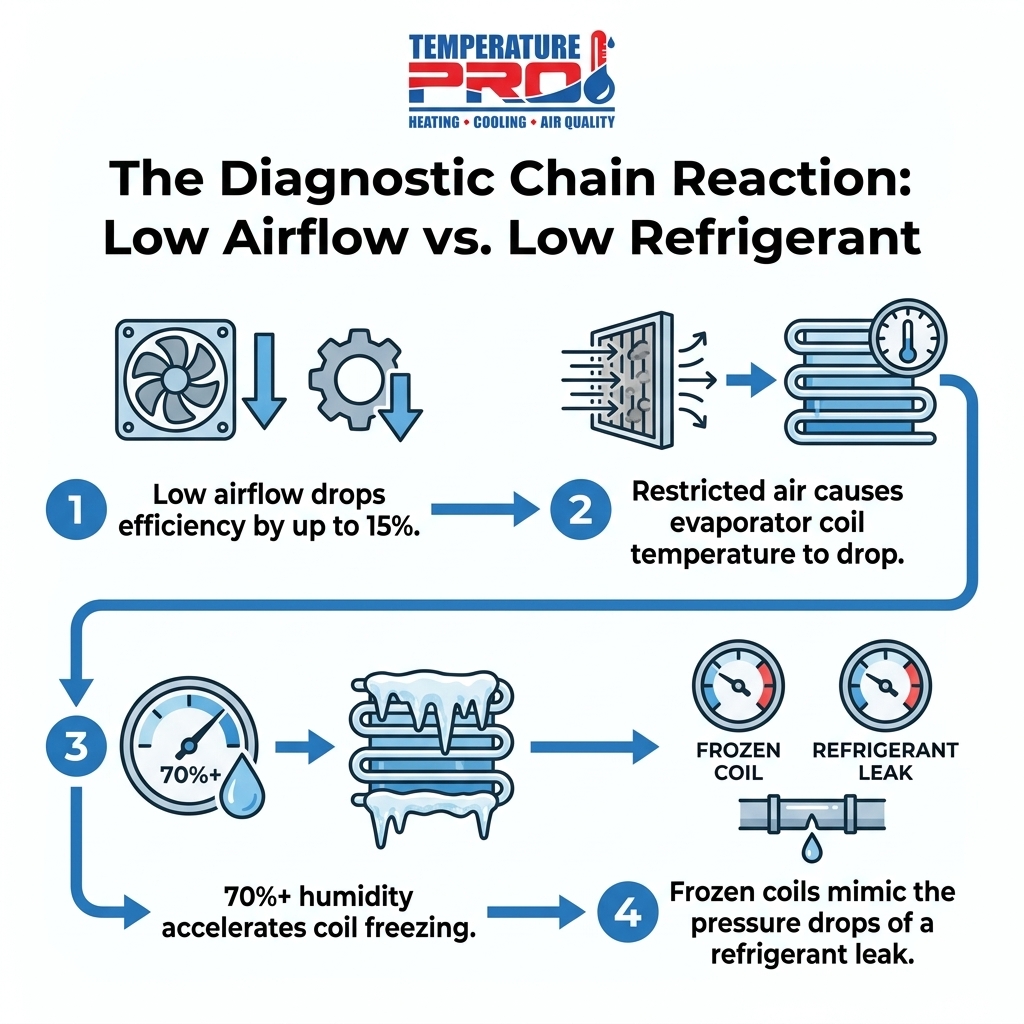
When an air conditioner is blowing warm air, the temptation for a "quick fix" is high. However, jumping straight to a recharge without performing a holistic system check is one of the most dangerous things that can happen to your HVAC equipment. If a technician attaches gauges and sees low pressure, but fails to realize the low pressure is caused by an airflow bottleneck, they will likely add refrigerant to a system that is already full.
The Danger of Overcharging
Blindly adding refrigerant to a system with an airflow issue effectively overcharges the unit. Because the restricted airflow is preventing the refrigerant from absorbing enough heat, the refrigerant may not fully boil off into a gas before it returns to the outdoor compressor. Compressors are designed to pump gas, not liquid. If liquid refrigerant enters the compressor—a condition known as "liquid slugging"—it can cause catastrophic, irreversible compressor failure.
This is why proper HVAC troubleshooting is a vital consumer protection measure. Getting a proper second opinion is incredibly valuable if a previous diagnosis seemed rushed or focused solely on adding refrigerant. For example, during the busy back-to-school transition last August, one local homeowner reached out to our TemperaturePro Baton Rouge team seeking a second opinion on a costly estimate they had received from another company. Our professionals carefully inspected the system and identified the true root cause—which involved a disengaged fuse and a foreign substance on the control board rather than a major mechanical failure. Because we took the time to diagnose the system properly rather than guessing, we had their AC up and running within 30 minutes. Accurate diagnostics prevent you from paying for refrigerant you don't need, and more importantly, they protect your system from the severe consequences of an overcharge during the August late-summer heat.
The first phase of our professional diagnostic protocol focuses entirely on the mechanical components that move the air. Before we even look at the refrigerant lines, our licensed technicians perform a thorough physical inspection of the air handler to ensure the system can breathe properly.
When evaluating the evaporator coil and blower motor assembly, our professionals follow a strict checklist to rule out physical restrictions:
1. Evaluating Air Filters: We check the condition of the system's filters. In our experience servicing Baton Rouge neighborhoods, heavily loaded filters are at peak failure rates by the end of the cooling season. A severely clogged filter is the most common cause we find for choked airflow and frozen coils.
2. Inspecting the Blower Wheel: The blower wheel's blades are designed with a specific "cup" shape to scoop and push air. If these blades are caked with dust and debris, they lose their ability to move air effectively, drastically reducing system output.
3. Testing Blower Motor Operation: Our technicians test the blower motor to ensure it is operating at the correct speed. We measure the amperage draw to confirm the motor is not over-amping or failing under load, which would indicate a mechanical breakdown.
4. Assessing Return Vents and Ductwork: We inspect the return vents and accessible ductwork for blockages, crushed sections, or restrictions. If the system cannot pull enough air in through the returns, it cannot push enough conditioned air out into the home.
By verifying the physical integrity of the blower system first, we ensure that your equipment is mechanically capable of supporting the refrigeration cycle. This thorough physical inspection is also a critical part of maintaining proper indoor air quality, as a clean blower assembly prevents dust and allergens from circulating through your living spaces.
Proper diagnostics rely on hard data, not just holding a hand up to a vent and guessing if the airflow feels strong enough. Once the physical inspection is complete, our technicians move on to quantifying the exact volume of air moving through the system.
Measuring CFM (Cubic Feet per Minute)
We use CFM (Cubic Feet per Minute) airflow measurements to determine exactly how much air the blower is moving. Every air conditioning system is designed by the manufacturer to move a specific amount of air—typically around 400 CFM per ton of cooling capacity. Hitting this manufacturer's specified target is non-negotiable for system health. If a 3-ton system is only moving 800 CFM instead of its required 1,200 CFM, the refrigeration cycle will not function correctly.
To gather this data, our technicians utilize specialized professional tools that provide precise readings. These measurements are strictly performed by trained professionals to ensure accuracy and safety.
• Static Pressure Probes — What It Measures: Resistance inside the ductwork — Why It Matters for Diagnostics: High static pressure indicates a severe restriction, much like high blood pressure in the human body.
• Anemometers — What It Measures: Air velocity at the vents — Why It Matters for Diagnostics: Helps calculate the actual volume of air entering the room to confirm the blower is performing adequately.
• Manometers — What It Measures: Pressure drops across the coil — Why It Matters for Diagnostics: Confirms if a dirty evaporator coil is acting as a wall, blocking air from passing through the system.
By relying on concrete CFM targets rather than guesswork, we can definitively prove whether the system has an airflow problem before we ever touch the refrigeration circuit.
The final step of our diagnostic protocol is evaluating the refrigerant charge. To state it clearly: our gauges are only attached to the system after the CFM target has been confirmed. This step-by-step process is the only way to ensure that the data we read on our gauges is accurate and actionable.
When we confirm that the correct volume of air is moving over the coil, we stabilize the heat transfer process. With stable heat transfer, the refrigerant pressures and temperatures will reflect the true state of the charge. Here is how our technicians finalize the diagnosis:
1. Attaching the Gauges: Once proper CFM (Cubic Feet per Minute) airflow measurements are verified, our technicians attach professional digital manifolds to read the exact pressures of the refrigerant.
2. Measuring Superheat and Subcooling: We measure the temperature of the refrigerant lines to calculate superheat (how much heat the vapor has absorbed) and subcooling (how much heat the liquid has rejected). These metrics are impossible to read accurately if airflow is restricted.
3. Isolating the Root Cause: Because we have already ruled out airflow issues, any abnormal pressure readings at this stage definitively point to a refrigeration problem. This methodical approach completely isolates whether the system actually has a leak or if the issue was entirely airflow-related.
This rigorous protocol prevents us from masking underlying duct or blower issues with unnecessary refrigerant. If you want to know more about the actual indicators of a leak once airflow is verified, you can review the true low refrigerant signs in your AC system. By following these steps in order, we guarantee a diagnosis based on science, not assumptions.
Verifying airflow before checking refrigerant is more than just a technical requirement; it serves as a vital consumer protection measure. Accurate root-cause analysis saves homeowners from the frustration of repeated breakdowns, frozen coils, and the unnecessary expense of adding refrigerant to a system that simply needed a blower motor repair or a duct restriction cleared.
We see the value of this approach every day in the field. Another local customer recently called us during the summer to diagnose their ongoing AC issues and establish a clear path forward for repair. Because our technicians arrived within the estimated time window and provided a knowledgeable, data-backed diagnosis starting with airflow verification, we were able to help the customer make a confident plan to fix their HVAC issues for good. Our transparent, step-by-step diagnostic protocol ensures we find the true root cause rather than blindly adding expensive refrigerant.
When you are facing a hot house during the August late-summer heat, you deserve the peace of mind that comes from a clear, actionable plan forward based on actual diagnostic data. Our commitment to honesty and long-term system health means we never settle for quick, temporary fixes. By ensuring your system can breathe properly first, we protect your equipment and keep your home comfortable for the long haul.
Yes, low airflow can perfectly mimic the symptoms of low refrigerant. When not enough warm air passes over the evaporator coil, the coil's temperature drops, which directly causes the refrigerant pressure inside to drop as well. To an untrained eye, this artificially low pressure looks exactly like a system that has a leak and needs a recharge.
Technicians check airflow first because the refrigeration cycle relies on a specific volume of air to transfer heat correctly. If airflow is restricted, the pressure readings on the technician's gauges will be inaccurate, leading to a false diagnosis. Verifying airflow ensures that any subsequent refrigerant readings reflect the true state of the system.
An evaporator coil freezes when restricted airflow causes the coil's temperature to drop below the freezing point. In a highly humid environment, the air contains a massive amount of moisture that condenses on the cold coil. Because the coil is below freezing, that condensation rapidly turns to ice, eventually encasing the entire coil in a solid block.
Professionals test airflow using specialized diagnostic tools that measure the exact volume and resistance of the air. Technicians use static pressure probes to measure the resistance inside the ductwork and anemometers to measure the velocity of the air at the vents. These tools allow them to calculate the exact Cubic Feet per Minute (CFM) moving through the system.
No, you should never blindly add refrigerant just because the system is blowing warm air. If the warm air is being caused by an airflow restriction, adding refrigerant will overcharge the system. Overcharging can lead to liquid refrigerant entering the compressor, which often causes catastrophic and irreversible equipment failure.
CFM stands for Cubic Feet per Minute, and it is the standard measurement for the volume of air moving through your HVAC system. It matters because air conditioners are engineered to operate at specific CFM targets, usually around 400 CFM per ton of cooling. If the system fails to hit this target, it cannot properly cool your home or maintain the correct refrigerant pressures.
Go With Experience