5 min read
Fall HVAC Troubleshooting: Why Your Heater Smells Like Burning Dust on Startup
Is that burning dust smell normal? Read our home maintenance tips and troubleshooting to see why heating startup odors happen and when to call a professional.


Shutting down your HVAC system during that first cool September breeze allows dense coastal moisture to invade your home. Maintaining constant dehumidification is critical during the false fall.
Is your first instinct to flip the thermostat to the "off" position and throw open all the windows the moment that first cool breeze sweeps through the neighborhood? It is a common temptation in the Baton Rouge Gulf South climate. At TemperaturePro Baton Rouge, we hear homeowners asking themselves this exact question every September: should I turn my AC off completely when the first fall cold front arrives? The straightforward answer is no. Completely shutting off your cooling system during this initial temperature drop can jeopardize your home's comfort, indoor air quality, and even its structural integrity.
When the first signs of autumn appear, the outdoor air finally feels pleasant. However, this early seasonal shift is notoriously deceptive. In our years of servicing HVAC systems across the Gulf South, our team has come to know this brief window as the Baton Rouge "false fall." During this time, sensible temperatures might drop beautifully into the 70s, but the dense coastal moisture remains heavily suspended in the air. Your HVAC equipment does much more than just pump cold air into your living room; it is responsible for simultaneously cooling and dehumidifying your environment. When you power down the unit completely, you strip your home of its primary defense against that lingering, invisible moisture.
To keep your air conditioning system running efficiently through this tricky seasonal transition, proactive homeowners rely on a routine HVAC maintenance plan.
To understand why a cool breeze doesn't automatically equal a comfortable home, you have to look at the science of heat. In the world of heating and cooling, professionals measure two distinct types of heat: sensible heat and latent heat. Sensible heat is exactly what it sounds like—the temperature you can sense and read on a standard thermometer. Latent heat, on the other hand, refers to the thermal energy hidden within water vapor, commonly known as humidity.
Early fall cold fronts are excellent at sweeping away sensible heat. The blazing summer sun backs off, and the thermometer drops. However, these same weather fronts frequently leave massive amounts of latent heat behind. The air outside might read a perfect 72 degrees, but if the relative humidity is hovering at 85 percent, that air is heavily loaded with water vapor. Shutting your system off completely removes the only mechanical process actively extracting that moisture from your indoor environment.
The outdoor advantage: When you step outside on a breezy autumn day, the natural movement of the wind constantly evaporates moisture from your skin. This natural airflow makes a humid 75-degree day feel refreshing and crisp.
The indoor reality: Inside a tightly sealed house, that natural breeze does not exist. Our technicians frequently visit homes during early autumn where, without active air circulation and dehumidification, trapped indoor humidity makes those exact same lower temperatures feel heavy, stagnant, and uncomfortably clammy. The air becomes saturated, and because your body cannot efficiently evaporate sweat in a high-humidity environment, you end up feeling sticky even though the thermostat insists the house is cool.
Your cooling equipment removes latent heat through a very specific mechanical cycle. Warm, moist indoor air is pulled into the return vents and blown across the indoor evaporator coils. Because these coils are filled with frigid refrigerant, they are significantly colder than the air passing over them.
The condensation process: Just like water droplets forming on the outside of a cold glass of iced tea on a summer afternoon, the moisture in your indoor air condenses onto these cold evaporator coils. This liquid water then drips safely down into the condensate drain pan and is routed outside your house.
The need for run time: For this dehumidification process to work, the system must run for a minimum continuous duration. If the unit is turned off entirely, this vital condensation cycle stops completely. The moisture stays suspended in your indoor air, slowly permeating your furniture, carpets, and drywall.
Allowing latent heat to build up inside your house is not merely a matter of physical discomfort. When you leave your cooling equipment off for extended periods during highly humid weather, you expose your property and your family to significant hidden risks.
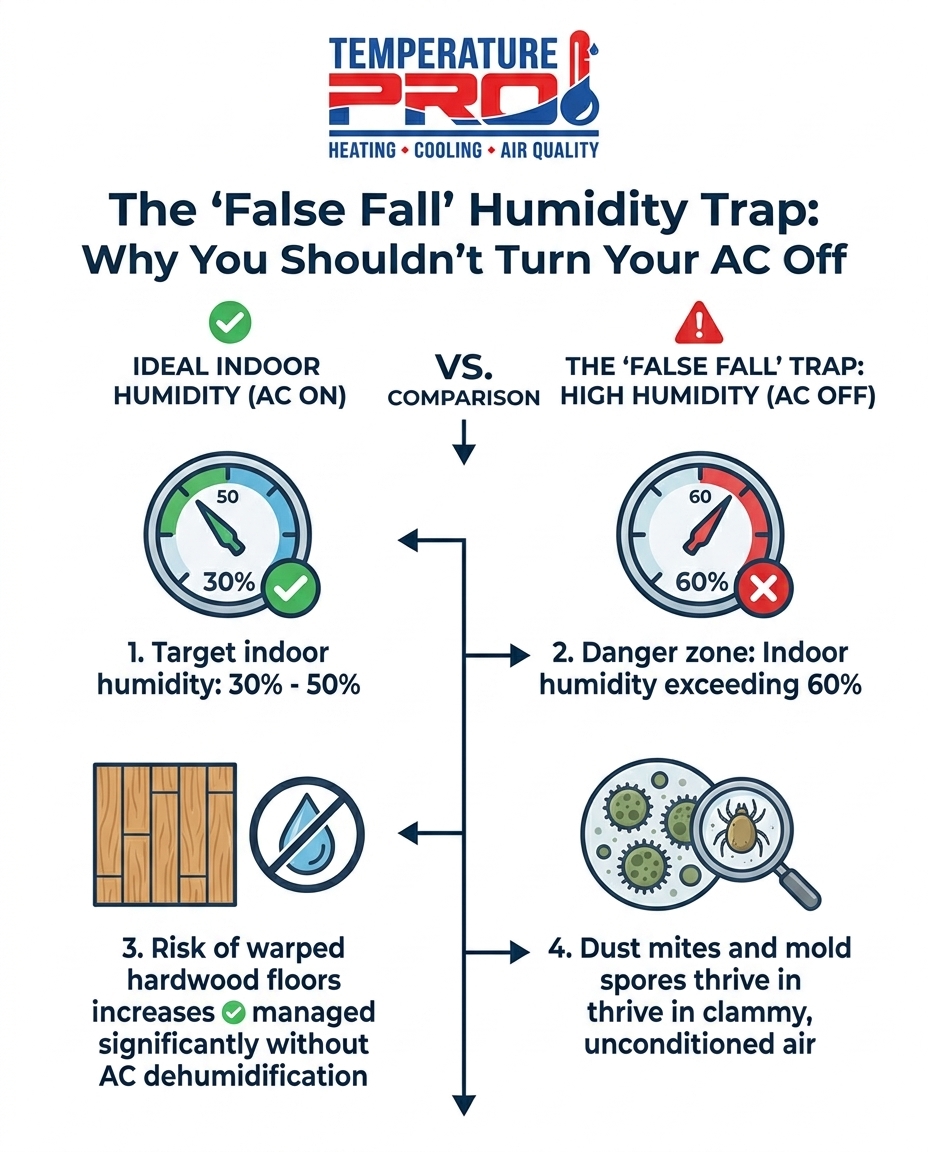
According to environmental guidelines, ideal indoor humidity should be maintained between 30 percent and 50 percent. When indoor humidity levels exceeding 60% become the norm, your home enters a danger zone. Without the active moisture removal provided by your HVAC equipment, you may quickly find yourself needing comprehensive indoor air quality solutions to undo the resulting damage.
• 30% - 50% — Comfort Impact: Crisp, comfortable, and breathable — Home & Health Impact: Ideal zone. Protects wood flooring and minimizes allergens.
• 51% - 59% — Comfort Impact: Slightly heavy but generally tolerable — Home & Health Impact: Borderline. Safe for short durations, but requires monitoring.
• 60% and Above — Comfort Impact: Clammy, sticky, and stagnant — Home & Health Impact: Danger zone. Rapid mold growth, dust mite spikes, and wood warping.
Wood is a highly hygroscopic material, meaning it naturally absorbs and releases moisture depending on the surrounding environment. Expensive hardwood floors, custom cabinetry, wooden doors, and decorative millwork are all highly sensitive to sudden shifts in water vapor.
The warping mechanism: When indoor humidity spikes because the cooling system is shut off, dry wood absorbs the excess moisture from the air like a sponge. As the wood fibers swell, hardwood planks begin to push against one another. This pressure causes the edges of the floorboards to lift, creating a wavy texture known as "cupping." If the moisture is not rapidly controlled, this swelling can lead to irreversible warping, buckling, and structural damage. Our team has unfortunately seen too many beautiful Baton Rouge homes require complete floor replacements simply because the AC was turned off too early in the season.
Beyond physical damage to the house, unchecked humidity creates a thriving biological breeding ground. Biological pollutants are highly dependent on ambient moisture to survive and multiply.
• Dust mites: These microscopic organisms are a leading cause of indoor allergies and asthma flare-ups. They cannot drink water; instead, they absorb it directly from the air. When relative humidity drops below 50 percent, dust mites desiccate and die. When it rises above 60 percent, their populations explode.
• Mold and mildew: Mold spores are always present in the air, but they require a moist surface to take root and grow. A clammy, unconditioned home provides the perfect environment for mold to colonize inside ductwork, behind drywall, and in dark closets.
Running your cooling equipment strategically during early autumn is a necessary defense mechanism to protect both your property investments and your family's respiratory health.
After a long, grueling summer of keeping the house sealed up tight, the appeal of throwing open the windows for fresh air is undeniable. A cross-breeze feels wonderful, and many homeowners assume that letting nature cool the house will save energy and refresh the stale indoor environment. However, our technicians get countless calls every September from homeowners who tried this, only to realize that in subtropical climates where coastal moisture persists long after the summer heat breaks, this practice introduces massive amounts of unseen water vapor into their living space.
When you open your windows on a humid day, the high-moisture outdoor air instantly mixes with your drier indoor air. Once you finally close the windows again—perhaps because it got too warm or the humidity became unbearable—your HVAC equipment now has to work twice as hard. It must run extended cycles to wring all that newly introduced water vapor out of the carpets, furniture, and air, often negating any energy you saved while the unit was turned off. For more targeted advice on managing this regional phenomenon, reviewing AC and humidity control tips for Gulf Coast homes can help you navigate the tricky coastal weather patterns.
If you want to open your windows safely, you need to look at the dew point rather than just the relative humidity or the temperature. The dew point is an absolute measure of how much moisture is in the air.
The safe threshold: As a general rule, it is only safe to open your windows for extended ventilation when the outdoor dew point drops below 60 degrees Fahrenheit. If the temperature is 72 degrees but the dew point is 68 degrees, the air is simply too wet to bring inside your home without causing a spike in indoor humidity.
As a veteran-owned and family-operated business, we believe in giving you straightforward, practical advice—like adjusting your thermostat to protect your home's integrity rather than relying on generic energy-saving myths. Our technicians consistently recommend managing the September early fall transition strategically instead of utilizing the "Off" switch. By implementing these adjustments, you can successfully balance energy savings with critical moisture control.
Here are the most effective steps to manage your thermostat during the early autumn weeks:
1. Raise the temperature, don't turn it off: Instead of shutting the system down completely, raise your cooling setpoint by three to five degrees. If you normally keep the house at 72 degrees, set it to 76 degrees. This prevents the system from running constantly while ensuring it still cycles on periodically to extract building humidity.
2. Use the 'Auto' fan setting: Never leave your thermostat fan setting on "On" during humid weather. When the fan runs continuously between cooling cycles, it blows air over the wet indoor evaporator coil, evaporating the condensation back into your home. The "Auto" setting ensures the fan only runs when the compressor is actively cooling and dehumidifying.
3. Leverage smart thermostat sensors: Many modern smart thermostats feature built-in humidity sensors. You can program these devices to activate the cooling cycle specifically when indoor humidity crosses the 60 percent threshold, regardless of the room temperature. This "overcool to dehumidify" feature is incredibly valuable during false falls.
4. Utilize ceiling fans strategically: Run your ceiling fans counterclockwise to create a wind-chill effect on your skin. This allows you to tolerate a higher thermostat setting comfortably while the central system still manages the latent heat load in the background.
As the autumn season progresses and the true cold fronts begin to arrive, your cooling system will naturally run less and less frequently. Because the run times become much shorter, these brief cycles become less effective at pulling moisture from the air. This is the critical window where ensuring your system's fan, blower motor, and internal components are operating optimally becomes vital for maintaining proper air circulation and transitioning into the heating season.
A dual-season checkup bridges this gap perfectly. It prepares the heating elements for the upcoming winter while ensuring the cooling components can still handle lingering coastal humidity. Recently, our team responded to a local homeowner who experienced this exact overlap during the fall season when their heater stopped working and the AC fan was not functioning optimally. After our technician diagnosed the issue, safely repaired the heater, and identified a crucial wiring error, both the heating element and the AC fan performance improved immediately.
A well-maintained system transitions between cooling and heating seamlessly. Whether you are dealing with a humid 75-degree afternoon or a crisp 45-degree morning, professional heating services and comprehensive tune-ups ensure your equipment is ready to protect your home's indoor air quality regardless of what the forecast dictates.
You should only turn your AC off completely when the outdoor dew point consistently drops below 60 degrees and the daily high temperatures no longer require mechanical cooling. In our subtropical climate, this often does not happen until late October or November. Until the deep, dry cold fronts arrive, it is safer to simply raise your thermostat setting rather than turning the system off entirely. This ensures the unit can still cycle on to remove excess latent heat from your home.
Yes, it can be harmful if the outdoor air is highly humid. Opening windows when the outdoor dew point is high introduces massive amounts of water vapor directly into your living space. This moisture absorbs into your carpets, upholstery, and hardwood floors, creating a clammy environment. Once you close the windows, your cooling equipment will have to work extremely hard to extract all that newly introduced humidity.
A setting between 74 and 78 degrees is generally ideal for early fall, depending on your personal comfort preferences. Raising the thermostat a few degrees higher than your summer setting saves energy while still allowing the system to run enough to dehumidify the air. If your thermostat has a humidity control feature, program it to maintain indoor moisture levels between 40 and 50 percent.
If your cooling system is off, the most effective way to reduce indoor humidity is by running a dedicated whole-home or portable dehumidifier. Additionally, you should always use exhaust fans in the kitchen and bathrooms when cooking or showering to vent moisture directly outside. Avoid air-drying laundry indoors, and ensure your dryer vent is properly connected and routing damp air to the exterior of the house.
It certainly creates the ideal conditions for mold growth. Mold spores require moisture, warmth, and organic material to thrive. When you turn off your cooling equipment in a humid Southern climate, indoor humidity can quickly spike past 60 percent. This trapped, stagnant moisture allows mold to easily colonize inside dark areas like ductwork, closets, and behind drywall.
The most accurate method is to check the relative humidity reading on a digital hygrometer or a smart thermostat. Physically, you might notice that the air feels heavy or sticky, your skin feels clammy, or condensation begins forming on the inside of your window panes. You may also notice musty odors developing in closed spaces or hardwood floors beginning to subtly cup at the edges.
Navigating the unpredictable shifts of early autumn requires more than just reacting to the daily temperature. Maintaining active dehumidification is essential for protecting your property from warped floors and poor air quality. For a clear, scientifically grounded approach to your home's comfort, contact our TemperaturePro Baton Rouge team today to schedule your seasonal system evaluation.
Go With Experience