Why Commercial Kitchens in Downtown Baton Rouge Need Dedicated Make-Up Air Adjustments for Fall
Why Commercial Kitchens in Downtown Baton Rouge Need Dedicated Make-Up Air Adjustments for Fall
When autumn weather turns your dining room into a wind tunnel, your heating system likely isn't to blame. Balancing your restaurant's make-up air solves severe negative pressure drafts.
When Fall Weather Turns Your Dining Room Into a Wind Tunnel
Your guests are clutching their jackets, the host stand feels like a wind tunnel, and the front entrance doors are suddenly slamming shut with enough force to rattle the windows. If you run a restaurant, you might think your heating equipment has failed. However, our team at TemperaturePro Baton Rouge knows firsthand that understanding why commercial kitchens in Downtown Baton Rouge need dedicated make-up air adjustments for fall is the real key to solving these sudden, severe indoor drafts.
During the September fall-prep and cooling weather transition in Louisiana, the humid summer air is finally replaced by crisper, cooler breezes. While this shift is a relief outside, it creates a massive comfort problem inside unbalanced restaurants. The concrete problem we see local establishments experiencing is negative pressure drafts in Downtown Baton Rouge restaurants during the fall transition, caused by commercial vent hoods pulling massive amounts of air and creating a vacuum that sucks chilly outside air straight into your dining room.
Before you assume your HVAC systems are broken, it is time to look into professional commercial HVAC services. You are facing a critical decision point: deciding to have commercial make-up air units professionally balanced for the fall season instead of just cranking up the dining room heat to combat drafts. Fixing the root cause of the vacuum is the only way to restore comfort for your patrons.
The Physics of Kitchen Exhausts and Negative Pressure
To understand why your dining room feels like a wind tunnel, we always tell our clients to look at what is happening over their stoves and fryers. Commercial kitchens rely on heavy-duty ventilation to keep staff safe and remove heavy smoke, grease, and heat.
The Massive Pull of Commercial Hoods
Commercial exhaust hoods are incredibly powerful machines. They do not just gently vent air; they aggressively pull thousands of cubic feet per minute (CFM) of air out of the building. Every time that exhaust fan runs, it is rapidly emptying the air inside your restaurant and pushing it out onto the roof.
The 80-90% Replacement Rule
Because you are throwing thousands of cubic feet of air outside, you have to bring new air back inside to replace it. This is the job of the Make-Up Air (MUA) unit. A properly functioning MUA unit must replace 80% to 90% of the air that the exhaust hood removes. The remaining 10% to 20% deficit creates a very slight, intentional negative pressure in the kitchen, which keeps food odors from drifting into the dining room.
When the Building Becomes a Vacuum
When the MUA unit falls short—perhaps it is broken, clogged, or simply improperly calibrated—the building enters a severe state of negative pressure. The exhaust hood is still throwing air out, but the MUA unit is not bringing enough back in. Nature hates a vacuum. The building will forcefully pull replacement air through any opening it can find: under doors, through window seals, and down chimney flues.
In our experience servicing local eateries, this vacuum effect is especially pronounced in Downtown Baton Rouge commercial districts, where historic or older commercial buildings often have tighter envelopes or specific structural quirks. When the building cannot breathe naturally, the pressure differential turns your front door into a high-speed intake vent.
• Balanced Make-Up Air — Airflow Direction: Dining room gently flows toward kitchen — Door Operation: Doors open easily and close smoothly — Dining Room Comfort: Draft-free and temperature stable
• Unbalanced (Negative Pressure) — Airflow Direction: Outside air rushes forcefully into dining room — Door Operation: Doors are heavy to pull and slam shut — Dining Room Comfort: Cold drafts and localized freezing zones
Why the Fall Transition Exposes Air Balance Issues
A common question our commercial HVAC technicians hear from restaurant managers is why this problem seems to appear overnight in autumn. The truth is, if your make-up air is unbalanced, the negative pressure exists year-round. You just do not notice it as a problem until the weather changes.
The Summer Masking Effect
During the peak of a Louisiana summer, the outside air is hot and incredibly humid. When your restaurant is in a state of negative pressure during July, it sucks that hot air into the building. Your air conditioning works overtime to cool it down, and the draft moving through the dining room just feels like "extra air" circulating. Guests might even appreciate a slight breeze when it is sweltering outside.
The September Shock
Everything changes during the September fall-prep / cooling weather transition. The temperature drops, and the air loses its heavy humidity. Now, that same vacuum effect is pulling 60-degree, unconditioned outside air directly across the host stand and through the main seating areas. We've seen firsthand how the Baton Rouge fall transition creates a stark, uncomfortable contrast between the hot, frantic kitchen and the chilly outdoor air being sucked into the dining room.
This sudden influx of chilly air ruins the dining experience. Guests seated near entrances or windows will constantly ask to be moved, leaving you with abandoned tables in your most visible seating areas. Staff working the front of the house will be freezing, while kitchen staff remain hot. This is why proactive seasonal adjustments are strictly necessary before deeper winter temperatures arrive and make the problem even worse.
Spotting the Signs of Negative Pressure in Your Restaurant
Diagnosing this issue does not require a degree in mechanical engineering. Over countless service calls, our team has learned that the building will tell you exactly what is wrong if you know what to look for. Having a unique perspective—understanding that dining room comfort issues are almost always a kitchen exhaust and make-up air balancing problem—allows our experts to quickly identify these common symptoms.
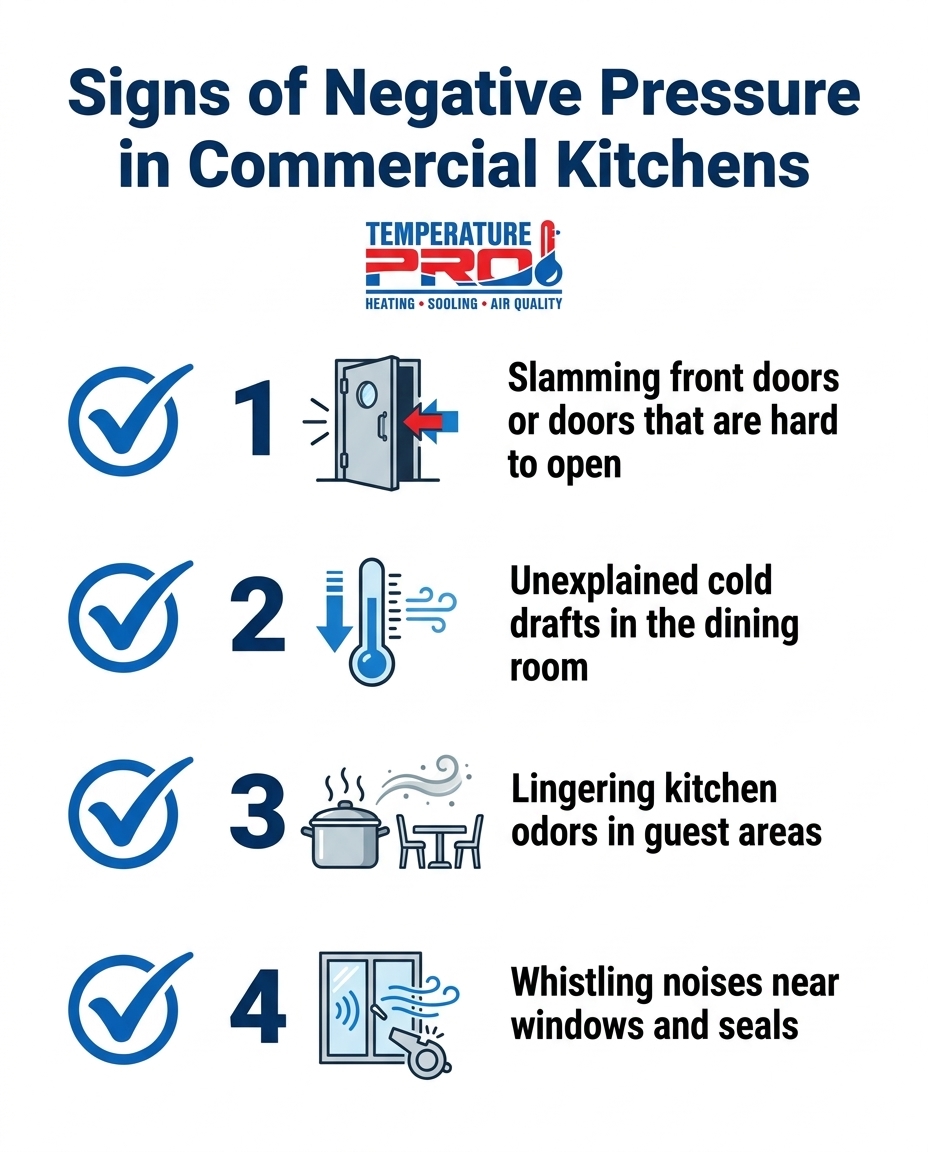
• Aggressive front doors: Front doors that slam shut aggressively behind guests, or require significant physical force to pull open against the vacuum.
• Targeted cold drafts: Unexplained cold drafts sweeping through specific paths in the dining room, especially near the host stand or patio entrances.
• Audible whistling: High-pitched whistling noises coming from window frames, exterior door seals, or drop-ceiling tiles as air squeezes through tight gaps.
• Reversed odors: Lingering food, grease, or exhaust odors drifting from the kitchen into guest seating areas, indicating that the proper airflow direction has reversed.
• Pilot light issues: Gas equipment in the kitchen or dining room struggling to stay lit because the draft is pulling the flame away from the thermocouple.
Signs of Negative Pressure in Commercial Kitchens
The Trap of the Thermostat: Why Heating Can't Fix a Vacuum
When guests complain about the cold, the instinctive reaction we see from most restaurant managers is to walk over to the thermostat and turn the heat up. While this makes sense on a residential level, it is a complete trap in a commercial restaurant environment suffering from negative pressure.
Static Air vs. Dynamic Drafts
Commercial heating systems are designed to condition static air inside a sealed building envelope. They calculate the square footage, measure the ambient temperature, and warm the air accordingly. They are absolutely not designed to fight a continuous, high-speed stream of unconditioned outdoor air pulled by a vacuum.
If your exhaust hood is creating a 2,000 CFM deficit, you have 2,000 cubic feet of freezing air entering your dining room every single minute. The warm air from your ceiling vents simply gets blown away or sucked straight toward the kitchen hood before it can ever warm up the guests sitting by the door.
The Financial Drain of Fighting Physics
Attempting to heat a vacuum is a massive financial waste. Your heating equipment will run constantly, driving up utility bills and putting unnecessary wear and tear on the unit, while the cold air continues to bypass the system entirely. You are essentially paying to heat the air that is being immediately sucked out of the roof exhaust. Balancing the MUA unit is the only true mechanical fix for this specific draft issue. You cannot out-heat bad physics.
ASHRAE 154 and Commercial Make-Up Air Compliance
Properly balancing your make-up air is not just about keeping guests comfortable; it is a strict requirement for safety and code compliance. Commercial kitchens operate under specific regulatory standards designed to prevent fires and protect human health.
Understanding the Standard
ASHRAE Standard 154 dictates the ventilation requirements for commercial cooking operations. This standard outlines exactly how much exhaust is required for different types of cooking equipment and mandates that replacement air must be provided to keep the building pressure within safe limits. Operating a restaurant in Downtown Baton Rouge commercial districts with a severely unbalanced system means you are likely operating out of compliance with these critical safety standards.
When Comfort Becomes a Safety Hazard
The most dangerous consequence of negative pressure is backdrafting. When the building acts like a vacuum, it can pull air down through the exhaust flues of gas-fired appliances, such as water heaters or furnaces. Instead of harmful combustion gases venting safely outside, they are pulled back into the building. This creates severe carbon monoxide risks for both your staff and your patrons.
Furthermore, an unbalanced system traps airborne grease, smoke, and excess moisture inside the building. Connecting proper ventilation to overall indoor air quality is essential. A balanced MUA system ensures that harmful particulates are effectively swept out of the kitchen, keeping the environment clean and safe for everyone.
What a Professional Make-Up Air Adjustment Entails
Balancing a commercial kitchen ventilation system is highly complex work. It requires specialized commercial HVAC expertise in balancing complex restaurant systems to protect guest experience and staff safety. General residential HVAC knowledge is simply not enough for this task.
Here is what our professional commercial technicians at TemperaturePro Baton Rouge do to restore balance to your restaurant:
1. Measuring the Exhaust Deficit: Technicians use specialized tools like anemometers and manometers to measure the exact cubic feet per minute (CFM) of air being pulled out by the exhaust hoods. They then measure the intake CFM from the MUA unit to calculate the exact pressure differential.
2. Inspecting the Belts and Motors: The technician will inspect the fan belts on the MUA unit. A loose or slipping belt is a common reason an MUA unit fails to deliver its rated air volume. They will adjust the tension or replace worn belts to restore full fan speed.
3. Checking Motorized Dampers: Commercial systems use motorized dampers to control outside air intake. If these dampers are stuck closed due to rust, debris, or a failed actuator, the MUA unit cannot pull in outside air. The technician will verify these are opening fully.
4. Calibrating Fan Speeds: Using variable frequency drives (VFDs) or adjustable pulleys, the technician will fine-tune the fan speeds so the MUA intake precisely matches 80% to 90% of the exhaust output, restoring that slight, safe negative pressure in the kitchen.
5. Verifying Building Pressure: Finally, they will test the front doors and dining room airflow to confirm the vacuum effect is gone and the drafts have stopped.
To learn more about how complex these systems are, you can review a comprehensive commercial HVAC guide for business owners. Proper balancing protects your equipment, your staff, and your bottom line. Should your MUA unit require replacement, our team can also help you identify generally applicable energy rebates or utility incentive programs that may help offset the cost of high-efficiency upgrades, though we always recommend verifying current programs directly with your utility provider.
Frequently Asked Questions
Why is my restaurant dining room so cold in the fall?
Your dining room is cold because a negative pressure vacuum is pulling chilly outside air into the building. When your kitchen exhaust hoods pull air out, your make-up air unit must replace it. If it fails to do so, the building sucks in cold fall air through doors and windows to make up the difference.
What causes front doors to slam in commercial buildings?
Front doors slam due to extreme negative air pressure inside the building. The kitchen exhaust fans are acting like a giant vacuum, pulling air out of the restaurant faster than it can be replaced. This vacuum forcefully pulls exterior doors shut and makes them very heavy to open.
How does a commercial make-up air unit work?
A make-up air unit pulls fresh, outside air into the building to replace the air that exhaust hoods remove. It typically filters and sometimes conditions this incoming air. By replacing 80% to 90% of the exhausted air, it keeps the building's air pressure balanced and prevents severe drafts.
What happens if make-up air is not working in a kitchen?
If the make-up air is not working, the kitchen exhaust hoods will depressurize the building. This causes front doors to slam, creates severe hot or cold drafts in the dining room, and causes food odors to drift into guest areas. It can also cause dangerous carbon monoxide backdrafts from gas appliances.
How do you balance a commercial kitchen hood?
Balancing a commercial hood requires a licensed professional using specialized tools like an anemometer to measure airflow. The technician calculates the exhaust volume and adjusts the make-up air unit's fan speeds, belts, and dampers to ensure it replaces the exact right amount of air. As our technicians will tell you, this is absolutely not a DIY task.
Can negative pressure in a restaurant be fixed by adjusting the thermostat?
No, adjusting the thermostat cannot fix negative pressure. Heating systems only warm the static air inside the building; they cannot stop a continuous, high-speed draft of outdoor air being pulled in by a vacuum. The only fix is to mechanically balance the make-up air unit.
Providing a clear explanation of the physics of negative pressure is step one, but the realization that a professional make-up air adjustment will solve your dining room comfort issues is what truly protects your business. Stop fighting the thermostat and let the experts at TemperaturePro Baton Rouge balance your airflow before the deeper winter cold arrives.
Thank you! Your submission has been received!
Oops! Something went wrong while submitting the form.
Property managers prepping multi-family duplexes for the fall heating season face a crucial choice. Evaluate the safety of electric systems against the fast recovery of gas.
A failing defrost control board won't show symptoms in mild autumn weather, but it can turn your outdoor coil into an ice block this winter. See how our technicians catch silent failures early.
It seems logical to skip pre-season heating maintenance if you barely ran your system during a mild winter. However, long dormant periods in high humidity can damage internal components.